
Information
AI-Generated Images Linking Trump, Epstein, and Beyoncé Circulate Online Without Verification
A wave of AI generated fake images purporting to show former President Donald Trump , convicted sex trafficker Jeffrey Epstein , and music superstar Beyonc

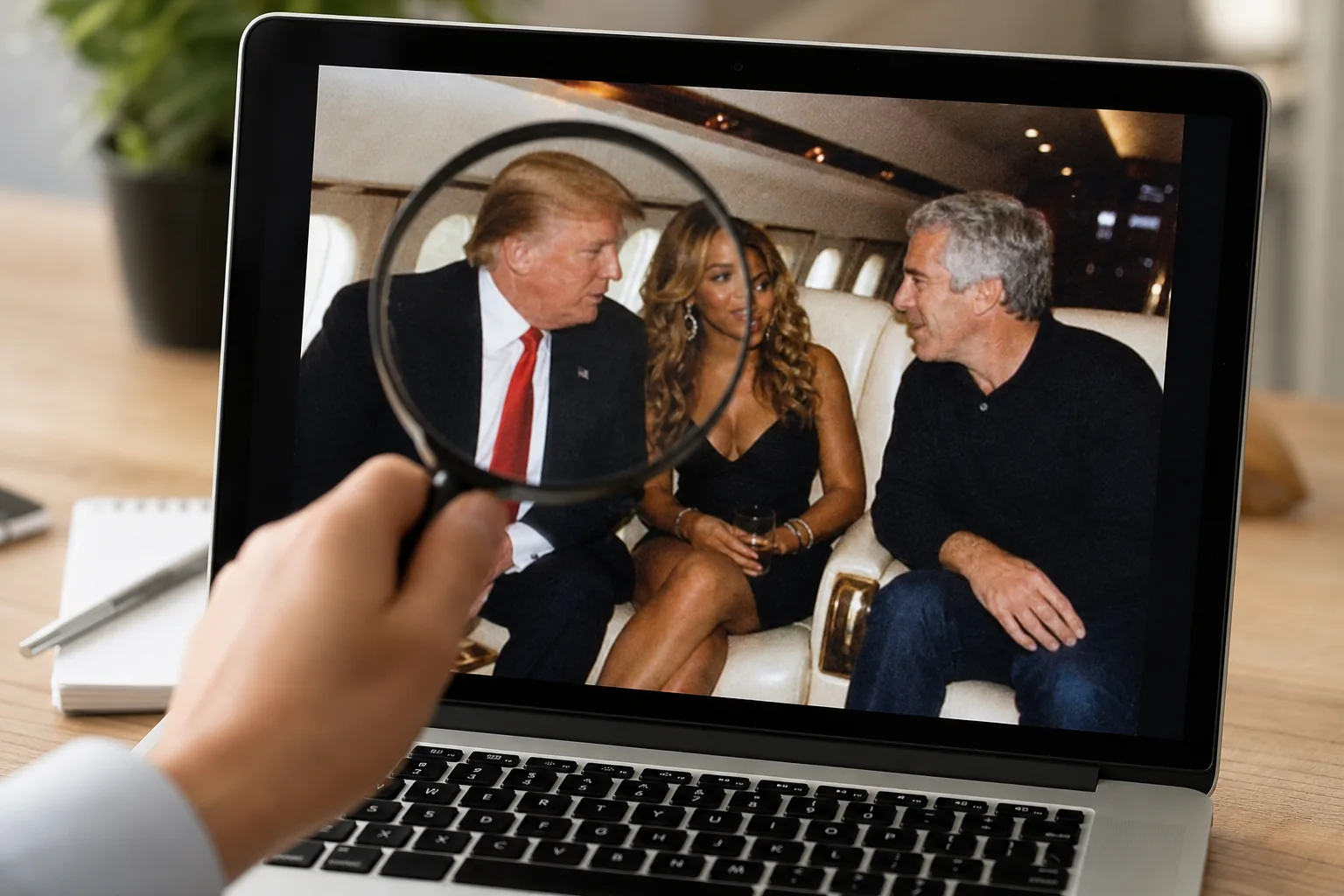
A wave of AI generated fake images purporting to show former President Donald Trump, convicted sex trafficker Jeffrey Epstein, and music superstar Beyoncé together on a private jet circulated widely across social media platforms in late October and early November 2026, with some users claiming the fabricated pictures constituted proof of criminal association. Technical analysis confirmed every image in the cluster was synthetically generated — none originated from any official document release, law enforcement file, or authentic photographic archive.
What the Circulating Images Actually Showed
The most widely shared variant depicted Trump, Epstein, and Beyoncé apparently seated together aboard a private aircraft. A second version showed a visibly younger Trump alongside Epstein in what appeared to be a jet interior, accompanied by a scene involving cash. That earlier variant had already circulated in January 2026, making its reappearance alongside the Beyoncé composite part of a recurring pattern rather than a single isolated incident.
Social media accounts including @FablexUG and @TomthunkitsMind were among those amplifying the images. The posts accompanying the pictures ranged from vague insinuation to explicit claims that the photographs proved Beyoncé’s involvement in Epstein’s crimes. None of these claims were supported by any evidence, and the images themselves were not sourced from any verifiable archive.
Crucially, no such images appear in any official Epstein-related document release. Fact-checkers at Snopes, Full Fact, WhatTheFact, and France 24 each independently confirmed this after reviewing available public records. Beyoncé has no documented connection to the Epstein case in any court filing, witness statement, or investigative record.
How Digital Forensics Identified the AI Generated Fake Images
Verification of the images relied on both contextual analysis and dedicated detection technology. Experts using Optic’s AI or Not detection tool — a widely used instrument in digital forensics — confirmed that the images bore the hallmarks of synthetic generation. The MIT AI Risk Repository documented the incident as a case of purported deepfake imagery circulating to create false associations between named public figures.
AI image generators have become sophisticated enough to produce photorealistic composites that can fool a casual viewer, particularly when the subject matter — a private jet interior, informal clothing, familiar faces — is plausible enough to bypass immediate scepticism. The images did not need to be technically flawless to spread; they needed only to be convincing enough at a glance to be shared before scrutiny could catch up.
→ Read also: AI-Generated and Manipulated Images Spread Across Social Media
While the specific technical markers identified in these particular images — such as anomalies in hand rendering or facial geometry — were not fully detailed in public reporting, the consensus across multiple independent fact-checking organisations was unambiguous: the images are AI-generated composites, not authentic photographs.
The Epstein Context That Made the Images Spreadable
Understanding why these fabrications gained traction requires understanding the information environment into which they were released. The Epstein case has generated sustained public interest since his 2019 death, and periodic releases of court documents, flight logs, and witness depositions have kept speculation about unnamed associates alive across political and celebrity spheres. Each new document release tends to trigger a secondary wave of speculation, and fabricated imagery has repeatedly surfaced alongside genuine disclosures, exploiting the confusion.
The late October and early November 2026 circulation coincided with renewed public discussion of Epstein-related materials, providing a ready-made context in which fabricated images could be mistaken for leaked evidence. This pattern — anchoring a synthetic image to a real news cycle — is one of the more effective mechanisms for making AI generated fake images appear credible. Audiences primed to expect new revelations are less likely to pause and verify.
The January 2026 variant followed a similar logic: a younger-looking Trump alongside Epstein, with visual cues suggesting wealth and proximity, was calibrated to fit a narrative that already existed in public discourse about the two men’s documented social history. That the image was fabricated did not prevent it from being treated as confirmation by some who encountered it.
Why Beyoncé Was Targeted
The inclusion of Beyoncé in the later composite is notable because she has no documented connection to the Epstein case whatsoever. Her insertion into the image appears designed to extend the reach of the fabrication beyond the political audience already engaged with Epstein-Trump narratives, drawing in a different and very large fan base and generating conflict between communities.
This tactic — using a celebrity with a massive, passionate following as a target — maximises the potential for emotional reaction and rapid sharing. Claims that the image proved her involvement in Epstein’s crimes were made without any supporting evidence and contradict all available public records. The fabrication functions not as journalism or even as coherent argument, but as an association attack: placing a person’s likeness in a compromising context and allowing viewers to draw their own conclusions.
→ Read also: AI-Generated and Manipulated Images Circulate as Real Photos: Zelenskyy, Trump State Dinner, RAF Fairford Suspects
It is worth noting that the creators of these images have not been publicly identified, and the platforms on which the images circulated have not, at the time of writing, issued detailed statements about their removal or the accounts responsible.
The Broader Problem of Synthetic Media and False Association
The Trump-Epstein-Beyoncé cluster is one example within a much larger and growing category of AI generated fake images used to manufacture false associations between public figures. The technique requires no access to real footage, no insider knowledge, and no technical expertise beyond the ability to use a commercially available image generation tool. The barrier to creating a convincing fabrication has dropped dramatically, while the effort required to debunk one remains significant.
Fact-checking organisations must trace the image’s origin, consult detection tools, cross-reference official document releases, and publish a detailed rebuttal — all of which takes time. By the time a thorough debunking reaches the people who saw the original image, many will have already formed an impression. Research into misinformation consistently finds that corrections spread more slowly than the original false claim, a structural asymmetry that benefits fabricators.
The MIT AI Risk Repository’s documentation of this incident reflects a broader effort to catalogue AI-related harms systematically, treating synthetic media fabrications as a category of risk that warrants structured tracking rather than ad hoc response. That kind of institutional record-keeping is increasingly important as individual incidents multiply.
What Audiences Can Do
Practical verification of suspicious images does not require specialist tools, though tools like AI or Not are freely accessible. Several habits reduce the risk of sharing fabricated content:
- Check the source claim: If an image is described as a “leaked” document or file, verify whether any such release has been reported by established news organisations.
- Use reverse image search: Uploading the image to a search engine’s image search can reveal whether it has appeared in verified contexts or only in unverified social media posts.
- Look for fact-checker coverage: When a viral image makes a serious claim about a public figure, major fact-checking outlets typically respond within hours to days.
- Treat emotional urgency as a signal: Images designed to provoke a strong reaction — outrage, vindication, shock — are more likely to have been engineered for that effect.
- Consult AI detection tools: Services such as Optic’s AI or Not offer accessible, rapid analysis of whether an image is likely to be synthetically generated.
None of these steps is foolproof, and AI generation technology continues to improve. But the combination of source verification and tool-assisted detection catches the majority of fabrications currently in circulation.
The images of Trump, Epstein, and Beyoncé on a private jet do not exist in any authentic archive because they never happened — they were assembled by a machine, seeded into a receptive information environment, and allowed to do reputational work that no real photograph could have done. That process will repeat, with different faces and different narratives, for as long as the tools remain accessible and the incentives to deceive remain in place. Recognising the pattern is the first and most durable defence.
This article was produced with AI assistance and reviewed editorially.

Trump’s ’60 Minutes’ Post-Election Interview: Claims Fact-Checked

Claims About Abdul El-Sayed’s Background Check and Senate Eligibility: What the Record Shows

Voting Machine Claims After 2026 Midterms Lack Evidence of Election Fraud

AI-Generated Images Linking Trump, Epstein, and Beyoncé Circulate Online Without Verification
