
Information
Fabricated Charlie Hebdo Cover Attributed to October 2026 French Protests Spreads on Social Media
A fabricated Charlie Hebdo cover circulating online falsely claims to be from October 21, 2026, featuring ‘Free Palestine,’ iPhone, and Balenciaga slogans. Fact-checkers

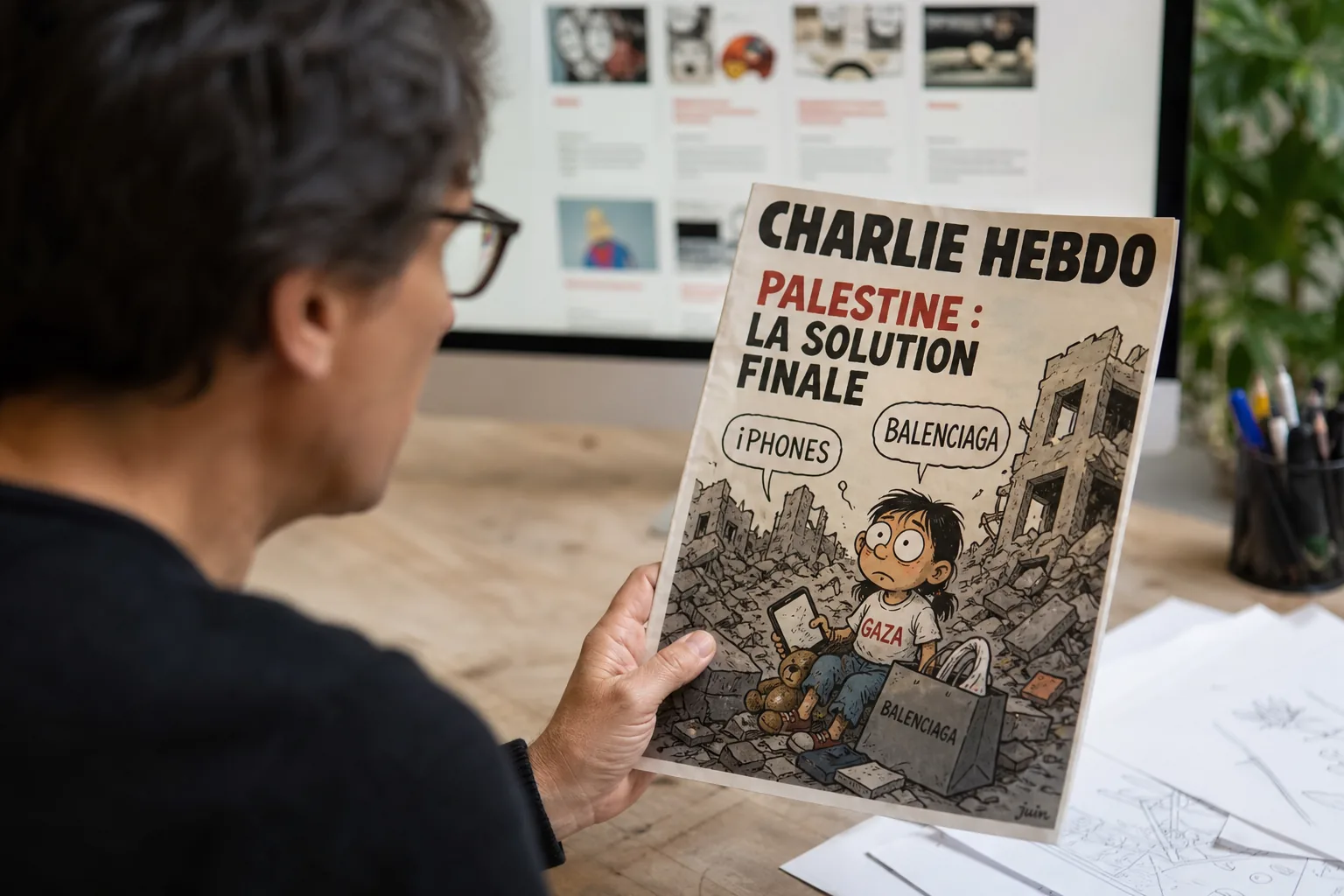

A fabricated magazine cover bearing the branding of Charlie Hebdo has been circulating online in October 2026, falsely presented as the satirical weekly’s issue dated October 21, 2026. The image — which fact-checkers at Reuters and Yahoo News have confirmed is either AI-generated or digitally doctored — depicts cartoon figures alongside slogans reading “Free Palestine,” “free iPhone,” and “free Balenciaga,” apparently mocking the motivations of protesters in France. The real Charlie Hebdo published no such cover, and its website contains no record of the image. This fake charlie hebdo cover is a clear example of fabricated media being deployed to shape public perception of an ongoing political moment.
What the Fake Cover Actually Shows
The image in question mimics the visual style of Charlie Hebdo closely enough to deceive casual observers. The publication’s distinctive masthead, font choices, and cartoon illustration style are all replicated — or approximated — in the fabricated version. Inside the image, cartoon figures are shown carrying or demanding three things simultaneously: solidarity with Palestine, a free iPhone, and a free Balenciaga product. The juxtaposition is clearly designed to ridicule protesters by implying their political grievances are insincere or commercially motivated.
The slogans themselves tell a specific story about how the image was constructed and for what purpose. “Free Palestine” is a genuine rallying cry associated with pro-Palestinian activism. Pairing it with consumer brand names like Balenciaga and iPhone is a rhetorical move: it suggests that the people protesting in France are opportunists using political cover for looting or personal gain, rather than people with legitimate grievances. This framing has appeared in right-wing commentary across Europe during periods of civil unrest, and the fake cover appears to crystallize that argument in a single, shareable image.
The choice of Charlie Hebdo‘s branding as the vehicle for this message is not accidental. The magazine has a long and internationally recognized history of provocative, often offensive satire. Using its visual identity lends the fake cover a false sense of legitimacy — it implies that a well-known publication has made an editorial judgment about the protests, when in fact no such judgment was made. The real magazine published nothing of the sort.
How Fact-Checkers Identified the Fake Charlie Hebdo Cover
Both Reuters and Yahoo News investigated the image after it began circulating in connection with French protests in October 2026. The verification process followed a straightforward but essential path: checking the source directly. Charlie Hebdo’s own website does not contain the cover. The magazine’s archive of published issues shows no edition from October 21, 2026 bearing this image or these slogans. That absence is itself the primary evidence.
Beyond the archival check, fact-checkers assessed the image’s technical characteristics. Reuters confirmed the cover is fabricated, with Yahoo News further reporting that it is AI-generated or doctored. These two findings are consistent: whether the image was produced entirely by an AI image generator or was created by manipulating a real Charlie Hebdo cover, the result is the same — a piece of altered media falsely attributed to a real publication on a specific date.
→ Read also: AI-Generated and Manipulated Images Spread Across Social Media During Paris Riots and European Protests
The false attribution to October 21, 2026 is a detail worth examining closely. Pinning a fabricated image to a specific, recent issue date makes it harder to dismiss at a glance. Someone unfamiliar with the magazine’s actual output might assume the date is verifiable without checking. In reality, the date appears to have been chosen to place the fake cover squarely within the window of the French protests, giving it a sense of timeliness and editorial relevance it does not actually possess.
The French Protest Context and Why It Matters
The fake cover did not emerge in a vacuum. It circulated in October 2026 in direct connection with protests taking place in France. The research brief notes that the protests appear linked to cost-of-living pressures — a subject that has driven street demonstrations across multiple European countries throughout the mid-2020s. When protests occur, fabricated media often follows quickly, designed to characterize demonstrators in a particular light before a broader public has formed its own view.
This pattern is well-documented. During periods of civil unrest, images — real and fake — spread rapidly because they are emotionally resonant and easy to share. A single fabricated magazine cover, if it looks authoritative enough, can reach millions of people before any fact-check catches up. The specific combination of slogans in this fake cover — Palestine, iPhone, Balenciaga — is engineered for maximum viral impact: it is provocative, it is easy to screenshot, and it fits a pre-existing narrative that some audiences are already primed to accept.
The use of Charlie Hebdo‘s brand in this context adds another layer of complexity. The magazine has been a flashpoint in debates about free speech, religious satire, and the limits of humor since its offices were attacked in January 2015. Its name carries enormous weight in French public discourse and internationally. Attaching that name to a fabricated political message about protests gives the fake cover a cultural authority it has not earned and does not deserve. It exploits the magazine’s reputation — and the strong reactions, both positive and negative, that its name reliably generates — to amplify a message the publication never endorsed.
Altered Media and the Misuse of Satirical Branding
Fabricated covers imitating satirical magazines represent a distinct and growing category of disinformation. Unlike a simple text-based false claim, a fake magazine cover carries visual authority. It looks like journalism. It looks like editorial judgment. It implies that a team of editors, cartoonists, and publishers reviewed and approved the content — when in fact a single anonymous actor created it in minutes using widely available tools.
AI image generation has made this kind of fabrication significantly easier to produce at a convincing level of quality. The masthead of a well-known publication, its characteristic color palette, its typical cartoon style — all of these can be approximated without the technical skills that would previously have been required. The result is a category of fake charlie hebdo cover and similar fabrications that are harder to spot and faster to spread than older forms of image manipulation.
→ Read also: Eiffel Tower Protest Videos and Images Are AI-Generated Fakes
What makes satirical publications particularly vulnerable to this kind of misuse is their visual distinctiveness. Charlie Hebdo‘s covers are immediately recognizable: the red masthead, the bold black outlines of the cartoons, the irreverent typography. That recognizability is an asset for the real magazine and a liability when bad actors want to borrow its authority. The more distinctive a publication’s visual identity, the more useful its branding becomes as a vehicle for disinformation, because the branding itself does the work of establishing credibility.
This is not the first time Charlie Hebdo‘s name and visual style have been misused online. The magazine’s history of controversy makes it a recurring target for both genuine critics and those who wish to fabricate content that will provoke strong reactions. Each new fake charlie hebdo cover that circulates online risks further muddying the public’s understanding of what the real publication has and has not said — a cumulative erosion of clarity that benefits no one except those who traffic in deliberate confusion.
How to Verify a Magazine Cover Before Sharing
The verification steps that fact-checkers applied to this image are available to any reader. When a magazine cover circulates online — especially one making a provocative claim — the first step is to visit the publication’s official website directly and check its archive of issues. Most major publications maintain accessible, searchable archives. If a cover dated to a specific issue cannot be found there, that absence is strong evidence against its authenticity.
A second step is to search for the cover using a reverse image search tool. This can reveal whether the image has appeared in earlier contexts, whether it has been flagged by other fact-checkers, or whether the underlying image was drawn from a real cover that was subsequently altered. In the case of AI-generated images, reverse image search may not return an exact match, but it can still surface related discussions or debunking articles.
Third, checking whether established fact-checking organizations have already assessed the image — as both Reuters and Yahoo News did with this fake charlie hebdo cover — can save time and provide authoritative sourcing. The key is to complete at least one of these steps before sharing, rather than after the image has already spread through a network.
The fabricated Charlie Hebdo cover attributed to October 21, 2026 is a reminder that the most convincing disinformation often works by borrowing the credibility of real institutions. Charlie Hebdo published no such cover. The image is fabricated, its attribution is false, and its slogans were constructed to make a political argument the magazine never made. Verifying that took fact-checkers a single visit to the magazine’s own website — a check that anyone with internet access can perform before deciding whether to pass an image along.
This article was produced with AI assistance and reviewed editorially.

Trump’s ’60 Minutes’ Post-Election Interview: Claims Fact-Checked

Claims About Abdul El-Sayed’s Background Check and Senate Eligibility: What the Record Shows

Voting Machine Claims After 2026 Midterms Lack Evidence of Election Fraud

AI-Generated Images Linking Trump, Epstein, and Beyoncé Circulate Online Without Verification
