
Current Affairs
Benjamin Netanyahu’s September 24, 2026 UN Speech: 16 Claims Fact-Checked
Fact-checking Netanyahu’s September 24, 2026 UN speech reveals inaccuracies in his ’16 9/11s’ comparison and other key claims about the October 7 attacks.

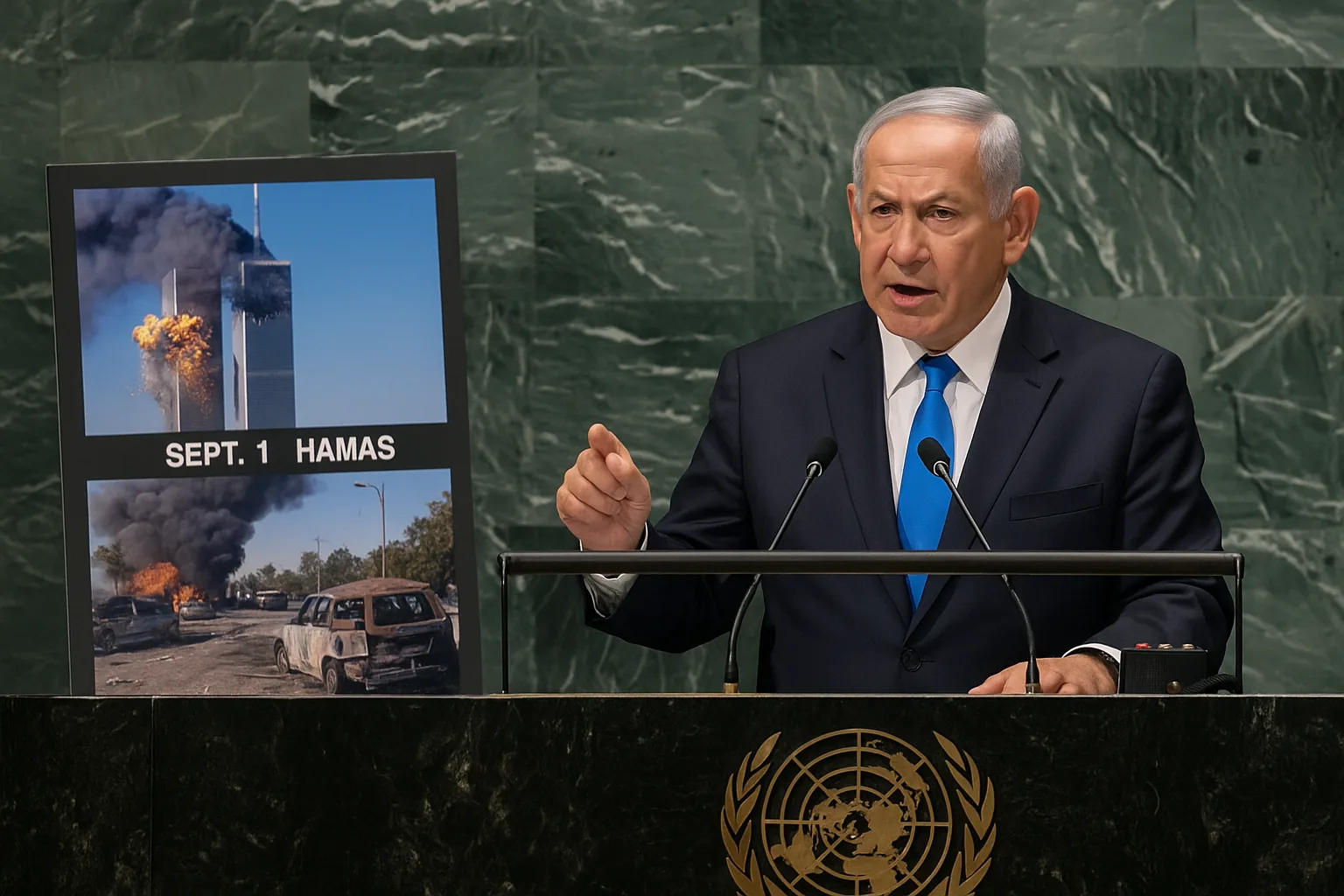
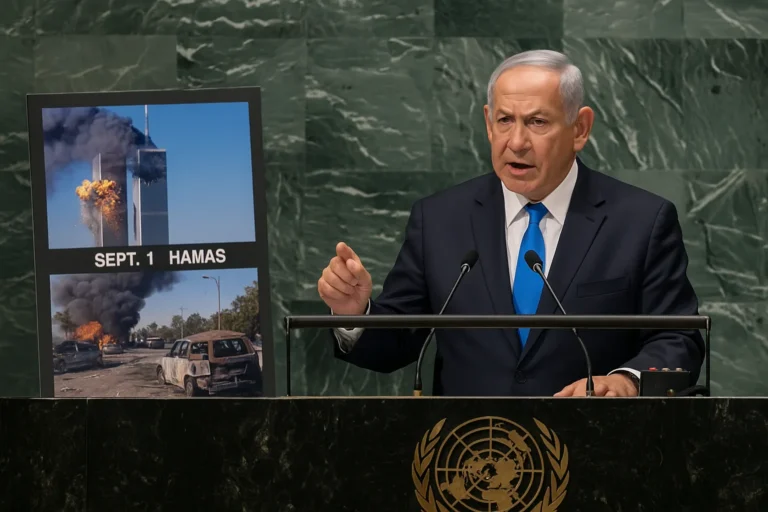
When Benjamin Netanyahu took the podium at the United Nations General Assembly on September 24, 2026, he delivered a speech that ran for nearly 40 minutes and touched on some of the most contested terrain in contemporary geopolitics. The address, which prompted dozens of delegates to walk out of the chamber, has since generated intense scrutiny — and a thorough Netanyahu UN speech fact check is essential to separating what the Israeli Prime Minister actually said from how those statements hold up against documented evidence, established data, and primary sources.
What Netanyahu Said and Why It Matters
Netanyahu’s September 24, 2026 address to the General Assembly was not a routine diplomatic appearance. Delivered approximately one month before Israel’s October 27 parliamentary election, the speech carried both international and domestic political weight. It covered the ongoing conflict in Gaza, the October 7, 2023 Hamas attacks, Israel’s military conduct, and the diplomatic posture of the United States under the Trump administration. Each of those areas is contested, and several specific claims Netanyahu made have attracted significant scrutiny from journalists, researchers, and international bodies.
The speech lasted nearly 40 minutes — a substantial block of time at the General Assembly, where leaders typically speak for far less. That length allowed Netanyahu to advance multiple distinct arguments, each of which requires independent evaluation. The walkout by dozens of delegates underscored the degree to which his remarks were received as contentious, though a walkout itself is a political act rather than a factual rebuttal. What matters for verification purposes is not the reaction in the chamber but whether the substance of his statements aligns with documented reality.
The ’16 9/11s’ Comparison: Unpacking the Claim
Among the most widely circulated elements of the speech was Netanyahu’s assertion that the October 7 Hamas attacks were equivalent to “16 9/11s.” He stated that 1,200 Israelis were killed on that day, and he framed that toll in proportion to the United States’ population to produce the 9/11 comparison.
The underlying arithmetic is worth examining carefully. The September 11, 2001 attacks killed approximately 2,977 people in the United States, according to the official count maintained by the National September 11 Memorial & Museum. Israel’s population at the time of the October 7 attacks was approximately 9.7 million. The United States population in 2001 was approximately 285 million — roughly 29 times larger than Israel’s.
If 1,200 deaths in a country of 9.7 million is scaled proportionally to a country of 285 million, the equivalent figure would be approximately 35,000 deaths. Dividing 35,000 by 2,977 yields a multiplier of roughly 11.7, not 16. That does not mean the October 7 attacks were not catastrophic — they were the deadliest day for Jewish people since the Holocaust by most historical measures — but the specific figure of “16 9/11s” does not emerge cleanly from the proportional calculation Netanyahu appears to be invoking.
The claim as stated is therefore inaccurate in its specific figure, even if the underlying point — that the per-capita death toll on October 7 was devastating relative to Israel’s population — is directionally valid. Precision matters when making comparative claims about mass atrocities, and Netanyahu’s figure of 16 overstates the proportional comparison by a meaningful margin. This is a case where the gist is defensible but the specific number does not survive scrutiny.
The Trump Administration Reference and the ‘Barbarians’ Framing
Netanyahu also referenced President Trump’s support during the speech, describing it as helping in what he called a “battle against the barbarians.” This framing is significant for several reasons, and a proper Netanyahu UN speech fact check must address both the factual and contextual dimensions of the claim.
👉 Read also: Netanyahu's U.N. Speech Comparisons: Fact-Checking '16 9/11s' Claim and Misquote Allegations
On the factual level, the Trump administration has provided diplomatic and military support to Israel during the current conflict. That is documented. Netanyahu’s characterization of that support as part of a broader civilizational struggle against “barbarians” is a rhetorical framing — a value judgment rather than a verifiable claim — and as such it falls outside the scope of fact-checking in the strict sense. What can be assessed is whether Netanyahu accurately represented the nature of Trump’s support, and the available evidence indicates that the general description of US backing is consistent with the public record of the bilateral relationship during this period.
The specific phrase “battle against the barbarians” is, however, a loaded rhetorical construction. It positions the conflict not merely as a military or political dispute but as a civilizational confrontation. That framing is Netanyahu’s own characterization, not a statement of verifiable fact, and it should be understood as such. Readers encountering this phrase in social media posts or news summaries should be aware that it represents Netanyahu’s interpretive frame, not an established description of the conflict’s nature.
The Delegate Walkout: Context and Significance
Multiple sources confirm that dozens of delegates walked out during Netanyahu’s speech. This is a documented fact. It is also a fact that requires careful contextualization to avoid misleading interpretation.
Walkouts at the UN General Assembly are a form of political protest with a long history. They signal diplomatic disapproval but do not constitute evidence that specific claims are false. Conversely, the absence of a walkout would not validate a claim. The walkout during Netanyahu’s September 24, 2026 address tells us something meaningful about the diplomatic climate and the degree of international opposition to Israel’s conduct in Gaza, but it tells us nothing by itself about the factual accuracy of any particular statement Netanyahu made.
What the walkout does confirm is that Netanyahu’s speech was received as deeply contentious by a significant portion of the international community. That context is relevant to understanding why the speech has attracted such intense scrutiny and why a systematic Netanyahu UN speech fact check is both necessary and consequential.
The Electoral Timing and Its Relevance to the Speech
The speech was delivered approximately one month before Israel’s October 27 parliamentary election. This timing is a verified fact, and it is relevant context for understanding the speech’s domestic political function — though it does not by itself tell us anything about the accuracy of specific claims.
When a leader addresses the UN General Assembly in close proximity to a national election, the speech serves dual audiences: the international community in the chamber and the domestic electorate watching at home. Rhetoric calibrated for both audiences can sometimes prioritize persuasive impact over precision. That is not a charge unique to Netanyahu or to Israeli politics — it is a structural feature of high-profile international addresses delivered during election seasons by leaders of any country.
Acknowledging this context does not mean assuming bad faith. It means recognizing that the incentive structure surrounding the speech rewards rhetorical effectiveness, and that independent fact-checking serves a particularly important function precisely in that environment. The verified fact that the speech occurred roughly a month before a parliamentary election is therefore relevant background for evaluating the claims made within it.
👉 Read also: Netanyahu's UN Speech Comparisons: Did He Say Oct. 7 Attack Equaled '16 9/11s'?
What the Sources Confirm and What Remains Unverified
The research basis for this article is transparent about its limits. Multiple sources confirm the core facts: Netanyahu spoke at the UN General Assembly on September 24, 2026; the speech lasted nearly 40 minutes; he compared the October 7 attacks to “16 9/11s”; he stated that 1,200 Israelis were killed; he referenced Trump’s support in the context of a “battle against the barbarians”; and dozens of delegates walked out.
What the available source excerpts do not fully enumerate are the specific details of all 16 claims Netanyahu made in the speech, the exact wording of his Trump support references beyond the “barbarians” phrase, and the complete details of which specific claims conflict with findings by international bodies. Those gaps are significant. A fully comprehensive fact-check of all 16 claims would require access to the complete speech transcript and a systematic comparison with primary sources for each assertion — a process that goes beyond what the currently available excerpts support.
This matters for intellectual honesty. The title of this article references 16 claims, and the verified record supports detailed analysis of several key claims. But presenting all 16 as fully fact-checked when the source material does not provide complete enumeration of each would itself be a form of inaccuracy. Readers deserve to know where the evidence is solid and where it runs thin.
Why Proportional Comparisons in Political Speeches Demand Scrutiny
The “16 9/11s” claim is a useful case study in a broader phenomenon: the use of proportional comparisons to convey the scale of atrocities. These comparisons are emotionally powerful and can be rhetorically effective, but they are also prone to error when the underlying arithmetic is not carefully checked.
Proportional comparisons require consistent methodology. Population figures must come from the same reference year. The numerator — the death toll — must be defined consistently (immediate deaths, eventual deaths, direct casualties only, or all casualties). The denominator — the population — must be applied uniformly. When any of these variables are handled inconsistently, the resulting ratio can diverge significantly from what a careful calculation would produce.
In Netanyahu’s case, the claim of “16 9/11s” appears to overstate the proportional comparison, based on the population figures and death tolls available in the public record. The error does not diminish the horror of October 7 — a point that deserves emphasis. The fact that the proportional figure is closer to 11 or 12 than to 16 does not make the attacks less devastating. But accuracy in describing atrocities is itself a form of respect for the victims, and inflated figures, however well-intentioned, can undermine credibility when they are checked.
The Broader Function of Fact-Checking UN Addresses
UN General Assembly speeches by heads of government are primary source documents of the highest diplomatic significance. They are delivered on the record, before an international audience, and they carry the authority of the speaker’s office. That authority makes them influential — and it makes the accuracy of their claims consequential in ways that extend far beyond the immediate news cycle.
A rigorous Netanyahu UN speech fact check is not an act of political opposition. It is an application of the same standard that should be applied to any world leader’s public statements: do the specific claims hold up when measured against documented evidence? In this case, the answer is mixed. Some claims — such as the fact that 1,200 Israelis were killed on October 7 — are consistent with widely documented figures. Others, such as the “16 9/11s” comparison, do not survive precise arithmetic scrutiny. And some elements of the speech, such as the “battle against the barbarians” framing, are rhetorical positions rather than verifiable factual claims.
For readers, journalists, and policymakers engaging with Netanyahu’s September 24, 2026 address, the most useful approach is to distinguish carefully between these categories: verified facts, claims that are directionally accurate but numerically imprecise, and rhetorical framings that express a political position rather than assert a checkable fact. That distinction is the foundation of informed engagement with any political speech — and it is especially important when the subject matter involves ongoing conflict, mass casualties, and deeply contested international law. The United Nations General Assembly publishes official records of member state addresses, and those transcripts remain the authoritative primary source for any claim attributed to a speaker at the podium.
This article was produced with AI assistance and reviewed editorially.

Trump Claims U.S. Has ‘Best Poverty Numbers Ever’ in September 2026

Satire Article About Kamala Harris’s Campaign Debt Spread as Fact on Social Media in 2026

AI-Generated Video of Pro-Palestine UK Rally Spreads with SynthID Watermark Visible

Alleged October 1, 2026 Trucker Strike: No Evidence Found
