
Current Affairs
Alleged October 1, 2026 Trucker Strike: No Evidence Found
Viral claims of an October 1, 2026 trucker strike spread on social media, but fact-checkers found no credible evidence of any organized action.

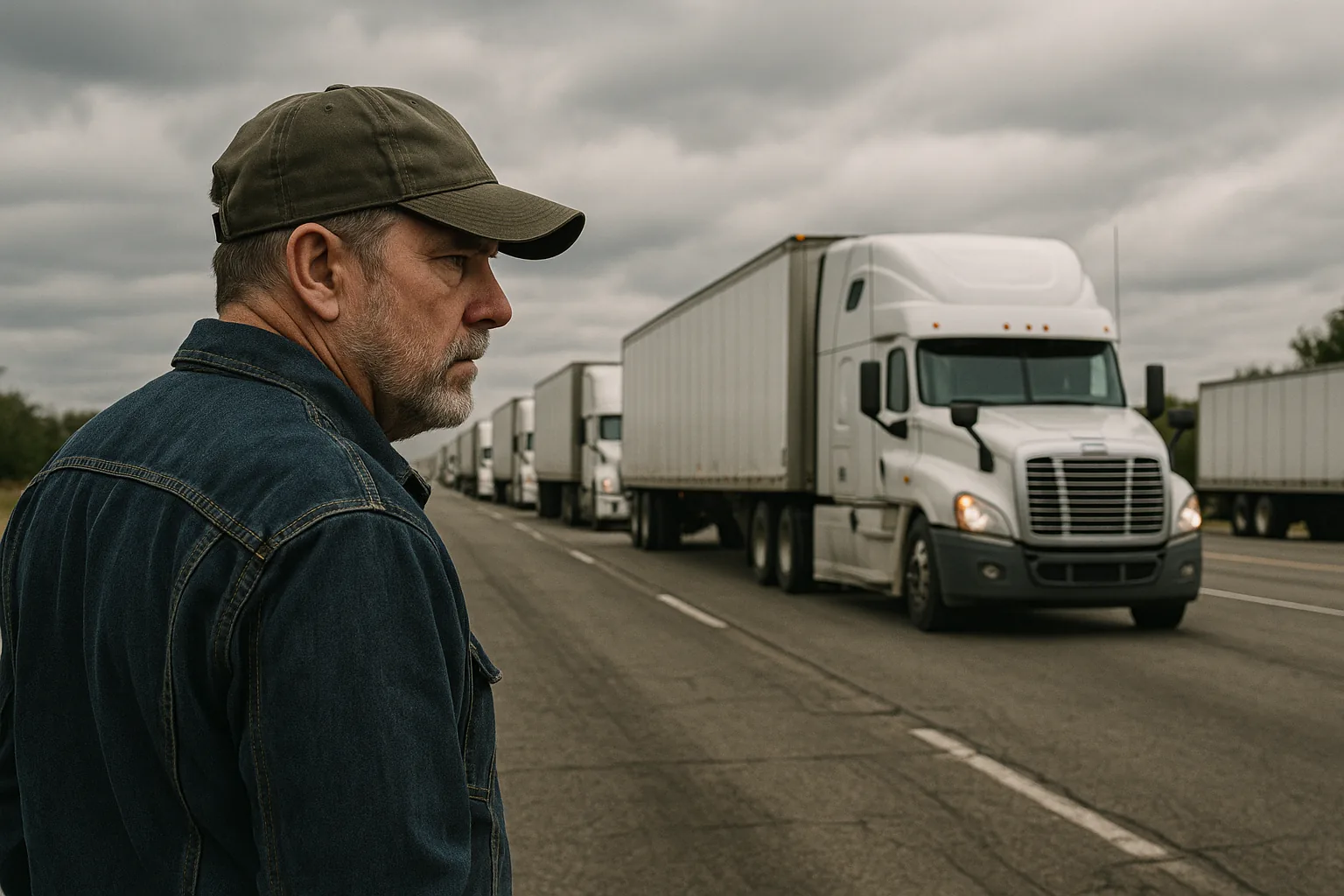
A viral video posted to Facebook and Instagram on September 15, 2026, set off a wave of online speculation claiming that American truck drivers would “park it” beginning October 1, 2026, in a nationwide protest over soaring fuel prices. The claim spread rapidly across social media platforms, alarming supply-chain observers, grocery shoppers, and small business owners alike — but when journalists and fact-checkers contacted the trucking industry’s own advocacy organizations, they found no credible evidence that any coordinated trucker strike october 1 action was actually being organized. What emerged instead was a case study in how a single piece of viral content, amplified by genuine economic anxiety, can generate the appearance of a mass movement where none exists.
What the Viral Claim Actually Said
The original video, first posted on September 15, 2026, featured a man speaking directly to camera and urging truck drivers across the country to refuse to haul loads starting October 1. The stated grievance was fuel prices, which by late September 2026 had climbed to record highs of between $6.285 and $6.51 per gallon for diesel. The video’s message was emotionally resonant: independent owner-operators, it argued, could no longer afford to keep their trucks moving when fuel costs consumed so much of their per-mile revenue. The speaker called on drivers to “park it” — a phrase that carries specific meaning in trucking culture, referring to a deliberate work stoppage — and implied that thousands of drivers were already committed to the action.
Within days, the video had been shared thousands of times. Screenshots of the original post were circulated on X (formerly Twitter), Reddit threads debated whether supply chains would collapse, and local news comment sections filled with readers asking whether store shelves would empty by mid-October. The emotional logic of the claim was straightforward: diesel prices were genuinely, verifiably high, owner-operators genuinely do operate on thin margins, and the idea of a trucker shutdown is not historically implausible — there have been smaller, localized work stoppages in the U.S. trucking industry in previous decades. All of those background conditions made the rumor feel plausible even to skeptical readers.
What the video did not provide, however, was any of the organizational infrastructure that a real nationwide strike would require. There was no named organizer, no union authorization, no documented list of participating carriers or fleets, and no formal demands submitted to any government body or industry association. The claim existed entirely as a social media assertion.
The Trucker Strike October 1 Claim Collapses Under Scrutiny
Fact-checkers moved quickly to evaluate the claim once it began circulating at scale. Snopes, one of the longest-running online fact-checking organizations in the United States, traced the claim and found no evidence supporting it. Snopes’s investigation, referenced in reporting by ts2.tech, could not identify a named organizer, a formal strike committee, or any trucking company or union that had publicly committed to the October 1 action.
More telling was the response from the Owner-Operator Independent Drivers Association (OOIDA), the primary national advocacy organization for independent truck drivers and small trucking businesses in the United States. OOIDA told Newsweek directly that the discussion appeared to be “limited to social media chatter.” That characterization is significant: OOIDA represents the very constituency — independent owner-operators — that the viral video claimed to be mobilizing. If a genuine, coordinated shutdown were being planned among that group, OOIDA would almost certainly be aware of it. Their dismissal of the claim as social media noise, rather than an acknowledgment of an emerging grassroots movement, is a primary indicator that no real organizational effort was underway.
👉 Read also: False and Misleading Claims About US-Canada Relations Since Trump's 2024 Reelection
The ts2.tech fact-check, which aggregated findings from multiple sources, stated plainly: “No verified nationwide U.S. trucker strike has been confirmed for October 1, 2026.” That conclusion aligned with reporting from Newsweek, Yahoo News, Times Now News, and other outlets that independently investigated the claim during the final two weeks of September 2026.
Why Diesel Prices Made the Rumor Believable
To understand why this particular piece of misinformation spread so effectively, it is necessary to understand the genuine economic conditions facing American truck drivers in late September 2026. Diesel fuel prices had reached record highs of $6.285 to $6.51 per gallon — figures that represent a severe cost burden for independent owner-operators who purchase fuel out of pocket and are reimbursed, imperfectly, through per-mile fuel surcharges negotiated with brokers and shippers.
For an owner-operator running a standard long-haul route of, say, 100,000 miles per year in a truck averaging six miles per gallon, the difference between $4.00 per gallon diesel and $6.50 per gallon diesel represents roughly $41,667 in additional annual fuel costs — a figure that can easily erase thin operating margins or push a driver into operating at a loss. That arithmetic is not hypothetical; it is the lived reality for thousands of small trucking businesses across the country, and it creates a genuine grievance that is entirely understandable.
Viral misinformation rarely succeeds by inventing problems from thin air. It succeeds most reliably when it attaches itself to real, documented problems and offers a simple, emotionally satisfying narrative about them. In this case, the real problem — record diesel prices squeezing independent truckers — was accurate. The proposed response — a nationwide coordinated shutdown beginning October 1 — was the fabricated or at minimum entirely unsubstantiated element. The genuine economic pain made audiences predisposed to believe that drivers might be angry enough to act collectively, even when no evidence of collective organization existed.
How Unverified Strike Claims Circulate and Why They Persist
The October 1 trucker strike claim follows a pattern that researchers who study viral misinformation have documented repeatedly. A short, emotionally compelling video is posted on a platform optimized for engagement. It makes a bold, specific claim — a date, a scale (“nationwide”), a cause (fuel prices) — that gives it the texture of real news. Audiences who share it are not necessarily acting in bad faith; many genuinely believe they are alerting their communities to an impending disruption. Each share expands the claim’s apparent credibility, because social proof — the sense that many people are talking about something — functions as a proxy for legitimacy in fast-moving online environments.
The specificity of the October 1 date was itself a factor in the claim’s spread. Vague predictions (“truckers might strike sometime this fall”) are harder to act on and less shareable than precise ones. A specific date creates urgency, encourages stockpiling behavior, and gives the claim a built-in news hook. It also creates a kind of self-fulfilling anxiety: if enough people believe a disruption is coming and begin buying extra groceries or fuel, the resulting behavior can itself generate news coverage, which in turn appears to validate the original claim.
What the October 1 trucker strike claim lacked — and what distinguishes genuine labor actions from viral rumors — was any of the organizational architecture that real collective action requires. Legitimate strikes, even among independent contractors who are not formally unionized, typically involve publicly named organizers, stated demands, a mechanism for drivers to signal their participation, and some form of coordination with legal counsel regarding the boundaries of lawful collective action under U.S. labor law. The October 1 claim had none of these elements. There was no petition, no sign-up page, no named spokesperson willing to go on record, and no engagement with any regulatory or legislative body.
👉 Read also: False Claims About Newsom, California Refineries, and US Gas Price Spike
The Role of Major Trucking Organizations
The silence — and in OOIDA’s case, the explicit denial — from established trucking organizations is one of the clearest indicators that the October 1 trucker strike claim was not grounded in real organizing. The Owner-Operator Independent Drivers Association has a long history of advocating for independent truckers on issues including fuel costs, Hours of Service regulations, and freight rate transparency. When OOIDA has concerns about policy or economic conditions, it communicates them publicly and through established channels. The organization’s characterization of the October 1 claim as “social media chatter” — language conveyed directly to Newsweek — suggests that its membership was not, in fact, organizing a shutdown.
It is worth noting that the identity of the man featured in the original viral video was not verified by any of the fact-checking sources reviewed for this article. That detail matters: in a genuine labor organizing effort, the people calling for collective action typically identify themselves publicly, because anonymity is inconsistent with the goal of recruiting participants. An anonymous video calling for a strike is structurally different from a named union official or advocacy leader making the same call, and that difference should register with audiences evaluating the claim’s credibility.
The absence of any involvement from the American Trucking Associations (ATA), the largest U.S. trucking industry trade group, or from any regional trucking federation, further underscores the claim’s lack of organizational grounding. A nationwide work stoppage involving even a fraction of the country’s roughly 3.5 million commercial truck drivers would require coordination at a scale that could not plausibly remain invisible to industry organizations.
Supply Chain Anxiety and the Information Environment
The rapid spread of the October 1 trucker strike claim also reflects a broader pattern of heightened public sensitivity to supply chain disruptions. After the logistical shocks of the early 2020s, which left lasting impressions on consumers who experienced empty shelves and delivery delays, many Americans have become acutely alert to news — or rumors — of potential supply disruptions. That alertness is not irrational; supply chains are genuinely complex and genuinely vulnerable. But it does create an environment in which unverified claims about strikes, port shutdowns, or transportation disruptions can achieve rapid, wide circulation before any verification has taken place.
For journalists and editors, the October 1 trucker strike episode is a reminder that the speed of social media circulation almost always outpaces the speed of responsible verification. By the time Newsweek, Snopes, and other outlets had confirmed that no strike was actually being organized, the original video had already been viewed and shared by audiences who may never encounter the correction. Newsweek’s reporting on the claim noted OOIDA’s direct statement that the supposed shutdown was limited to social media discussion — a primary-source denial that should function as a definitive check on the rumor’s further spread.
What to Look for Before Sharing Strike Claims
For readers who encountered the October 1 trucker strike claim and are trying to evaluate similar claims in the future, the key questions are consistent regardless of the specific topic. Who is organizing the action? A real strike has named organizers willing to be identified publicly. Which organizations have endorsed it? Legitimate collective action in the trucking industry would involve OOIDA, the Teamsters, or another recognized body. What are the formal demands? Real labor actions make specific, documented demands of specific counterparties. Is there a mechanism for participation? Drivers planning to participate in a real shutdown would need some way to coordinate — a sign-up, a dispatch network, a communication channel beyond a single viral video.
When none of those elements are present, the most responsible interpretation is that the claim is unverified — and that sharing it, however well-intentioned, risks amplifying misinformation that can cause real harm in the form of unnecessary panic buying, market disruption, or erosion of public trust in legitimate labor organizing when it does occur. The October 1, 2026 trucker strike claim failed every one of those basic tests, and the verdict from every credible source that investigated it was the same: no verified nationwide strike was confirmed, and the claim amounted to nothing more than social media chatter amplified by genuine, understandable anxiety about record diesel prices.
This article was produced with AI assistance and reviewed editorially.

Trump Claims U.S. Has ‘Best Poverty Numbers Ever’ in September 2026

Satire Article About Kamala Harris’s Campaign Debt Spread as Fact on Social Media in 2026

AI-Generated Video of Pro-Palestine UK Rally Spreads with SynthID Watermark Visible

Alleged October 1, 2026 Trucker Strike: No Evidence Found
