
Current Affairs
Old Footage Circulates Online With False Dates and Locations
Misleading videos on social media often recycle old footage as breaking news. Learn how genuine recordings are stripped of context and repackaged to spread false narrativ

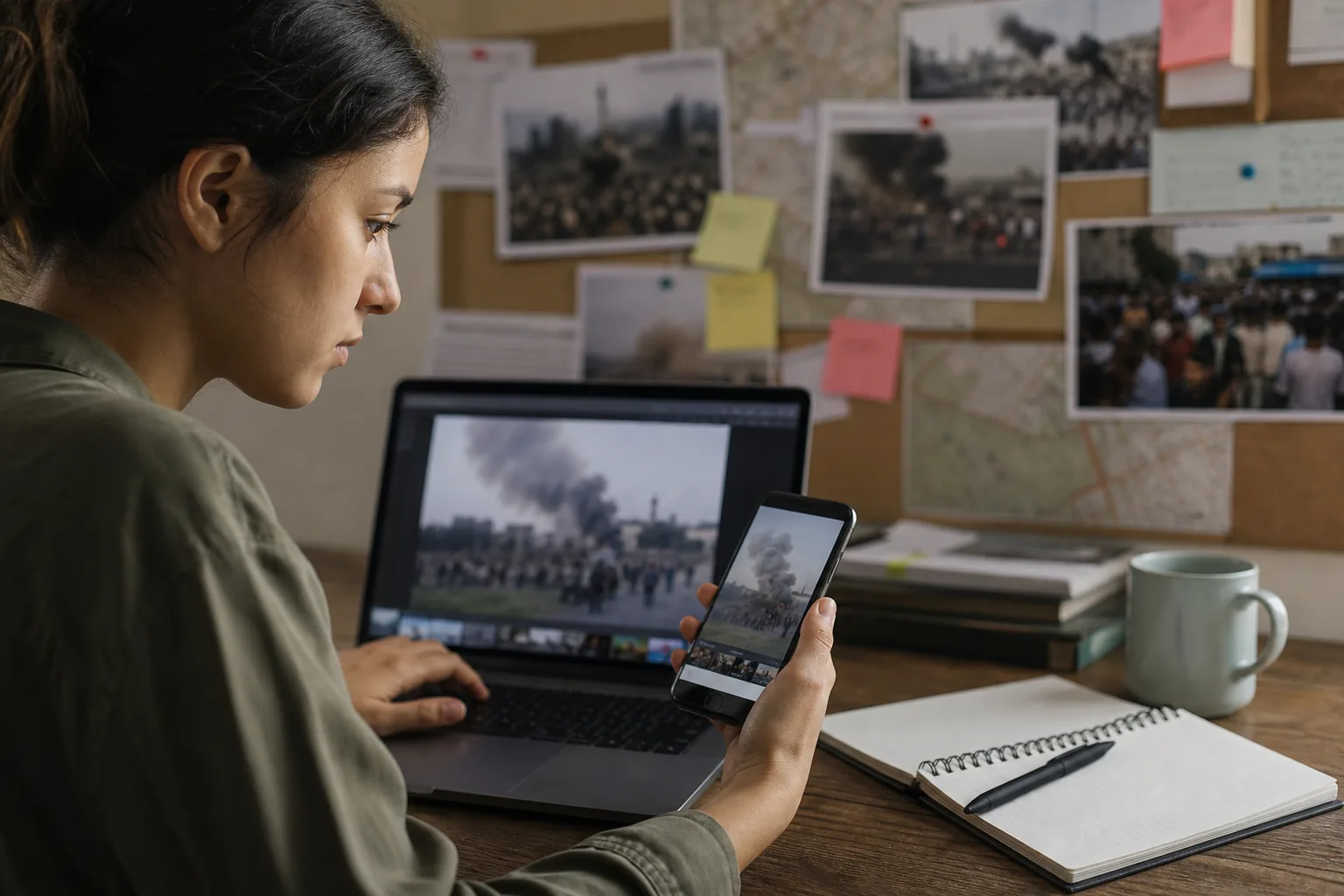

Every day, footage that is months or years old resurfaces on social media platforms dressed up as breaking news — a protest erupting in a European capital, a military confrontation unfolding in real time, an infrastructure attack at a major international hub. These misleading videos on social media are not always sophisticated fakes; often they are entirely genuine recordings stripped of their original context and repackaged to fit a current narrative. Understanding how this happens, why it is effective, and how to push back against it has become one of the most practical media-literacy skills anyone can develop.
Why Old Footage Finds New Life
The mechanics are straightforward. A dramatic clip — a crowd surging against a line of officers, an explosion lighting up a night sky, a vehicle convoy moving through an urban street — carries emotional weight regardless of when or where it was recorded. When that clip is stripped of its original caption and reposted with a fresh claim, most viewers have no immediate way to check whether the footage matches the description. The visual content feels self-evidently real because it is real; the deception lies entirely in the label attached to it.
According to Full Fact’s guide to spotting misleading videos, there are broadly two categories of deceptive video content: footage that is genuine but mislabeled to make a political point or to maximise sharing, and footage that is not real because it has been staged or digitally altered. The first category — real footage, false context — is by far the more common and, in some ways, the harder to counter. Because the imagery itself is authentic, it bypasses the instinctive scepticism many people apply to obviously doctored material.
Full Fact documents a telling example of this pattern: a video that circulated with the claim it showed young men attacking and abducting a woman was, on verification, older footage of police in France clashing with a suspected drug dealer. The clip was real. The people in it were real. The action was real. Everything except the description was accurate — and that single false description was enough to redirect the emotional charge of the footage toward an entirely different group and narrative.
How Misleading Videos on Social Media Are Categorised
The Washington Post‘s Fact Checker team has developed a taxonomy that is useful for anyone trying to assess suspicious footage quickly. Their framework identifies three principal categories of manipulated or misleading video: missing context, deceptive edits, and other alterations.
Missing context is the category most relevant to recycled footage. It breaks into two sub-types. The first is misrepresentation — incorrect framing that leads viewers to draw a false conclusion about what they are watching, even though nothing in the video itself has been changed. The second is isolation — sharing a brief clip extracted from a longer recording in a way that strips out the information that would make the true meaning clear. A clip of a crowd running, cut away from the footage showing that they were fleeing a fireworks display rather than gunfire, is a classic example of isolation.
→ Read also: Old Videos of Middle East Incidents Reshared With False Current Event Claims
Deceptive edits involve active manipulation of the footage: splicing together segments from different events, reversing the chronological order of scenes, or cutting a speaker’s words to reverse their apparent meaning. Other alterations covers a wider range of interventions, including the addition of false subtitles, the dubbing of replacement audio, and increasingly, the use of generative tools to create or modify visual content.
India’s Press Information Bureau Fact Check unit has issued repeated public warnings noting that old incidents, visuals from unrelated locations, and AI-generated videos are being shared online without proper context — a pattern that its analysts observe across multiple platforms and subject areas. The warning is significant because it comes from an official government verification body, and because it confirms that the phenomenon is not confined to any single country, language, or political tendency.
The Anatomy of a Recycled-Footage Claim
While the specific incidents named in some circulating fact-check summaries — a police video misattributed to student protests, protest footage reframed as military conscription, airport footage relabeled as an attack on a different facility — cannot be independently verified from primary sources at the time of writing, they represent patterns that are extremely well-documented in the broader fact-checking literature. The structural template is consistent across verified cases:
- A triggering news event creates demand for visual evidence. Audiences want to see what is happening, and they want to see it immediately.
- A superficially matching clip — same type of location, same general kind of action, same emotional register — is located, sometimes from years earlier.
- A new caption or voiceover asserts that the clip shows the current event, often with a specific date, city, or named participant to add credibility.
- Platform algorithms reward engagement, and alarming footage generates high engagement, so the clip spreads rapidly before verification can catch up.
- Corrections circulate more slowly than the original claim, reaching a fraction of the audience that saw the false version.
This template explains why recycled footage is particularly effective during fast-moving situations — military conflicts, civil unrest, natural disasters — where the supply of verified imagery is temporarily outpaced by public demand for visual information.
Practical Verification: What to Check Before Sharing
Media-literacy organisations and fact-checkers have converged on a set of practical steps that significantly reduce the risk of amplifying misleading content. None of them requires specialist software or technical expertise.
Reverse image and video search
Most major search engines now support reverse image search, and several free tools allow users to extract still frames from a video and search for earlier appearances of the same imagery. If a clip described as showing an event in one city in one year actually appeared in news coverage from a different city two years earlier, a reverse search will typically surface that discrepancy within minutes. This single step catches a substantial proportion of recycled-footage claims.
→ Read also: Viral Videos Misidentified With False Context or Recycled Archival Footage
Check the metadata and watermarks
Broadcast footage, news agency clips, and amateur recordings often carry watermarks, lower-third graphics, or embedded metadata that identify their origin. A clip described as showing an event in one country but carrying the watermark of a news agency’s archive from a different region is an immediate red flag. Similarly, shadows, seasonal vegetation, and architectural styles visible in the background can contradict the claimed location.
Look for the original source
Authentic footage of a significant event will almost always have been reported by journalists or documented by official bodies at the time it occurred. Searching for news coverage of the claimed event — using the location, date, and type of incident described — and finding no corroborating reports is a strong indicator that the description is false, even if the footage itself is genuine.
Assess the account sharing the clip
Accounts with no posting history prior to a recent date, accounts that have changed their names, and accounts that post exclusively in one narrow subject area without any other personal content are worth treating with additional scepticism. None of these features proves that a clip is misleading, but they are useful signals that warrant a pause before sharing.
Why the Problem Is Structural, Not Accidental
It would be comforting to believe that misleading videos on social media are primarily the product of bad actors engaged in coordinated campaigns. Some are. But a significant share of recycled footage spreads through entirely ordinary behaviour: people who genuinely believe they are sharing important information, who feel a sense of civic duty to alert their networks, and who simply did not have the tools or the habit of verification before pressing the share button.
This means that the solution is not purely technical or regulatory. Platform-level interventions — labeling disputed content, reducing the algorithmic amplification of unverified clips, adding friction to the sharing of flagged material — can reduce the speed of spread. But they cannot substitute for the individual habit of pausing before amplifying. The emotional urgency that makes a dramatic clip feel important to share is precisely the feeling that should trigger a verification reflex rather than an immediate repost.
Fact-checking organisations including AFP Fact Check, Full Fact, and others have invested heavily in building publicly accessible databases of verified and debunked footage precisely because the verification record needs to be findable. When a clip resurfaces for a third or fourth time with a new false label, a quick search of those databases can surface the original debunk within seconds. The infrastructure for resisting misleading videos on social media exists and continues to grow; the remaining challenge is making its use a reflex rather than an afterthought. The footage that travels fastest is almost never the footage that has been checked most carefully — and closing that gap, one pause before sharing at a time, is work that every platform user can contribute to right now.
This article was produced with AI assistance and reviewed editorially.

Trump’s ’60 Minutes’ Post-Election Interview: Claims Fact-Checked

Claims About Abdul El-Sayed’s Background Check and Senate Eligibility: What the Record Shows

Voting Machine Claims After 2026 Midterms Lack Evidence of Election Fraud

AI-Generated Images Linking Trump, Epstein, and Beyoncé Circulate Online Without Verification
