
Information
Viral Videos Misidentified With False Context or Recycled Archival Footage
Every week, millions of people encounter video clips that appear to document breaking news — a military strike, a natural disaster, a violent confrontation

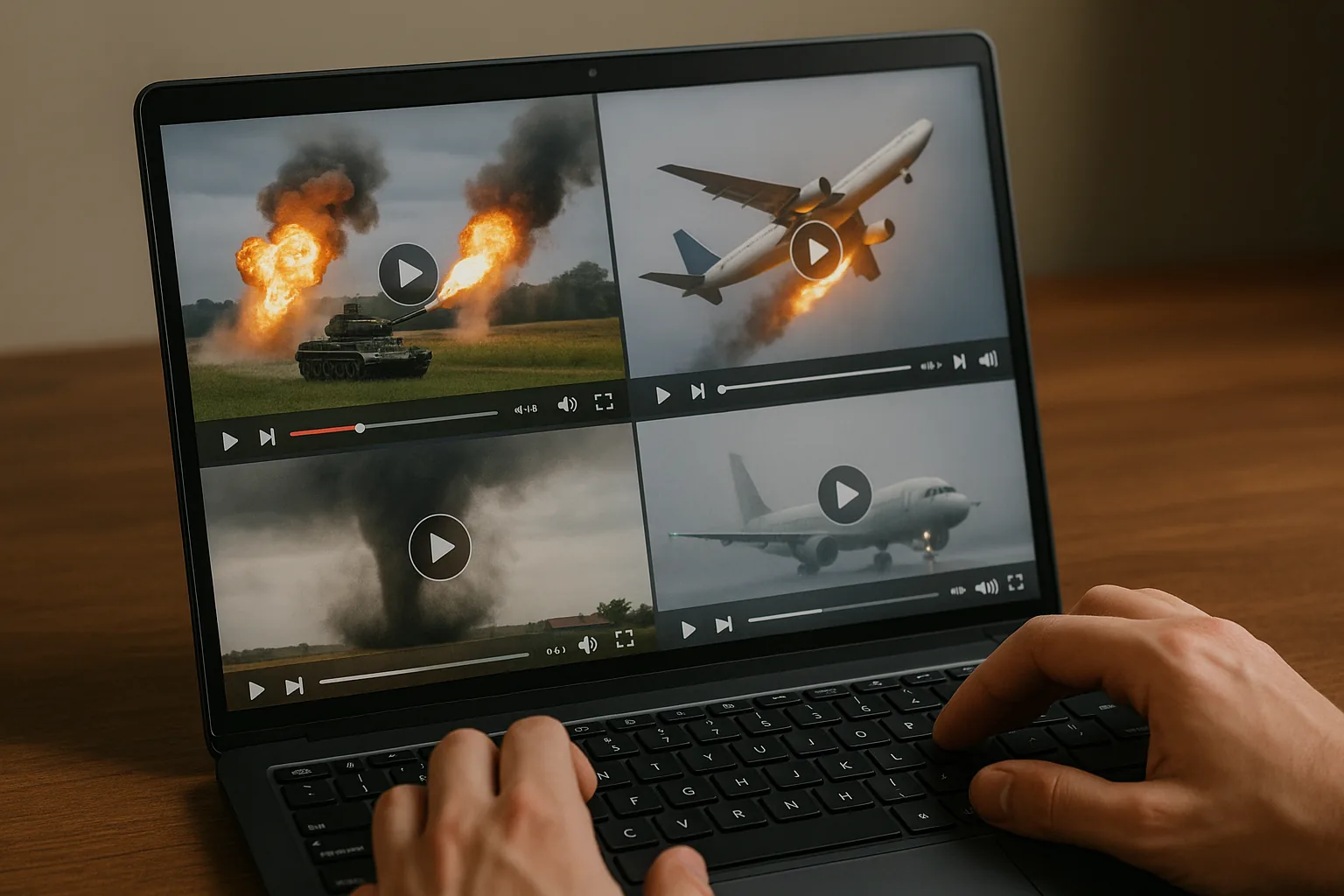
Every week, millions of people encounter video clips that appear to document breaking news — a military strike, a natural disaster, a violent confrontation — only for those clips to turn out to be footage recorded somewhere else, months or years earlier, stripped of its original context and relabelled. The phenomenon of viral videos false context is not new, but the speed and scale at which recycled footage now circulates has grown substantially, making it one of the most persistent challenges in digital media literacy today. Understanding how this pattern works, why it succeeds, and how ordinary viewers can protect themselves from it is increasingly essential.
Why Recycled Footage Spreads So Effectively
The mechanics behind video recycling are straightforward once you examine them closely. A dramatic clip — fire, explosion, crowd panic, wreckage — carries immediate emotional weight. Viewers respond to what they see on screen before they process where or when it was recorded. When that clip is attached to a headline referencing a current event, the brain performs a fast, largely automatic association: the footage feels like evidence.
Several structural features of social media platforms accelerate this effect. Algorithmic amplification rewards engagement, and emotionally charged content generates engagement quickly. A video shared with a false caption can accumulate hundreds of thousands of views within hours, long before any fact-checker has had time to trace its origin. By the time a correction circulates, the original post has often reached a much larger audience than the rebuttal ever will.
There is also the question of source amnesia — the well-documented cognitive tendency to remember content without remembering where or when it was first encountered. A viewer who saw a particular piece of footage two years ago during a different news cycle may not consciously recognise it when it reappears with a new label. The unfamiliarity feels like novelty, and novelty feels like credibility.
Finally, bad actors and well-meaning but careless sharers alike exploit a simple asymmetry: it takes seconds to reshare a video with a false caption and considerably longer to verify it. That asymmetry is structural, and no amount of goodwill eliminates it without deliberate effort.
Documented Cases of Viral Videos With False Context
The pattern is not theoretical. Fact-checkers around the world have documented specific, verified instances of footage being stripped from its original context and redeployed to support false narratives about current events. These cases share common features that reveal how the phenomenon operates in practice.
Disaster Footage Misattributed Across Borders
One well-documented example involves a video that circulated with the claim that it showed the aftermath of a 7.4-magnitude earthquake in Colombia. The footage, which showed structural damage and distressed conditions consistent with a natural disaster, was widely shared as evidence of the Colombia event. Fact-checkers at CyberPeace Corps established that the footage was actually recorded at Tubalan Elementary School in the Philippines, months before the Colombia earthquake claim emerged. The footage was real; the location and event attached to it were not.
This kind of geographic misattribution is among the most common forms of video recycling. Disaster footage is particularly vulnerable because the visual markers of destruction — collapsed walls, debris fields, crowds in distress — are broadly similar across different events and locations. A viewer with no prior knowledge of Tubalan Elementary School has no immediate visual cue to dispute the Colombia label.
Conflict Footage Reassigned to Different Atrocities
Conflict zones generate some of the most emotionally powerful video content, and that power makes such footage especially attractive for misuse. A verified case involved a video circulating on social media with claims that it showed Baloch civilians killed by Pakistani security forces in Balochistan. The footage was being used to support a specific contemporary political narrative about events in Pakistan.
👉 Read also: Viral Videos Claiming to Show Recent Events Are AI-Generated or Mislabeled Footage
Verification traced the video to a completely different event: the Tadamon massacre in Damascus, Syria, which took place in April 2013 — more than a decade before the video was circulating with its new Balochistan label. The underlying footage documented a real atrocity, which adds a particular dimension of harm to its misuse: the suffering of one group of victims is instrumentalised to make false claims about an entirely different situation, distorting both.
Iran Strike Coverage and the Flood of False Footage
Following reported US and Israeli military operations against Iran, social media platforms were rapidly flooded with videos and images presented as live documentation of the strikes. Fact-checkers at Global Fact Checking found that a significant portion of this material either dated to earlier events or was taken entirely out of context. The specific clips involved varied, but the pattern was consistent: the urgency of a breaking news moment creates a demand for visual documentation that outpaces the supply of verified footage, and that gap is filled — sometimes opportunistically, sometimes carelessly — with archival material relabelled as current.
This dynamic is particularly acute in conflict coverage, where access is restricted, independent verification is difficult, and audiences are hungry for any visual confirmation of reported events. The conditions that make genuine documentation hard to obtain are the same conditions that make false documentation easy to circulate.
Archival 9/11 Footage Presented as a Recent Strike
Perhaps the starkest example of temporal misattribution in the verified record involves footage of the September 11, 2001 attacks being circulated as evidence of a recent military strike in West Asia. This case, documented by PTI News, illustrates that the footage being recycled need not be obscure or difficult to identify — some of the most widely seen video in human history was being presented to audiences as something new.
The fact that recognisable 9/11 footage could circulate as purportedly recent material suggests that a significant portion of the audience encountering it either did not recognise it or did not have the contextual knowledge to identify it as archival. It also suggests that the act of resharing can outpace the act of recognition even for well-known content.
France Riots and the Perth Parking Lot Fire
During civil unrest in France, a video showing multiple cars engulfed in flames circulated with the claim that it documented rioters burning a parking lot in France. The footage was vivid and consistent with the kind of property destruction associated with the riots. Fact-checkers at Newschecker traced the video to a fire at an auction yard in Perth, Australia, recorded on April 29, 2023 — a fire that had nothing to do with French civil unrest and predated the riots being referenced.
This case is instructive because the footage was not from a conflict zone or a politically charged event in its original context; it was simply dramatic footage of a fire. Its power came entirely from the label attached to it when it was reshared. Remove the caption, and the footage is a news clip from Australia. Add the caption, and it becomes apparent evidence of events happening in France.
Bangladesh and the Sustained Misattribution Pattern
The situation in Bangladesh offers a case study in what sustained, high-volume video misattribution looks like over time. Fact-checkers at Factually documented that throughout 2025 and into 2026, a steady stream of short, shocking videos tied to Bangladesh — ranging from election clashes to alleged leaked content — flooded social media platforms. Repeated investigation found misattribution, reuse of older footage, and outright hoaxing across multiple categories of claim.
The Bangladesh pattern illustrates that video recycling is not always a single, discrete event. In situations of ongoing political instability or international attention, a context becomes a persistent target for misattribution, with multiple waves of false footage circulating as different news cycles unfold. Audiences following a particular situation closely may encounter recycled footage repeatedly, each time attached to a different specific claim.
The Anatomy of a False Context Claim
Across all these verified cases, several structural features recur. Recognising them is the first step toward more critical engagement with viral videos false context claims.
👉 Read also: AI-Generated and Manipulated Videos Spread Misinformation About September 2026 Events
- Urgency framing: The caption or accompanying text emphasises that the footage is current, live, or breaking. Phrases like “just now,” “happening today,” or “this morning” appear frequently, even when the footage is years old.
- Emotional loading: The footage itself is selected for maximum emotional impact — fire, bodies, explosions, crowds in panic. The emotional response the footage triggers tends to suppress the analytical response that would prompt verification.
- Absence of verifiable detail: Recycled footage rarely includes on-screen text, recognisable landmarks, or audible language that would allow quick geographic identification. When such details are present, they are often cropped or muted.
- Rapid initial spread: The first hours of circulation are the most consequential. Recycled footage that achieves high engagement quickly becomes harder to correct, because the correction must now reach not just the original audience but everyone who reshared the post.
- Plausible fit: The footage is chosen because it looks consistent with the event it is falsely attributed to. A fire looks like a fire; rubble looks like rubble. The visual plausibility of the match is the mechanism that makes the misattribution work.
How Verification Works in Practice
Professional fact-checkers use a range of techniques to establish whether footage is what it claims to be. Understanding these methods helps non-specialists apply similar reasoning, even without specialist tools.
Reverse image and video search is the most widely applicable technique. Tools that allow users to search by image or video frame can surface earlier instances of the same footage, revealing when and where it first appeared. If a clip presented as current turns out to have been indexed months or years earlier, that is strong evidence of recycling.
Geolocation involves identifying specific visual features of a location — building styles, signage, vegetation, road markings, terrain — and cross-referencing them with satellite imagery or street-level photography to establish where footage was actually recorded. This technique has been used effectively to debunk footage misattributed across continents, as in the Colombia earthquake case.
Metadata analysis can sometimes reveal when a video was recorded, though metadata is easily stripped or altered and should not be treated as definitive on its own. It is most useful when combined with other verification methods.
Source tracing involves following the chain of shares backward to find the earliest instance of a clip, then examining the context in which it originally appeared. This is time-consuming but often definitive: if the earliest instance of a clip is a news broadcast from 2013 in Damascus, the clip is not footage from Balochistan in 2025.
The First Draft project has published extensive guidance on these verification techniques, and several of its frameworks have become standard practice in newsrooms that take visual verification seriously.
The Broader Stakes of Video Misattribution
The consequences of viral videos with false context extend well beyond individual instances of misinformation. At the level of public understanding, repeated exposure to misattributed footage erodes the evidentiary value of video itself. When audiences learn — or simply sense — that footage cannot be trusted at face value, the result is not necessarily greater skepticism toward false content; it can equally produce greater skepticism toward genuine documentation.
This dynamic has particular implications for conflict coverage, where video documentation of real atrocities plays a critical role in accountability. If audiences have been conditioned by repeated exposure to false footage to distrust visual evidence, genuine documentation of genuine events becomes harder to communicate. The harm is not only to individual viewers misled by a specific clip; it is to the broader epistemic environment in which visual evidence functions.
There is also a political dimension. Misattributed footage is frequently not random — it tends to cluster around contested political events, ongoing conflicts, and moments of social tension. The cases documented here, from Bangladesh to France to Iran to Balochistan, all involve situations where particular narratives are politically consequential. Whether the misattribution is deliberate or careless, its effect is to distort the informational environment around events that matter.
Addressing the problem requires effort at multiple levels: platform-level friction that slows the spread of unverified content, media literacy education that equips audiences with basic verification instincts, and sustained investment in professional fact-checking infrastructure. None of these is sufficient on its own, and none produces results quickly. But the documented cases make clear that the problem is real, recurring, and consequential — and that the tools to identify it, while imperfect, exist and work.
This article was produced with AI assistance and reviewed editorially.

Political Ads in 2026 Midterms Contain False or Misleading Claims About Opponents

Trump Administration ‘Super Intelligence’ Accord Misspells ‘United States’ as ‘Unites States’

Trump Administration ‘Super Intelligence’ Accord Misspells ‘United States’ as ‘Unites States’

No Going Back PAC Ad Makes Misleading Claim About Roy Cooper and Rape Kits
