
Current Affairs
Old Videos of Middle East Incidents Reshared With False Current Event Claims
Archived footage from 2020 incidents is being recirculated with false claims about current Middle East conflicts. A UAE market fire, Israeli basketball player video, and

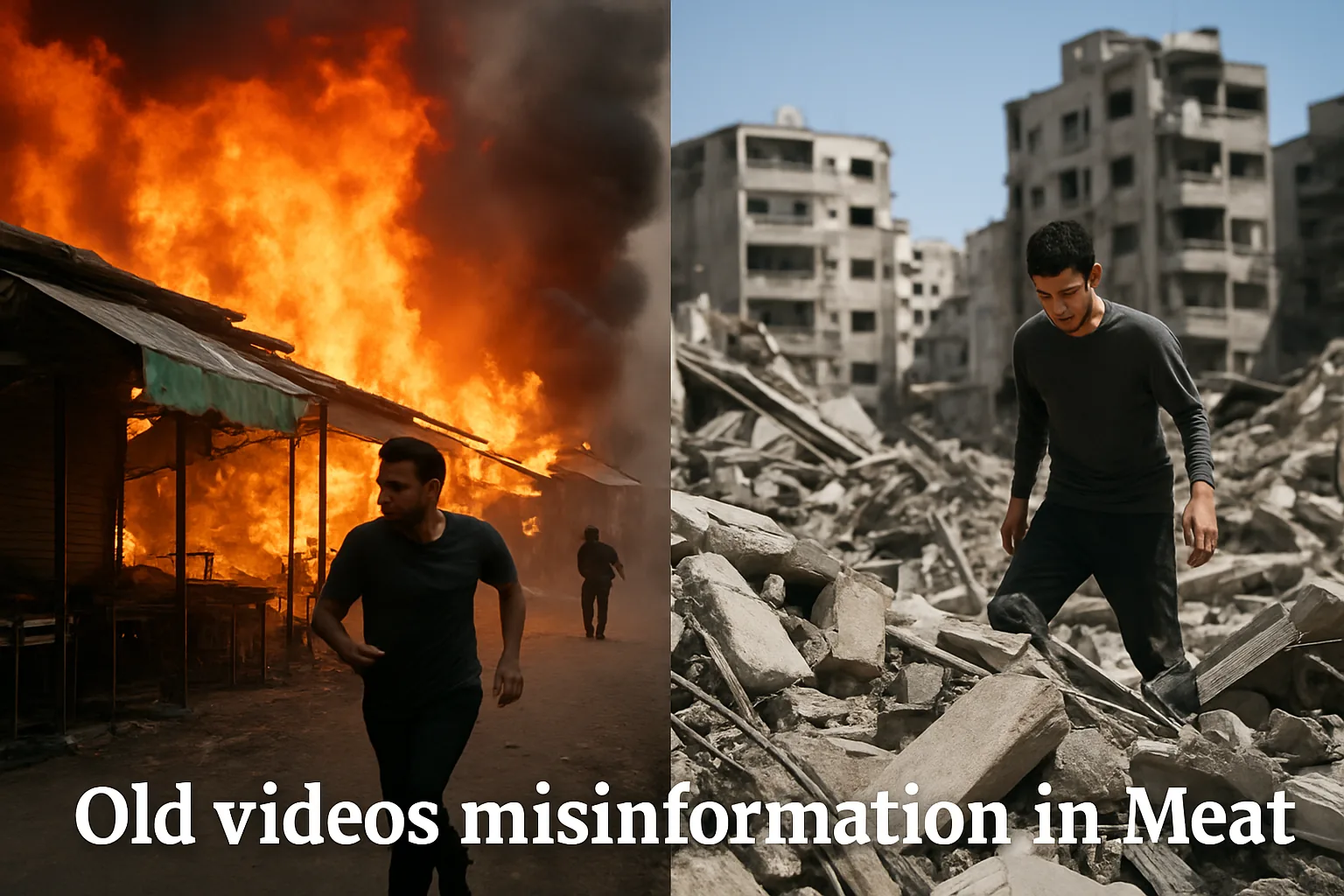
Across social media platforms in October 2026, a familiar and damaging pattern has re-emerged: footage from unrelated incidents — some dating back to 2020 or earlier — is being stripped of its original context and reshared with urgent, false claims about current Middle East conflicts. The spread of old videos misinformation in the Middle East is not a new phenomenon, but the scale, speed, and sophistication with which archived footage is being weaponized has intensified as fresh hostilities draw global attention and emotional investment.
How Archived Footage Becomes a Weapon of Narrative War
The mechanics are straightforward but effective. A video recorded months or years ago — during a fire, a sporting event, a military exercise — is clipped, sometimes cropped or re-encoded to strip metadata, and then posted alongside a caption claiming it shows something happening right now. On fast-moving platforms where users scroll rapidly and share instinctively, the false caption often travels far further than any subsequent correction. By the time fact-checkers identify the original footage, the misattributed version may have accumulated hundreds of thousands of views.
According to research compiled by Full Fact, at least 15 miscaptioned videos and eight AI-generated images related to the current Middle East conflict had been identified, with thousands of interactions recorded between them, as of March 2026. That figure almost certainly understates the true volume: fact-checkers can only assess content they encounter, and much viral misinformation never reaches formal review. What the data does confirm is that the problem is large, coordinated in effect if not always in origin, and growing.
The UAE Market Fire Video: A Case Study in Recycled Misinformation
One of the clearest and most thoroughly documented examples involves a video of a market fire in Ajman, UAE, from August 2020. The footage shows dramatic, billowing flames and thick smoke — visually compelling material that, divorced from its original context, could plausibly be mistaken for an airstrike or explosion in any number of settings. Recirculated in October 2026, the video has been shared with false claims that it shows a strike on an oil facility in Israel.
This is not the first time this particular clip has been misused. Full Fact has fact-checked this video on multiple prior occasions, each time confirming its origin as the Ajman market fire and debunking whatever current-event claim was attached to it at the time. The video’s reappearance in October 2026 illustrates a core challenge in combating this type of misinformation: debunking does not delete. A piece of footage, once uploaded, can be retrieved and repurposed indefinitely. Each new cycle of conflict creates fresh demand for dramatic imagery, and bad actors — or simply careless sharers — meet that demand with whatever archive material is available.
👉 Read also: Archival Footage Reshared Online With Misleading Captions Connecting Unrelated Videos to Current Conflicts
The Ajman fire video is particularly instructive because it has been recycled across multiple distinct conflict narratives over several years. It has been labeled as footage from Syria, from Yemen, from Lebanon, and now from Israel. The footage itself has not changed; only the caption has. This adaptability makes certain pieces of archive footage especially durable as misinformation vectors.
Parachute Videos and the Anatomy of a False Claim
A more recent cluster of misattributed footage emerged in April 2026, following the confirmed shootdown of a US F-15 fighter jet by Iranian forces on April 3, 2026. The jet’s two-person crew ejected and landed in separate locations — a real, verified event that immediately generated intense public interest and a corresponding demand for visual documentation. Into that information vacuum, old, unrelated videos were inserted as supposed evidence.
Two parachute videos circulated widely with false claims that they showed the ejected US aircrew. One video was actually filmed during a military training exercise in Libya; the other showed a Bangladeshi paraglider who had accidentally landed at a closed airport in Pakistan. Neither clip had any connection to the F-15 incident. Yet both accumulated significant reach before fact-checkers intervened to establish their actual origins.
This episode demonstrates a slightly different mechanism from the Ajman fire case. Here, the underlying event — the shootdown — was real and significant. The misinformation did not invent the event; it fabricated the visual evidence for it. This is a subtler and in some ways more dangerous form of distortion: audiences who correctly understand that the shootdown occurred may lower their guard when evaluating footage that purports to document it, accepting visual “confirmation” that is entirely fabricated in context.
The Role of Prominent Sharers in Amplifying Old Videos Misinformation About the Middle East
Individual accounts with large followings play a disproportionate role in spreading this type of content. Maram Susli, an Australian-based commentator known online as Syrian Girl or Partisan Girl, has shared multiple false or misleading posts on X since the current conflict began on February 28, 2026, according to a fact-check by Australian Associated Press. High-follower accounts function as amplifiers: content that might otherwise reach a few hundred people can, through a single share by an account with hundreds of thousands of followers, reach an audience of millions within hours.
It is important to apply epistemic care here. The fact that an account shares false content does not, by itself, establish that the sharing is deliberate or coordinated. Some misinformation spreads through genuine belief rather than bad faith. What is established is the effect: false or misleading content reaching large audiences, shaping perceptions of ongoing events, and creating emotional responses — grief, outrage, fear — based on footage that does not depict what it claims to depict.
👉 Read also: Viral Videos Claiming to Show Recent Events Are AI-Generated or Mislabeled Footage
AI-Generated Content Compounds the Problem
Alongside recycled real footage, AI-generated images and video have added a new dimension to the misinformation landscape. Whereas old footage at least has a verifiable origin that can be traced through reverse image search and metadata analysis, synthetic media may have no real-world referent at all. Full Fact’s March 2026 overview identified at least eight AI-generated images circulating in connection with Middle East conflict claims — a figure that represents only confirmed cases.
The combination of recycled authentic footage and AI-generated synthetic content creates a particularly difficult environment for audiences trying to assess what is real. Each type of false content exploits different cognitive vulnerabilities: recycled footage exploits the assumption that real-looking video is recent and relevant; AI-generated content exploits the assumption that photorealistic imagery reflects a real event. Together, they saturate the information environment with competing false images, making it harder to identify and trust accurate documentation.
A further complicating factor emerged in April 2025, when a video falsely claimed to show panic in Tel Aviv following an Iranian strike. Fact-checkers at AFP established that the footage actually dated to April 2025 and depicted a commotion caused by a mistaken terror alarm — not an actual attack. The video resurfaced in 2026 with updated false framing, demonstrating again that debunked content does not disappear; it waits for the next relevant news cycle.
What Audiences and Platforms Can Do
Understanding the mechanics of video recirculation misinformation makes it possible to identify practical defenses, even without specialist tools.
- Reverse image and video search tools — available through major search engines — allow anyone to check whether a piece of footage has appeared online before, and in what context. A clip that first appeared in 2020 is unlikely to be showing something that happened today.
- Check the source account’s history before sharing. Accounts that frequently post dramatic conflict footage without sourcing it deserve additional scrutiny.
- Look for corroboration from established news organizations or verified official sources before accepting that a video shows what its caption claims. If an event is significant, multiple credible sources will document it independently.
- Pause before sharing. The emotional intensity of conflict imagery is precisely what makes it effective as misinformation. That intensity is also a signal to slow down and verify, not an invitation to amplify immediately.
Platform-level responses — labels, reduced algorithmic promotion of unverified content, faster fact-checker integration — can reduce the spread of recycled footage, but no platform intervention has yet proven sufficient to stop it. The burden falls partly on individual users and partly on the broader media literacy infrastructure: journalists, educators, and fact-checking organizations who can identify and document false content quickly enough to limit its reach.
The pattern documented in October 2026 is not unprecedented, and it will not end when the current conflict cycle does. As long as dramatic archived footage exists and as long as audiences seek visual confirmation of fast-moving events, the incentive to recirculate old videos with false current-event claims will persist. Recognizing the pattern — understanding that old videos misinformation in the Middle East follows predictable mechanics and exploits predictable emotional responses — is the first and most durable defense against it.
This article was produced with AI assistance and reviewed editorially.

Political Ads in 2026 Midterms Contain False or Misleading Claims About Opponents

Trump Administration ‘Super Intelligence’ Accord Misspells ‘United States’ as ‘Unites States’

Trump Administration ‘Super Intelligence’ Accord Misspells ‘United States’ as ‘Unites States’

No Going Back PAC Ad Makes Misleading Claim About Roy Cooper and Rape Kits
