
Current Affairs
What the US-Denmark-Greenland defense agreement actually covers
The US-Denmark-Greenland defense agreement signed in September 2026 expands American military presence in the Arctic while preserving Greenland’s status under Danish sove

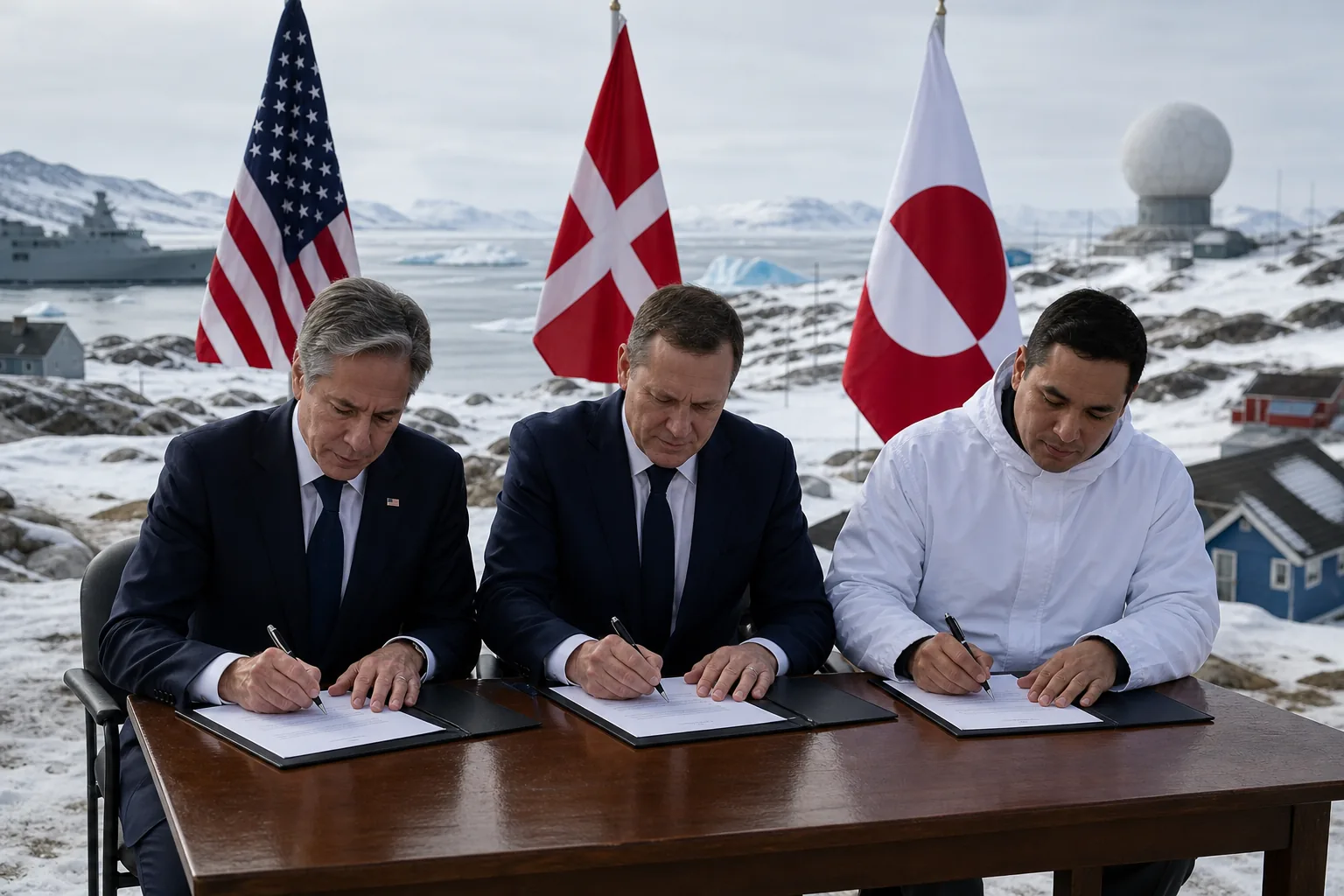
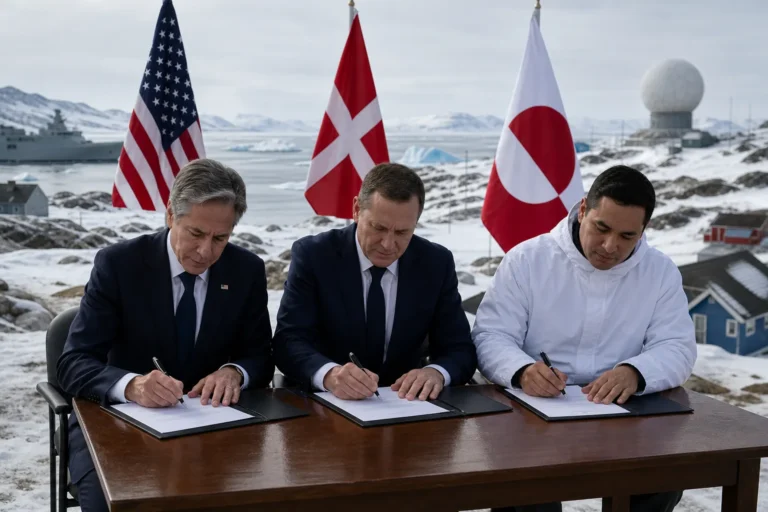
When President Donald Trump, Danish Prime Minister Mette Frederiksen, and Greenland Prime Minister Jens-Frederik Nielsen put their signatures to a trilateral security pact in September 2026, the event immediately generated a wave of conflicting interpretations. Some commentators declared that Washington had effectively annexed Greenland; others insisted the deal was largely symbolic. Neither reading holds up to scrutiny. The US-Denmark-Greenland defense agreement is a substantive but carefully bounded document — one that expands American military reach in the Arctic while leaving the island’s constitutional status firmly intact. Understanding precisely what it does and does not do matters enormously, because misreadings of the deal have already shaped public debate on both sides of the Atlantic.
The Political Path That Led to the September 2026 Signing
The agreement did not emerge from a vacuum. For much of the preceding year, the Trump administration had signalled an unusually assertive interest in Greenland, at one point openly discussing the possibility of the United States taking control of the territory. That push alarmed Copenhagen and complicated an already delicate relationship between Denmark and its semi-autonomous territory in the North Atlantic. The eventual pact, signed in September 2026, represents a significant retreat from that maximalist position. The agreement expands the U.S. military presence in Greenland but stops short of the Trump administration’s earlier push for the U.S. to take control of the territory, according to reporting by U.S. News & World Report.
That outcome is, by most measures, a diplomatic achievement for Copenhagen. The Bruegel think tank, analysing the deal shortly after its signing, described it as a “diplomatic victory” for Denmark, arguing that it maintains the status quo and, critically, makes independence for Greenland less likely rather than more. For a Danish government that had spent months insisting Greenland was not for sale and was not subject to unilateral American decision-making, securing a deal that keeps the island within the Kingdom of Denmark while satisfying Washington’s security ambitions was no small feat.
What the US-Denmark-Greenland Defense Agreement Actually Establishes
At its core, the agreement is a security and defence arrangement that strengthens Arctic security and expands the U.S. military presence on Greenland. The White House has characterised the deal in expansive terms: the United States now claims ‘permanent control’ over Greenland’s security, a formulation that has generated considerable confusion about what that phrase actually means in practice.
It is important to read that claim carefully. Permanent control over security arrangements is not the same as sovereignty over the territory itself. Greenland remains under Danish sovereignty — that foundational fact is not altered by the agreement. What has changed is the scope and permanence of the American military footprint on the island, and the degree to which Washington has formalised its role in Arctic defence planning that involves Greenlandic territory.
The deal could dramatically expand Washington’s military presence in the Arctic, a region of rapidly growing strategic importance as climate change opens new shipping lanes and as competition between great powers intensifies. The Arctic is no longer a peripheral theatre; it sits at the intersection of NATO’s northern flank, Russian military activity, and Chinese economic ambitions. A formalised, expanded American presence in Greenland directly addresses those pressures.
For readers seeking the official text, the White House briefings and statements page carries the full agreement document, framed as an amendment and supplement to an earlier bilateral framework.
Greenland’s Sovereignty: What Has and Has Not Changed
Perhaps the most persistent misconception circulating since the signing is that the agreement transfers Greenland — or meaningful governing authority over it — to the United States. That claim is not supported by the text or by any of the parties involved. Greenland remains under Danish sovereignty, and the trilateral structure of the agreement itself underlines that point: Greenland’s own government, led by Prime Minister Jens-Frederik Nielsen, was a signatory in its own right, not a passive subject of a bilateral US-Danish arrangement.
The trilateral format is significant. By including Greenland as a distinct party at the table, the agreement formally recognises the island’s selvstyre — its self-governance status within the Kingdom of Denmark — while simultaneously binding its security arrangements more tightly to Washington. That is a nuanced constitutional position, and it is one that resists simple summary.
→ Read also: False and Misleading Claims About US-Canada Relations Since Trump's 2024 Reelection
The Bruegel analysis adds another layer to this picture. By locking Greenland into a long-term security relationship with the United States through a formal agreement, the deal arguably reduces the practical space for Greenland to pursue full independence in the near term. A Greenland that hosts an expanded American military presence and whose security is formally guaranteed by Washington is, in structural terms, more deeply integrated into existing alliance arrangements — not less. Whether that outcome serves Greenlandic interests is a matter of ongoing political debate within the island’s own government and society, but it is a separate question from the legal one of sovereignty, which the agreement does not disturb.
The Three Leaders and What Each Side Gained
The three signatories — Trump, Frederiksen, and Nielsen — each brought different priorities to the table, and the agreement reflects those competing interests in its structure.
For the Trump administration, the deal delivers a concrete, formalised expansion of American military reach into one of the world’s most strategically sensitive regions, along with a claim of permanent security stewardship that can be presented domestically as a significant foreign policy achievement. The earlier, more aggressive posture toward Greenland — which raised alarm across NATO allies — is effectively replaced by a negotiated framework that achieves many of the same practical objectives without the diplomatic cost of coercion.
For Prime Minister Frederiksen and the Danish government, the agreement preserves sovereignty while demonstrating that Copenhagen can manage its relationship with Washington without capitulating to maximalist demands. That is a meaningful political outcome at home, where the prospect of losing Greenland to American pressure had been a source of acute national anxiety.
For Greenland’s Prime Minister Nielsen, the calculus is more complex. Greenland’s government participates as a named party, which reinforces its status as a self-governing entity with agency in its own security arrangements. At the same time, the Bruegel assessment suggests the deal constrains the path toward full independence — a goal that remains a live aspiration within Greenlandic politics, even if its timeline was already uncertain.
Common Misreadings and Why They Spread
Several specific misreadings of the US-Denmark-Greenland defense agreement have gained traction in public commentary. The most consequential is the conflation of security control with territorial sovereignty. When the White House stated that the US now holds permanent control over Greenland’s security, some outlets and commentators reported this as confirmation that the United States had effectively taken over the island. That reading ignores the explicit preservation of Danish sovereignty in the agreement and misunderstands what security arrangements — even permanent ones — legally entail.
A second misreading runs in the opposite direction: the claim that the deal is essentially meaningless, a face-saving exercise that changes nothing on the ground. Given that the agreement is described as capable of dramatically expanding Washington’s military presence in the Arctic, that characterisation understates the deal’s practical significance. Expanded military infrastructure, formalised security guarantees, and a permanent American role in Arctic defence planning are not trivial outcomes.
A third area of confusion involves Greenland’s independence prospects. The agreement neither grants independence nor formally forecloses it — Greenland’s constitutional path remains what it was before September 2026. But the Bruegel analysis makes a reasonable case that the practical and political conditions for independence have become more complicated, not less, as a result of the deal’s terms.
The September 2026 agreement is best understood as a carefully negotiated compromise that delivered real strategic gains for Washington, preserved the constitutional framework that Denmark required, and gave Greenland’s government a formal seat at the table — while leaving the deeper questions about the island’s long-term political future unresolved. Those questions will not be settled by a security pact, however significant its military provisions may prove to be.
This article was produced with AI assistance and reviewed editorially.

Trump’s ’60 Minutes’ Post-Election Interview: Claims Fact-Checked

Claims About Abdul El-Sayed’s Background Check and Senate Eligibility: What the Record Shows

Voting Machine Claims After 2026 Midterms Lack Evidence of Election Fraud

AI-Generated Images Linking Trump, Epstein, and Beyoncé Circulate Online Without Verification
