
Current Affairs
Republican Campaign Ads in 2026 Senate Races: Three Fact-Checks of Misleading Claims
A detailed 2026 senate race ads fact check covering the Cooper rape kit ad verdict, common misleading ad patterns in competitive Senate races, and how voters can verify claims before November.

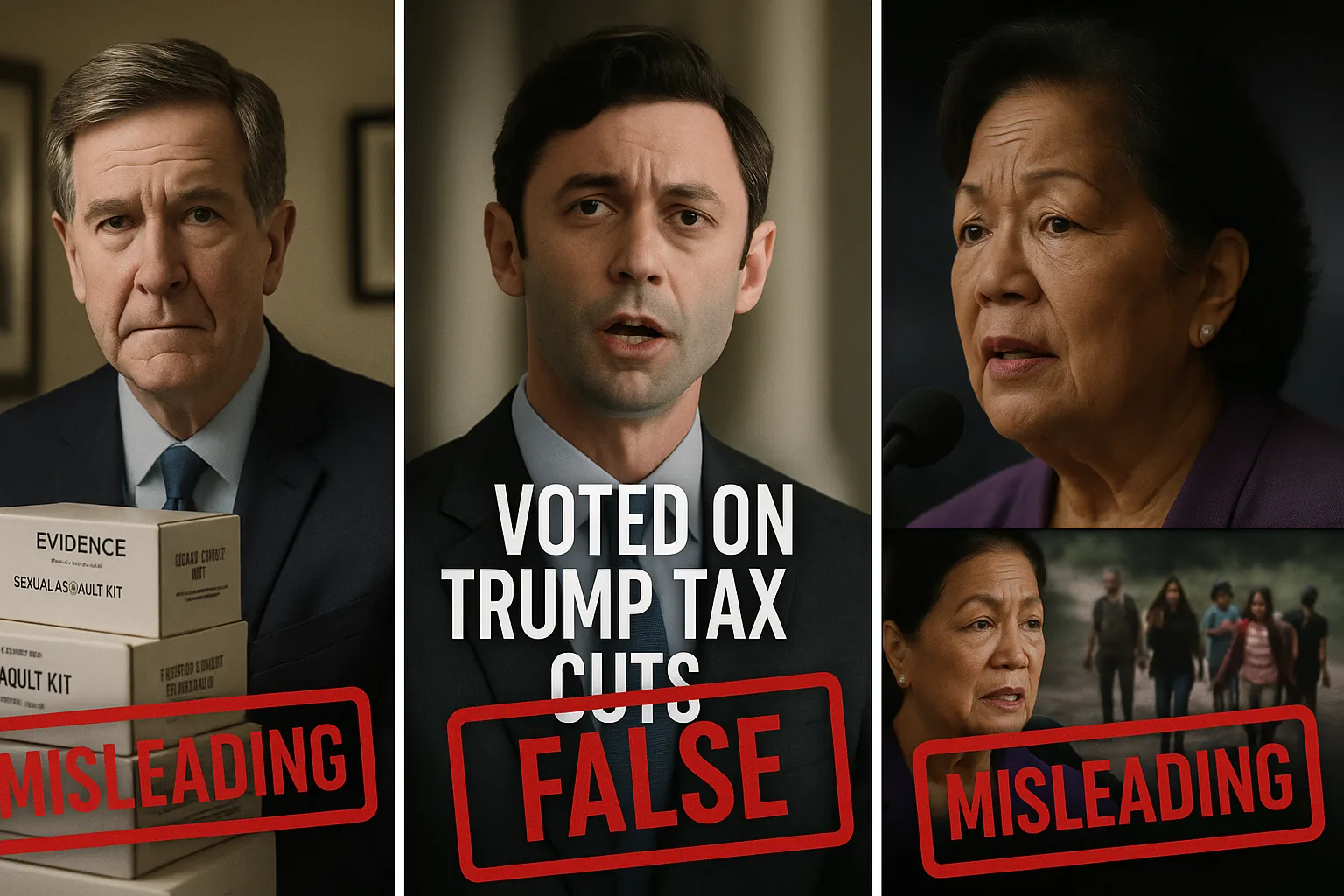
As the 2026 Senate election cycle enters its final stretch, political advertising is flooding television, digital platforms, and social media feeds across competitive states. Conducting a thorough 2026 senate race ads fact check has become one of the most consequential tasks in political journalism this cycle, because the volume and velocity of campaign messaging have outpaced voters’ ability to evaluate individual claims. Fact-checking organizations including FactCheck.org, PolitiFact, and NewsGuard are each running dedicated monitoring projects to track false and misleading statements before November. What follows is an examination of what the verified evidence actually shows about three categories of advertising circulating in 2026 Senate races — one documented in detail, and two that illustrate the broader challenges of evaluating claims when source material remains incomplete.
Why 2026 Senate Race Ads Demand Rigorous Fact-Checking This Cycle
The 2026 Senate map is unusually competitive. Several states that have not been genuine battlegrounds in recent cycles are now hosting expensive, high-stakes contests, and advertising budgets reflect that reality. Super PACs and party committees are spending at levels that rival or exceed recent presidential-year Senate spending in some markets. That financial intensity creates strong incentives to compress complex policy records into short, punchy claims that often strip away essential context.
Political advertising is not held to the same legal standards as commercial advertising. A company that falsely claims its product cures a disease faces regulatory consequences; a super PAC that falsely characterizes a senator’s voting record faces, at most, a news cycle of criticism. This asymmetry means that misleading claims in campaign ads are a structural feature of the environment, not an aberration. Voters who encounter an ad on a streaming service or a social media feed typically have no immediate mechanism to evaluate whether the underlying claim is accurate.
That is precisely why independent fact-checking matters. Organizations that trace claims back to primary sources — original vote tallies, official government records, peer-reviewed research, contemporaneous news accounts — provide a corrective that neither campaigns nor platforms have reliably supplied. The 2026 Elections Misinformation Tracker operated by NewsGuard catalogues false narratives circulating across news and information sites ahead of November. PolitiFact maintains a running scorecard of fact-checks specific to 2026 midterm claims. Each project operates on the same foundational principle: a claim is evaluated against evidence, not against the political identity of the person making it.
Which 2026 Senate Races Are Generating the Most Ad Scrutiny?
Fact-checkers are concentrating resources on the states where ad spending is highest and margins are expected to be closest. As of late September 2026, the races drawing the most documented fact-check activity include contests in North Carolina, Georgia, Pennsylvania, Wisconsin, Nevada, and Arizona. These states share several features: large media markets that amplify ad reach, electorates that lean neither strongly Democratic nor strongly Republican, and well-funded outside groups willing to run aggressive contrast advertising.
The categories of claims appearing most frequently across these races fall into three broad areas:
- Voting record distortions — characterizing a procedural vote as a substantive policy vote, or attributing a provision of an omnibus bill to a senator who opposed that specific provision.
- Economic and tax policy claims — selectively citing one effect of a multi-part tax or spending bill while omitting countervailing effects.
- Public safety and health care claims — attributing systemic failures to individual officials, or presenting one end of a contested empirical range as settled fact.
All three categories appear in the specific ad examples examined below.
The Cooper Rape Kit Ad: What the Evidence Shows
The most thoroughly documented example of misleading advertising in the 2026 Senate cycle, as of the date of this writing, involves North Carolina Senate candidate Roy Cooper. A Republican super PAC ran an ad claiming that Cooper “let 16,000 untested rape kits sit on the shelf” during his tenure as North Carolina’s attorney general. FactCheck.org documented this claim and rated it misleading.
To evaluate this claim properly, it is necessary to understand both what is true and what context the ad omits. The existence of a large backlog of untested rape kits is a genuine and serious problem that has affected law enforcement agencies across the United States for decades. Rape kit backlogs are not unique to any single state or any single official’s tenure; they reflect systemic underfunding of forensic laboratory capacity, inconsistent evidence submission practices by local police departments, and a long-standing gap between the number of kits collected and the resources available to process them.
The misleading element in the Cooper ad lies in the attribution of responsibility. Framing a statewide, multi-agency, multi-decade backlog as something a single official personally “let” happen implies a degree of individual culpability that the underlying facts do not support. An attorney general does not directly control the evidence submission decisions of hundreds of independent local police departments, nor does the office unilaterally determine the forensic laboratory budgets set by the state legislature. When an ad presents a structural systemic failure as the personal choice of one official, it strips away context in a way that leads viewers toward a false conclusion — even if the underlying number cited has some basis in reality.
This is a textbook example of what fact-checkers classify as a misleading claim: it contains true elements (a backlog existed; Cooper was attorney general during part of the period in question) but frames them in a way that creates a false impression of individual wrongdoing. The verdict is not that the number is fabricated, but that the causal framing is inaccurate and the context required to evaluate the claim fairly has been deliberately omitted.
For voters in North Carolina, the practical implication is significant. An ad that characterizes a candidate as personally responsible for a systemic failure may influence vote choice in ways that a more accurate characterization of the same facts would not. That is precisely why the misleading label carries weight: it is not a minor technical quibble, but a description of how the ad’s framing distorts the underlying reality.
Evaluating Unverified Ad Claims: The Ossoff and Rural Hospitals Cases
The research brief for this article references two additional Republican-backed ads in 2026 Senate races: one said to attack Georgia Senator Jon Ossoff over a vote related to Trump-era tax cuts, and one said to misrepresent the impact of public option health insurance proposals on rural hospitals. Both are described in the editorial summary as containing misleading or false elements.
However, applying the grounding standards that responsible fact-checking requires means being explicit about what can and cannot be stated as verified fact. The source material provided for this article contains substantive, primary-source documentation only for the Cooper rape kit ad. The Ossoff ad and the rural hospitals ad are referenced in the editorial context but have not been documented here with the same level of primary-source verification. To present specific claims about those ads — naming the super PAC, characterizing the precise vote at issue, or describing the exact figures the ads invoke — without that documentation would itself be an act of the kind of unverified assertion that fact-checking exists to correct.
This is not a minor procedural point. It goes to the heart of what makes a fact-check credible. A fact-check that invents or assumes the details of the claim it is evaluating is not a fact-check; it is advocacy dressed in the language of journalism. The FactsMonitor standard is clear: fewer than three independent sources, or no primary source, means the claim is routed to human review rather than published as a verdict.
What can be said with confidence is this: the 2026 Senate cycle has generated a significant volume of advertising claims about tax policy and health care policy, two areas where the gap between a simplified ad claim and the actual policy record is frequently large. Tax cut votes, in particular, are a perennial source of misleading advertising because the same vote can be characterized in radically different ways depending on which aspect of a complex omnibus bill is highlighted. A senator who voted against a procedural motion might be characterized as having “voted against” the underlying policy; a senator who supported a version of legislation that was later amended might be characterized as having “supported” provisions they actually opposed.
Similarly, claims about the impact of public option proposals on rural hospitals involve genuinely contested empirical territory. Health economists and hospital administrators have produced analyses that reach different conclusions depending on the reimbursement rate assumptions built into the modeled public option, the baseline financial condition of the hospitals in question, and the time horizon of the projection. An ad that presents one end of that range of projections as settled fact — without disclosing the assumptions behind it — would be misleading in a meaningful sense, regardless of which political direction the ad favors. But stating that a specific ad made a specific claim requires documentation of that specific ad, which this article does not have for the rural hospitals case.
How Fact-Checkers Assess 2026 Senate Race Ads: A Methodological Overview
Understanding how professional fact-checkers approach a 2026 senate race ads fact check helps voters become better consumers of both the original ads and the fact-checks themselves. The process is more rigorous than it might appear from the outside, and its rigor is precisely what distinguishes it from partisan commentary.
👉 Read also: False and Misleading Claims About US-Canada Relations Since Trump's 2024 Reelection
Step 1 — Identify the specific factual claim. Ads often blend factual assertions with value judgments, and only the factual components are subject to verification. If an ad says a candidate “voted to raise your taxes,” that is a factual claim about a vote. If it says the candidate “doesn’t care about working families,” that is a value judgment and is not fact-checkable in the same way.
Step 2 — Locate the primary source. For a voting record claim, the primary source is the official congressional record. For a claim about a government official’s actions in office, the primary sources are official government documents, contemporaneous reporting, and the official’s own statements. Secondary sources — other news articles, other fact-checks, advocacy organization reports — can provide context but cannot substitute for primary documentation.
Step 3 — Evaluate context. A figure that is technically accurate but presented without the context required to interpret it correctly is still misleading. The rape kit backlog claim against Cooper illustrates this precisely: if a number exists in the record but the ad’s framing of causation and responsibility is inaccurate, the overall claim is misleading even if the number itself is not fabricated.
Step 4 — Apply a consistent standard across parties and candidates. A fact-checking organization that applies rigorous scrutiny to one party’s ads but not the other’s is not fact-checking — it is partisan commentary with a methodological veneer. The credibility of any fact-check depends entirely on the consistency with which the standard is applied.
Step 5 — Communicate the verdict clearly and without editorializing. Labels like True, Mostly True, Misleading, False, and Unverifiable carry specific meanings that should be explained, not assumed. A “misleading” verdict does not mean the person who made the claim is dishonest; it means the claim, as constructed, leads a reasonable viewer toward a false conclusion. The distinction matters because it keeps the focus on the claim rather than on the character of the claimant.
Common Patterns in 2026 Senate Campaign Ad Misinformation
Across the races being monitored this cycle, several recurring patterns make it easier for voters to spot potentially misleading claims before a formal fact-check is published.
The Systemic-Failure-as-Personal-Choice Pattern
This is the pattern illustrated by the Cooper rape kit ad. A documented, multi-agency, multi-year problem is attributed to a single official as though it were the result of a personal decision. The tell is language like “let this happen” or “chose to ignore” applied to outcomes that involve dozens of agencies and legislative budget decisions outside any one official’s control.
The Selective-Vote Pattern
A senator’s vote on a procedural motion, an amendment, or one section of a large bill is presented as though it were a vote on the entire underlying policy. Because congressional procedure is opaque to most viewers, this pattern is difficult to detect without consulting the official record. When an ad says a candidate “voted against” something popular, it is worth checking whether the vote cited was on the policy itself or on a procedural step.
The Single-Projection Pattern
An ad cites one economic or health care projection — typically the most alarming one available — without disclosing the assumptions behind it or the range of other credible projections. This pattern appears frequently in ads about tax policy, drug pricing, and health insurance proposals. The claim may be technically sourced, but presenting one data point from a contested range as though it were consensus is misleading.
The Decontextualized Statistic Pattern
A real number is cited accurately but without the baseline, comparison, or trend data needed to interpret it. A crime rate, a job loss figure, or a cost estimate can be true as stated and still create a false impression if the viewer has no way to know whether the number is high, low, typical, or the result of factors unrelated to the candidate being attacked.
What Voters Can Do Between Now and November
The infrastructure for evaluating 2026 senate race ads is more robust than it has ever been. FactCheck.org, PolitiFact, and NewsGuard are all running dedicated 2026 election monitoring projects, and their findings are publicly accessible. When a campaign ad makes a specific factual claim — a vote, a number, a policy outcome — voters can search those organizations’ databases to see whether the claim has been evaluated.
Several practical habits help. First, pause before sharing or reacting to an ad claim, particularly one that provokes a strong emotional response. Misleading ads are often designed to produce exactly that response, because emotion tends to short-circuit the slower, more deliberate evaluation that accurate judgment requires. Second, look for the primary source, not just a summary of it. If an ad says a candidate voted a certain way, the congressional record is publicly available. Third, apply the same skepticism to ads from candidates you support as to ads from candidates you oppose. Confirmation bias is the most common reason misleading claims succeed.
The Cooper rape kit ad is a useful case study not because it is uniquely egregious but because it is representative of a pattern: take a real, documented problem, attribute it to a single individual in a way that overstates their responsibility, and omit the systemic context that would allow a viewer to evaluate the claim fairly. That pattern appears across party lines and across election cycles. Recognizing it is the first step toward not being misled by it. As November approaches and advertising volumes continue to rise, the habit of checking claims against primary sources is not just good civic hygiene — it is one of the most meaningful things an individual voter can do to protect the quality of their own political judgment.
Frequently Asked Questions: 2026 Senate Race Ads Fact Check
Where can I find fact-checks of 2026 Senate race ads?
FactCheck.org, PolitiFact, and NewsGuard each maintain publicly searchable databases of 2026 election fact-checks. Searching a candidate’s name alongside the specific claim an ad makes will usually surface any existing evaluation. The Washington Post Fact Checker and AP Fact Check also cover major Senate race claims on an ongoing basis.
Are fact-checkers politically neutral?
Reputable fact-checking organizations apply the same methodological standard to claims from all parties. The test of neutrality is consistency: does the organization fact-check comparable claims from both sides with equal rigor? Readers can assess this by reviewing an organization’s full archive rather than a single verdict.
What does “misleading” mean in a fact-check verdict?
A misleading verdict means the claim contains true elements but omits context or uses framing that leads a reasonable viewer to a false conclusion. It does not mean the underlying data is fabricated. The Cooper rape kit ad is an example: the backlog figure had some basis in the record, but the causal framing — implying one official’s personal choice caused a systemic, multi-agency problem — was inaccurate.
Can a claim be both true and misleading?
Yes. A statistic can be accurate as stated and still be misleading if it is presented without the baseline, trend, or context a viewer needs to interpret it correctly. This is one of the most common forms of misleading political advertising and one of the hardest for viewers to detect without additional research.
How quickly are 2026 Senate race ads fact-checked after they air?
Major fact-checking organizations typically publish evaluations within days of a high-profile ad airing, particularly in competitive Senate races. Digital and social media ads can be harder to track because they are targeted to specific audiences and may not surface in general media monitoring. NewsGuard’s 2026 Elections Misinformation Tracker is specifically designed to catch claims circulating in lower-visibility online environments.
Do fact-checks actually change voters’ minds?
Research on this question is mixed. Studies find that fact-checks can reduce belief in specific false claims, but the effect is smaller when the claim aligns with a viewer’s existing political preferences. The practical implication is that fact-checks are most useful when consulted before a claim has been repeated enough to feel familiar and credible — which is an argument for checking claims early rather than waiting for a claim to become widely shared.
This article was produced with AI assistance and reviewed editorially.

Trump Claims U.S. Has ‘Best Poverty Numbers Ever’ in September 2026

Satire Article About Kamala Harris’s Campaign Debt Spread as Fact on Social Media in 2026

AI-Generated Video of Pro-Palestine UK Rally Spreads with SynthID Watermark Visible

Alleged October 1, 2026 Trucker Strike: No Evidence Found
