
Current Affairs
Fake Story Claims $140 Million Found at Ukrainian Official’s Home; Mimics The New Voice of Ukraine
A fabricated story claiming $140 million was found at a Ukrainian official’s home circulated in September 2026, using a fake domain to impersonate The New Voice of Ukrain

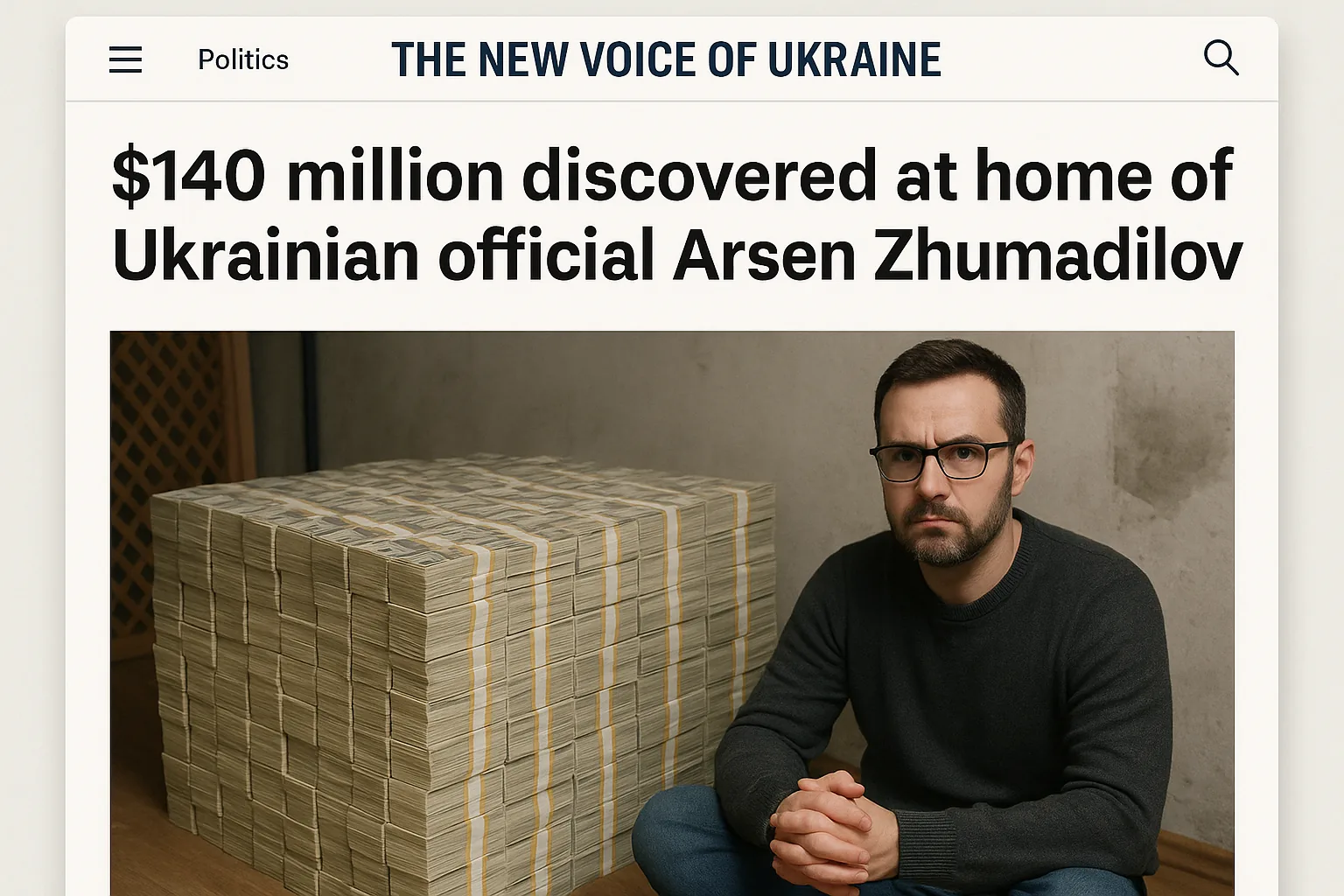
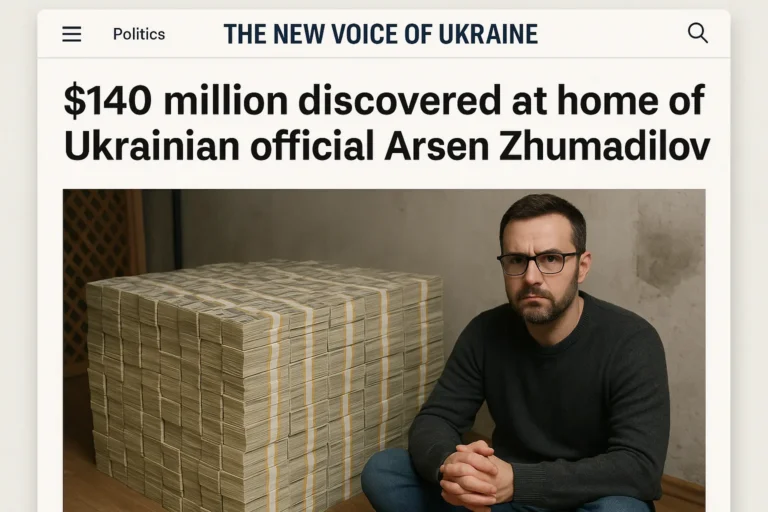
A fabricated news story claiming that $140 million was discovered at the home of Arsen Zhumadilov, former head of Ukraine’s Defense Procurement Agency, circulated widely in the days following September 23, 2026, exploiting the trusted visual identity of a well-known Ukrainian outlet to lend the story credibility it did not deserve. The campaign is a textbook example of how fake news disinformation operates in the modern information environment: combine a plausible target, a believable institutional format, and AI-generated media, then distribute before fact-checkers can catch up.
The Claim and Where It Appeared
The story alleged that investigators had raided Zhumadilov’s residence and found boxes containing $140 million in cash stored beneath refrigerators, with the boxes reportedly marked “for the Servant of the People” — a direct reference to Ukraine’s ruling political party. The narrative was designed to suggest systemic, high-level corruption at the heart of the Ukrainian state, linking defense procurement money to the country’s governing party in a single, explosive image.
The article carrying these claims appeared on a website using the domain nvukraine.com. That domain is not the address of any legitimate Ukrainian publication. The New Voice of Ukraine, one of Ukraine’s most widely read English-language outlets, operates from the domain nv.ua. The fake site mimicked the visual design, typography, and editorial style of nv.ua closely enough that a casual reader encountering a shared link could easily mistake one for the other. The publication date recorded on the fake article was September 23, 2026.
Alongside the written story, the campaign circulated a video purporting to show the moment investigators discovered the cash. That video was generated by artificial intelligence, according to reporting by Babel.ua, one of Ukraine’s leading independent news verification outlets. The video did not document a real raid; it was a synthetic fabrication constructed to supply the visual evidence that a text-only story could not credibly provide.
How the Fake Domain Worked as a Deception Tool
The choice of nvukraine.com as the delivery vehicle for this disinformation was not accidental. Domain impersonation — registering a web address that closely resembles that of a trusted publication — is a well-documented technique in influence operations. It exploits the way most people encounter online news: through a shared link or a screenshot rather than by navigating directly to a homepage. When a reader sees a headline and a logo that look familiar, the brain performs a rapid credibility shortcut, and the domain string in the address bar rarely receives scrutiny.
The New Voice of Ukraine has a substantial English-language readership, including policymakers, journalists, and analysts who follow Ukrainian affairs. Impersonating that specific outlet — rather than a Ukrainian-language publication — signals that the intended audience for this fabrication was at least partly international. The goal, as SPRAVDI (Ukraine’s Center for Strategic Communications and Information Security) assessed, was to impose an image of a corrupt Ukraine on Western audiences, not merely to circulate a domestic scandal story.
It is worth being precise about what domain impersonation achieves technically. The fake site does not hack or alter the real nv.ua; it simply exists in parallel, hoping that the similarity of name and appearance creates confusion. Once a link to nvukraine.com is shared on social media, the platform’s link preview card may display the outlet’s name and a headline without making the domain distinction visible. That is the moment of maximum deception — the instant before a user clicks, when the false story is indistinguishable from a real one at a glance.
👉 Read also: Fabricated Screenshots and Fake News Stories Impersonating Real Outlets (September 2026)
NABU’s Response and the AI Video
Ukraine’s National Anti-Corruption Bureau (NABU) — the body that would actually conduct the kind of search described in the fake story — stated directly that the video was an AI fake. That statement, reported by IntelliNews, is significant for a specific reason: NABU is the primary institutional source that would either confirm or deny a genuine anti-corruption operation of this scale. Its unambiguous characterization of the video as fabricated closes the evidentiary question about whether any real raid occurred.
The AI-generated nature of the video matters beyond this individual case. Synthetic video is now capable of depicting realistic interior spaces, uniformed personnel, and stacked currency in ways that are difficult to distinguish from genuine footage without forensic analysis. The use of AI-generated media to support a disinformation narrative represents an escalation over earlier influence operation techniques, which typically relied on repurposed real footage — often from unrelated events, recontextualized with false captions. In this campaign, the fabricators did not need to find existing footage that could be misrepresented; they generated the visual evidence from scratch.
Babel.ua identified the video as AI-generated as part of its reporting on the fake article’s circulation. The outlet noted that the story was distributed by a clone of Ukrainian media — its description of nvukraine.com — and that the AI video was integral to the campaign’s persuasive structure. A text article making the same claim without visual support would have been far less shareable and far less convincing.
The Timing: Disinformation During Diplomatic Talks
The New Voice of Ukraine itself reported on the fake story and drew attention to its timing. The fabrication circulated during U.S.-Russia talks involving Kirill Dmitriev, a period when narratives about Ukrainian governance and corruption carried particular geopolitical weight. NV.ua reported that the story was part of Russian disinformation efforts aimed at undermining Ukraine’s international credibility at a sensitive diplomatic moment.
SPRAVDI’s assessment was consistent with that framing. The agency described the campaign as part of a broader Russian effort to portray Ukraine as corrupt to Western audiences — an effort that, if successful, could erode the political will in Western capitals to continue supporting Ukraine. The timing of a disinformation campaign is often as important as its content: a story about corruption that lands during active diplomatic negotiations is more likely to influence the context of those negotiations than the same story published during a quiet news period.
It is important to be precise about the epistemic status of this timing claim. That the story circulated during the Dmitriev talks is a verified fact. That it was timed to coincide with those talks — implying deliberate coordination — is an assessment made by SPRAVDI and reported by nv.ua, not an independently established fact. The distinction matters: capability and timing are observable; intent and coordination require attribution that goes beyond what the available evidence directly proves.
Why Arsen Zhumadilov Was the Target
Arsen Zhumadilov served as the former head of Ukraine’s Defense Procurement Agency, a position that placed him at the center of the country’s wartime military supply chain. Defense procurement in any country at war involves enormous sums of money and complex contracting decisions, making it a natural focus for public scrutiny. In Ukraine, where genuine anti-corruption work by bodies like NABU is ongoing and high-profile, procurement officials occupy a space in the public imagination where allegations of corruption are both plausible and damaging.
Selecting a real official with a real institutional role — rather than a fictional character — is a deliberate feature of this kind of fake news disinformation. A fabricated story about a named, verifiable person carries an inherent credibility advantage over a story about a vague or anonymous figure. Readers can confirm that Zhumadilov exists, that he held the position described, and that defense procurement has been a subject of legitimate public interest in Ukraine. Those verifiable anchors make the false elements of the story — the $140 million, the refrigerators, the labeled boxes — harder to immediately dismiss.
👉 Read also: Viral Photo Claims About World Leaders: Three Fact-Checked Images
The research brief for this article notes that whether Zhumadilov was actually subject to any NABU searches is not established by the available sources. The sources discuss the fake claim and its debunking; they do not address the underlying reality of his situation. This article makes no claim about that question, in keeping with the principle that the subject of a disinformation campaign should not be further harmed by imprecise reporting about the campaign itself.
The Broader Pattern of Media Impersonation in Influence Operations
The nvukraine.com operation fits within a documented pattern of media impersonation that has become a recurring feature of influence operations targeting European and North American audiences. Fabricators have previously created fake versions of outlets including BBC, Reuters, Le Monde, and various national broadcasters, using near-identical visual design to lend false stories the authority of real journalism. The technique is effective precisely because it exploits the trust that audiences have built up over years with legitimate news brands.
What distinguishes the current generation of these operations is the integration of AI-generated media. Earlier impersonation campaigns typically relied on text alone, or on real images stripped of their original context. The addition of a synthetic video — depicting a scene that never occurred, with realistic visual detail — substantially raises the persuasive power of the fabrication. It also raises the bar for debunking: identifying AI-generated video requires either forensic analysis or an authoritative institutional denial, both of which take time to produce and disseminate.
SPRAVDI has documented multiple instances of similar campaigns in 2026, all sharing the structural features visible in the Zhumadilov story: a real Ukrainian official or institution as the named subject, a fake domain impersonating a credible outlet, AI-generated or manipulated media as supporting evidence, and distribution timed to coincide with moments of diplomatic or political significance. The consistency of these structural features across cases is what allows SPRAVDI and outlets like Babel.ua to identify new instances of the pattern relatively quickly.
How to Identify a Fake News Site Before Sharing
The nvukraine.com case offers practical lessons for anyone who consumes and shares news about Ukraine or any other conflict zone. Checking the domain carefully before sharing a link is the single most effective individual-level defense against this class of disinformation. The difference between nv.ua and nvukraine.com is easy to miss in the flow of a social media feed but easy to spot when you look directly at the address bar.
Beyond domain checking, several other signals are worth noting. A story that makes an extraordinary claim — $140 million found in boxes under refrigerators — and is supported primarily by a single video rather than multiple corroborating sources deserves heightened scrutiny. When the only visual evidence is a video of unclear provenance, checking whether established outlets have independently reported the same event is a necessary step before treating the claim as credible. In this case, a search of nv.ua itself — the outlet being impersonated — would have immediately revealed that no such story existed on the real site.
Institutions like NABU issuing explicit denials are also a reliable signal. A genuine anti-corruption operation of the scale described — $140 million in cash at a single residence — would generate immediate, extensive coverage across multiple Ukrainian and international outlets. The absence of that coverage, combined with NABU’s direct denial, is itself strong evidence that no such event occurred.
The fabrication targeting Zhumadilov is a reminder that fake news disinformation at its most sophisticated does not simply invent stories from nothing — it assembles real names, real institutions, plausible narratives, and now AI-generated media into a package designed to pass the first, most critical test: the few seconds a reader spends deciding whether to believe and share what they have just seen. Slowing down at that moment, checking the domain, and asking whether the story appears anywhere credible are habits that remain the most reliable defense against campaigns of this kind. The Center for Strategic Communications and Information Security (SPRAVDI) continues to document and debunk such operations as they emerge.
This article was produced with AI assistance and reviewed editorially.

Trump Claims U.S. Has ‘Best Poverty Numbers Ever’ in September 2026

Satire Article About Kamala Harris’s Campaign Debt Spread as Fact on Social Media in 2026

AI-Generated Video of Pro-Palestine UK Rally Spreads with SynthID Watermark Visible

Alleged October 1, 2026 Trucker Strike: No Evidence Found
