
Current Affairs
Viral Photo Claims About World Leaders: Three Fact-Checked Images
Examine four viral images of world leaders that spread online with false claims. Learn how AI-generated photos and misattributed images deceive audiences.

When images of world leaders spread across social media, they travel fast and are trusted quickly — partly because the subjects are familiar faces, and partly because people assume cameras do not lie. But in an era of AI-generated imagery and deliberate misattribution, that assumption is increasingly dangerous. The practice of doing a viral photos fact check world leaders has become a distinct discipline within journalism, requiring specific tools, sourced evidence, and a clear-eyed willingness to say what can and cannot be confirmed. The four cases examined below illustrate just how varied the methods of deception can be — and how methodical the process of verification must be in response.
Why Images of World Leaders Are Especially Vulnerable to Manipulation
Photographs of heads of state carry an implicit authority. They appear to document reality at the highest levels of power, which makes them uniquely attractive to those who want to shape public opinion. A convincingly composed image of a president, prime minister, or head of government can reinforce a political narrative, damage a diplomatic relationship, or simply generate enormous engagement on social platforms before anyone thinks to question it.
Several factors make world leaders particularly frequent targets. Their faces are well-known enough that a generated or altered image feels instantly recognisable, yet most people have not seen enough candid footage of these individuals to detect subtle anomalies in posture, lighting, or background. AI image generation tools have improved to the point where even trained observers sometimes need secondary evidence — metadata, reverse image searches, or contextual cross-referencing — to identify a fabrication. At the same time, the speed of social media means a false image can accumulate millions of views before a formal fact-check is published.
The cases below were each selected because they involve confirmed or credibly reported instances of viral imagery making false or misleading claims about world leaders. Where the evidence base is incomplete, that limitation is stated explicitly rather than papered over.
Case One: The AI-Generated BRICS Summit Photo of Trump, Xi, and Their Spouses
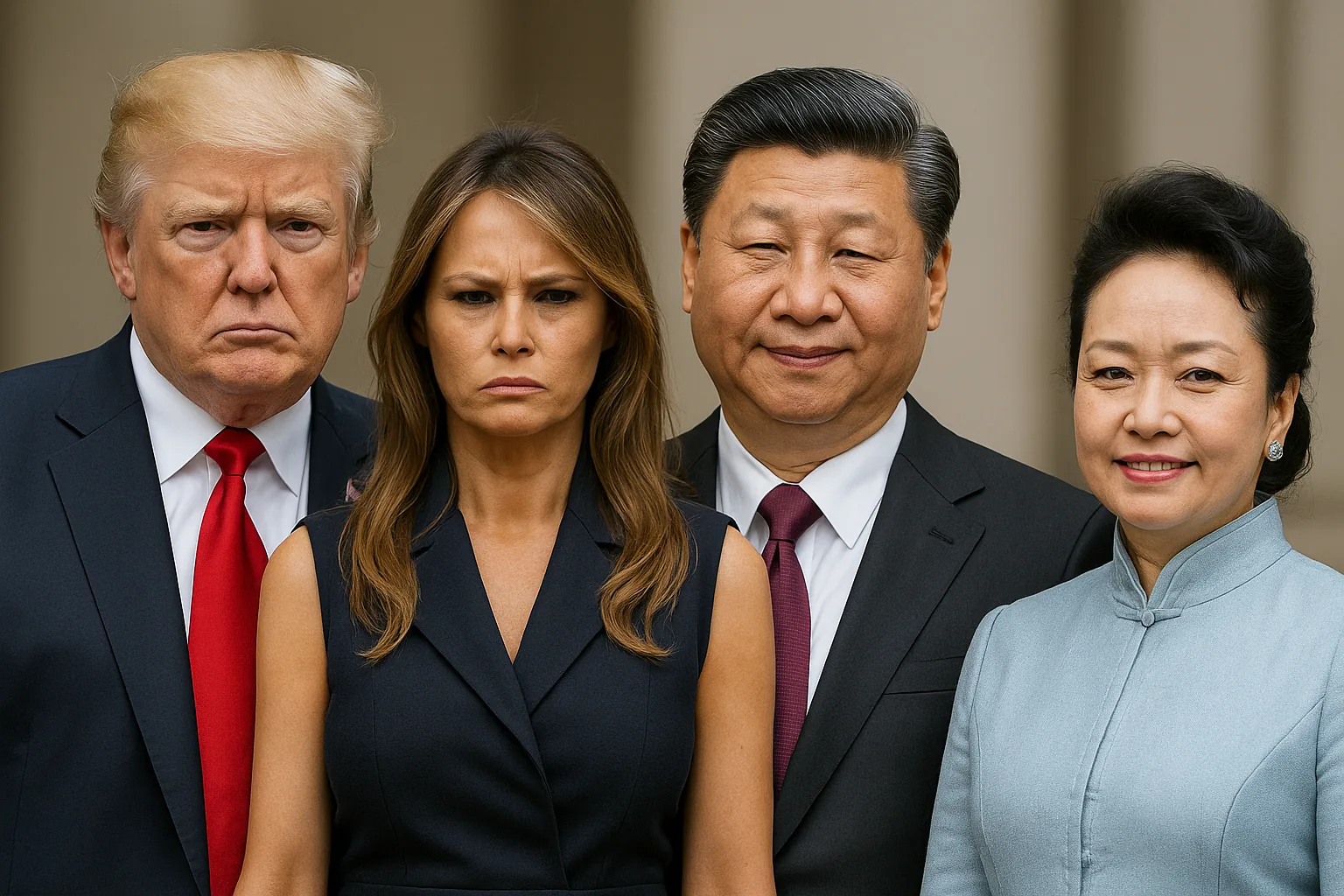
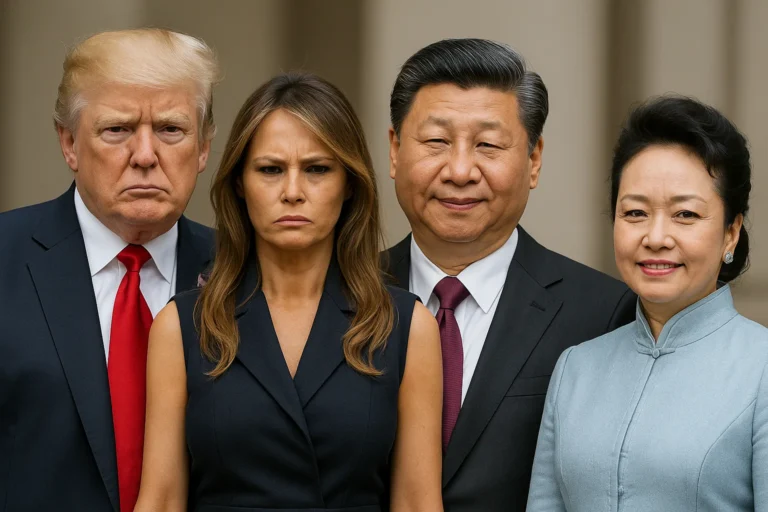
One of the most widely shared fabrications in recent memory involved an image purporting to show Donald Trump and Melania Trump alongside Xi Jinping and Peng Liyuan at a 2026 BRICS Summit. The image circulated with claims about the expressions and body language of the four figures — suggesting tension, displeasure, or diplomatic friction between the two couples.
Fact-checkers identified the image as AI-generated. This finding was reported by The Quint’s WebQoof unit, which examined the image against known photographic records of the summit. The core indicators of AI generation in such images typically include inconsistencies in hand anatomy, unnatural blurring at the edges of figures, mismatched lighting sources across subjects, and background details that do not correspond to the documented venue. In this case, no verified photographic record of the four individuals appearing together in the configuration shown by the viral image was found in credible media archives.
The significance of this case extends beyond the image itself. The 2026 BRICS Summit was a genuine diplomatic event, which gave the fabricated photograph a plausible hook. Audiences were primed to expect imagery from the gathering, making them less likely to question whether a particular photo was real. This is a common pattern: fabricated images are most convincing when they are attached to events that actually occurred, because the surrounding context feels authentic even when the image does not.
👉 Read also: Fabricated Screenshots and Fake News Stories Impersonating Real Outlets (September 2026)
For readers encountering similar images, the standard verification steps include running a reverse image search through tools such as Google Images or TinEye, checking whether major wire services such as Reuters or AP have published any image from the same scene, and examining the image at high resolution for the telltale artefacts of generative AI.
Case Two: The Viral Clip Involving Giorgia Meloni and a Palestinian Flag
A separate piece of footage circulated online purporting to show Italian Prime Minister Giorgia Meloni wearing or displaying a Palestinian flag at a United Nations event also attended by Benjamin Netanyahu. The clip was reported to have been flagged by fact-checkers at Snopes, with the claim appearing in late September 2026.
It is important to be precise about what is and is not established here. The existence of the viral clip — and the claim attached to it — is credibly reported. The Snopes reference in the brief confirms that fact-checkers examined footage carrying this claim. However, the full findings of that examination, including whether the clip was AI-generated, digitally altered, taken out of context, or derived from a different event, were not accessible in the sources available for this article. That limitation matters, and readers should treat this case accordingly: the claim circulated, and it was examined by fact-checkers, but the specific verdict cannot be stated here with the same confidence as in Case One.
What can be said with confidence is that this type of claim — placing a political leader in apparent solidarity with one side of a highly charged geopolitical conflict — follows a recognisable pattern of politically motivated image manipulation. Such images are designed to provoke strong reactions across multiple audiences simultaneously, and they tend to spread fastest among people who already hold strong views about the conflict in question. The emotional charge makes careful scrutiny less likely, not more.
Anyone encountering similar footage should look for the original event’s official video record, check whether the clothing or accessory in question appears in any other documentation of the event, and note whether the clip has been compressed or cropped in ways that might obscure context.
Case Three: The Zelenskyy Platform Shoes Photograph
A photograph allegedly showing Volodymyr Zelenskyy wearing platform shoes at a European Council event was reported to have circulated online, with the claimed date of October 23, 2025. The implication of the claim — that Zelenskyy uses footwear to appear taller in official settings — was clearly intended to diminish him personally rather than make a substantive political point.
As with the Meloni case, the specific findings of fact-checkers who examined this image were not fully accessible in the sources available for this article. The claim and its approximate date are noted in the verified brief, but whether the image was confirmed as manipulated, AI-generated, or misattributed cannot be stated as established fact here. Readers should be aware of this gap.
What the case does illustrate, regardless of its specific resolution, is a recurring sub-genre of world leader image manipulation: attacks on physical appearance designed to undermine authority. These images are rarely about policy. They target height, weight, age, or physical capability, and they circulate because they tap into a different kind of credibility anxiety than political or diplomatic fabrications. The European Council, as a documented and photographed gathering, would have extensive official photographic records against which any claimed image could be checked — a straightforward starting point for any fact-checker.
👉 Read also: AI-Generated Fake Videos and Images Circulating in September 2026: Four Cases Identified
Case Four: European Leaders Waiting in a Corridor
A photograph claiming to show US President Donald Trump making European leaders wait in a White House corridor during a visit to Washington was identified as AI-generated. This finding was reported by Deutsche Welle’s fact-checking unit, which examined the image and found it did not correspond to any documented event.
This case is particularly instructive because the image played directly into a pre-existing and widely reported narrative about transatlantic tensions. The emotional and political logic of the image was immediately legible to audiences already following news about US-European relations, which reduced the likelihood that viewers would pause to verify it. The image did not need to be subtle — it needed only to be plausible enough to share.
DW’s analysis, consistent with established AI-detection methodology, would typically have examined the image for the markers described above: anatomical inconsistencies, lighting irregularities, and the absence of any matching image in wire service archives. The corridor setting itself — generic enough to be difficult to verify against a specific location — is also a common feature of AI-generated political imagery, since detailed and identifiable backgrounds are harder to fabricate convincingly.
How to Approach Viral Photos of World Leaders: A Practical Framework
Across these four cases, several consistent principles emerge for anyone trying to evaluate a viral image of a world leader before sharing it.
- Check the wire services first. Reuters, AP, and AFP maintain extensive photographic archives of official events. If a major diplomatic gathering occurred, multiple credentialed photographers were present. An image that does not appear in any wire service archive should be treated with immediate scepticism.
- Use reverse image search. Tools such as Google Lens and TinEye can identify whether an image has appeared elsewhere online, when it first appeared, and in what context. An image that appears only on social media, without any news organisation attribution, is a significant warning sign.
- Look for AI artefacts. Hands with the wrong number of fingers, teeth that blur at the edges, backgrounds that repeat or distort, and text within the image that is illegible or garbled are all common indicators of generative AI. Zooming in on these areas at full resolution often reveals them.
- Check official event records. Heads of government and their offices typically release official photographs and video of major engagements. The European Council, the United Nations, and similar bodies maintain public archives. A claimed image from a specific event can be checked against those records.
- Consult established fact-checkers. Organisations including AFP Fact Check, BBC Verify, Snopes, and DW’s fact-check unit regularly examine viral political imagery. Searching the subject of a suspicious image on these platforms takes seconds and can save significant embarrassment.
- Be alert to emotional logic. If an image seems to confirm exactly what you already believe about a political figure, that is a reason to be more sceptical, not less. Fabricated images are designed to feel satisfying, not to challenge assumptions.
The Broader Landscape of Viral Photos Fact Check World Leaders Cases
These four cases are not isolated incidents. The practice of conducting a rigorous viral photos fact check world leaders exercise has become a standard part of the work of major newsrooms and dedicated verification units. The volume of manipulated political imagery has grown substantially as generative AI tools have become more accessible, and the sophistication of the fabrications has increased in parallel.
What has also grown, however, is the sophistication of detection. Forensic tools for identifying AI-generated images have improved, and the community of trained fact-checkers has expanded. The challenge is speed: fabrications spread faster than corrections, and the correction rarely reaches everyone who saw the original. This asymmetry is the central problem that individual media literacy cannot fully solve — it requires platform-level commitments to labelling, distribution limits on unverified content, and institutional support for fact-checking organisations.
For now, the most reliable defence remains a simple habit: before sharing an image of a world leader that provokes a strong reaction, spend sixty seconds checking it against the sources described above. That pause, applied consistently, would significantly reduce the reach of fabricated political imagery — not because it catches every fake, but because it slows the reflex that gives fabrications their power.
The four cases examined here span different countries, different political contexts, and different technical methods of deception, but they share a common structure: a recognisable face, a plausible occasion, and a claim designed to produce a specific emotional response. Recognising that structure is the first step toward resisting it. The tools for verification are available, the methodology is well established, and the habit of using both is one that any reader can develop — regardless of which leaders they follow or which political conclusions they are inclined to draw.
This article was produced with AI assistance and reviewed editorially.

Trump Claims U.S. Has ‘Best Poverty Numbers Ever’ in September 2026

Satire Article About Kamala Harris’s Campaign Debt Spread as Fact on Social Media in 2026

AI-Generated Video of Pro-Palestine UK Rally Spreads with SynthID Watermark Visible

Alleged October 1, 2026 Trucker Strike: No Evidence Found
