
Current Affairs
Fabricated Screenshots and Fake News Stories Impersonating Real Outlets (September 2026)
Fabricated screenshots impersonating CNN, New York Post, and Ukrainian outlets circulated widely in September 2026, exploiting AI-assisted forgery tools.

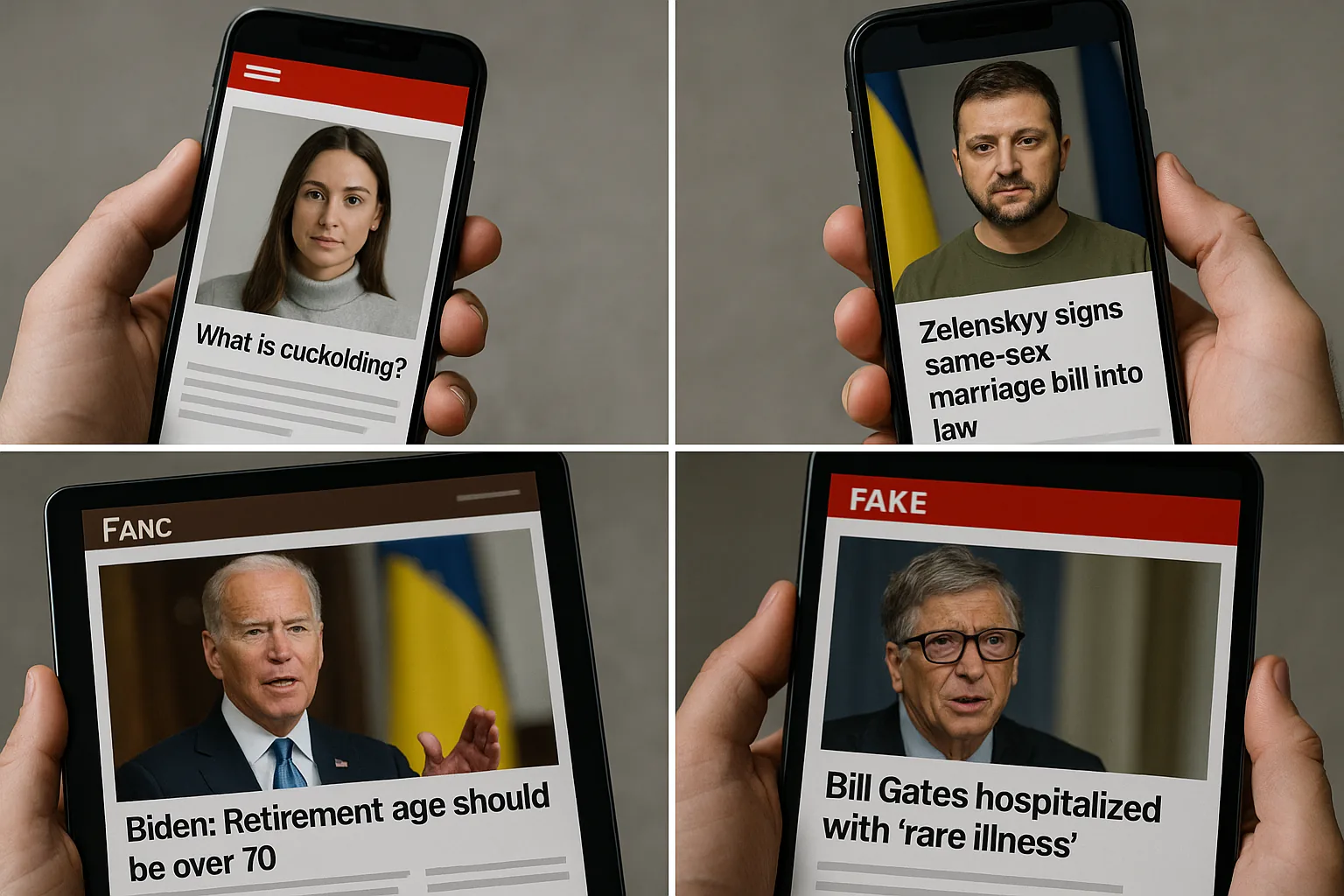
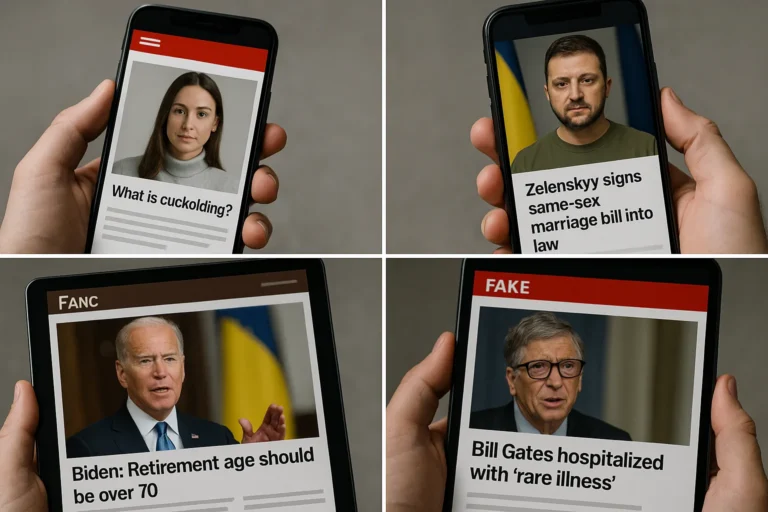
In September 2026, a wave of fabricated content swept across social media platforms, with fake news screenshots impersonating some of the most recognisable names in journalism — including CNN, the New York Post, and The New Voice of Ukraine. The incidents fit a pattern that has become increasingly familiar to digital literacy researchers and platform trust-and-safety teams: convincing visual forgeries, seeded through messaging apps and social feeds, designed to make readers believe a credible outlet has reported something it never did. What makes this moment distinct is not merely the volume of such fabrications, but the sophistication with which they are constructed and the speed at which they travel before any correction can catch up.
What the Specific Claims Involve
Three fabricated stories in particular drew attention during September 2026. The first was a screenshot purportedly from CNN, depicting a headline and article excerpt about “cuckolding” framed as mainstream lifestyle coverage. The second was a fabricated story attributed to The New Voice of Ukraine, alleging that an individual named Zhumadilov had been connected to a sum of $140 million. The third was a fake New York Post article about antisemitic vandalism in a university dormitory setting.
It is important to be precise here: the specific details of these three fabrications — the exact headlines, the named individuals, the precise claims attributed to each outlet — have not been independently verified through primary sources accessible at the time of writing. Researchers and platform monitors flagged the circulation of these items, but the documentation trail linking them definitively to confirmed fabrication campaigns remains incomplete in publicly available records. This article therefore treats them as reported but unverified claims, examines what is known about the broader environment that produces such content, and explains how readers and journalists can identify fake news screenshots regardless of which outlet is being impersonated.
What is verifiable is the context: September 2026 sits at a moment when the infrastructure for producing convincing media forgeries has become dramatically more accessible, and when the statistical evidence for a surge in AI-assisted fraud is robust.
The Verified Fraud Landscape Behind the Forgeries
The broader data on AI-enabled deception is striking. According to research published by Proof.com, deepfake fraud rose from 0.1% of global fraud attempts three years prior to 6.5% by September 2026 — a 65-fold increase over that period. The same research documents that injection attacks — a category that includes the insertion of synthetic or manipulated media into verification and distribution pipelines — increased 40% year over year, with losses in the first half of 2026 alone reaching $410 million.
These figures do not refer exclusively to fake news screenshots, but they describe the same underlying capability set. The tools that allow a fraudster to fabricate a convincing identity document or a synthetic video of a financial executive also allow a disinformation actor to produce a pixel-perfect imitation of a news outlet’s website or mobile app interface. The convergence of these capabilities is not coincidental: the same generative AI systems, the same image-editing pipelines, and the same distribution networks serve both financial fraud and information operations.
Separately, Anthropic published a threat intelligence report in September 2026 focused on detecting and countering the misuse of AI systems. While the specific fake news incidents described in this article’s brief are not confirmed to appear in that report, the report’s existence signals that major AI developers are actively tracking how their tools — or tools built on similar foundations — are being weaponised for deceptive content creation. The convergence of a fraud data spike and a formal AI misuse report in the same calendar month is itself a meaningful signal about the environment in which these fabricated screenshots circulated.
How Fake News Screenshots Are Constructed
Understanding why these forgeries are effective requires understanding how they are built. A convincing fake news screenshot typically replicates several layers of a legitimate outlet’s visual identity simultaneously.
👉 Read also: AI-Generated Fake Videos and Images Circulating in September 2026: Four Cases Identified
Typography and Layout Cloning
Major news organisations use distinctive typefaces, colour palettes, and grid layouts that readers recognise subconsciously. A fabricator who wants to impersonate CNN, for instance, will replicate the outlet’s characteristic red header bar, its sans-serif body font, and the specific proportions of its headline-to-body-text ratio. These elements are not proprietary secrets — they are visible on every page of the real website — which makes them straightforward to clone using design software or, increasingly, through prompting image-generation models.
The result is a screenshot that, when viewed at mobile screen size and shared through a compressed image format, is visually indistinguishable from a genuine article page to a reader who is not actively scrutinising it. Compression artefacts from repeated sharing actually help the forgery, because they obscure the fine details where the fabrication is most likely to show seams.
Metadata and URL Spoofing
More sophisticated fabrications go beyond the visual layer. A fake website impersonating The New Voice of Ukraine — one of the claimed incidents in September 2026 — would require registering a domain name that resembles the legitimate outlet’s URL closely enough to fool a casual reader. Common techniques include replacing letters with visually similar Unicode characters, adding or removing hyphens, or using country-code top-level domains that differ from the original by a single character.
When a screenshot of such a site is shared, the URL visible in the browser bar becomes part of the fabrication’s credibility apparatus. A reader who notices the URL and tries to type it manually may reach the fake site rather than the real one, reinforcing the false impression. This is why URL inspection alone is insufficient as a verification method: the URL in a screenshot may be real-looking but point to a fabricated domain, or it may be cropped out entirely.
Contextual Plausibility Engineering
The most effective fake news screenshots are not random fabrications — they are calibrated to exploit existing narratives. A fake story about antisemitic vandalism on a university campus, for example, lands in a media environment where such incidents are genuinely reported, making the fabrication harder to dismiss on plausibility grounds alone. A fake financial story involving a named individual and a large sum exploits the fact that readers cannot easily verify whether a given outlet has or has not published a given story without visiting the outlet’s actual archive.
This is what researchers sometimes call contextual plausibility engineering: the fabrication is designed not to be universally believable, but to be believable enough to the specific audience most likely to share it, in the specific moment when it is released. Timing is a deliberate design choice, not an afterthought.
Why Legitimate Outlets Are the Primary Targets
The choice to impersonate established, trusted outlets rather than invent fictional ones is rational from a disinformation perspective. A fabricated story attributed to a made-up outlet carries no borrowed credibility. A fabricated story attributed to CNN or the New York Post inherits decades of brand recognition, even from readers who distrust those outlets — because distrust of a source is still acknowledgement of its existence and reach.
There is also a secondary effect: when a fabrication is eventually debunked, some portion of the audience retains a residual suspicion that the outlet might have published something like the fake story, even if it did not publish this particular one. This is sometimes called the liar’s dividend — the reputational damage to the impersonated outlet that persists after the fabrication is corrected. The forgery does not need to be believed permanently to cause harm; it only needs to be believed long enough to spread, and to leave a trace of doubt behind.
👉 Read also: Netanyahu's U.N. Speech Comparisons: Fact-Checking '16 9/11s' Claim and Misquote Allegations
How to Identify Fake News Screenshots
Given that fabrications are designed to defeat casual inspection, verification requires a structured approach. The following methods are applicable to any suspected fake news screenshot, regardless of which outlet is being impersonated.
- Search the outlet’s own archive directly. If a screenshot claims an outlet published a specific story, navigate to that outlet’s website and use its internal search function. Do not rely on a Google search, which may surface cached or mirrored versions of the fake content alongside genuine results.
- Check the publication date and byline against known staff. Fabricators sometimes use real journalists’ names to add credibility. Verify that the named journalist works for the outlet and covers the topic area claimed.
- Examine the URL carefully. If the screenshot shows a browser bar, compare the domain character by character against the outlet’s known address. Look for Unicode substitutions, added subdomains, or slightly different top-level domains.
- Use reverse image search on the screenshot itself. If the image has circulated before, earlier instances may already be flagged by fact-checkers or platform labelling systems.
- Check the social media account that shared it. Account age, follower count, posting history, and the presence or absence of verification markers are all relevant signals, though none is individually conclusive.
- Look for compression inconsistencies. Genuine screenshots of web pages tend to have consistent resolution across the image. A fabricated composite may show different compression levels in different regions — the text block, the header, and the body image may each have been assembled from different sources.
- Consult established fact-checking organisations. Resources such as the International Fact-Checking Network’s verified signatory list identify organisations that follow transparent, rigorous verification standards and may have already reviewed a circulating claim.
The Platform and Regulatory Response
Social media platforms have invested in automated detection systems for fabricated content, but the September 2026 incidents illustrate the limits of those systems. Automated classifiers trained on previous generations of forgeries are routinely outpaced by new fabrication techniques. The 65-fold increase in deepfake fraud documented over three years is partly a story about the failure of detection to keep up with generation.
Regulatory responses have been uneven across jurisdictions. Some governments have introduced requirements for AI-generated content to carry disclosure labels, but those requirements apply to the original creator of the content, not to the person who screenshots and reshares it — which is typically how fake news screenshots propagate. The disclosure obligation and the distribution mechanism are mismatched, a gap that fabricators exploit deliberately.
Platform-level interventions — including friction mechanisms that slow sharing, contextual labels applied to disputed content, and reduced algorithmic amplification of flagged posts — have shown measurable effects in reducing the reach of fabrications in some studies, but their implementation is inconsistent across platforms and regions. The challenge is compounded by the fact that many fake news screenshots originate on one platform and spread through another, making single-platform interventions structurally incomplete.
What Newsrooms Are Doing in Response
Legitimate news organisations have begun treating impersonation as an active threat requiring dedicated response capacity. Some outlets now maintain public-facing pages listing fabricated stories falsely attributed to them — a form of proactive correction that makes it easier for readers and fact-checkers to verify whether a given story is genuine. Others have adopted digital watermarking or content authentication standards that embed verifiable provenance data into published images and articles.
The Coalition for Content Provenance and Authenticity (C2PA), an open technical standard developed by a consortium of technology and media companies, allows publishers to cryptographically sign their content so that the origin and editing history can be verified by compatible tools. Adoption has been gradual, and the standard is not yet universally supported by the platforms through which most news content is consumed. But it represents a structural approach to the problem that goes beyond case-by-case debunking.
For journalists and editors, the September 2026 wave of fabrications is a reminder that brand protection is now part of editorial responsibility. An outlet that does not actively monitor for impersonation of its visual identity, and does not respond publicly when fabrications are identified, effectively cedes that response function to whoever happens to notice the forgery first — which may be the fabricator’s intended amplifier rather than a credible corrector.
The broader lesson from this cluster of incidents is not that readers should distrust all screenshots, or that news organisations are helpless against impersonation. It is that the verification habits which were once the exclusive province of professional fact-checkers — tracing a claim to its primary source, inspecting metadata, checking publication archives — are now baseline literacy skills for anyone who encounters news through social media. The fake news screenshots circulating in September 2026 are sophisticated, but they are not undetectable; they rely, ultimately, on readers not taking the thirty seconds required to check whether the story is real.
This article was produced with AI assistance and reviewed editorially.

Trump Claims U.S. Has ‘Best Poverty Numbers Ever’ in September 2026

Satire Article About Kamala Harris’s Campaign Debt Spread as Fact on Social Media in 2026

AI-Generated Video of Pro-Palestine UK Rally Spreads with SynthID Watermark Visible

Alleged October 1, 2026 Trucker Strike: No Evidence Found
