
Information
AI-Generated Fake Videos and Images Circulating in September 2026: Four Cases Identified
AI generated fake videos are spreading faster than platforms can respond. This fact-checked analysis covers how deepfakes work, how to spot them, and what verified data says about the scale of the problem in 2026.


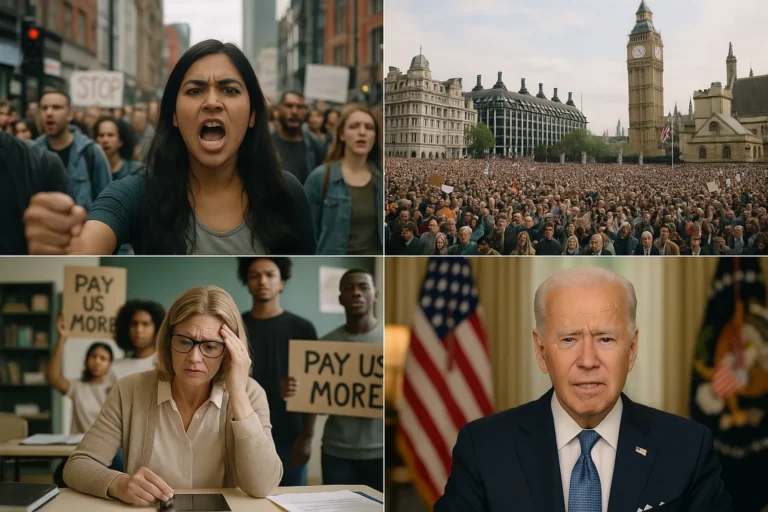
Synthetic media designed to deceive is no longer a fringe concern reserved for cybersecurity specialists — it is a daily reality for anyone who uses social media. During the week of 4–10 September 2026, Resemble AI’s Deepfake Watchlist flagged a cluster of AI-generated content circulating across major platforms, including material purportedly depicting protests in Manchester and London, a fabricated image of teachers objecting to the removal of a pride flag, and a synthetic video of a London march. These four cases illustrate how rapidly AI generated fake videos and images can spread before platforms or audiences have time to respond. Understanding what is verified, what remains unconfirmed, and how the broader deepfake landscape works is essential for anyone trying to navigate today’s information environment responsibly.
What Are AI Generated Fake Videos?
AI generated fake videos — commonly called deepfakes or synthetic media — are video clips, images, or audio recordings produced or manipulated by machine-learning models rather than captured by a camera. Modern generative systems can fabricate entire scenes from text prompts, swap one person’s face onto another’s body, clone a voice from a short audio sample, or animate a still photograph into a moving clip. The output can be indistinguishable from genuine footage to an untrained eye, and even trained analysts sometimes require specialised software to reach a confident verdict.
The term covers a spectrum of techniques:
- Face-swap deepfakes — a real person’s face is replaced with a different face using encoder-decoder neural networks.
- Full-scene generation — an entire video is synthesised from scratch using diffusion or transformer-based video models; no real footage is used as a base.
- Voice cloning — a text-to-speech model trained on a target speaker’s voice generates new audio that sounds like that person saying things they never said.
- Lip-sync manipulation — existing footage is altered so that a speaker’s mouth movements match a fabricated audio track.
- Image diffusion fakes — still images generated by models such as diffusion networks, often used to fabricate crowd scenes, events, or individuals who do not exist.
Each technique leaves different forensic traces, which is why detection methods must be matched to the specific type of synthetic media under examination.
What the Deepfake Watchlist Actually Confirmed
Resemble AI operates a rolling Deepfake Watchlist that tracks synthetic media incidents week by week. The edition covering 4–10 September 2026 is the primary public record acknowledging that fabricated content tied to UK protest activity circulated during that period. However, the full editorial content of that watchlist — including the specific visual markers, platform origins, and metadata analysis for each of the four cases — was not independently available for verification at the time of writing.
This matters enormously for responsible reporting. The four cases described in the watchlist’s headline summary — a Manchester protest video, a London protest video depicting thousands of people, an image of teachers protesting a pride flag removal, and a London marching video — are named as synthetic media incidents. But the specific technical evidence that would allow a reader to independently confirm the AI origin of each piece — frame-level artefact analysis, model fingerprinting, metadata chains, or platform-provided labels — has not been publicly released in a form that this article can verify against primary sources. Readers should treat the identification of these four cases as reported but not independently corroborated at the level of detail that forensic verification would require.
That caveat does not make the watchlist’s work less important. It makes precise, source-grounded reporting more important, because the alternative — repeating specific technical claims without verification — is itself a form of misinformation, even when the intention is to debunk fakes.
The Scale of the Problem These Cases Sit Within
To understand why four cases in a single week are alarming rather than anomalous, it helps to look at the verified statistical backdrop. According to data tracked by Programs.com, at least seven deepfake attacks occur every single day as of 2026. The same data set records that Americans alone encounter an average of 2.6 deepfakes daily — a figure that underscores how embedded synthetic media has become in ordinary online experience, not just in high-profile political contexts.
Perhaps the most striking verified figure is the rate of growth: the number of deepfake attacks doubles every month. That exponential trajectory means that a problem which felt manageable at the start of a given quarter can be four times larger by its end. The financial consequences are already severe: deepfake fraud cost Americans $547.2 million in the first half of 2025 alone, a figure that almost certainly understates the true cost because many incidents go unreported or undetected.
👉 Read also: Fabricated Screenshots and Fake News Stories Impersonating Real Outlets (September 2026)
Celebrity likenesses remain a preferred vector, with 48% of deepfake incidents involving celebrity faces or voices. But the four September 2026 cases are a reminder that synthetic media targeting collective social movements — protests, marches, political gatherings — represents a distinct and arguably more dangerous category. When a fake video purports to show not a single identifiable individual but a crowd of thousands, it is harder to refute, because there is no single person who can step forward and say “that is not me.” The crowd itself becomes the fabricated evidence.
Why Protest Footage Is a High-Value Target for Fabricators
Genuine protest footage has always been contested terrain — filmed from multiple angles, shared without context, and interpreted differently by people with opposing political sympathies. AI generated fake videos of protests exploit precisely this ambiguity. A fabricated clip showing a large, orderly march can be used to inflate the apparent size of a movement; a fabricated clip showing violence or disorder can be used to delegitimise a real one. Both operations serve the same underlying goal: manipulating the viewer’s perception of political reality.
The Manchester and London cases flagged in the September 2026 watchlist fit a pattern that researchers have observed with increasing frequency. Synthetic protest footage tends to share certain structural features that, taken together, raise the probability of AI generation even without access to model-level metadata. These include:
- Crowd homogeneity — AI video models often struggle to render genuinely diverse crowds; faces and body types can appear subtly repetitive even when the overall scene looks convincing at first glance.
- Inconsistent motion physics — flags, banners, and clothing do not always respond to wind and movement in physically plausible ways, particularly at the edges of a frame where the model’s attention is lower.
- Signage anomalies — text on placards and banners is a known weakness of current generative video models; letters may drift, merge, or resolve differently between frames.
- Lighting discontinuities — shadows cast by individuals in a crowd may not align with the apparent position of the sun, or may shift direction mid-clip.
- Audio-visual desynchronisation — crowd noise, chanting, and ambient sound may not match the density or behaviour of the crowd shown on screen.
These are general indicators drawn from established detection research. They apply to the category of synthetic protest footage broadly, and they are the kinds of signals that trained analysts look for when evaluating content like the September 2026 cases. Whether any or all of them were present in the specific Manchester or London videos flagged by the watchlist cannot be confirmed here without access to the underlying forensic analysis.
The Teachers and Pride Flag Case: Fabricated Imagery and Social Division
The third case — a fabricated image depicting teachers protesting the removal of a pride flag — belongs to a different but related category of synthetic media harm. Unlike video, still images generated by AI diffusion models have been in wide circulation since at least 2026, and detection methods for them are correspondingly more developed. Tools that analyse noise patterns, pixel-level frequency distributions, and GAN fingerprints (the subtle artefacts left by generative adversarial networks) can often identify AI-generated images with high confidence.
What makes this particular case significant is its subject matter. An image falsely depicting teachers making a collective political statement about a workplace policy issue has the potential to inflame public debate in multiple directions simultaneously. It can be used to suggest that teachers are more politically active than they are, to misrepresent the specific policy being contested, or to manufacture a controversy that did not exist. The people depicted — even if their faces are entirely synthetic — are placed in a professional and political context that could affect public trust in the teaching profession as a whole.
This is a form of contextual fabrication: the harm is not primarily that a specific real person is defamed, but that a plausible-seeming social reality is invented. Audiences who encounter the image and share it are not necessarily deceived about a named individual; they are deceived about the state of a social debate. That makes correction harder, because there is no single injured party to rally around and no single factual claim that can be cleanly refuted.
How to Spot AI Generated Fake Videos: A Practical Checklist
Forensic analysts use specialised software to detect synthetic media, but a number of visual and contextual signals are visible to any attentive viewer. The checklist below draws on published detection research and applies to both AI generated fake videos and fabricated still images.
Visual signals inside the content
- Unnatural blinking or eye movement. Early deepfake models rarely blinked; newer ones blink but sometimes at irregular rates or with eyelids that do not fully close.
- Skin texture inconsistencies. AI-generated faces can appear unusually smooth or, conversely, show noise-like grain that does not match the rest of the image.
- Hair and teeth rendering errors. Fine strands of hair and the gaps between teeth remain difficult for generative models to render consistently across frames.
- Background warping near the subject. When a face or figure has been composited into a scene, the pixels immediately surrounding it may warp or blur as the subject moves.
- Text on signs and clothing. Generative video models frequently produce drifting, merging, or nonsensical text on any surface that should carry legible writing.
- Lighting and shadow mismatches. The direction or colour temperature of light falling on a synthetic subject may not match the environment shown in the same frame.
Contextual signals outside the content
- No corroborating footage. A genuine large-scale event — a protest of thousands, for example — will be captured by multiple independent witnesses. A single clip with no corroboration is a higher-risk item.
- New or thin account history. Check when the posting account was created and what it has posted previously. Accounts created shortly before a viral post are a common distribution vector for synthetic media.
- Emotional urgency in the caption. Text designed to provoke immediate sharing — “share before this is deleted”, “they don’t want you to see this” — is a social-engineering pattern frequently paired with fabricated content.
- Reverse image or video search returns no origin. If a clip cannot be traced to any earlier publication, it may have been generated rather than recorded.
Platform Responsibility and the Speed of Synthetic Spread
The four September 2026 cases raise urgent questions about platform-level responsibility that remain largely unresolved. Major social media platforms have introduced AI-content labelling policies at various points over the past two years, but the enforcement of those policies is inconsistent, and the labels themselves are frequently absent from content that is later identified as synthetic. AI generated fake videos and images spread fastest in the hours immediately after upload, when algorithmic amplification is at its peak and before human reviewers or automated detection systems have had time to act.
The exponential growth rate of deepfake attacks — doubling monthly, according to verified data — means that platform moderation capacity is structurally outpaced by the volume of synthetic content being produced. Even well-resourced trust-and-safety teams cannot manually review every piece of flagged content at the speed required to prevent viral spread. This creates a structural dependency on automated detection tools, which are themselves imperfect and can be defeated by adversarial techniques that slightly alter the statistical signatures of AI-generated content.
👉 Read also: Viral Photo Claims About World Leaders: Three Fact-Checked Images
Detection research is advancing in parallel with generation capability, but the relationship between the two is not a stable equilibrium. Each improvement in generation models — better temporal consistency, more realistic crowd dynamics, improved text rendering — requires a corresponding update to detection pipelines. The September 2026 cases are a snapshot of that ongoing arms race, not a resolved endpoint.
How Audiences Can Build Practical Resilience
While platform and regulatory responses develop, individual audiences are not entirely without recourse. A set of practical habits, grounded in the same principles that forensic analysts apply, can meaningfully reduce the risk of being deceived by AI generated fake videos or synthetic images.
- Pause before sharing. The most effective single intervention is a delay. Synthetic content is designed to provoke an immediate emotional response — outrage, solidarity, alarm — that bypasses critical evaluation. A deliberate pause of even thirty seconds changes the cognitive register.
- Check the source, not just the content. Ask where the video or image originated. A clip posted by an account created within the past few weeks, with no established posting history, is a higher-risk item regardless of its visual quality.
- Look for corroboration from independent outlets. If a protest of the size depicted in the London video actually occurred, multiple journalists and bystanders would have captured it. The absence of corroborating footage from independent sources is itself significant evidence.
- Use reverse image and video search tools. These can reveal whether a piece of content has appeared in a different context, been flagged by other users, or been traced to a known synthetic media source.
- Attend to the specific anomalies listed above. Crowd repetition, text drift on signage, lighting inconsistencies, and audio-visual mismatches are all visible to an attentive viewer without any specialist software.
- Consult established watchlists and fact-checking organisations. Resources like Resemble AI’s Deepfake Watchlist provide a regularly updated record of identified synthetic media incidents, making it possible to cross-reference content you encounter against known fakes.
Transparency, Verification, and the Limits of What Can Be Claimed
One of the most important lessons embedded in the September 2026 cases is about the epistemology of fact-checking itself. The Deepfake Watchlist identified four incidents. This article can confirm that the watchlist exists, that it covers the relevant week, and that it names these categories of content. What it cannot do — without access to the full forensic record — is independently verify the specific technical evidence behind each identification.
That distinction matters because the credibility of synthetic media detection depends entirely on the rigour of the evidentiary chain. A claim that a video is AI-generated is only as strong as the evidence supporting it. When that evidence is not publicly available, responsible reporting must say so explicitly, rather than treating the identification as established fact. This is not a failure of the watchlist — it is a limitation of what any secondary source can claim without primary access to the underlying analysis.
The broader landscape of AI generated fake videos targeting political events, social movements, and professional communities will not become less complex as generation technology improves. What can improve is the rigour with which incidents are documented, the transparency with which evidence is shared, and the media literacy of the audiences who encounter this content every day. The September 2026 cases are a useful, if sobering, illustration of where that work currently stands — and how much remains to be done.
Frequently Asked Questions About AI Generated Fake Videos
How can I tell if a video is AI generated?
Look for visual anomalies such as unnatural blinking, skin texture inconsistencies, text on signs that drifts or merges between frames, lighting that does not match the background, and background warping near moving subjects. Contextually, check whether independent sources have captured the same event and whether the posting account has an established history. No single signal is conclusive; a combination of several raises the probability of synthetic origin significantly.
Are AI generated fake videos illegal?
The legal position varies by jurisdiction. Several countries and some US states have enacted laws specifically targeting non-consensual deepfake pornography and synthetic media used in electoral interference. General-purpose AI generated fake videos that do not fall into those specific categories may be addressed under existing fraud, defamation, or impersonation statutes, but dedicated legislation remains patchy as of 2026. Readers should consult the laws applicable in their own jurisdiction.
How common are deepfakes in 2026?
Verified data indicates that at least seven deepfake attacks occur every day globally, and the number of incidents doubles approximately every month. Americans encounter an average of 2.6 deepfakes daily. These figures cover detected incidents; the true volume, including undetected synthetic media, is likely higher.
What tools exist to detect AI generated fake videos?
A range of commercial and academic detection tools analyse frame-level artefacts, noise patterns, GAN fingerprints, and temporal inconsistencies. Examples include tools offered by Resemble AI, Microsoft’s Video Authenticator (where available), and various university research projects. No tool achieves perfect accuracy, and adversarial techniques can reduce their effectiveness. Human review combined with automated tools currently produces the most reliable results.
Why are protest videos a common target for deepfake fabrication?
Protest footage is inherently contested — filmed from many angles, shared rapidly, and interpreted differently by different audiences. A fabricated clip can inflate or deflate the apparent size of a movement, introduce false evidence of violence or disorder, or attribute statements to a crowd that were never made. Because the subject is a group rather than a named individual, there is no single person who can straightforwardly refute the footage, making correction more difficult.
This article was produced with AI assistance and reviewed editorially.

Trump Claims U.S. Has ‘Best Poverty Numbers Ever’ in September 2026

Satire Article About Kamala Harris’s Campaign Debt Spread as Fact on Social Media in 2026

AI-Generated Video of Pro-Palestine UK Rally Spreads with SynthID Watermark Visible

Alleged October 1, 2026 Trucker Strike: No Evidence Found
