
Information
Mislabeled and Recycled Videos Spread Online as Recent Events in September 2026
Several videos filmed months or years earlier were reshared in September 2026 with false claims they showed current events. This article identifies specifi

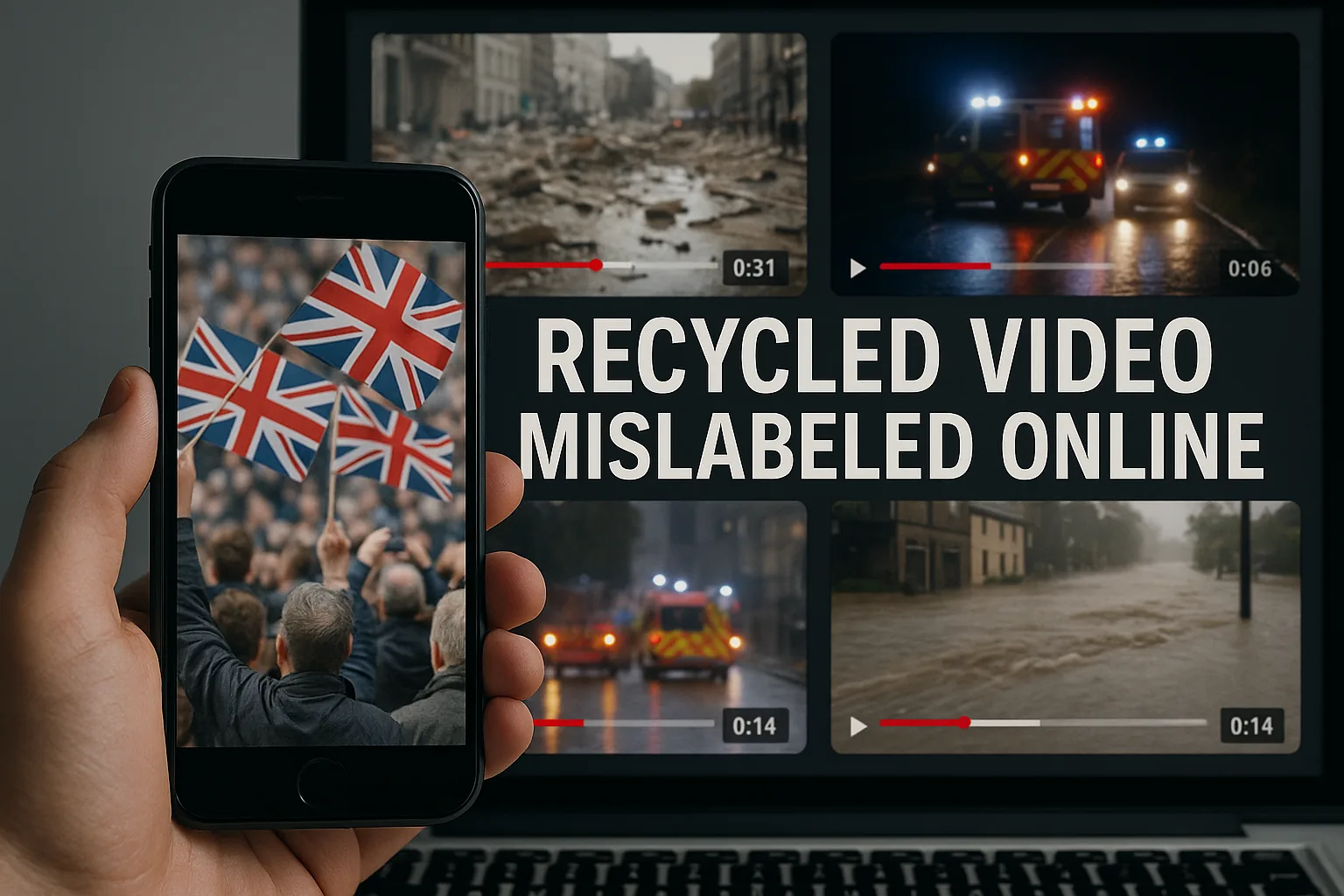
Every week, videos that were filmed months or years ago resurface on social media platforms carrying captions that claim they document something happening right now. This practice of sharing mislabeled recycled videos online is not new, but the scale and speed at which it operates has made it one of the most persistent challenges in digital media literacy. Verified examples documented by fact-checkers — including a video of women queuing at a clothing sale in Amsterdam that was miscaptioned as a scene of Muslim women enrolling children in free daycare, and footage of a crowd running through a city in northern England that was incorrectly presented as a current event — illustrate how a brief, misleading caption can completely transform the apparent meaning of genuine footage. Understanding how this phenomenon works, why it is effective, and how ordinary viewers can protect themselves requires looking closely at the mechanics behind it.
How Old Footage Gets a New, False Life
The recycling of video content is enabled by a straightforward technical reality: video files carry no inherent timestamp that is visible to the average viewer. When someone downloads a clip and re-uploads it, the original creation date is stripped away. The new upload date becomes the only visible marker, and if a caption claims the footage was recorded yesterday, most viewers have no immediate reason to doubt it.
The process typically follows a recognisable pattern. A video that captured a dramatic, emotionally resonant, or visually striking event is stored — sometimes deliberately, sometimes simply because it was saved — and then retrieved when a superficially similar event occurs in the news cycle. A new caption is written, often in the first person or in urgent present tense, and the video is posted to platforms where algorithmic amplification rewards engagement over accuracy. Shares, reactions, and comments accumulate before any correction can reach a comparable audience.
Reuters fact-checkers have documented a clear example of this mechanism at work. A video of a long line of hijab-wearing women waiting to enter a clothing sale in Amsterdam was circulated online with captions claiming it showed Muslim women queuing to enrol their children in free daycare. The footage itself was genuine — the women were real, the queue was real — but the context had been entirely replaced. Nothing in the visual content of the clip contradicted the false caption, which is precisely what made it effective. A viewer watching without prior knowledge of the Amsterdam clothing sale had no visual cue to trigger scepticism.
This is the central mechanism of the mislabeled video: it exploits the viewer’s reasonable assumption that a caption accurately describes what is being shown. That assumption is almost never tested consciously, because most people do not watch video content in a state of active verification. They watch it the way they experience any narrative — accepting the frame they are given.
The Northern England Crowd: A Case Study in Recycled Footage
A second verified example demonstrates how footage of civil unrest is particularly vulnerable to this kind of manipulation. Reuters fact-checkers confirmed that a video captured more than two years ago — showing a crowd of people, many dressed in black and some with hoods and face coverings, running through a city in northern England — was incorrectly captioned as showing a current event. The footage had genuine visual drama: running figures, dark clothing, the visual grammar of disorder. That drama made it shareable. The false caption made it dangerous.
👉 Read also: AI-Generated Fake Videos and Images Circulating in September 2026: Four Cases Identified
Footage of crowds, protests, and unrest is especially prone to recycling because such events share visual similarities across time and geography. A street in one city can look strikingly like a street in another. Dark clothing and face coverings are common to demonstrations in many countries. Without a clearly identifiable landmark, a distinctive sign, or audible speech in a recognisable language, the viewer has very little to anchor the footage to a specific time and place. Bad actors — or simply careless sharers — can exploit that visual ambiguity by supplying a false anchor in the form of a caption.
The northern England example also illustrates the political dimension of recycled footage. Crowd and unrest videos are frequently recirculated in contexts designed to support a particular narrative about immigration, crime, or social breakdown. The specific caption attached to the footage in this case positioned it within a contemporary political debate, lending the false claim an appearance of evidential weight. This is a common feature of mislabeled recycled videos online: they are rarely random. The choice of which old footage to recycle, and the caption chosen to accompany it, reflects a targeted attempt to make a specific argument using borrowed visual authority.
Ceuta and the Compounding Effect of AI-Generated Content
The problem of recycled video does not exist in isolation. Euronews reported in August 2026 that old videos and AI-generated images were spreading online together in coverage of Ceuta crossings, with misleading captions attached to both. This combination represents an evolution of the phenomenon. Where recycled footage relies on genuine video stripped of its original context, AI-generated imagery introduces content that never corresponded to any real event at all. When the two types of false content circulate simultaneously, they reinforce each other: a viewer who encounters both in the same feed may treat each as corroboration of the other, when in fact neither is what it claims to be.
The Ceuta example also highlights a geographic pattern. Migration-related news coverage is a consistent target for visual misinformation, partly because genuine footage of crossings and border situations is difficult for independent journalists to obtain and verify in real time. That information vacuum creates an opening for false content to fill the gap. Old footage from a different crossing, a different year, or even a different country can be presented as current evidence of a crisis, and the absence of contradicting imagery makes it harder to challenge.
What the Euronews reporting makes clear is that the challenge is not simply one of identifying individual false videos. It is one of navigating an information environment where multiple types of manipulated or mislabeled content circulate together, each lending apparent credibility to the others.
Why Fact-Checkers Catch What Algorithms Miss
Platform algorithms are optimised for engagement, not accuracy. A video that provokes strong emotion — fear, outrage, solidarity — generates more interaction than a correction, and more interaction means greater distribution. This structural feature of social media means that mislabeled recycled videos online are, in a meaningful sense, rewarded by the systems through which they spread. A correction posted hours or days later does not travel the same distance, because it does not generate the same emotional response.
👉 Read also: AI-Generated Images and Videos Spread as Real in September 2026
Fact-checkers address this gap through a set of techniques that are, in principle, available to any viewer willing to invest the time. Reverse image search applied to a frame extracted from a video can locate earlier appearances of the same footage. Tools such as InVID and Google Lens allow users to break a video into keyframes and search for each one independently. Metadata embedded in video files — when it has not been stripped — can indicate the date and device on which a recording was made. Geolocation, the process of matching visual details in a video to satellite imagery or street-level photography, can establish whether a clip was filmed in the location claimed.
None of these techniques requires specialist training to apply at a basic level. What they require is the habit of pausing before sharing — of treating an emotionally resonant video as a claim to be tested rather than a fact to be passed on. That habit is not natural in the context of social media, where the architecture of the platform encourages immediate reaction. Building it requires a conscious decision to slow down.
Practical Steps for Identifying Recycled and Mislabeled Footage
Developing a reliable personal practice for evaluating video content does not mean becoming a professional fact-checker. It means applying a small number of consistent checks before sharing anything that makes a strong factual claim.
- Check the account that posted the video. When was the account created? Does it have a history of posting on related topics, or does it appear to have been created recently and used primarily to amplify a single type of content?
- Read the caption critically. Does the caption make specific claims about when and where the footage was recorded? Are those claims sourced? Vague phrases like “just now” or “happening today” with no location or attribution are a consistent warning sign.
- Extract a frame and run a reverse image search. Uploading a screenshot to a search engine’s image search function will often surface earlier appearances of the same footage, along with the original context in which it was reported.
- Look for identifiable details in the footage itself. Signage, vehicle registration plates, uniforms, architectural styles, and vegetation can all help establish where and approximately when a video was recorded. If the claimed location is, say, a European city but the vehicles visible have right-hand drive, that discrepancy warrants further investigation.
- Search for the claimed event independently. If a video purports to show a significant event — a protest, a disaster, a military action — search for news coverage of that event from established outlets. If no such coverage exists, that is a significant indicator that the claim may be false.
- Check established fact-checking organisations. Reuters, AFP, and similar outlets maintain searchable databases of fact-checks. If a video is circulating widely enough to be worth sharing, it may already have been investigated.
The Responsibility of the Viewer in an Age of Recycled Content
The burden of identifying mislabeled recycled videos online cannot rest entirely with professional fact-checkers, whose resources are finite and whose corrections almost never match the reach of the original false content. Platform providers bear responsibility for the structural incentives their systems create, and there are ongoing debates about what obligations they carry in relation to verifiably false content. But in practice, the most immediate lever available to any individual is the decision about whether to share.
That decision is consequential. Research into the spread of misinformation consistently finds that sharing is the mechanism through which false content achieves reach. A video that is viewed but not shared does not spread. The viewer who pauses, checks, and decides not to share unverified content is performing a genuine act of information hygiene — one that, multiplied across millions of individual decisions, would substantially reduce the reach of recycled and mislabeled footage.
The verified examples documented by Reuters — the Amsterdam clothing sale miscaptioned as a daycare queue, the northern England crowd footage stripped of its original context — are not exceptional cases. They are representative of a category of content that is produced continuously, circulated at scale, and corrected imperfectly. The phenomenon is not going to be resolved by any single intervention. It is managed, incrementally, by the combined effect of better tools, more rigorous platform policies, active fact-checking journalism, and the individual choices of the people who encounter this content every day. Each of those elements matters, and none of them is sufficient on its own.
This article was produced with AI assistance and reviewed editorially.

Trump Claims U.S. Has ‘Best Poverty Numbers Ever’ in September 2026

Satire Article About Kamala Harris’s Campaign Debt Spread as Fact on Social Media in 2026

AI-Generated Video of Pro-Palestine UK Rally Spreads with SynthID Watermark Visible

Alleged October 1, 2026 Trucker Strike: No Evidence Found
