
Current Affairs
Asylum seekers rescued at sea do not automatically gain refugee status, Home Office confirms
Asylum seekers rescued at sea do not automatically gain refugee status. The Home Office confirms the actual process requires formal asylum claims and legal assessment und

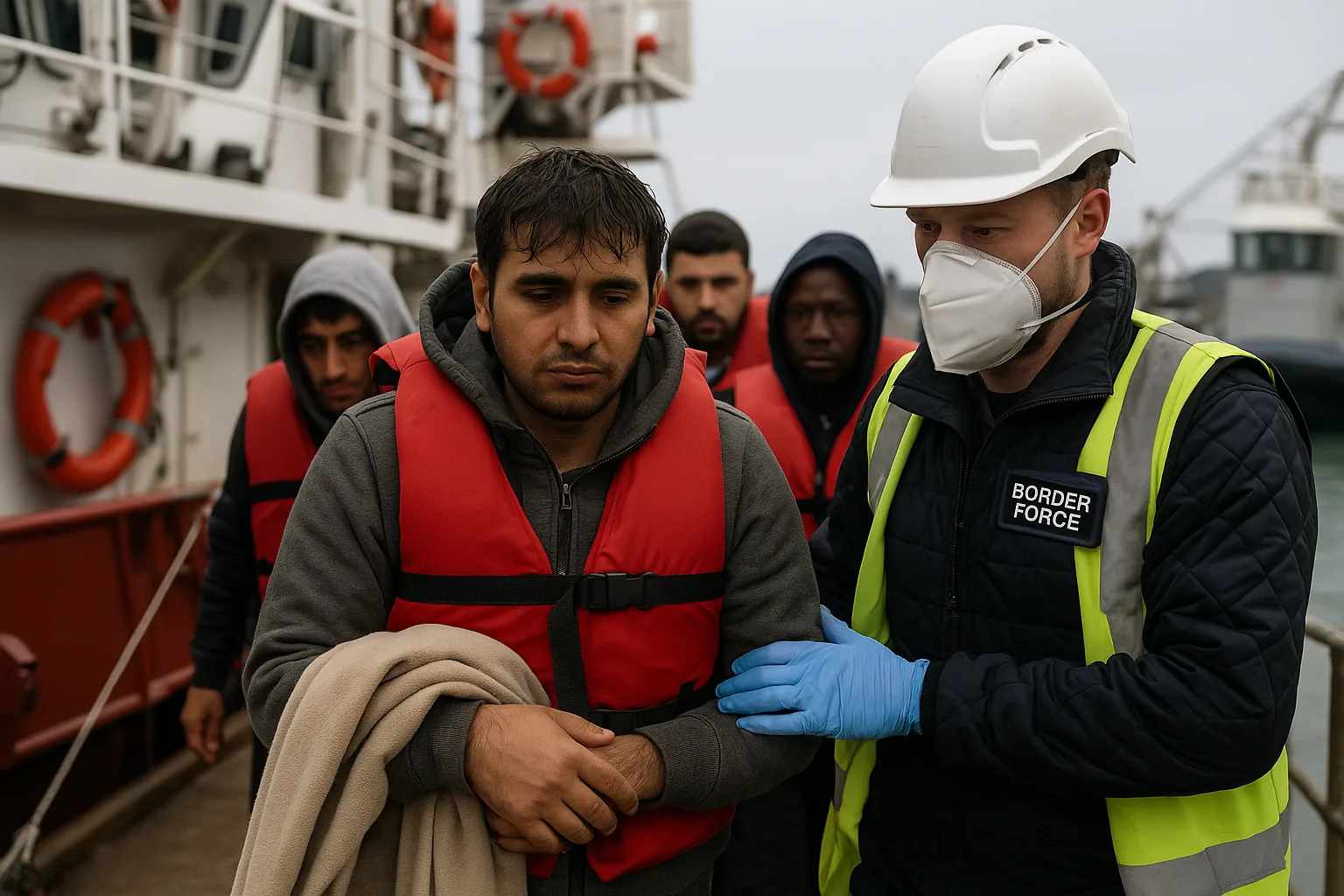
A claim that has circulated widely on social media — asserting that migrants rescued in the English Channel by vessels including RNLI lifeboats or Border Force ships are automatically granted refugee status the moment they are pulled from the water — fundamentally misrepresents how UK asylum law works. Understanding the real process that connects refugee status asylum seekers undergo after a sea rescue is not merely a legal technicality; it shapes public debate, influences policy discussion, and directly affects how communities perceive migration. The claim has been shared more than a thousand times on Facebook alone, according to documentation by the independent fact-checking organisation Full Fact, and its persistence makes a careful, evidence-based correction essential.
What the false claim actually says
The social media posts in question assert, in various wordings, that any migrant who is intercepted or rescued in the Channel — whether by an RNLI volunteer crew, a Border Force cutter, or any other vessel — is immediately and automatically awarded refugee status as a direct consequence of that rescue. Some versions of the claim go further, suggesting this happens before the individual even sets foot on British soil, or that the act of rescue itself constitutes a legal trigger for status recognition.
This framing is false. It conflates two entirely separate legal processes: the maritime obligation to rescue people in distress at sea, and the domestic administrative process by which a country determines whether an individual qualifies for international protection. These two processes operate under different legal frameworks, at different times, and with entirely different outcomes. Treating them as one and the same is a significant misrepresentation of the law.
The claim appears to have been circulating on Facebook for at least several days prior to 26 September 2026, the date at which it was documented and checked. Full Fact recorded its spread and confirmed the figure of over a thousand shares, which is significant enough to suggest the claim reached a substantial audience before correction.
How refugee status asylum seekers actually obtain protection in the UK
Refugee status in the United Kingdom is not an automatic or immediate grant. It is the outcome of a formal, multi-stage legal process. When someone arrives in the UK — including after a sea rescue — and wishes to seek protection, they must make an asylum claim. That claim is then assessed by the Home Office, which examines whether the individual meets the legal definition of a refugee under the 1951 Refugee Convention and its 1967 Protocol.
Under that definition, a refugee is a person who has a well-founded fear of persecution based on race, religion, nationality, membership of a particular social group, or political opinion, and who is unable or unwilling to return to their country of origin because of that fear. Meeting this definition requires evidence, documentation where available, and an assessment by a trained caseworker. It is a substantive legal determination, not an administrative formality.
The process typically involves several stages. An individual first registers their asylum claim, often at an initial screening interview where basic personal details and the broad basis of the claim are recorded. This is followed by a substantive asylum interview, in which the applicant explains in detail why they fear return to their home country. A caseworker then considers all available evidence and issues a decision. If the claim is refused, the applicant generally has a right of appeal to an independent immigration tribunal. Only if the claim is ultimately successful — at the initial decision stage or on appeal — is refugee status formally granted.
This process can take many months, and in some cases considerably longer, depending on the complexity of the claim, the availability of country-of-origin information, and the current caseload of the decision-making authority. At no point during this period does rescue at sea serve as a substitute for, or shortcut through, this process.
What rescue at sea does — and does not — legally require
The confusion in the false claim likely arises, at least in part, from a misunderstanding of maritime law. International maritime conventions do impose a clear and binding obligation on ships’ masters and coastal states to rescue people found in distress at sea. This duty is long-established, predating modern refugee law by centuries, and is codified in instruments including the International Convention for the Safety of Life at Sea (SOLAS) and the International Convention on Maritime Search and Rescue.
However — and this is the critical point — as the Migration Policy Institute has documented, maritime rescue law requires ships to aid those in danger at sea, but no state is automatically obligated to accept rescued asylum seekers as refugees by virtue of the rescue alone. The duty to rescue is a humanitarian and legal imperative that exists independently of any immigration or asylum determination. Saving someone’s life at sea does not, under any current international legal framework, simultaneously resolve their immigration status or grant them protection in the rescuing country.
👉 Read also: Small boat Channel crossings predate Brexit referendum, contrary to Liberal Democrat claim
What rescue does guarantee, in a practical sense, is that the person is brought to a place of safety. Once ashore, they enter the domestic legal framework of the receiving country. In the UK, that means they may make an asylum claim, and that claim will be assessed on its individual merits. The rescue is, legally speaking, the beginning of a process — not the end of one.
The legal protection that does apply during a pending claim
There is one important legal protection that applies to asylum seekers in the UK while their claim is being considered, and it is worth explaining clearly because it is sometimes mischaracterised in public debate. Under UK law, someone with a pending asylum case cannot be sent back to their home country while that case is unresolved. This principle — sometimes referred to as non-refoulement — is a cornerstone of international refugee law and is incorporated into UK domestic law through multiple instruments.
Non-refoulement means that even if an asylum claim has not yet been decided, the applicant cannot be forcibly returned to a country where they may face persecution, torture, or serious harm. This protection exists regardless of how the person arrived in the UK — whether by sea, by air, or by land. It is not the same as refugee status, and it does not confer the rights that refugee status brings, such as the right to remain in the UK indefinitely, the right to work, or access to certain public services. It is, rather, a procedural safeguard that ensures the asylum process can be completed fairly before any removal takes place.
This distinction matters because some versions of the false claim appear to conflate non-refoulement protection — the temporary bar on removal — with the full grant of refugee status. They are legally and practically distinct. The former is a procedural protection; the latter is a substantive recognition of international protection needs.
Why this kind of misinformation spreads and why it matters
False claims about immigration law tend to spread for several interconnected reasons. First, the underlying legal framework is genuinely complex, and the gap between what people assume the law says and what it actually says is often wide. Second, the topic of Channel crossings generates strong emotional responses across the political spectrum, which makes people more likely to share content that confirms existing beliefs without checking its accuracy. Third, the claim has a surface plausibility — it sounds like the kind of thing that might be true, which lowers the threshold for sharing.
The consequences of this kind of misinformation are real. When large numbers of people believe that sea rescue automatically confers refugee status, it distorts public understanding of immigration policy in ways that can feed into demands for changes to maritime rescue operations themselves. There have been periodic public debates about whether RNLI vessels, which are funded by charitable donations, should be involved in Channel rescues at all — debates that are sometimes fuelled by exactly this kind of false premise. If the public incorrectly believes that rescue equals automatic status, opposition to rescue operations takes on a different character than it would if people understood the actual legal framework.
Accurate public understanding of how refugee status asylum seekers actually obtain protection is therefore not just a matter of legal pedantry. It is a precondition for informed democratic debate about immigration policy. Decisions about how the UK manages Channel crossings, what resources are allocated to asylum processing, and how international obligations are balanced against domestic concerns all benefit from a public that understands the actual rules rather than a distorted version of them.
How to identify and respond to similar claims
Claims about immigration law are among the most frequently misleading content categories in social media misinformation. A few practical approaches help in evaluating them.
- Check whether the claim conflates different legal processes. As in this case, many false claims about immigration merge distinct legal frameworks — maritime law, asylum law, human rights law — into a single, inaccurate assertion.
- Look for primary sources. The House of Commons Library publishes detailed, regularly updated briefings on UK asylum law that are freely accessible and written for a general audience. Government and parliamentary sources are always preferable to secondary commentary when checking legal claims.
- Be sceptical of claims that describe automatic or instant legal outcomes. Most legal processes — particularly those involving status determinations — involve multiple stages, individual assessment, and the possibility of appeal. Claims that describe an instant, automatic outcome should prompt immediate scepticism.
- Consider the source and the incentive to share. Claims that generate strong emotional reactions about immigration are disproportionately likely to be misleading. This does not mean all such claims are false, but it does mean they warrant extra scrutiny before sharing.
The verdict
The claim that migrants rescued in the Channel are automatically granted refugee status is false. It misrepresents both UK asylum law and international maritime law. Refugee status is granted only after a successful asylum claim — a formal, multi-stage process assessed on individual merit by the Home Office. Maritime rescue law requires ships to aid those in distress, but does not require any state to automatically grant refugee status to those rescued. The only automatic legal protection that applies upon making an asylum claim is the principle of non-refoulement, which prevents removal while a claim is pending — a procedural safeguard that is entirely distinct from refugee status itself. The false claim has been shared widely on Facebook, where it has been documented and corrected by Full Fact. Understanding what refugee status asylum seekers actually go through — a careful, evidence-based determination process rather than an instant administrative grant — is essential for any honest public conversation about Channel crossings and UK immigration policy.
Correcting this particular claim is not a defence of any specific immigration policy, nor is it a judgement about the appropriate level of migration to the UK. It is simply an insistence that the debate be conducted on the basis of what the law actually says. The legal framework governing asylum is complex enough without the added burden of false claims circulating unchallenged at scale; the least any informed participant in that debate can do is start from an accurate description of the rules as they exist.
This article was produced with AI assistance and reviewed editorially.

Trump Claims U.S. Has ‘Best Poverty Numbers Ever’ in September 2026

Satire Article About Kamala Harris’s Campaign Debt Spread as Fact on Social Media in 2026

AI-Generated Video of Pro-Palestine UK Rally Spreads with SynthID Watermark Visible

Alleged October 1, 2026 Trucker Strike: No Evidence Found
