
Information
AI-Generated Videos Spread as Real Footage: SynthID Watermarks Reveal Fakes
Learn how Google’s SynthID watermark technology detects AI-generated videos circulating as real footage, including September 2026 viral examples.

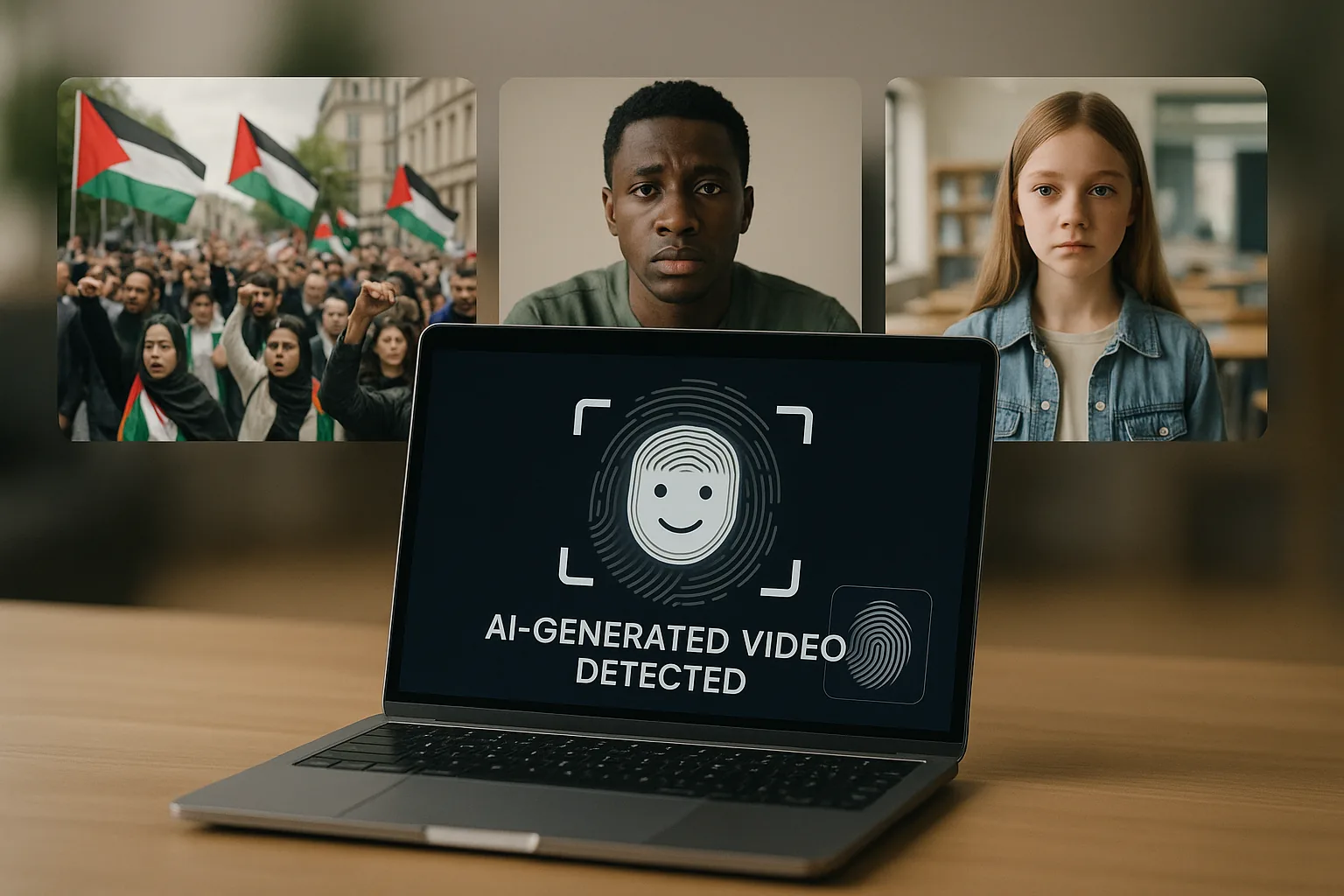

The ability to distinguish authentic video footage from synthetic fabrications has become one of the most consequential media-literacy challenges of our time. As AI-generated videos detection moves from a specialist research problem to an everyday necessity, the tools and techniques available to journalists, fact-checkers, and ordinary viewers are rapidly evolving — and so are the tactics of those who create and spread convincing fakes. In September 2026, a cluster of viral videos circulating across social media platforms illustrated just how serious the problem has become: clips purporting to show a pro-Palestine rally in the United Kingdom, a statement from an asylum seeker, and a school bus altercation were each flagged as potentially or wholly synthetic, with detection in some cases relying on Google DeepMind’s SynthID watermarking technology. While the specific details of those incidents remain unverified at time of writing, the broader phenomenon they represent is thoroughly documented — and the detection infrastructure behind them is real, growing, and increasingly consequential.
What SynthID Is and How It Works
SynthID is a technology developed by Google DeepMind that embeds invisible digital watermarks directly into AI-generated content — including images, audio, text, and video. According to Google’s official documentation on SynthID, the watermark is woven into the content at the point of generation, not applied as a visible label or overlay afterward. This distinction matters enormously: a visible label can be cropped away, edited out, or simply ignored by a viewer who does not notice it. An embedded watermark, by contrast, persists through many common forms of manipulation.
The watermarks are, by design, imperceptible to human viewers. A person watching a SynthID-watermarked video will see nothing unusual — no banner, no logo, no pixel-level artifact visible to the naked eye. Yet detection software can read the watermark reliably, even after the video has been compressed, re-encoded, or shared across multiple platforms. This combination of invisibility and robustness is what makes SynthID genuinely useful for provenance verification rather than merely symbolic.
Detection currently works across a range of Google’s own generative tools — including Google Gemini and Google Imagen — as well as, since May 2026, content generated via ChatGPT and DALL-E, following OpenAI’s adoption of the standard. The practical implication is significant: SynthID is no longer a Google-only system. It is becoming something closer to an industry-wide provenance layer, at least for content generated by the largest platforms.
The Scale of AI-Generated Content in Circulation
To understand why detection tools matter, it helps to appreciate the sheer volume of synthetic content now being produced. Google announced at its I/O developer conference that its tools alone had been used to create more than 100 billion AI-generated images and videos within just a couple of years. That figure does not include content produced by competing platforms, open-source models, or the growing number of consumer-facing video synthesis tools that require no technical expertise to operate.
The implication is not that all — or even most — of this content is deceptive. The vast majority of AI-generated images and videos are created for legitimate creative, commercial, or personal purposes. But a fraction of that volume, when applied to politically sensitive or emotionally charged subject matter and distributed without disclosure, is capable of causing real harm. A single convincing fake video of a public protest, a refugee’s testimony, or a violent incident can spread to millions of viewers before any fact-checker has had time to examine it. The speed of viral distribution consistently outpaces the speed of verification.
This asymmetry — between the ease of creation and the difficulty of verification — is precisely what makes robust, scalable AI generated videos detection infrastructure so urgent. Human review alone cannot keep pace. Automated watermark detection, when it works, closes that gap substantially.
The September 2026 Cluster: What Is Known and What Is Not
In September 2026, several videos attracted significant attention on social media platforms, each touching on politically or socially sensitive subjects: an apparent protest in the United Kingdom framed as a pro-Palestine rally, a video presented as a first-person statement from an asylum seeker, and footage depicting what appeared to be a violent altercation on a school bus. All three were flagged as potentially AI-generated, with SynthID detection cited in at least some of the reporting around them.
👉 Read also: AI-Generated and Manipulated Videos Spread Widely Across Social Media in September 2026
It is important to be precise about what can and cannot be stated with confidence here. The specific details of these three cases — the identities of creators, the exact platforms on which they spread, the precise detection methodology applied in each instance, and the names attributed in the school bus video — remain unverified at the time of writing. The research trail does not yet contain primary-source documentation that would allow a fact-checker to confirm or refute each claim with the rigor that publication requires. What is established is the general pattern: AI-generated videos on politically sensitive topics are circulating as real footage, and SynthID watermark detection is among the tools being used to identify them.
This distinction between the verified phenomenon and the unverified specifics is not a technicality. It is the core discipline of responsible fact-checking. Reporting the three cases as confirmed fakes without independent verification would itself be a form of misinformation — substituting one false certainty for another. The honest position is that these cases are plausible illustrations of a documented trend, but each requires independent source verification before a definitive verdict can be assigned.
Why Political and Social Topics Are Particularly Vulnerable
The subject matter of the September 2026 cluster is not accidental. Videos depicting protests, refugee experiences, and violence involving young people share several characteristics that make them attractive targets for synthetic fabrication and particularly damaging when faked.
First, they are emotionally activating. Content that provokes strong feelings — solidarity, fear, outrage, sympathy — tends to be shared rapidly and with less critical scrutiny than neutral or mundane content. A viewer who feels moved by a video of a protest or a personal testimony is less likely to pause and question its authenticity before forwarding it.
Second, these topics are difficult to verify through conventional means. A video of a specific protest can be checked against contemporaneous reporting, photographs, and witness accounts — but only if a fact-checker knows where and when to look. A video that provides vague or false location information can frustrate geolocation efforts for hours or days, during which time it continues to spread.
Third, they are politically instrumentalisable. Footage of a rally, a refugee’s words, or a school incident can be used to support or undermine specific policy positions, to inflame community tensions, or to discredit individuals and groups. The potential payoff for a bad actor is high relative to the technical effort required to generate a convincing synthetic video using current tools.
Taken together, these factors explain why AI generated videos detection is not merely a technical problem but a democratic one. The integrity of public discourse depends, in part, on the ability of citizens and institutions to distinguish what actually happened from what was synthesised to appear as though it did.
The Limits of Watermark-Based Detection
SynthID is genuinely useful, but it is not a complete solution. Several important limitations constrain what watermark-based detection can achieve in practice.
The most fundamental limitation is coverage. SynthID watermarks are embedded by the generating platform. If a video is created using a tool that does not implement SynthID — an open-source model, a smaller commercial platform, or a custom-built system — the resulting content will carry no SynthID watermark, and detection tools looking for that watermark will return a negative result. A negative result does not mean the video is authentic; it means only that no SynthID watermark was found. This distinction is critical and easy to misunderstand.
👉 Read also: AI-Generated Video of Pro-Palestine UK Rally Spreads with SynthID Watermark Visible
A second limitation is robustness under adversarial conditions. While SynthID watermarks are designed to survive common forms of re-encoding and compression, determined adversaries may develop techniques to remove or corrupt them. Research into watermark removal is ongoing, and the field is best understood as a continuing contest between embedding and removal techniques rather than a solved problem. Ars Technica‘s July 2026 assessment of SynthID described it as working well in standard conditions while noting that labeling AI content at scale may ultimately be “a losing game” — a characterisation that captures the structural tension between the technology’s genuine capabilities and the limits of any single technical approach.
Third, there is the question of public literacy. Even when a watermark is detected and a video is correctly identified as AI-generated, that information must reach the people who have already seen and shared the content. Correction rarely travels as far or as fast as the original false claim. Detection infrastructure is necessary but not sufficient; it must be paired with effective communication strategies, platform-level labeling, and ongoing public education.
Building a Broader Detection Ecosystem
Watermark detection is one component of a larger and necessarily diverse toolkit for identifying synthetic video. Fact-checkers and researchers currently draw on several complementary approaches, and understanding how they work together helps clarify what robust AI generated videos detection looks like in practice.
Forensic analysis examines video at the pixel and frame level for artifacts characteristic of AI generation: unnatural blinking patterns, inconsistent lighting, temporal flickering at object boundaries, and anomalies in background detail that human vision tends to overlook but that algorithmic analysis can flag. These signatures vary by generation model and are not always present, but they provide a useful secondary check when watermark data is absent.
Geolocation and open-source verification cross-reference visual elements in a video — architecture, signage, vegetation, road markings — against satellite imagery, street-level photography, and other publicly available sources to confirm or contradict claimed locations. A video purporting to show a specific city or venue can often be verified or refuted within hours by analysts skilled in this technique, regardless of whether the content carries any watermark.
Metadata analysis examines the technical properties of a video file — creation timestamps, encoding signatures, device identifiers — for inconsistencies that suggest manipulation or synthetic origin. Metadata can be stripped or altered, but its absence is itself informative, and its presence can corroborate or contradict other findings.
Provenance chain verification traces a video back through its distribution history to identify the earliest known upload, the account that posted it, and any contextual claims attached to it at that point. Accounts with short histories, no prior content, or patterns of posting synthetic material are red flags that warrant closer examination of the content itself.
None of these methods is individually decisive. Each has failure modes. Their value lies in combination: a video that passes forensic analysis, carries no SynthID watermark, matches verified geolocation data, has consistent metadata, and traces to an established account with a credible posting history is substantially more likely to be authentic than one that fails on several of these dimensions. Conversely, a video that triggers concern on multiple fronts warrants a clear label of uncertainty rather than a confident verdict in either direction.
The September 2026 cases, whatever their ultimate verified status, have served a useful function by bringing these detection methods into wider public awareness. As the tools for generating synthetic video become more accessible and the resulting content more convincing, the tools and habits of mind needed to evaluate it must keep pace. SynthID represents a meaningful step toward a world in which AI-generated content carries a verifiable provenance signal — but it is one step in a long process, not an endpoint. The most important safeguard remains the same one it has always been: a commitment to tracing every significant claim back to its source before treating it as established fact.
This article was produced with AI assistance and reviewed editorially.

AI-Generated Videos of Geopolitical Events Spread as Authentic Footage

AI-Generated and Manipulated Images Spread Across Social Media During Paris Riots and European Protests

Political Ads in 2026 Midterms Contain False or Misleading Claims About Opponents

Trump Administration ‘Super Intelligence’ Accord Misspells ‘United States’ as ‘Unites States’
