
Current Affairs
Misleading Videos Mix Old Footage and AI to Distort Recent Events
Misleading viral videos use recycled old footage and AI-generated content to misrepresent recent events. Learn how to identify mislabeled clips and synthetic media.

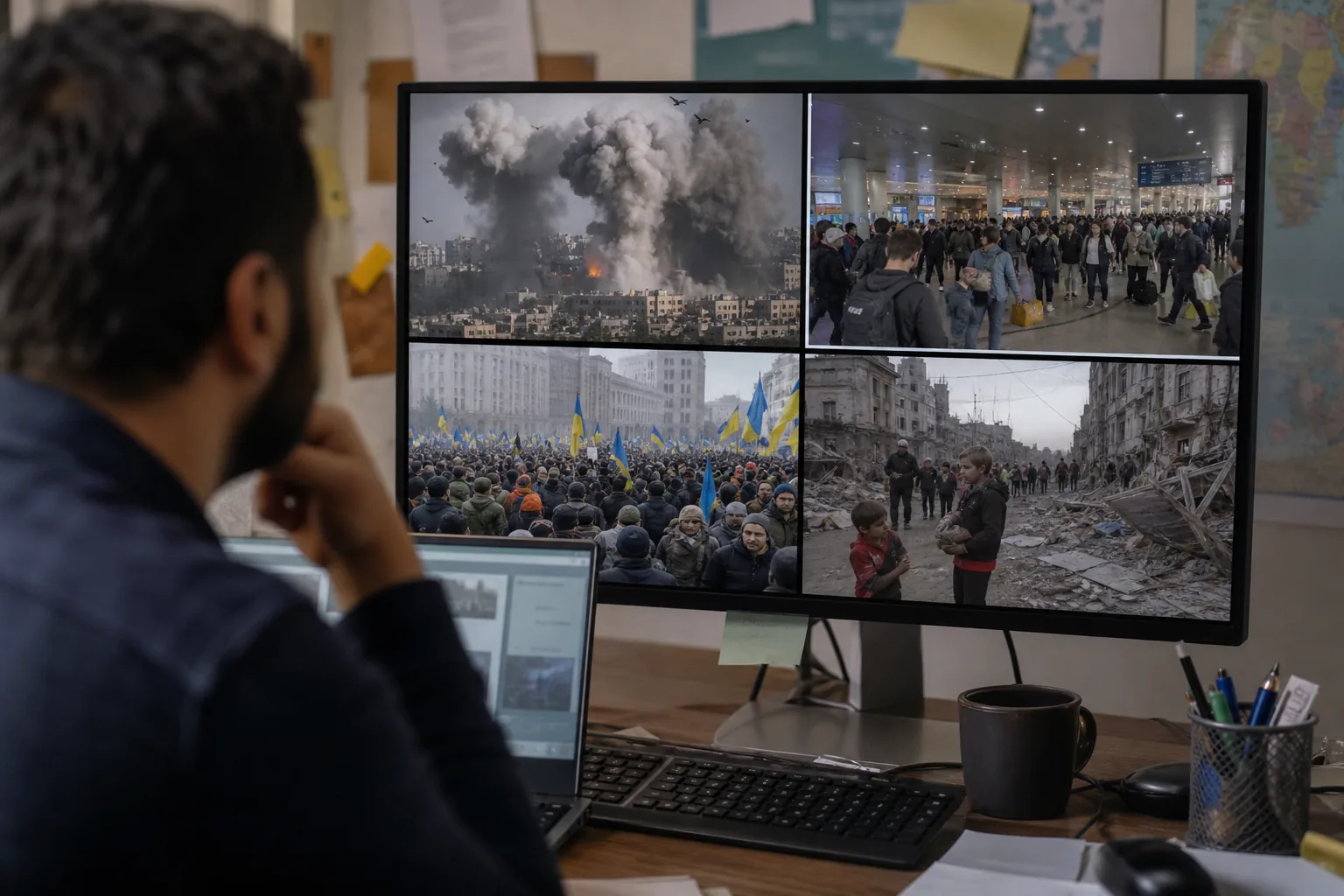
The speed at which video content travels across social media platforms has created fertile ground for viral videos misinformation — a phenomenon in which old footage, mislabeled clips, and increasingly sophisticated AI-generated content are presented as evidence of events that either never happened or unfolded very differently from what is claimed. As geopolitical tensions rise and news cycles accelerate, the window between a breaking story and the flood of misleading video content has narrowed to minutes, not hours.
How Old Footage Gets Recycled as Breaking News
One of the most persistent and low-tech forms of video misinformation involves no artificial intelligence at all: simply taking genuine footage from a previous incident, stripping its original context, and resharing it with a new caption. This technique exploits the fact that most viewers do not reverse-search video content and are primed to accept dramatic footage as current when it appears in their feed alongside fresh headlines.
The mechanics are straightforward. A video showing airport chaos, a street protest, or an explosion may be entirely authentic — but filmed months or years before the event it is now claimed to document. Because the footage is real, it can pass basic credibility checks. The deception lies entirely in the framing, not the pixels. Investigators who specialize in open-source verification have developed techniques to date footage by examining metadata, identifying environmental details such as seasonal foliage or visible signage, and cross-referencing the clip against known archives.
The practical damage is significant. Audiences who encounter mislabeled footage form impressions of events — political violence, military operations, civil unrest — that are factually disconnected from what actually occurred. Those impressions can persist even after corrections are issued, because corrections rarely travel as far or as fast as the original misleading post.
AI-Generated Video and the Collapse of Visual Trust
While recycled footage is an old problem, the rise of generative AI has introduced a qualitatively different challenge. Hyper-realistic AI-generated news videos are now flooding social media, making it increasingly difficult for ordinary viewers — and even trained journalists — to distinguish genuine reporting from fabricated content. This is no longer a theoretical risk; it is a documented, ongoing pattern.
Hany Farid, a professor at UC Berkeley and chief science officer at GetReal Security, has stated plainly that AI has eliminated the barriers that once made creating highly compelling images and videos of events technically demanding. What previously required professional equipment, skilled operators, and significant post-production time can now be produced by anyone with access to widely available generative tools. The result is a supply of synthetic media that far outpaces society’s current capacity to detect it.
→ Read also: Old Footage Circulates Online With False Dates and Locations
The problem has been clearly illustrated in recent geopolitical contexts. When news broke about a reported development involving Venezuelan President Nicolás Maduro and US forces, misleading AI-generated content began circulating online within minutes of the story appearing. Viewers encountered fabricated video before authoritative reporting had even been published. That sequence — synthetic content first, facts second — is increasingly the norm rather than the exception, and it shapes the mental model that audiences carry into subsequent, accurate reporting.
Researchers have also identified a telling technical signature worth noting: many AI-generated videos are exactly eight seconds long, a limitation of current generative tools that can serve as one indicator — though not a definitive one — when assessing whether a clip may be synthetic. As the technology matures, even this marker is likely to disappear.
The Memory Problem: Why Corrections Often Fail
The consequences of viral videos misinformation extend beyond momentary confusion. Emerging research suggests that exposure to AI-generated content and misinformation can create false memories and distort human recollection of events — meaning that people may later remember seeing “evidence” of something that never happened, even after being told the content was fabricated. This is not a minor cognitive quirk; it represents a structural vulnerability in how democratic publics form shared understandings of reality.
The mechanism is not unique to AI. Psychologists have long documented that vivid, emotionally engaging media can implant or alter memories. What AI does is dramatically scale the production of such media, ensuring that more people encounter more convincing false content more frequently. The cumulative effect on collective memory and public discourse is an area of active concern among researchers studying the intersection of technology and cognition.
This is part of why the standard fact-checking approach — publish a correction, label the post, add a context note — is necessary but insufficient on its own. By the time a correction reaches a viewer, the false memory may already be forming. Effective responses require faster detection, platform-level labeling at the point of first exposure, and broader media literacy so that audiences approach dramatic video content with calibrated skepticism rather than reflexive acceptance.
Conflict Zones and the Surge in Synthetic Media
Conflict reporting has become a particularly acute arena for viral videos misinformation. AI-generated videos related to the Iran conflict have surged, contributing to a broader information environment in which it is genuinely difficult for audiences — and sometimes for journalists — to establish what footage is authentic. The incentive structure is clear: dramatic conflict imagery attracts enormous engagement, and engagement-driven platforms amplify content regardless of its veracity.
→ Read also: Viral Videos Misidentified With False Context or Recycled Archival Footage
In conflict contexts, the stakes of misinformation are especially high. False footage of attacks, casualties, or military movements can influence public opinion, affect diplomatic calculations, and in some cases contribute to real-world violence by inflaming tensions based on events that did not occur. The Rutgers University Libraries resource on AI-generated images and misinformation notes the particular risk that synthetic media poses when it intersects with ongoing conflicts, where verification infrastructure may be degraded and the appetite for information is highest.
Deepfake technology adds another layer of complexity. Deepfake videos are capable of appearing to show a specific individual doing or saying something they did not do or say — a capability that, applied to political or military figures, can produce content with the potential to escalate conflict or undermine peace negotiations. The technology does not require sophisticated actors; the tools are accessible, the learning curve is shortening, and the outputs are improving rapidly.
What Verification Actually Looks Like
Against this backdrop, verification practice has had to evolve. Open-source investigators and professional fact-checkers now apply a layered methodology when assessing viral video claims. The first step is always to question the framing: does the caption or accompanying text actually match what the video shows? The second is to attempt to establish the provenance of the footage — where did it first appear, and when?
Tools for reverse video search allow investigators to identify earlier appearances of a clip online, which can reveal that footage presented as current is in fact months or years old. Metadata analysis, where data has not been stripped, can provide timestamps and device information. Environmental analysis — examining weather, vegetation, visible infrastructure, or crowd clothing — can help narrow down the time and location of filming. For suspected AI-generated content, analysts look for characteristic artifacts: unnatural motion, inconsistent lighting, distorted hands or faces, and the kind of temporal compression that current generative tools produce.
None of these methods is foolproof, and the pace of AI development means that artifacts that are detectable today may be undetectable in future model iterations. This is why the field increasingly emphasizes provenance — establishing a verifiable chain of custody for media — rather than relying solely on content analysis to identify fakes.
What Audiences Can Do Right Now
Media literacy remains the most scalable defense against viral videos misinformation, even as detection technology catches up with generation technology. Several practical habits significantly reduce the risk of being misled by manipulated or mislabeled video content.
- Pause before sharing. The urgency that viral content creates is often itself a manipulation vector. Slowing down reduces amplification of false content.
- Check the source, not just the content. Who posted this first? Does the account have a verifiable history? Is the footage attributed to a named journalist or organization?
- Use reverse image and video search tools to check whether a clip has appeared in earlier contexts with different labels.
- Look for corroboration. If a dramatic event occurred, multiple independent sources should be reporting it. A single viral video with no corroborating coverage is a significant red flag.
- Be especially skeptical of footage from conflict zones, where verification is hardest and the incentive to produce misleading content is highest.
- Notice emotional intensity. Content engineered to produce outrage or fear is statistically more likely to be misleading than content that informs without provoking.
The challenge of misleading and AI-generated video content is not going to resolve itself as the technology matures — if anything, the sophistication of synthetic media will continue to outpace casual detection for the foreseeable future. What can change is the degree to which audiences, platforms, and institutions treat visual evidence with the same critical scrutiny they would apply to any other claim. A video is not proof of anything until its provenance is established. That principle, applied consistently, is the most durable protection available against the ongoing and evolving problem of viral misinformation.
This article was produced with AI assistance and reviewed editorially.

Trump’s ’60 Minutes’ Post-Election Interview: Claims Fact-Checked

Claims About Abdul El-Sayed’s Background Check and Senate Eligibility: What the Record Shows

Voting Machine Claims After 2026 Midterms Lack Evidence of Election Fraud

AI-Generated Images Linking Trump, Epstein, and Beyoncé Circulate Online Without Verification
