
Current Affairs
False claims about UK asylum and Channel rescue procedures
Does being rescued at sea give asylum seekers automatic refugee status? No — we explain the actual legal process, why the viral claim is false, and what really happens after a Channel rescue.

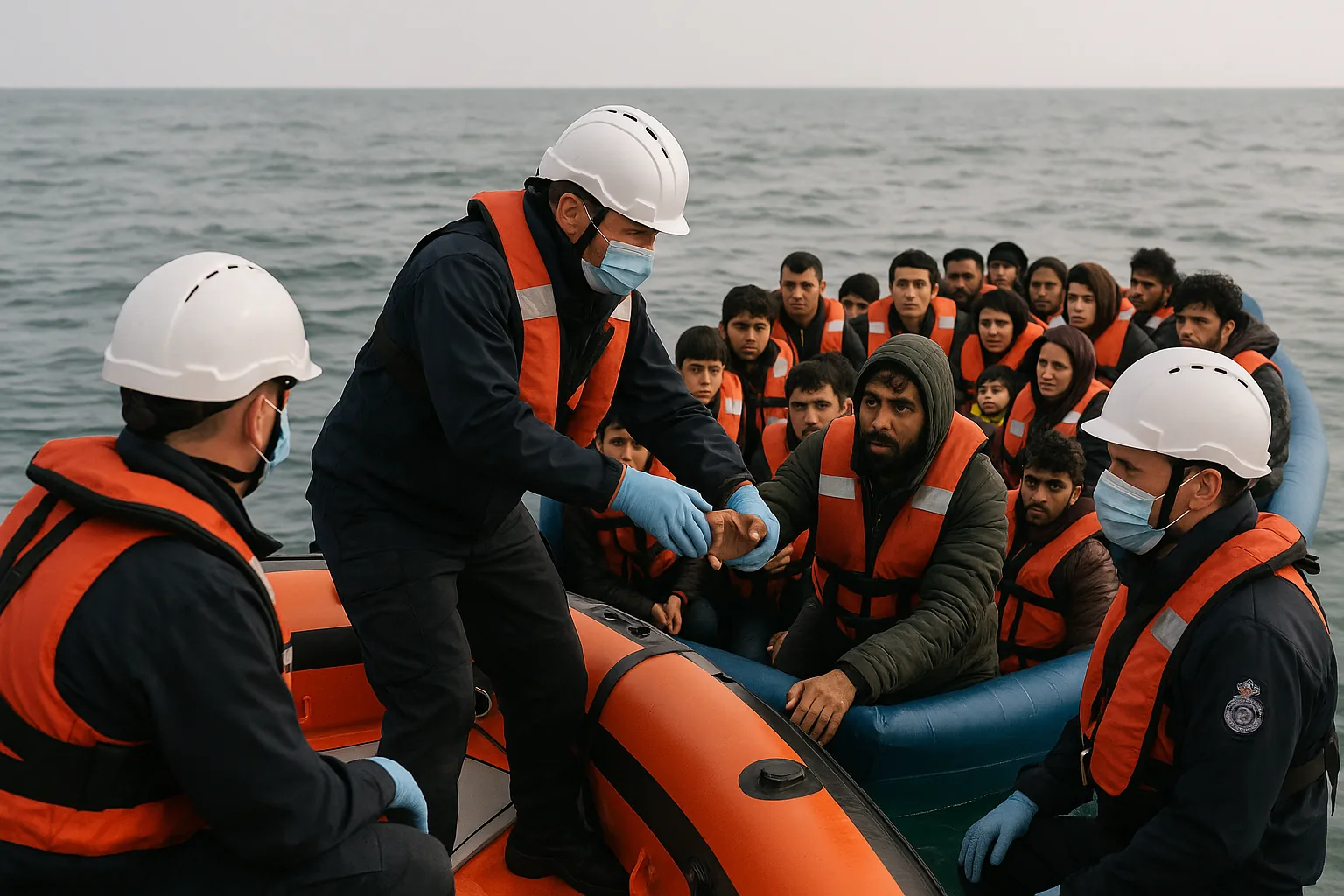
Among the most persistent and consequential categories of misinformation circulating on UK social media is the false claim that asylum seekers rescued at sea automatically gain refugee status — that the act of being pulled from the Channel by the Royal National Lifeboat Institution or Border Force somehow confers an immediate and permanent right to remain in the United Kingdom. The claim has been shared over a thousand times across social media platforms, and its effects have not been confined to online debate. It has contributed to a climate of hostility that, according to the RNLI itself, has led to volunteers, staff and their families facing online abuse and, in some cases, physical threats. Understanding exactly why this claim is false — and what the actual relationship between maritime rescue and asylum procedure genuinely involves — matters both for public accuracy and for the safety of people who save lives at sea.
The claim and how widely it has spread
The specific false claim at issue holds that any migrant crossing the English Channel who is rescued by the RNLI or Border Force automatically becomes a refugee as a direct consequence of that rescue. Variants of this claim frame the RNLI as a “taxi service” that effectively guarantees legal status, and suggest that Border Force officers who intercept small boats are, in effect, processing passengers directly into refugee recognition. The implication — sometimes stated explicitly in the posts — is that the act of rescue itself triggers a legal entitlement that cannot subsequently be challenged or removed.
This framing has proved remarkably durable on social media. Posts repeating it in various forms have been shared widely on Facebook and other platforms, and the claim is regularly recycled whenever Channel crossing numbers feature in news coverage. Full Fact, the UK’s leading independent fact-checking organisation, has specifically identified this as a category of misinformation that misunderstands asylum rules. The persistence of the claim is not incidental: it maps onto broader anxieties about immigration policy and is emotionally compelling precisely because it presents a simple, dramatic mechanism — rescue equals status — that is easy to share and difficult to dislodge with nuance.
Does being rescued at sea give you refugee status? The short answer
No. Being rescued at sea does not give a person refugee status. Rescue is a humanitarian and legal obligation under international maritime law. It is entirely separate from the domestic and international legal frameworks that govern asylum determination. The two processes operate on different legal tracks, with different decision-makers and different timelines. No provision in UK law, EU law or international maritime law converts the act of rescue into a grant of refugee recognition.
This distinction is the central fact that viral posts consistently collapse. The sections below explain how each process actually works.
What happens to asylum seekers rescued at sea: the actual process
When a person is rescued from the Channel — whether by an RNLI lifeboat, a Border Force cutter or any other vessel — they are brought ashore. What follows is an initial screening process, not a status determination. Individuals are typically taken to a reception facility where they are registered, given basic welfare checks and, if they wish to claim asylum, begin a formal application process. That process involves detailed interviews, documentary evidence where available, legal representation and, ultimately, a decision by a Home Office caseworker applying the definition of a refugee set out in the 1951 Refugee Convention and its 1967 Protocol.
Step 1: Arrival and initial screening
On reaching shore, individuals are registered and receive welfare checks. Border Force officers record basic details. No status decision is made at this stage.
Step 2: Asylum claim lodged
A person who wishes to seek protection formally lodges an asylum claim with the Home Office. This is a voluntary act; rescue does not automatically trigger a claim on a person’s behalf.
Step 3: Substantive interview and casework
A Home Office caseworker conducts a detailed interview. The caseworker examines the individual’s country of origin, the nature of any persecution they face and the credibility of their account. This stage can take months.
👉 Read also: False Claims About Migrants, Refugees, and UK Border Policy Fact-Checked
Step 4: Decision and appeal rights
The caseworker issues a decision. If the claim is refused, the applicant has the right to appeal to the First-tier Tribunal (Immigration and Asylum Chamber). Some claims succeed on appeal; others do not. The outcome is neither automatic nor predetermined.
Why the automatic-status claim is false
Under the 1951 Refugee Convention and its 1967 Protocol, a refugee is a person who has a well-founded fear of persecution on specific grounds — race, religion, nationality, membership of a particular social group or political opinion — and who is outside their country of nationality and unable or unwilling to return to it because of that fear. None of these criteria are established by the act of crossing the Channel or being rescued from it. The rescue brings a person to shore; it does not evaluate their individual circumstances, their country of origin, the nature of any persecution they face or the credibility of their account. All of that is determined later, through a separate administrative and, where appealed, judicial process.
It is also worth noting that not every person who arrives via the Channel and claims asylum is ultimately recognised as a refugee. Asylum claim outcomes vary significantly depending on nationality, individual circumstances and the evidence presented. Many claims are refused at the initial decision stage; others succeed on appeal; some applicants are granted forms of leave to remain that fall short of full refugee recognition. The process is neither automatic nor uniform, and the outcome for any individual is genuinely uncertain at the point of rescue.
The real-world harm caused by this misinformation
Misinformation about asylum seekers rescued at sea and refugee status is not a victimless category of error. The RNLI — a charity staffed overwhelmingly by volunteers — has been forced to respond publicly to a wave of hostility directly traceable to false claims about its Channel activities. The organisation has confirmed that volunteers, staff and their families have faced online abuse and physical threats as a result of misinformation about rescue missions. This is a documented, serious harm: people who perform dangerous, life-saving work in some of the world’s busiest and most treacherous shipping lanes have been targeted because of a factual misunderstanding about what their work legally entails.
The RNLI’s mandate is clear and long-standing: it saves lives at sea, regardless of who is in the water. Its crews are not immigration officers, have no role in asylum determination and carry no legal authority to grant or deny status. When they rescue someone from a sinking dinghy in the Channel, they are fulfilling an obligation that predates modern immigration law and that exists independently of any political debate about border policy. The claim that they are somehow complicit in automatically granting refugee status misrepresents both their role and the law.
Beyond the RNLI, the broader ecosystem of misinformation about Channel crossings and asylum procedures creates a distorted public understanding of how the system actually works. This matters for democratic accountability: citizens cannot meaningfully evaluate government policy on asylum if their baseline understanding of that policy is built on false premises. When a significant portion of public debate rests on the assumption that rescue automatically equals refugee status, proposals to reform or tighten the system are evaluated against a fictional version of the rules rather than the real ones.
Separate concerns about fraudulent asylum claims
It is important to distinguish the false claim about automatic status from a separate, verified concern about fraudulent applications within the asylum system. These are distinct issues, and conflating them — as misinformation often does — obscures rather than illuminates both.
The BBC has reported that the Home Office is investigating evidence that some migrants are being advised to make false claims — including false claims about sexual orientation or about being victims of domestic abuse — in order to strengthen asylum applications. The Home Office has confirmed it is looking into a growing trend of fabricated claims from people presenting as gay, as well as concerns that rules designed to protect victims of domestic violence are being exploited. These are legitimate policy concerns that deserve serious scrutiny.
Government data indicates that approximately 2% of asylum claims in the UK — around 1,377 claims in the most recent reporting period — included sexual orientation as part of the basis for the claim. Whether and to what extent such claims are fraudulent is a matter under active investigation, and the figures alone do not establish fraud. What is clear is that the Home Office takes the integrity of the asylum system seriously and is actively examining these concerns.
👉 Read also: Small boat Channel crossings predate Brexit referendum, contrary to Liberal Democrat claim
None of this, however, supports the claim that rescue at sea automatically grants refugee status. Fraudulent claims, where they occur, are a problem precisely because the system requires individual assessment — if status were automatic, there would be nothing to fabricate. The two issues point in opposite directions: one (the false viral claim) suggests the system is too permissive and requires no evaluation; the other (the fraud concern) confirms that individual evaluation is exactly what the system demands, and that some people attempt to game that evaluation. Presenting both as the same story, as viral posts frequently do, is a form of misleading framing that serves neither accuracy nor good policy.
How to evaluate claims about asylum seekers rescued at sea and refugee status
For anyone encountering claims about Channel crossings and asylum procedures on social media, a few straightforward questions help separate fact from misinformation. First: does the claim describe a specific legal mechanism, or does it assert an outcome without explaining how it is produced? The automatic-status claim never specifies which law or regulation produces the alleged automatic recognition, because no such law exists. Second: does the claim distinguish between arrival and status determination? These are legally and procedurally distinct, and any claim that collapses them deserves scrutiny. Third: is the claim sourced to a government document, a court ruling or a credible institutional source — or does it rely on assertion and emotional framing?
Reputable fact-checking organisations, including Full Fact’s immigration section, regularly examine and correct claims circulating about UK asylum procedures. Consulting these resources before sharing posts about Channel crossings is a practical step that reduces the spread of misinformation and, in the case of claims targeting the RNLI, may help protect volunteers from unwarranted hostility.
It is also worth recognising that genuine complexity exists in UK asylum policy — on processing times, accommodation costs, the treatment of particular nationalities, the use of offshore processing proposals and much else. That complexity deserves honest public debate. But honest debate requires accurate premises, and the premise that rescue at sea automatically produces refugee status is simply not accurate. The act of saving a life at sea is a humanitarian obligation; the determination of refugee status is a separate legal process that follows its own rules, applies its own criteria and produces its own outcomes — outcomes that are neither predetermined nor automatic.
The persistence of this false claim, despite repeated correction, reflects something important about how misinformation functions: it fills gaps in public understanding with emotionally resonant but factually wrong narratives, and it does so most effectively when the accurate picture is genuinely complicated. The answer is not to simplify the real picture beyond recognition, but to be precise about what is actually known, what remains uncertain and what is demonstrably false — and the claim that rescued migrants automatically become refugees falls clearly into that last category.
Frequently asked questions
Do asylum seekers rescued at sea automatically get refugee status in the UK?
No. Being rescued at sea starts no legal process that grants refugee status. A person must separately lodge an asylum claim, which is then assessed by the Home Office against the criteria set out in the 1951 Refugee Convention. Many claims are refused.
What legal obligation requires rescuing people at sea?
The duty to render assistance to persons in distress at sea is established by the International Convention for the Safety of Life at Sea (SOLAS) and the International Convention on Maritime Search and Rescue (SAR). These obligations apply regardless of the nationality or immigration status of the people in the water.
Does the RNLI have any role in deciding asylum claims?
No. The RNLI is a search-and-rescue charity. Its crews have no immigration powers and play no part in asylum determination. Their legal duty is to save lives at sea; what happens to a rescued person afterwards is handled by separate government bodies.
What is the difference between an asylum seeker and a refugee?
An asylum seeker is a person who has applied for international protection but whose claim has not yet been decided. A refugee is a person whose claim has been assessed and accepted under the 1951 Refugee Convention. Rescue at sea makes a person neither; it simply brings them to shore.
Can an asylum seeker rescued at sea be returned to another country?
Potentially, yes. UK law allows for the removal of asylum seekers to safe third countries in certain circumstances, subject to legal challenges. Whether removal is lawful in any individual case depends on the specific facts and applicable law at the time of the decision.
This article was produced with AI assistance and reviewed editorially.

Trump Claims U.S. Has ‘Best Poverty Numbers Ever’ in September 2026

Satire Article About Kamala Harris’s Campaign Debt Spread as Fact on Social Media in 2026

AI-Generated Video of Pro-Palestine UK Rally Spreads with SynthID Watermark Visible

Alleged October 1, 2026 Trucker Strike: No Evidence Found
