
Current Affairs
AI-Generated Videos Spread False Claims About UK Protests, Immigration, and Asylum
The use of ai generated deepfake videos to spread false narratives about immigration, protest, and asylum policy in the United Kingdom has moved from a the

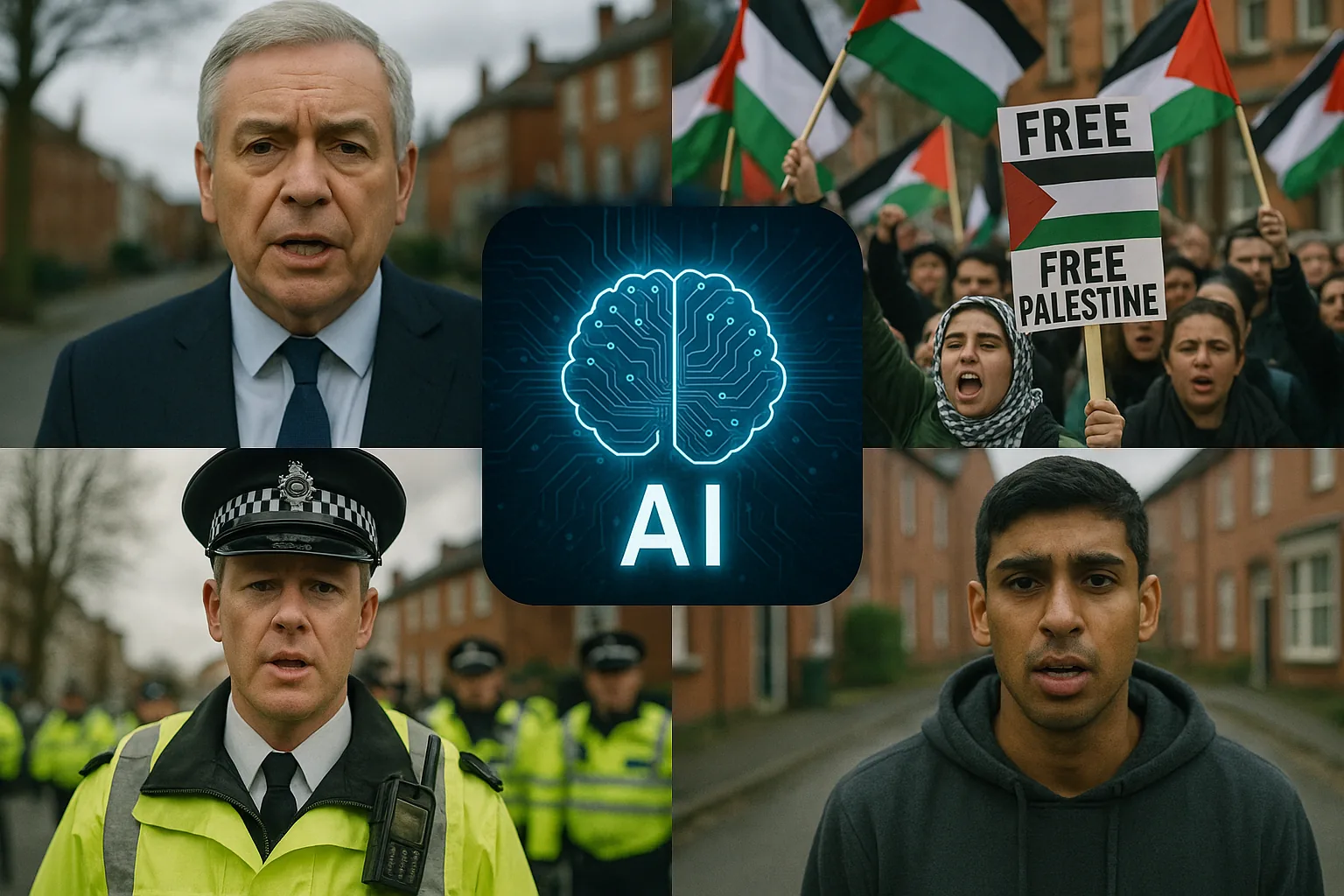
The use of ai generated deepfake videos to spread false narratives about immigration, protest, and asylum policy in the United Kingdom has moved from a theoretical threat to a documented, recurring reality. Between May and September 2026, multiple fabricated videos circulated across Facebook, Instagram, and Threads, each constructed to look authentic enough to provoke outrage, reshape public opinion, or smear named political figures — and each ultimately traced to sources with no connection to the events they claimed to depict. The pattern is neither random nor isolated: it represents a coordinated exploitation of the moment when synthetic media became cheap enough to produce at scale and convincing enough to fool audiences scrolling quickly through social feeds.
What the Documented Cases Actually Show
The clearest single example in this wave of fabricated content involved a deepfake video of a UK Labour Party politician. According to a decision published by the Meta Oversight Board, the video depicted the politician saying: “Refugees are welcome here, even if they rape our women, because white people do that too.” The politician said nothing of the sort. The video was removed from Facebook on September 17, 2026, after the Oversight Board found it contained hate speech against refugees — a ruling that underscored the double harm such fabrications inflict: they defame the person depicted while simultaneously amplifying hostility toward the group supposedly being defended.
The Oversight Board’s decision is significant beyond the individual case. It confirmed that the video was AI-generated, that it had been reported and initially left up before eventual removal, and that the platform’s own moderation processes had not caught it quickly enough. The case illustrates how even content that violates a platform’s stated policies can remain accessible long enough to accumulate views, shares, and emotional reactions that outlast the takedown itself.
A separate case, verified independently by Thai PBS Verify, involved a video posted on Threads on May 21, 2026, by an account identified as ‘torontopost11’. The video claimed to show a massive pro-Palestine protest in London. Verification analysts found it to be entirely AI-generated — the crowd, the setting, and the audio were all synthetic. The account name alone should give pause: a Toronto-based handle posting fabricated footage of London protests and presenting it as real news is a textbook example of how geographic and identity deception layers on top of content fabrication.
A third documented case, detailed in Meta’s own transparency materials, involved a Facebook album containing an AI-generated video showing protesters, with one man waving a Palestinian flag. The audio accompanying the video had him praising Antifa — a claim with no basis in the footage’s actual origin. The construction of this video followed a recognisable template: take a visual that carries emotional charge (a protest, a flag, a crowd), attach fabricated audio that links it to a politically charged label, and release it into an environment already primed for outrage.
The Infrastructure Behind the Fabrications
These videos did not appear in isolation. BBC investigations identified a network of interconnected Facebook and Instagram accounts working in concert to spread anti-immigration AI content. One account in this network was traced to a creator based in Sri Lanka — thousands of miles from the UK communities the content claimed to represent and speak for.
Among the accounts examined was a Facebook page called ‘Great British People’, which presented itself as a grassroots community from Yorkshire. The page accumulated 1.3 million views for a single video depicting an elderly white British man crying about his pension. Whether or not the video itself was AI-generated, the page’s framing — authentic local voice, relatable grievance, sympathetic subject — is precisely the aesthetic that synthetic media campaigns aim to replicate. A page run from overseas, presenting fabricated or decontextualised content as the authentic voice of a regional British community, is a form of identity fraud applied at the level of political discourse.
👉 Read also: AI-Generated Videos Spread False Claims About Asylum Seekers and Palestine Rallies
The network structure matters because it reveals how individual pieces of fabricated content gain amplification. A single deepfake video posted by an obscure account might reach a few hundred people. The same video cross-posted, shared, and boosted by a network of accounts — some with large followings built up over months — can reach millions before any fact-checker or platform moderator catches up. The velocity of spread is itself a feature of the strategy, not a side effect.
Why the UK Is a Recurring Target for AI-Generated Deepfake Videos
The United Kingdom presents a particularly attractive environment for this kind of synthetic disinformation. Immigration and asylum policy are among the most emotionally charged political topics in British public life. Debates about housing, public services, national identity, and community change are live and contested. Any piece of content that appears to confirm a pre-existing fear — that a politician secretly holds contemptible views, that protests are larger and more radical than reported, that particular groups are being favoured at the expense of others — finds a ready audience.
The political salience of these topics also means that fabricated content travels across ideological lines. A deepfake video of a Labour politician making an offensive statement about refugees is designed to damage both the politician and the cause of refugee welcome simultaneously. It tells one audience that the politician is a hypocrite, and tells another that even those who claim to support refugees harbour contempt. The same piece of content can be weaponised in multiple directions, which makes it unusually efficient as a tool of social division.
There is also a structural vulnerability in how British political discourse operates online. Local politicians, community figures, and regional spokespeople are less well-known nationally than senior cabinet ministers, which means that fabricated videos of them are harder for audiences to immediately dismiss. A deepfake of a prime minister is easily checked against hours of authentic footage. A deepfake of a local councillor, whose voice and mannerisms are unfamiliar to most viewers, is far more likely to be accepted as genuine on first encounter.
How Detection Works — and Where It Falls Short
Identifying AI-generated video content has become a specialist discipline, drawing on both technical analysis and contextual verification. Analysts look for a range of artefacts that synthetic media generation tools still struggle to eliminate entirely: inconsistent lighting across the face and background, unnatural blinking patterns, subtle mismatches between lip movement and audio, hair and teeth rendering that lacks the randomness of real footage, and background elements that repeat or blur in ways that no real environment would.
Audio analysis runs in parallel. AI-generated speech often has a particular flatness in the upper frequency range, an absence of the micro-variations in breath and vocal tension that characterise live human speech. When audio and video are both synthetic and assembled separately — as appears to have been the case in the Palestinian flag video — the synchronisation is frequently imperfect in ways that trained listeners can detect even if casual viewers cannot.
Reverse image and video search remains one of the most reliable first steps. The London protest video identified by Thai PBS Verify failed basic reverse search: no corroborating footage from the same event existed anywhere online, no news coverage referenced it, and the visual environment did not match known locations in the city. The absence of corroboration is itself evidence when a video claims to document a major public event.
👉 Read also: AI-Generated and Manipulated Videos Spread False Claims About Political Events and Figures
Where detection consistently falls short is in the gap between identification and action. Verification takes time — hours or days for a thorough analysis. Fabricated content spreads in minutes. Even when platforms act on reports, the removal of a video does not erase the emotional impression it has already made on everyone who saw it and did not subsequently see a correction. Research on misinformation correction consistently finds that corrections reach a smaller audience than the original false claim, and that the emotional impact of the original persists even in people who consciously accept the correction.
Platform Accountability and the Moderation Challenge
The Meta Oversight Board’s decision on the Labour politician deepfake raised pointed questions about how platforms handle AI-generated content that violates their policies. The video was reported, reviewed, and initially left up — only removed after the Board’s intervention. This sequence suggests that the platform’s first-line moderation, whether automated or human, did not identify the content as a policy violation quickly enough.
The challenge for platforms is genuine, even accounting for legitimate criticism of their response times. The volume of video content uploaded every minute across Facebook, Instagram, and Threads is enormous. Automated detection systems trained on earlier generations of synthetic media may not keep pace with the improving quality of current AI video generation tools. Human reviewers working at scale cannot apply the same depth of analysis that a specialist verification team brings to a single piece of content.
What the documented cases from 2026 demonstrate is that the existing framework — report, review, remove — is too slow and too reactive to contain the harm from ai generated deepfake videos that target political figures and vulnerable communities. Several proposals have been advanced in policy discussions: mandatory provenance labelling of AI-generated content at the point of upload, faster escalation pathways for content involving named individuals, and greater transparency about how long reported content remains accessible while under review. None of these is a complete solution, and each carries its own implementation challenges.
What Audiences Can Do Right Now
Individual media literacy is not a substitute for platform accountability or regulatory action, but it remains a meaningful first line of defence. When a video makes a claim that confirms a strong prior belief — that a politician said something shocking, that a protest was larger or more violent than reported, that a particular group behaved in a particular way — that confirmation should trigger scepticism rather than immediate sharing.
Practical steps are straightforward, even if they require a deliberate pause before engaging with content. Check whether any established news organisation has reported the same event. Search for the video using reverse video tools. Look at the account that posted it: how old is it, what else has it posted, where does it claim to be based? In the case of ‘torontopost11’ posting footage of a London protest, the account name alone was a signal worth examining.
For content involving named politicians or public figures, check against their own verified channels. A statement as extreme as the one fabricated in the Labour politician deepfake would, if genuine, have generated immediate and extensive coverage from multiple news organisations. Its absence from any other source is itself a verification signal.
The wave of AI-generated deepfake videos targeting UK political and social debates in 2026 is not the end of a trend but a marker of where the technology and its misuse currently stand. The tools for creating convincing synthetic media are becoming cheaper and more accessible; the tools for detecting it are improving but remain reactive; and the social conditions that make fabricated content about immigration and protest emotionally effective have not changed. Understanding the specific mechanics of each documented case — who made it, how it was distributed, what it claimed, and how it was caught — is the foundation for building responses that are proportionate to the actual threat rather than either dismissive or catastrophising.
This article was produced with AI assistance and reviewed editorially.

AI-Generated Videos of Geopolitical Events Spread as Authentic Footage

AI-Generated and Manipulated Images Spread Across Social Media During Paris Riots and European Protests

Political Ads in 2026 Midterms Contain False or Misleading Claims About Opponents

Trump Administration ‘Super Intelligence’ Accord Misspells ‘United States’ as ‘Unites States’
