
Current Affairs
Viral Videos About FlyDubai September 30, 2026 Incident Contain AI-Generated and Mislabeled Footage
FlyDubai Flight FZ1073 hijacking sparked widespread misinformation. Fact-checkers exposed AI-generated deepfakes, mislabeled footage, and fabricated BBC reports falsely b

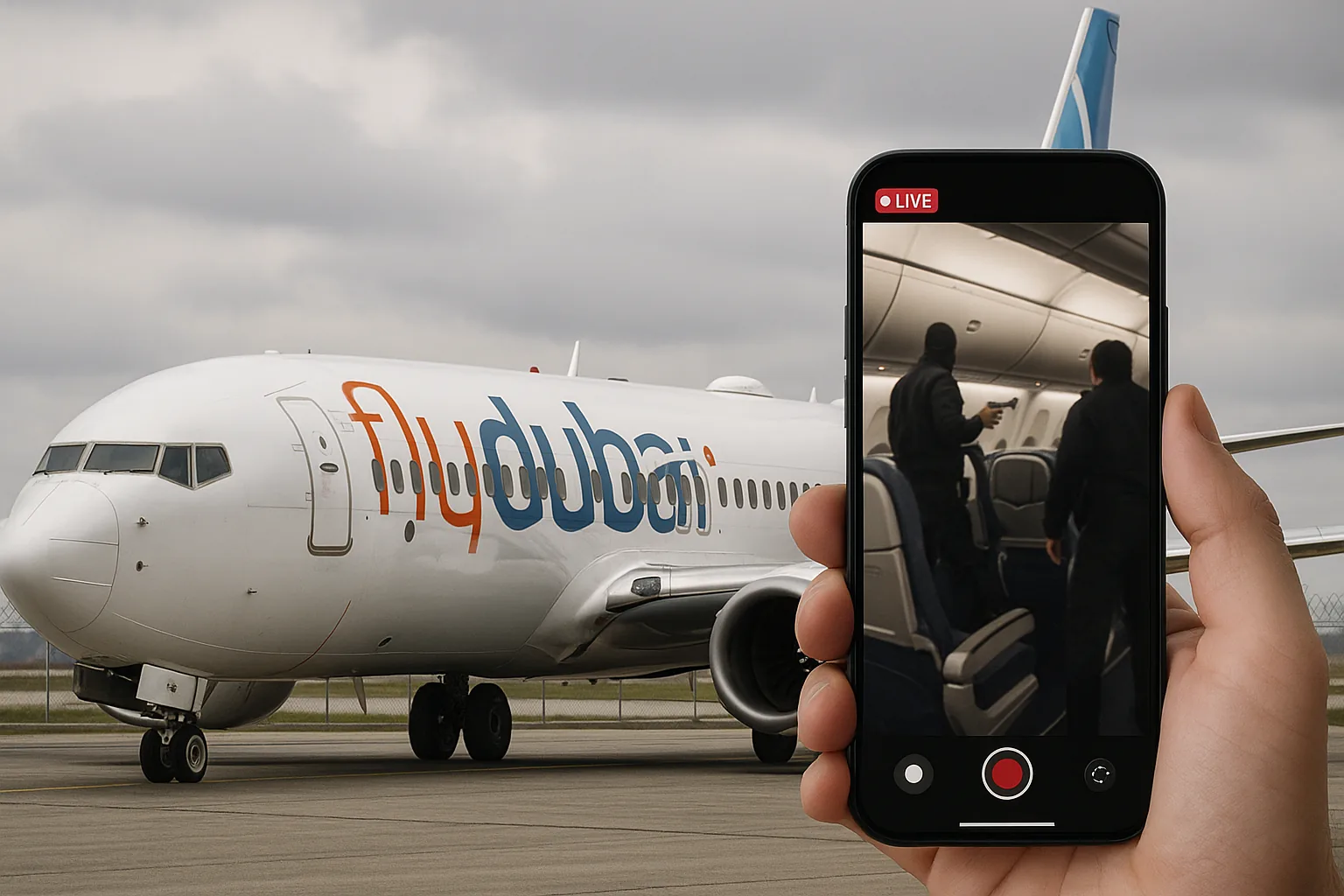
When FlyDubai Flight FZ1073 made an emergency landing on September 30, 2026, after a terrifying attempted hijacking mid-flight, the world had a real, documented crisis to process. Within hours, a parallel crisis had taken shape online — one built entirely from fabricated footage, mislabeled videos, and AI-generated deepfakes. The wave of flydubai hijacking misinformation that followed illustrates, with unusual clarity, how quickly a genuine aviation emergency can be buried under a landslide of false content, and how each false video serves a distinct narrative agenda that has nothing to do with the facts on the ground.
What Actually Happened on Flight FZ1073
The verified facts of the incident are striking enough on their own. FlyDubai Flight FZ1073 was operating a route from Dubai to Tel Aviv and was carrying 174 people when the emergency unfolded. According to verified reporting, the co-pilot stabbed the captain and attempted to crash the aircraft. Flight-tracking data recorded a drop of approximately 14,125 feet in just 29 seconds before the plane was stabilised — a statistic that underscores how close the incident came to catastrophe.
The aircraft was diverted to Tabuk, Saudi Arabia, where it landed safely. The suspect pilot was subsequently transferred to the UAE as the investigation got underway. No passengers were killed. That sequence of events — documented, sourced, and cross-referenced — is the foundation against which every piece of circulating video content must be measured. It is also, as the days following the incident demonstrated, a foundation that a large volume of online content chose to ignore entirely.
The Fake BBC Report: A Deepfake Designed to Implicate an Indian Passenger
Among the most widely shared pieces of flydubai hijacking misinformation was a fabricated BBC news report. The video was constructed to look and sound like a genuine broadcast from the British public broadcaster, complete with what appeared to be BBC studio graphics, a presenter, and authoritative delivery. Its central claim was that an Indian passenger was responsible for the hijacking attempt — a claim that contradicts the verified facts entirely.
Fact-checkers at France 24 established that the report was an AI-generated deepfake, with both doctored footage and manipulated audio. The BBC did not produce the report. No credible investigation has implicated an Indian passenger in the incident. The video’s construction was sophisticated enough to fool a significant number of social media users who shared it as genuine breaking news, and it spread across multiple platforms before debunking efforts could gain traction.
This type of fabrication — a fake broadcast from a trusted, globally recognised news organisation — is particularly dangerous because it exploits the credibility shortcut that viewers apply to familiar logos and formats. When a viewer recognises what appears to be a BBC studio, their threshold for scepticism drops. The creators of this deepfake understood that mechanism and built the video to exploit it. Fact-checkers at Newschecker and France 24 both identified the report as fabricated, noting the telltale signs of AI-generated video: inconsistent lip-sync, unnatural skin texture, and audio artefacts that do not match genuine broadcast recordings.
The false report did not merely misidentify a perpetrator — it introduced an entirely fictional narrative into public discourse at the precise moment when accurate information was most needed. Families of passengers, journalists covering the story, and government officials in multiple countries were all navigating a rapidly evolving situation. False content of this kind actively degrades the information environment at its most critical point.
The Azul Brazilian Airlines Video: Geography as Misinformation
A second category of false content is less technologically sophisticated but no less misleading. A video showing an Azul Brazilian Airlines aircraft was shared widely across social media platforms with captions and commentary claiming it depicted the FlyDubai Flight FZ1073 incident. The two airlines operate entirely different fleets, fly different liveries, and serve entirely different route networks. The Azul aircraft in the video bears no resemblance to a FlyDubai Boeing 737.
👉 Read also: AI-Generated and Manipulated Videos Spread Misinformation About September 2026 Events
Fact Crescendo’s investigation confirmed the misidentification. The Azul aircraft video predated the September 30, 2026 incident and had no connection to it. Yet the clip was presented as evidence of the FlyDubai emergency, often accompanied by dramatic captions designed to heighten the emotional impact. This form of misinformation — repurposing unrelated footage and attaching a new, false label — is one of the most common techniques in viral false content, precisely because it requires no technical skill. Anyone with a video clip and a caption can do it.
The Azul misidentification is also a reminder that geographic and brand illiteracy play a significant role in how misinformation spreads. Many users sharing the clip had no reason to know what an Azul Brazilian Airlines aircraft looks like, or what livery FlyDubai uses. They relied on the framing provided by whoever first attached the false caption, and that framing was wrong. The flydubai hijacking misinformation ecosystem depended, in part, on that knowledge gap.
The Yam Madar Video: Old Content, New False Context
A third verified example of false content circulating after the incident involved an old video of Israeli basketball player Yam Madar, originally recorded in 2025. The video was shared with claims linking it to the FlyDubai hijacking attempt — a connection that does not exist and that fact-checkers at AFP were able to disprove by tracing the video’s original publication date and context.
The use of Madar’s video illustrates a specific sub-category of misinformation: the recycling of content involving a recognisable public figure to lend apparent credibility to a false narrative. Because Madar is Israeli and the flight was bound for Tel Aviv, there is a superficial geographic logic that may have made the false connection seem plausible to some viewers. That superficial logic is precisely what misinformation exploits — the appearance of relevance without the substance of evidence.
AFP Fact Check confirmed that the Yam Madar video had no connection to the September 30, 2026 incident. The video was from 2025, recorded in an entirely different context, and was being circulated with a fabricated framing. The fact that a professional athlete’s unrelated footage could be weaponised as apparent evidence of an aviation crisis speaks to the speed and carelessness with which content travels across platforms.
How Misinformation Narratives Competed With Verified Facts
Taken together, the false content that circulated following the FlyDubai Flight FZ1073 incident did not form a single coherent false narrative. Instead, it produced several competing false narratives simultaneously. The fake BBC report blamed an Indian passenger. Other content, according to reporting by The Journal, framed the incident as an Indian-Israeli plot to implicate Iran. The Azul aircraft video simply generated false visual evidence of a crisis without specifying blame. The Yam Madar clip implied Israeli involvement without making an explicit claim.
This fragmentation is itself significant. When multiple false narratives compete, they do not cancel each other out. Instead, they collectively undermine confidence in any account of events, including the accurate one. A viewer who encounters three contradictory false versions of an incident may conclude that the truth is simply unknowable — which is, in practice, a form of informational paralysis that serves no one except those who benefit from confusion.
The verified facts — that a co-pilot attacked the captain, that the plane dropped more than 14,000 feet before being stabilised, that it landed safely in Tabuk, and that the suspect was transferred to the UAE — were available from credible sources within hours of the incident. But those facts had to compete, in the same social media feeds, with deepfakes, mislabeled clips, and recycled footage. The competitive disadvantage of accurate information in that environment is not a new problem, but the flydubai hijacking misinformation case illustrates it with particular sharpness.
👉 Read also: Flydubai September 2026 Incident Spawns Wave of Fabricated Videos and Deepfakes
The Role of AI-Generated Content in Aviation Misinformation
The fake BBC report is not the only piece of AI-generated content that circulated in connection with the FlyDubai incident. The broader pattern — in which a high-profile, emotionally charged event immediately attracts AI-generated fabrications — has become a recognisable feature of the current information landscape. Aviation incidents are particularly vulnerable to this pattern for several reasons.
First, genuine footage of aviation emergencies is almost never available in real time. Passengers are rarely in a position to film a cockpit attack or a rapid altitude drop. That absence of authentic footage creates a vacuum that fabricated content rushes to fill. Second, aviation emergencies carry enormous emotional weight, which increases the likelihood that users will share content without pausing to verify it. Third, the technical complexity of aviation — flight-tracking data, aircraft types, airline liveries, cockpit procedures — creates multiple points at which a non-specialist audience can be misled by confident-sounding false claims.
AI-generated deepfakes exploit all three of these vulnerabilities simultaneously. They provide apparent footage where none exists, they are designed to trigger emotional responses, and they can incorporate enough technical-sounding detail to appear authoritative. The fake BBC report on the FlyDubai incident followed this template closely: it presented fabricated footage in a format (a broadcast news report) that carries inherent authority, and it made a specific factual claim (an Indian passenger was responsible) that sounded like the kind of detail a genuine investigation would produce.
Organisations working to counter this type of content — including AFP Fact Check, France 24, Newschecker, and Fact Crescendo — face a structural challenge: the time required to verify, debunk, and publish a fact-check is almost always longer than the time required to create and distribute a deepfake. By the time a debunking is published, the false content has often already reached its maximum audience. AFP’s verified fact-check on the Yam Madar video is a concrete example of the kind of primary-source verification work that this environment demands.
What Readers Can Do When an Incident Goes Viral
The FlyDubai case offers several practical lessons for anyone navigating a breaking-news environment saturated with unverified content. The first is to treat any video claiming to show footage of an aviation emergency with heightened scepticism, particularly in the first 24 to 48 hours after an incident. Genuine cockpit footage almost never exists; genuine passenger footage of a cockpit attack is essentially impossible. If a video claims to show something that would be extraordinarily difficult to film, that is a reason for caution, not a reason to share.
The second lesson is to check the source of any broadcast-style video before accepting its framing. Major news organisations — the BBC, France 24, AFP — have official websites and social media accounts where their genuine reports can be verified. A video that appears to be from a major broadcaster but cannot be found on that broadcaster’s official channels is almost certainly fabricated.
The third lesson is to pay attention to aircraft liveries and airline branding. The Azul Brazilian Airlines aircraft looks nothing like a FlyDubai Boeing 737. A brief search for either airline’s livery would have revealed the misidentification immediately. Visual verification of this kind takes less than a minute and can prevent the spread of false content.
The fourth lesson is that old content can be given new, false context at any time. A video from 2025 can be captioned as 2026 content. A clip from one country can be labeled as footage from another. Reverse image search tools and video verification platforms can help establish when and where a piece of footage was originally published — and whether its current caption matches that original context.
The wave of false videos that followed FlyDubai Flight FZ1073’s emergency landing on September 30, 2026, did not change what happened on that flight. The co-pilot’s attack on the captain, the 14,125-foot altitude drop, the safe landing at Tabuk, and the subsequent transfer of the suspect to the UAE are all documented facts that no amount of fabricated footage can alter. What the misinformation did change is the informational environment in which those facts had to be understood — and that change, however temporary, carries real costs for public trust, for the families of those on board, and for the broader capacity of accurate reporting to reach the people who need it most.
This article was produced with AI assistance and reviewed editorially.

Political Ads in 2026 Midterms Contain False or Misleading Claims About Opponents

Trump Administration ‘Super Intelligence’ Accord Misspells ‘United States’ as ‘Unites States’

Trump Administration ‘Super Intelligence’ Accord Misspells ‘United States’ as ‘Unites States’

No Going Back PAC Ad Makes Misleading Claim About Roy Cooper and Rape Kits
