
Current Affairs
Trump Administration ‘Super Intelligence’ Accord Misspells ‘United States’ as ‘Unites States’
President Trump’s Super Intelligence accord signed in September 2026 contains a typo spelling ‘United States’ as ‘Unites States’ beneath his signature.

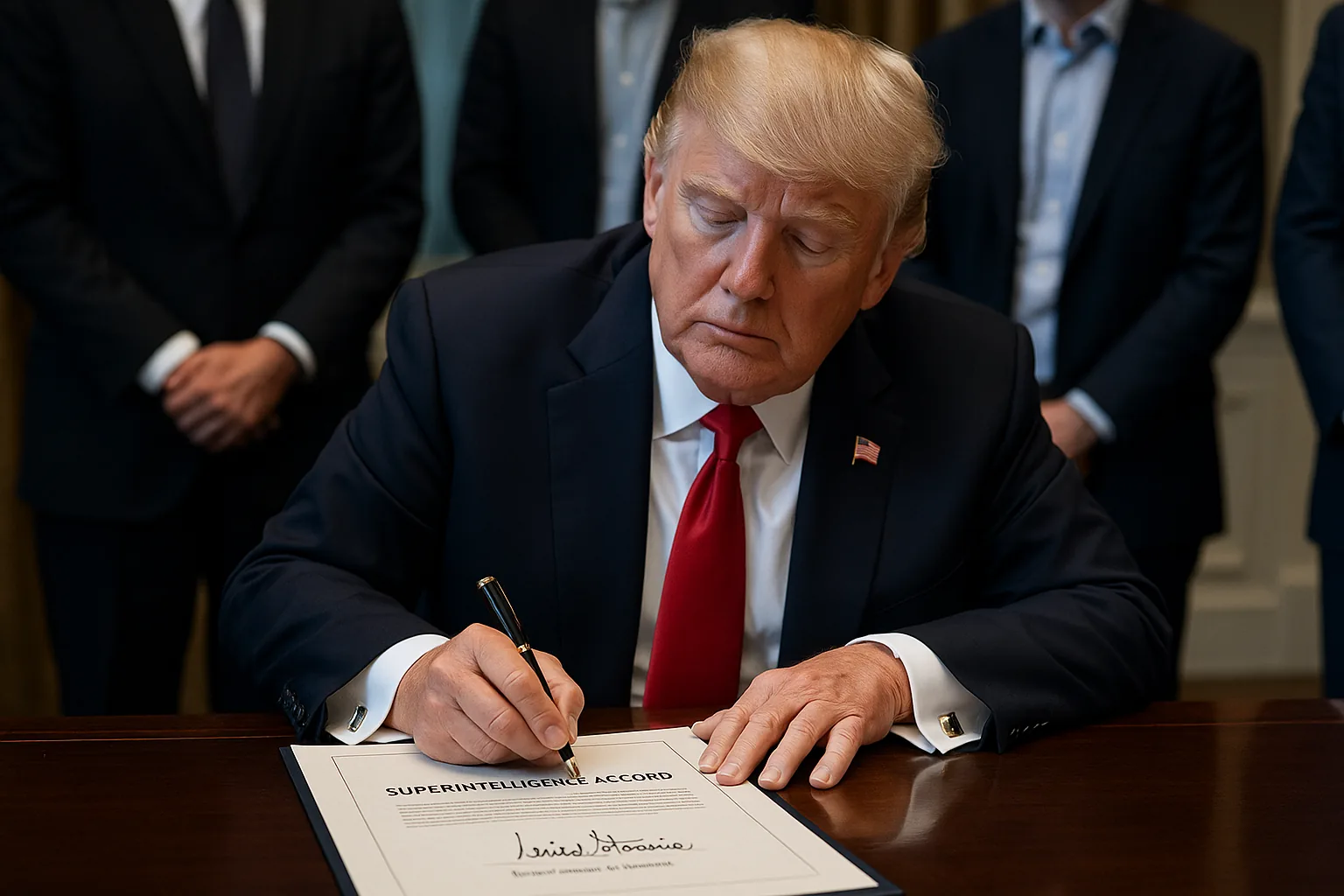
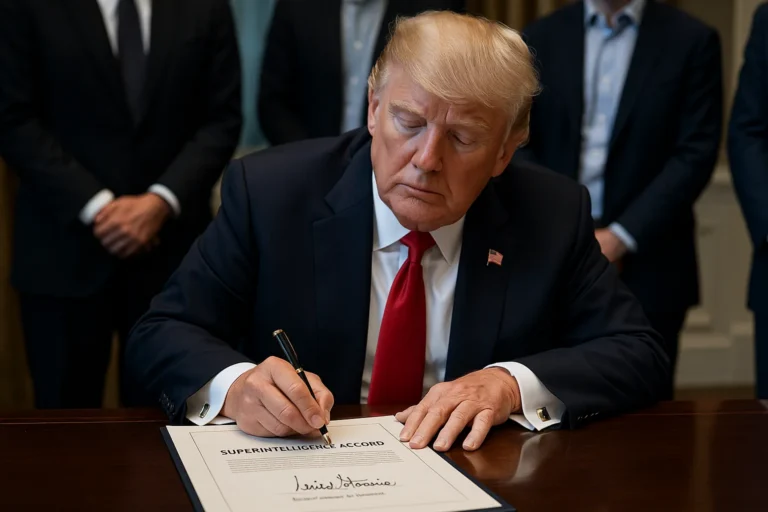
When the White House posted images of the White House Accord on Super Intelligence to its social media account on September 30, 2026, the document was intended to project technological ambition and executive authority. Instead, it immediately attracted attention for an embarrassing clerical error: the phrase identifying President Donald Trump as a signatory misspells “United States” as “Unites States” — a typo that the trump super intelligence accord typo has since spread widely across social media platforms, overshadowing the substance of the agreement itself.
What the White House Accord on Super Intelligence Actually Is
The White House Accord on Super Intelligence is a document signed by President Donald Trump on September 29, 2026, alongside a cohort of some of the most prominent figures in the technology industry. The accord is described as morally binding rather than legally enforceable — a distinction that matters significantly in understanding what the agreement can and cannot compel its signatories to do. Its central purpose is to address fears about artificial intelligence and to commit the parties to developing AI technology safely.
The technology executives who signed alongside Trump represent companies that collectively sit at the very center of the global AI industry. Sundar Pichai, the chief executive of Google, added his name to the document. So did Mark Zuckerberg, the chief executive of Meta; Elon Musk, leading xAI; and Jensen Huang, the chief executive of Nvidia. The combination of a sitting president and the leaders of companies that manufacture the chips, build the models, and deploy the consumer-facing applications that define modern AI gives the accord a symbolic weight that goes beyond its non-binding character.
The accord’s framing as “morally binding” is itself a notable choice of language. It signals that the White House sought to create a sense of shared commitment and accountability without subjecting the signatories — including the federal government — to the kind of legal obligations that a treaty or a formal regulatory instrument would impose. Whether that framing is a feature or a limitation of the document is a matter of ongoing public debate, but it is the framework the accord itself adopts.
The Typo That Defined the Coverage
Within hours of the document’s appearance on the White House’s social media account on September 30, 2026, observers began noting a spelling error that appears directly under Trump’s signature. The country’s name is rendered as “Unites States” rather than “United States.” The error is straightforward: a transposition that inverts the letters “d” and “s” in the word “United,” producing a word — “Unites” — that exists in English but carries an entirely different meaning, turning a proper adjective into a verb form.
The location of the error amplifies its visibility. It does not appear in a footnote, a technical annex, or a supporting clause buried in the body of the text. It appears beneath the president’s own signature, in the line that identifies his office and the nation he represents. That placement makes it one of the first things a reader’s eye encounters when looking at the signed portion of the document, and it is precisely why the trump super intelligence accord typo circulated so rapidly once the images were posted publicly.
USA Today confirmed the misspelling in its reporting on September 30, 2026, and noted that the White House did not immediately respond to a request for comment about the error. That non-response, as of the time of initial reporting, left open the question of whether the document would be corrected, reissued, or allowed to stand as signed. No verified information is available about how the misspelling occurred or whether a corrected version of the document would appear in any official registry.
→ Read also: Trump Posts AI-Generated Tiger Video and Footage of Fatal UK Zoo Attack on Truth Social
How the Error Spread and Why It Resonated
The mechanics of how the trump super intelligence accord typo spread are fairly straightforward. The White House posted the document to its own social media account, meaning the image came with an implicit official imprimatur. Users who encountered it were not looking at a leaked draft or a partial photograph taken from a distance; they were looking at an image the White House itself had chosen to publish. That origin made the error simultaneously easier to verify and harder to dismiss as a misrepresentation.
Social media platforms amplified the image quickly, and the combination of the accord’s high-profile subject matter — artificial intelligence, one of the most contested and consequential technology debates of the decade — with a basic spelling error in the president’s own title created a contrast that many users found irresistible. The accord is explicitly about the development of sophisticated intelligence, artificial and otherwise. A typographical error in the name of the country on a document about superintelligence carried an obvious ironic charge that required no editorial commentary to land.
Multiple outlets confirmed the error independently. Snopes, which has a long track record of verifying claims that circulate on social media, confirmed that the misspelling of “United States” as “Unites States” is genuine and appears in the document as posted. Hindustan Times also reported on the error, specifically identifying the phrase as it appears under Trump’s signature. USA Today, The Guardian, and other outlets each covered the story, providing independent verification that this was not a digitally altered image or a misreading of the original document.
The fact that so many independent newsrooms confirmed the same detail is relevant to the question of whether this is a real error or a manipulated image. It is a real error. The trump super intelligence accord typo is present in the document as officially posted, and USA Today’s reporting provides a detailed account of the verification process.
The Accord’s Broader Significance Beyond the Spelling Error
It would be a disservice to the substance of the agreement to allow the typo to entirely eclipse what the document represents as a policy artifact. The White House Accord on Super Intelligence is a rare instance of a sitting American president formally co-signing a document with the chief executives of major private technology companies on the subject of artificial intelligence governance. The accord’s aim — to develop AI technology safely and to address public fears about the trajectory of AI development — places it within a broader international conversation that has been accelerating throughout the mid-2020s.
The involvement of Jensen Huang and Nvidia is particularly significant in that context. Nvidia’s graphics processing units are the dominant hardware platform for training large AI models, which means Huang’s signature represents not just a corporate commitment but an acknowledgment of the role that semiconductor infrastructure plays in the pace and character of AI development. Similarly, Sundar Pichai‘s participation brings Google’s DeepMind research division and its Gemini model family into the accord’s moral framework, while Mark Zuckerberg‘s presence connects Meta’s open-weight model strategy to the same set of commitments.
Elon Musk‘s inclusion is notable given his public history of both promoting and criticizing AI development at various points. His company xAI, which developed the Grok model series, represents a newer but rapidly growing entrant in the large language model space. The fact that all four of these executives signed the same document alongside the president signals a degree of industry-government alignment on the broad goal of safe AI development, even if the accord’s morally binding rather than legally enforceable character limits what that alignment actually requires of anyone.
→ Read also: US Vote Against UN Women's Equality Resolution: Fact-Check After Trump Withdrew from UN Women
The accord does not, based on available verified information, specify enforcement mechanisms, timelines, or measurable benchmarks. Its character as a moral rather than legal commitment means that its practical effect depends heavily on the reputational and political incentives of the signatories to honor its terms. That is a meaningful limitation, and it is one that observers across the political spectrum have noted in their assessments of what the document can realistically accomplish.
What Remains Unknown
Several questions about the trump super intelligence accord typo and the document itself remain open as of the time of writing. The White House did not immediately respond to USA Today’s request for comment on the misspelling, which means there is no verified statement from the administration about whether the error will be corrected, whether a revised version of the document will be issued, or whether the signed original will be treated as definitive. Those are not trivial questions: the presence of a misspelling in the signatory block of an official document raises procedural questions about the document’s archival status.
It is also not verified how the misspelling occurred. Whether it resulted from a drafting error, a failure in the proofreading process, a software autocorrect, or some other cause is not established by any source in the public record as of this writing. Speculating about the cause would go beyond what the evidence supports, and the absence of an official explanation means that any account of the error’s origin would be conjecture rather than fact.
What is not in question is the error itself. The word “Unites” appears where “United” should appear, in the line beneath President Trump’s signature, on a document that the White House posted to its own social media account on September 30, 2026. Multiple independent newsrooms have confirmed this. The image is not altered or fabricated. The accord is real, the signatories are real, and the typo is real.
Placing the Error in Context
Typographical errors in official government documents are not unprecedented. Drafting errors have appeared in legislation, executive orders, and formal agreements throughout American political history, sometimes with significant legal consequences and sometimes with none at all. The significance of any given error depends on its location, the nature of the document, and whether the error affects the document’s meaning or legal effect.
In this case, the error is in the signatory block rather than in the operative text of the accord, and because the accord is described as morally rather than legally binding, the practical legal consequences of the misspelling are likely minimal. What the error does affect is the document’s credibility as a carefully prepared, authoritative expression of government policy. A document about the development of advanced intelligence that misspells the name of the country in the president’s own title invites a level of scrutiny about the care with which it was prepared that its drafters almost certainly did not intend.
The White House Accord on Super Intelligence was designed to signal seriousness — about AI safety, about government-industry collaboration, about the United States’ role in shaping the trajectory of one of the most consequential technologies of the century. The trump super intelligence accord typo does not negate that intent, but it does complicate the document’s reception, and it ensures that the accord will be remembered, at least in part, for a two-letter transposition that placed the word “Unites” where “United” was meant to stand. Whether the White House issues a correction, and what form that correction takes, will itself become part of the document’s public record.
For now, the image posted on September 30, 2026, stands as the official public face of an agreement that brought together the president of the United States and the leaders of some of the world’s most powerful technology companies — with a spelling error in the president’s own title that neither the White House nor any of the tech signatories had publicly addressed as of the time this article was written.
This article was produced with AI assistance and reviewed editorially.

Political Ads in 2026 Midterms Contain False or Misleading Claims About Opponents

Trump Administration ‘Super Intelligence’ Accord Misspells ‘United States’ as ‘Unites States’

Trump Administration ‘Super Intelligence’ Accord Misspells ‘United States’ as ‘Unites States’

No Going Back PAC Ad Makes Misleading Claim About Roy Cooper and Rape Kits
