
Current Affairs
Trump Administration ‘Super Intelligence’ Accord Misspells ‘United States’ as ‘Unites States’
The White House Accord on Super Intelligence signed by Trump in September 2026 contains a typo misspelling ‘United States’ as ‘Unites States’ beneath his signature.

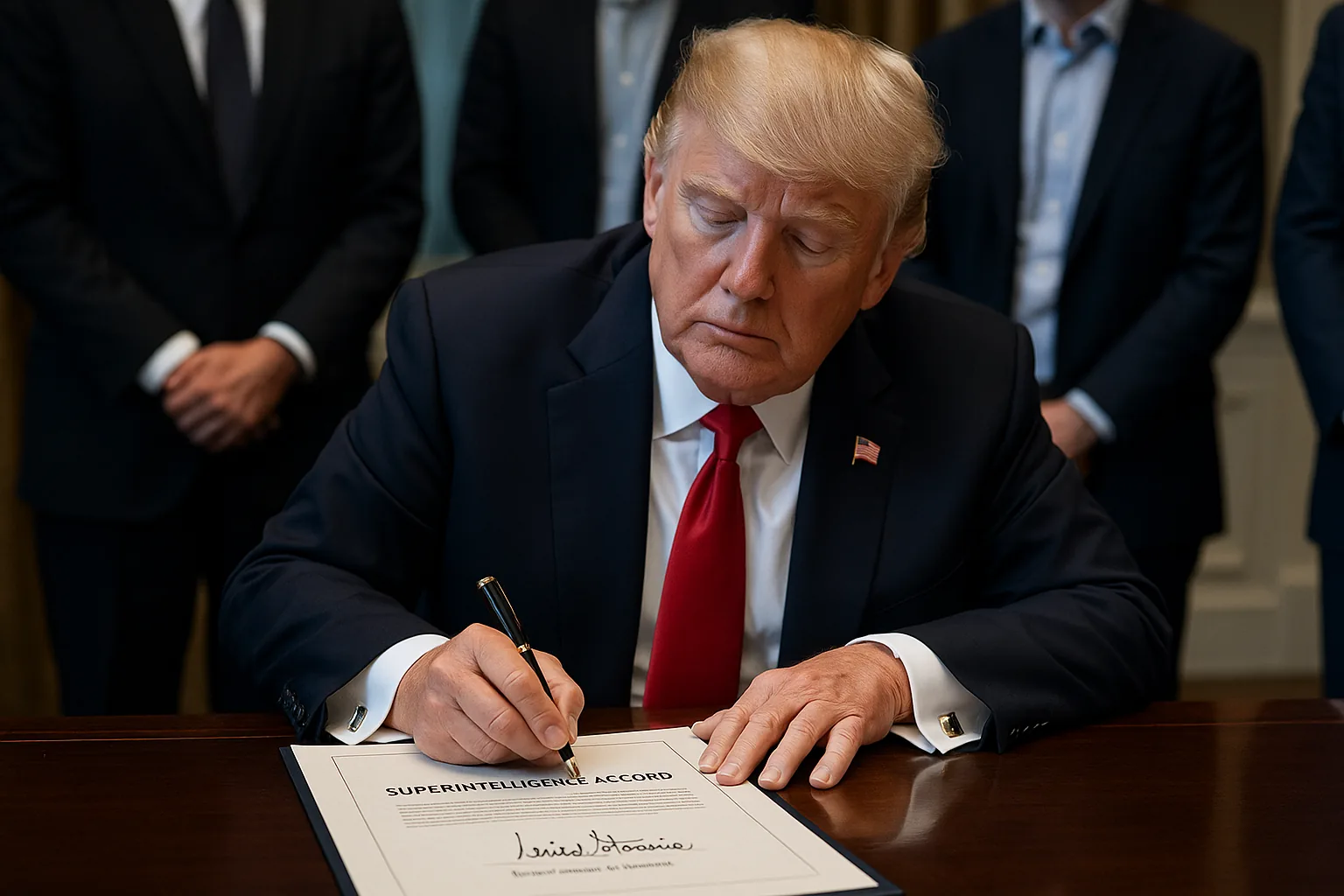
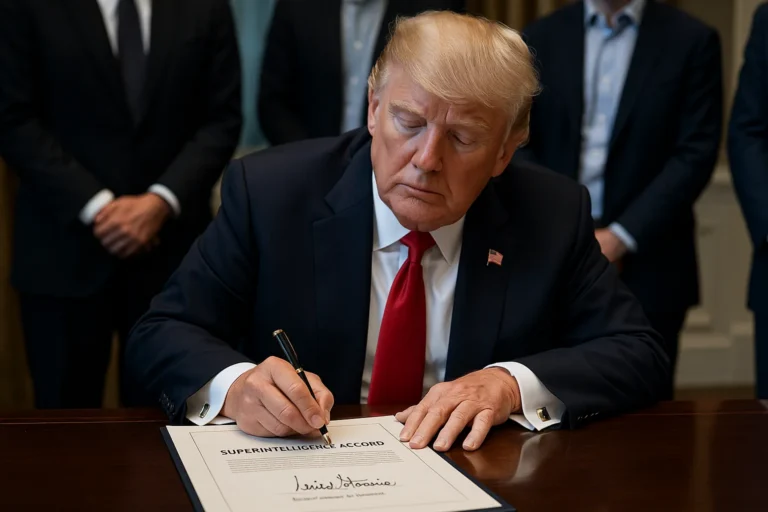
A spelling error on a high-profile White House document has drawn widespread attention and no small amount of mockery across social media platforms since the end of September 2026. The White House Accord on Super Intelligence — a document signed by President Donald Trump on September 29, 2026, alongside some of the most powerful figures in the technology industry — contains a glaring super intelligence accord typo that misspells the name of the country itself, rendering it as “Unites States” rather than the correct “United States.” The error appears directly beneath Trump’s own signature, making it one of the most conspicuous placements imaginable for a mistake of this kind on an official government document.
What the White House Accord on Super Intelligence Actually Is
To understand why the typo attracted such intense scrutiny, it helps to understand what the document represents and the context in which it was produced. The White House Accord on Super Intelligence is described as a morally binding agreement aimed at developing artificial intelligence safely. It is not a piece of legislation, nor a formal treaty requiring Senate ratification, but rather a statement of intent and shared principles between the executive branch of the United States government and the leaders of some of the most consequential technology companies operating today.
The accord reflects President Trump’s active push to rebrand artificial intelligence under the term “Super Intelligence,” or “SI,” a nomenclature he has been publicly championing in the lead-up to and following the document’s signing. Whether this rebranding effort will take hold in the broader technology and policy communities remains to be seen, but the accord itself represents a formal, if non-legislative, effort to align the federal government and private industry around a shared framework for AI development.
The document was signed at a White House event on September 29, 2026, and was subsequently posted to the White House’s official social media account on September 30, 2026. That public posting is precisely what brought the typo to mass attention: when the image of the signed document circulated online, readers quickly noticed the error beneath the president’s signature.
The Tech Executives Who Signed the Accord
The accord’s signatories read like a roster of the most influential figures in contemporary technology. Alongside President Trump, the document was signed by Elon Musk, the CEO of multiple technology and aerospace ventures; Sundar Pichai, the chief executive of Google and its parent company Alphabet; Mark Zuckerberg, the CEO of Meta; and Jensen Huang, the CEO of NVIDIA, whose chips have become foundational infrastructure for artificial intelligence workloads worldwide.
The participation of these four executives is significant for several reasons. Musk has had a complicated and publicly documented relationship with AI development — he was an early backer of OpenAI before departing its board and subsequently founding his own AI company, xAI. Pichai leads a company that has staked enormous resources on AI through products like Gemini. Zuckerberg has made AI central to Meta’s product roadmap, releasing open-source models under the Llama family. And Huang’s NVIDIA has become arguably the most critical hardware supplier in the global AI race, with demand for its H100 and successor chips far outpacing supply for much of the past several years.
The presence of these figures lends the accord a degree of industry weight that goes beyond symbolic politics. Whether a morally binding, non-legislative document can translate into concrete safety practices across organizations of this scale is a separate policy question — but the signing event itself was clearly intended to signal a convergence of governmental and corporate intent around the responsible development of what Trump and his administration are calling Super Intelligence.
→ Read also: Trump Posts AI-Generated Tiger Video and Footage of Fatal UK Zoo Attack on Truth Social
Where Exactly the Super Intelligence Accord Typo Appears
The super intelligence accord typo is not buried in a footnote or tucked into a dense paragraph of technical language. According to reporting by USA Today and confirmed by Snopes, the misspelling “Unites States” appears directly under President Trump’s signature on the document. This is among the most prominent locations on any signed agreement — the area immediately beneath a signatory’s name typically identifies their title and the entity they represent. In this case, the text that should read “United States” instead reads “Unites States,” a transposition of a single letter that fundamentally alters the word.
The error is a classic typographical mistake rather than a phonetic or conceptual one. The letters “d” and “s” are not adjacent on a standard keyboard, which means the error is less likely to be a simple keystroke slip and more likely to be a word-processing or drafting oversight — though, consistent with the verified facts available, no explanation for how the misspelling occurred has been confirmed by the White House or any official source. The absence of an official explanation or corrected version of the document is itself noted in reporting, though the reasons for that absence are not established by the available evidence.
What is established is that the image of the document — including the typo — was posted to the White House’s official social media account on September 30, 2026, the day after the signing. This means the error passed through whatever review process existed before public dissemination, and the official record of the accord as presented to the public contains the misspelling.
How the Error Spread and Why It Matters
The super intelligence accord typo spread rapidly across social media platforms after the White House posted the document image on September 30, 2026. Multiple major outlets — including USA Today, Snopes, TechCrunch, NDTV, and Hindustan Times — independently fact-checked and reported on the error, each confirming that the misspelling “Unites States” is visible in the official White House image of the signed accord.
The speed and breadth of the story’s circulation reflect several converging factors. First, the document itself was already newsworthy: a White House accord on artificial intelligence, signed by the president and four of the most prominent technology executives in the world, would attract significant media coverage under any circumstances. Second, the nature of the error — misspelling the name of the country in a document purporting to represent that country’s governmental authority — created a sharp contrast between the accord’s ambitious framing and its execution. Third, the error’s placement directly beneath the president’s signature made it impossible to attribute to a peripheral or incidental portion of the document.
From a policy communication standpoint, errors of this kind on official documents can complicate the reception of the underlying message. The White House Accord on Super Intelligence was intended to signal a serious, coordinated approach to AI safety and development. The typo, regardless of how it occurred, became the dominant story in much of the initial coverage, overshadowing the substance of the accord’s stated commitments.
The Broader Context of AI Naming and Policy
The accord exists within a broader effort by the Trump administration to shape the language and policy framework surrounding artificial intelligence. Trump has been actively promoting the term “Super Intelligence” — or “SI” — as an alternative to the more widely used phrase “artificial intelligence” or “AI.” This linguistic push is not merely semantic; it reflects an effort to frame the technology in terms that the administration finds more suitable to its policy goals and public messaging.
→ Read also: US Vote Against UN Women's Equality Resolution: Fact-Check After Trump Withdrew from UN Women
The rebranding effort has drawn mixed reactions from the technology and policy communities. Some observers see it as a meaningful attempt to distinguish transformative, general-purpose AI systems from the narrower tools that have dominated public discourse for the past several years. Others regard it as primarily a marketing or political exercise that does not alter the underlying technical or ethical challenges associated with developing powerful AI systems. The accord itself, described as morally binding, does not carry the force of law, which means its practical impact depends heavily on the voluntary commitments of its signatories.
What the accord does represent, regardless of one’s view of its substance, is a formal articulation of the administration’s intent to engage with AI safety as a governmental priority. The involvement of Musk, Pichai, Zuckerberg, and Huang suggests that at least some of the industry’s leading figures are willing to associate themselves publicly with that framing, whatever their private assessments of the document’s binding force.
A Pattern of Typographical Errors in High-Profile Documents
The super intelligence accord typo is not the first time a significant official or semi-official document has contained a spelling error that attracted public attention. Across administrations and governments, typographical mistakes on formal documents have periodically become news stories in their own right. The pattern is consistent: the higher the profile of the document, the more attention a spelling error receives, because the implicit expectation is that documents of national significance receive proportionally rigorous editorial review before signing and publication.
In the case of the White House Accord on Super Intelligence, the document was prepared for a signing ceremony involving the president of the United States and four major technology executives, then posted to an official White House social media account. Each of those steps represents an opportunity for review. The fact that the error persisted through all of them is what makes the story newsworthy beyond the simple fact of a misspelling.
It is worth noting, as the available evidence requires, that the mechanism by which the error was introduced and why it was not caught before publication are not established facts. Speculation about intent, negligence, or systemic failure in the White House’s document preparation process is not supported by the verified record. What is supported is the straightforward finding: the document, as published, contains the word “Unites States” where “United States” should appear, and that error is visible in the official image posted to the White House’s social media account on September 30, 2026.
Verification and the Limits of the Available Record
Multiple independent outlets — USA Today, Snopes, TechCrunch, NDTV, Hindustan Times, and Primetimer — have each confirmed the presence of the super intelligence accord typo in the official White House image of the document. This level of independent corroboration places the existence of the error beyond reasonable doubt.
What remains outside the verified record is equally important to state clearly. No confirmed explanation for how the misspelling occurred has been established. No official White House statement addressing the error has been confirmed by the available sources. Whether a corrected version of the document exists or will be published, and whether the accord as signed will appear in any official government registry, are questions that the available evidence does not answer. Responsible reporting on this story requires drawing a clear line between what is confirmed — the typo exists, in a specific location, on a specific document, posted on a specific date — and what is not.
The White House Accord on Super Intelligence will likely be debated on its policy merits for months to come, as the administration’s push to frame AI development under the Super Intelligence banner continues and as the technology itself evolves at a pace that challenges any static policy framework. But the immediate legacy of the document’s public debut is the striking image of a president’s signature sitting above a line that misspells the name of the nation he leads — a small error in absolute terms, and a very large one in symbolic ones.
This article was produced with AI assistance and reviewed editorially.

Political Ads in 2026 Midterms Contain False or Misleading Claims About Opponents

Trump Administration ‘Super Intelligence’ Accord Misspells ‘United States’ as ‘Unites States’

Trump Administration ‘Super Intelligence’ Accord Misspells ‘United States’ as ‘Unites States’

No Going Back PAC Ad Makes Misleading Claim About Roy Cooper and Rape Kits
