
Current Affairs
Trump Quote ‘I’ve Done a Shitty Job’ Taken Out of Context—Full Speech Shows Joke About America.gov
A viral Trump quote was taken out of context to misrepresent his meaning. The full speech shows he was joking about the America.gov portal launch.

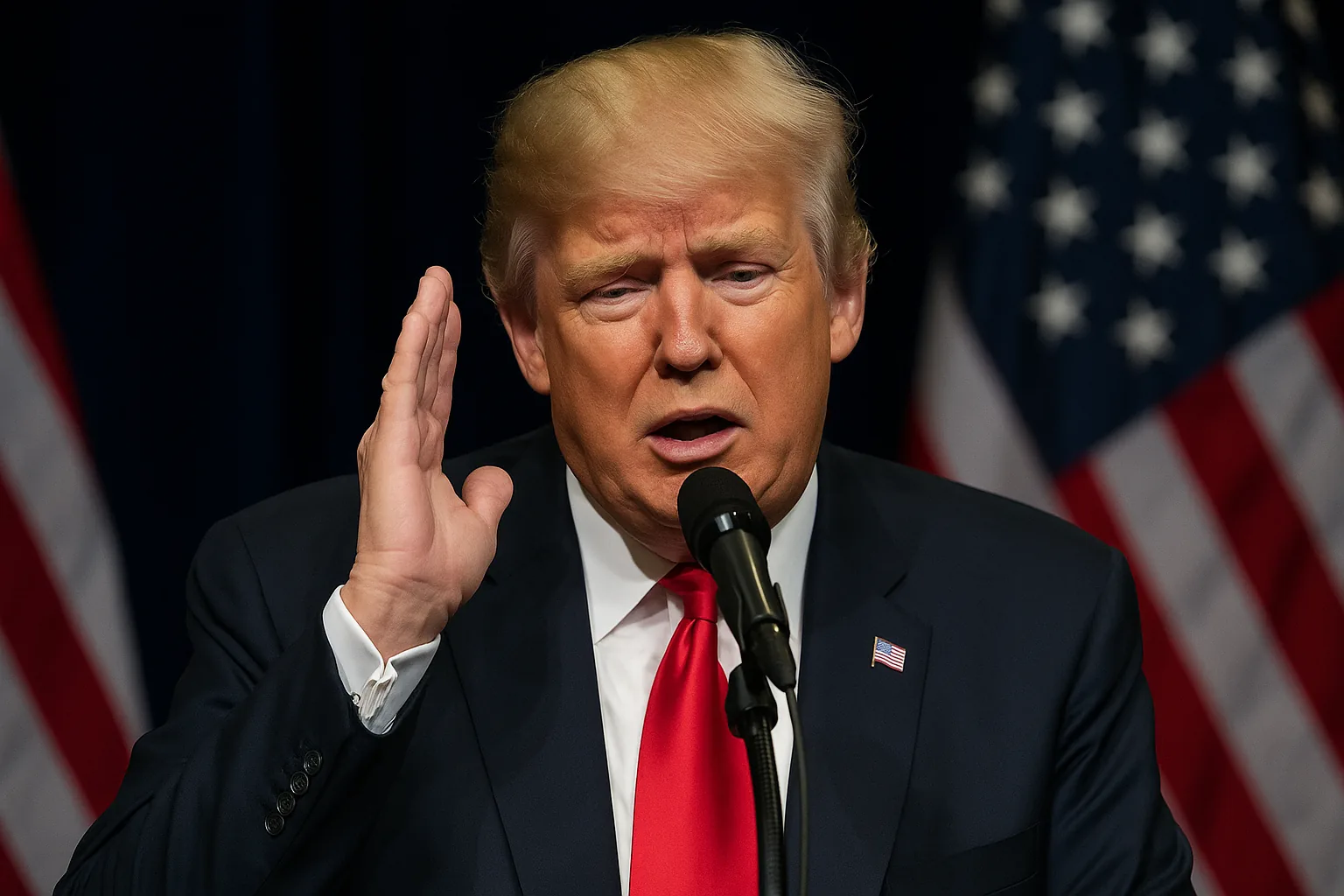
A short video clip posted across social media platforms in September 2026 appeared to show Donald Trump plainly admitting, in his own words, that he had failed as president. The clip spread rapidly, racking up millions of views within hours, and was framed by many who shared it as a rare moment of presidential self-criticism. But the full recording of the speech tells a fundamentally different story — one that illustrates, with unusual clarity, how a trump quote out of context can travel far faster than the correction that follows it.
What the Viral Clip Actually Showed
The video that circulated showed Trump uttering a phrase that, stripped of its surroundings, sounded like a candid admission of failure. Progressive accounts and Democratic critics shared it widely, often with captions presenting it as proof that even the president himself recognised his own shortcomings. Some posts accumulated hundreds of thousands of likes and shares before fact-checkers had time to publish responses.
On its face, the clip seemed explosive. A sitting president appearing to say he had done a poor job is the kind of moment that, if genuine, would dominate the news cycle for days. That surface-level impact is precisely why the decontextualised version spread so efficiently: it offered the emotional charge of a major political revelation without requiring viewers to sit through a longer, more nuanced speech.
The mechanics of how the clip was trimmed matter here. Someone — or multiple people acting independently — isolated a single sentence from a speech that ran considerably longer. The sentence, heard in isolation, carried a meaning that was categorically opposite to the meaning Trump was conveying in the full recording. That inversion is not a subtle distortion; it is a complete reversal of the speaker’s intent, and it is the defining feature of this particular episode.
The Full Quote and Its Actual Meaning
According to reporting by NJ.com and a hoax alert published by Lead Stories, Trump made the statement during the launch of America.gov on a Tuesday in September 2026. The event was a formal announcement of an AI-powered government portal designed to simplify how Americans access information and services across thousands of federal agency platforms — a significant administrative undertaking aimed at consolidating the sprawling digital infrastructure of the US government.
The full quote, as verified by fact-checkers, reads: “If it is the biggest thing I’ve ever done, I’ve done a s—ty job as president. But you know what? It’s damn, it’s damn good.” Read in its entirety, the sentence is a conditional joke. Trump was saying that if the America.gov portal turned out to be the single most significant achievement of his presidency, then his overall record would be disappointing — because he believed he had accomplished far more consequential things. He was not admitting failure; he was, in his characteristic rhetorical style, using self-deprecating framing to undersell the portal relative to his other claimed accomplishments, before pivoting to praise it enthusiastically.
This is a recognisable comedic structure: set up a hypothetical that sounds like an insult, then undercut it with a compliment. The joke only functions if the audience understands the conditional clause. Remove the conditional, and the entire meaning collapses into its opposite. That is precisely what the viral clip did.
Why This Trump Quote Out of Context Spread So Quickly
Understanding why a trump quote out of context gains traction requires looking at the information environment in which it circulates, not just the content of the clip itself. Several structural factors made this particular episode especially contagious.
First, the statement was inherently plausible to a large portion of the audience. For viewers who are already critical of Trump’s record, a clip appearing to show him admitting failure fits a pre-existing narrative. Psychologists and media researchers have long documented that people are more likely to share content that confirms what they already believe — a phenomenon sometimes called confirmation bias in information sharing. The clip did not need to be verified because it felt true to those who wanted it to be.
Second, the clip was short. Short-form video content is the dominant mode of political communication on most major platforms in 2026. A clip under fifteen seconds can be absorbed, reacted to, and reshared in the time it takes to read a single paragraph of a fact-check article. The asymmetry between the speed of misinformation and the speed of correction is not new, but it remains one of the most stubborn problems in digital media literacy.
Third, the accounts that initially amplified the clip had large followings. When a post originates from an account with hundreds of thousands or millions of followers, it reaches a critical mass of reshares before most viewers have any reason to question it. By the time fact-checkers at Lead Stories and NJ.com had published their analyses, the clip had already been embedded in countless timelines, group chats, and political newsletters as established fact.
Fourth — and this is worth emphasising — the clip was not labelled as satire or parody. It was presented as a straight recording of what Trump said. That presentation, without qualification, is what separates this episode from legitimate political commentary or humour. Satire that is clearly labelled as such serves a different social function from a decontextualised clip presented as genuine journalism.
What America.gov Is and Why the Launch Mattered
To fully appreciate how far the viral clip strayed from reality, it helps to understand what Trump was actually talking about. America.gov is an AI-powered hub announced in September 2026 with the stated purpose of simplifying how Americans access information and services across thousands of agency platforms. The federal government operates an enormous number of separate digital portals — for tax filings, benefits applications, veterans’ services, immigration paperwork, and hundreds of other functions — and navigating them has historically been a source of significant frustration for ordinary citizens.
The America.gov initiative was positioned as a consolidation effort: a single point of entry that would use artificial intelligence to route users toward the correct agency resources, answer common questions, and reduce the bureaucratic friction that has long characterised interactions between citizens and federal agencies. Whether the portal will achieve those goals in practice is a separate question, and one that remains to be answered as the platform rolls out. But the ambition of the project was real, and the launch event was a substantive policy announcement — not a casual press appearance.
Trump’s joke, in that context, was directed at the portal itself. He was, in effect, telling his audience: do not let the fact that this is a website fool you into thinking it is small — it is actually impressive. The rhetorical move was meant to pre-empt the perception that a digital portal is a minor achievement compared to legislation, executive orders, or foreign policy agreements. He framed it as something he was proud of, even if it sounded modest on the surface. The viral clip erased all of that framing.
How Fact-Checkers Verified the Record
The verification process in this case was relatively straightforward because the original speech was publicly available. Lead Stories published a hoax alert confirming that the rest of the speech had been edited away from the circulating clip, and that the full recording showed the statement was a joke. NJ.com independently confirmed the full quote and its context, reporting that the statement was made during the America.gov launch and that fact-checkers had determined it was taken out of context. HuffPost and Mediaite also covered the episode, with Mediaite specifically noting that left-wing influencers had pushed the out-of-context clip.
The verdict across these independent outlets was consistent: the claim that Trump admitted to doing a poor job as president was MISLEADING. The clip contained true elements — Trump did say those words — but it was stripped of the conditional framing and the surrounding context that determined the meaning. A statement that is technically accurate in transcription can still be profoundly misleading when the surrounding speech is removed.
This distinction is important for media literacy. The word “fake” is often applied loosely to any piece of misinformation, but this clip was not fabricated audio or a deepfake. Trump’s voice was genuine; the recording was real. What was false was the interpretation being attached to it — the claim that the quote represented a sincere admission of failure. That kind of manipulation, which operates through selective editing rather than outright fabrication, is in some ways harder to detect and correct than a straightforward forgery.
The Broader Pattern of Selective Editing in Political Video
This episode is far from unique. Selectively edited political video has become one of the most common forms of online misinformation, and it affects politicians across the political spectrum. A speech is a continuous act of communication in which meaning is built cumulatively — through setup, qualification, contrast, and emphasis. Extracting a single sentence from that structure almost always distorts the speaker’s meaning to some degree. When the extraction is deliberate and the distortion is severe, the result is the kind of trump quote out of context scenario that fact-checkers spend an increasing proportion of their working hours addressing.
The America.gov clip is a useful case study precisely because the distortion was so complete. There was no ambiguity in the full recording; the joke’s structure was clear, and the enthusiastic follow-up — “it’s damn good” — made the speaker’s actual sentiment unmistakable. And yet the clip still spread widely, still generated genuine outrage among people who believed it, and still required multiple independent fact-checking organisations to publish corrections before the record was widely understood.
For readers trying to evaluate political video in real time, the episode offers a practical lesson: before sharing a clip that seems to show a public figure saying something surprising or damaging, it is worth asking whether the full speech or press conference is available. Lead Stories’ full analysis of this clip demonstrates what a rigorous check looks like — tracing the clip back to its source event, locating the complete recording, and comparing the two versions side by side. That methodology is available to any viewer with a few minutes and a willingness to look.
The September 2026 America.gov clip will not be the last time a trump quote out of context — or a decontextualised quote from any prominent political figure — circulates as though it were a genuine revelation. What changes with each episode is the speed of amplification and, ideally, the speed of correction. The gap between those two speeds is where misinformation does its most lasting damage, and closing it depends as much on the habits of individual readers and sharers as it does on the work of professional fact-checkers. In this case, the full quote was publicly available, the context was unambiguous, and the correction was well-documented. The only thing required to get the story right was to watch the whole speech.
This article was produced with AI assistance and reviewed editorially.

Political Ads in 2026 Midterms Contain False or Misleading Claims About Opponents

Trump Administration ‘Super Intelligence’ Accord Misspells ‘United States’ as ‘Unites States’

Trump Administration ‘Super Intelligence’ Accord Misspells ‘United States’ as ‘Unites States’

No Going Back PAC Ad Makes Misleading Claim About Roy Cooper and Rape Kits
