
Current Affairs
Deepfake and Out-of-Context Video Compilations Spread False Narratives About Ukraine, Trump, and School Violence
Fact-checkers identified multiple videos edited or fabricated to mislead: a compilation mixing real and fake footage of Ukrainian soldiers, a Trump quote t

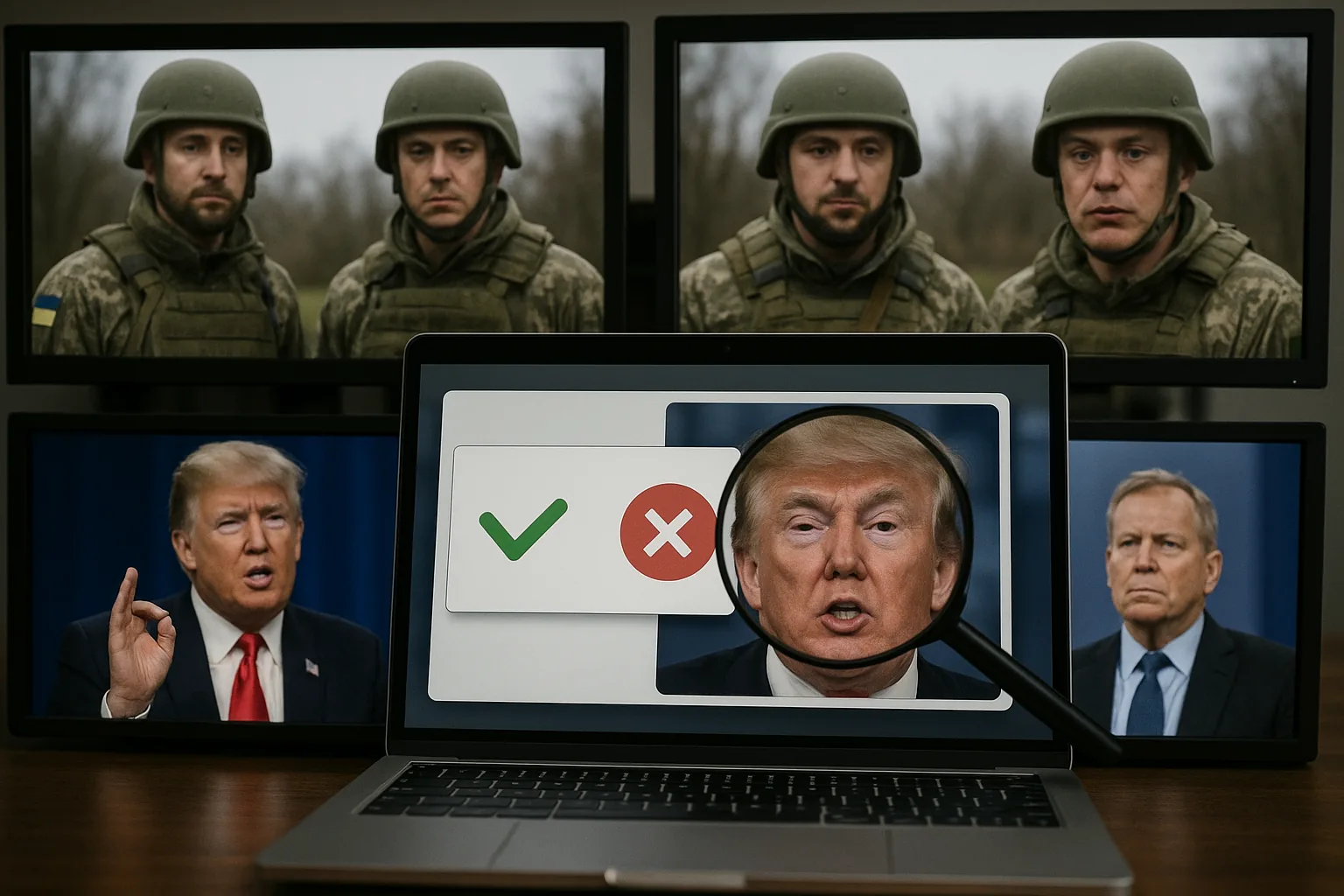
The spread of deepfake videos misinformation has reached a level of sophistication that challenges even experienced news consumers and professional journalists. Across conflicts, political campaigns, and everyday social environments, artificially manipulated audio-visual material — video or audio altered or entirely generated by machine-learning systems — is circulating at scale, eroding the baseline trust that makes factual reporting possible. Understanding how these fabrications are constructed, where they tend to appear, and what verified cases tell us about the broader threat is now an essential part of media literacy for anyone who follows current events.
What Deepfakes Actually Are — and Why They Fool People
The term deepfake combines “deep learning” with “fake,” referring to synthetic media produced using neural-network techniques that can map one person’s face or voice onto another’s body with increasing realism. Early examples were visibly imperfect — mismatched lighting, blurry edges around the hairline, unnatural blinking. Today, the artefacts are subtler, and many viewers lack the visual vocabulary to spot them without specialist tools.
Crucially, deepfakes and manipulated videos are not the same thing, though both contribute to the same information environment. A deepfake generates or substantially replaces content using artificial intelligence. A manipulated video may involve simpler edits: a clip stripped of context, spliced with unrelated footage, or paired with a misleading caption. Both categories can spread false narratives, and both require different verification approaches. The distinction matters because the remedies differ — a deepfake demands forensic analysis of the media itself, while an out-of-context clip demands tracing the original source and date.
Research on how these videos spread suggests that emotionally charged content — footage that provokes fear, outrage, or national pride — travels faster and farther than neutral material. This dynamic makes conflict zones and politically polarised environments particularly fertile ground for fabricated or manipulated media.
The Ukraine War as a Laboratory for Fabricated Conflict Footage
The Russia-Ukraine conflict has become one of the most extensively documented environments for the production and circulation of deepfake videos misinformation. Deepfakes from the Ukraine war have been identified as undermining trust in genuine conflict footage, according to reporting and analysis cited across multiple outlets. When fabricated clips circulate alongside authentic battlefield documentation, audiences struggle to distinguish the two — and some respond by dismissing all footage as potentially fake, which itself serves a disinformation function.
Verified cases include a deepfake video in which Ukrainian President Volodymyr Zelenskiy appears to call on Ukrainian soldiers to surrender — a fabrication that Ukrainian authorities and international fact-checkers identified and rebutted. The video was technically imperfect but spread rapidly before corrections reached the same audiences. This incident illustrated a pattern that researchers and journalists have since observed repeatedly: the correction rarely achieves the reach of the original false claim.
Separately, deepfake celebrity videos have been used to pressure European audiences over the Ukraine conflict, with fabricated clips purporting to show well-known public figures making statements they never made, according to reporting by Euronews. The goal, as assessed by analysts tracking the campaigns, appears to be shifting public opinion on military and financial support — though attributing specific intent to specific actors requires care and should be understood as an assessment rather than an established fact.
👉 Read also: Mislabeled and Recycled Videos Spread Online as Recent Events in September 2026
It is worth noting what the verified record does not confirm. Claims that specific compilations mixing real and fake footage of Ukrainian soldiers are circulating in a particular format have not been independently verified in the sources available at the time of writing. The pattern — mixing authentic and fabricated material within a single video package — is a documented technique, but the specific instances described in some social media posts should be treated as unverified until primary-source confirmation is available.
Political Deepfakes and the Trump-Zelenskiy Case
One of the most clearly documented individual cases of political deepfake misinformation involves a video in which Donald Trump appears to call Ukrainian President Volodymyr Zelenskiy a “total cokehead.” Australian fact-checking organisation AAP FactCheck investigated the clip and determined it to be a deepfake — Trump’s voice and lip movements had been artificially manipulated to produce a statement he did not make. The case is instructive for several reasons.
First, the fabrication targeted the relationship between two heads of government at a moment of significant geopolitical tension, making it politically consequential regardless of how many people ultimately saw it. Second, the video was technically plausible enough to prompt genuine uncertainty among viewers who encountered it without context. Third, the fact-check itself required specialist audio-visual analysis, not merely a search of the public record — demonstrating that standard verification workflows need to expand to include media forensics.
A separate category of political manipulation involves out-of-context clips rather than deepfakes in the strict sense. Statements by political figures are trimmed, reordered, or captioned to imply meanings the speaker did not intend. While specific instances described in some summaries of recent fact-check work have not been independently verified in the sources underpinning this article, the technique is well established and has been documented across multiple election cycles and conflict-related news cycles. Readers should be aware that a clip showing a politician saying something surprising is not, by itself, evidence that the politician said it in the way the clip implies.
The broader context of Russian actors creating deepfakes targeting US elections and media outlets has been reported and assessed by multiple outlets, including detailed reporting on a campaign that fabricated content associated with established American media brands. These assessments attribute the campaigns to Russian-linked actors, though readers should understand that attribution in information operations is an analytical judgement based on technical and contextual indicators, not always a directly proven fact.
School Violence, Viral Panic, and Unverified Claims
A distinct and particularly sensitive category of deepfake videos misinformation involves fabricated or manipulated footage purportedly depicting violence in school or community settings. This type of content operates differently from political deepfakes: its primary effect is not to shift opinion about a public figure but to generate immediate fear, prompt institutional responses, and potentially cause harm to named individuals or institutions through false association.
It is important to state clearly what is and is not verified here. The specific details of any school-related manipulated video incidents described in recent social media circulation have not been independently confirmed in the primary sources available to this publication at the time of writing. What is documented, across multiple prior cases, is the pattern: a clip is edited or partially generated using AI tools, given a specific school name and location in the caption or accompanying text, and shared in local parent or community groups where it spreads rapidly because it feels proximate and urgent.
👉 Read also: Fabricated Screenshots and Fake News Stories Impersonating Real Outlets (September 2026)
The consequences of such fabrications can be severe even when the underlying video is quickly identified as fake. Schools have been placed on precautionary lockdown based on viral clips. Families have been alarmed. In some documented cases, individuals named — correctly or incorrectly — in connection with such videos have faced harassment. This is why responsible reporting on this category of content requires particular care: repeating unverified specifics, even in the context of debunking, can amplify the harm.
Anyone who receives a video of this kind should apply a consistent checklist before sharing: Can the location and date be confirmed by a local news organisation? Does the clip appear in any verified reporting? Does the visual quality, metadata, or contextual detail suggest manipulation? If the answers are uncertain, the appropriate response is to report the content to the platform and, if relevant, to local authorities — not to share it further.
How to Evaluate Suspicious Video Content
Verification of video content has become a core journalism skill, and the same principles apply to any informed news consumer. The following practices are grounded in established open-source investigation methodology.
- Reverse-search keyframes: Extract a still from the video and run it through a reverse image search to check whether the footage has appeared in a different context or at an earlier date.
- Check the metadata: Where accessible, video file metadata can reveal creation dates and device information inconsistent with the claimed origin.
- Look for deepfake artefacts: Unnatural blinking patterns, inconsistent lighting between the face and background, blurring at the hairline or ears, and audio that does not quite sync with mouth movements are common indicators — though increasingly sophisticated tools reduce these tells.
- Trace the original source: Identify the earliest known upload of the clip. If the earliest version carries a different caption or appears on a different platform than the viral version, that discrepancy warrants investigation.
- Consult specialist tools: Organisations including the OECD AI Incident Monitor track documented cases of AI-generated misinformation. Forensic tools developed by academic and civil-society groups can assist with technical analysis.
- Apply the correction gap principle: Even if a video is later debunked, the debunking will reach fewer people than the original. This asymmetry means the threshold for sharing uncertain content should be higher, not lower, than for text-based claims.
The Systemic Challenge: Trust Erosion Beyond Individual Fakes
Perhaps the most consequential long-term effect of the current wave of deepfake videos misinformation is not any individual fabrication but the generalised erosion of trust in authentic footage. When audiences know that video can be fabricated, some respond by discounting all video evidence — a phenomenon researchers sometimes call the liar’s dividend. A genuine recording of a real event can be dismissed as a deepfake by anyone who finds its content inconvenient, and the burden shifts to the authenticator rather than the denier.
This dynamic is particularly visible in conflict documentation, where footage of atrocities has historically served as evidence for accountability processes. If that footage can be reflexively dismissed as AI-generated, the evidentiary value of visual documentation is weakened precisely when it matters most. Addressing this requires not only better detection technology but also provenance systems — technical standards that record and certify the origin and chain of custody of authentic media at the point of capture.
Several industry and standards bodies are working on such frameworks, including content authenticity initiatives that embed cryptographic signatures into media files. These are not yet universally adopted, and they do not solve the problem of footage captured on consumer devices without such systems. But they represent a structural response to a structural problem, complementing the case-by-case work of fact-checkers.
The current information environment demands a form of active scepticism that is neither credulous nor dismissive: one that asks, for every striking video, not just “is this real?” but “how would I know if it weren’t?” That question, applied consistently and without partisan selectivity, is the most durable protection against the harm that fabricated and manipulated media can cause — whether the subject is a war, a political leader, or a school in a community near you.
This article was produced with AI assistance and reviewed editorially.

Political Ads in 2026 Midterms Contain False or Misleading Claims About Opponents

Trump Administration ‘Super Intelligence’ Accord Misspells ‘United States’ as ‘Unites States’

Trump Administration ‘Super Intelligence’ Accord Misspells ‘United States’ as ‘Unites States’

No Going Back PAC Ad Makes Misleading Claim About Roy Cooper and Rape Kits
