
Current Affairs
AI-Generated Videos Spread False Claims About UK, Dublin, Palestine Protests
Sophisticated AI-fabricated videos depicting protests and rallies that never occurred circulated across social media in September–October 2026, bearing Google SynthID wat

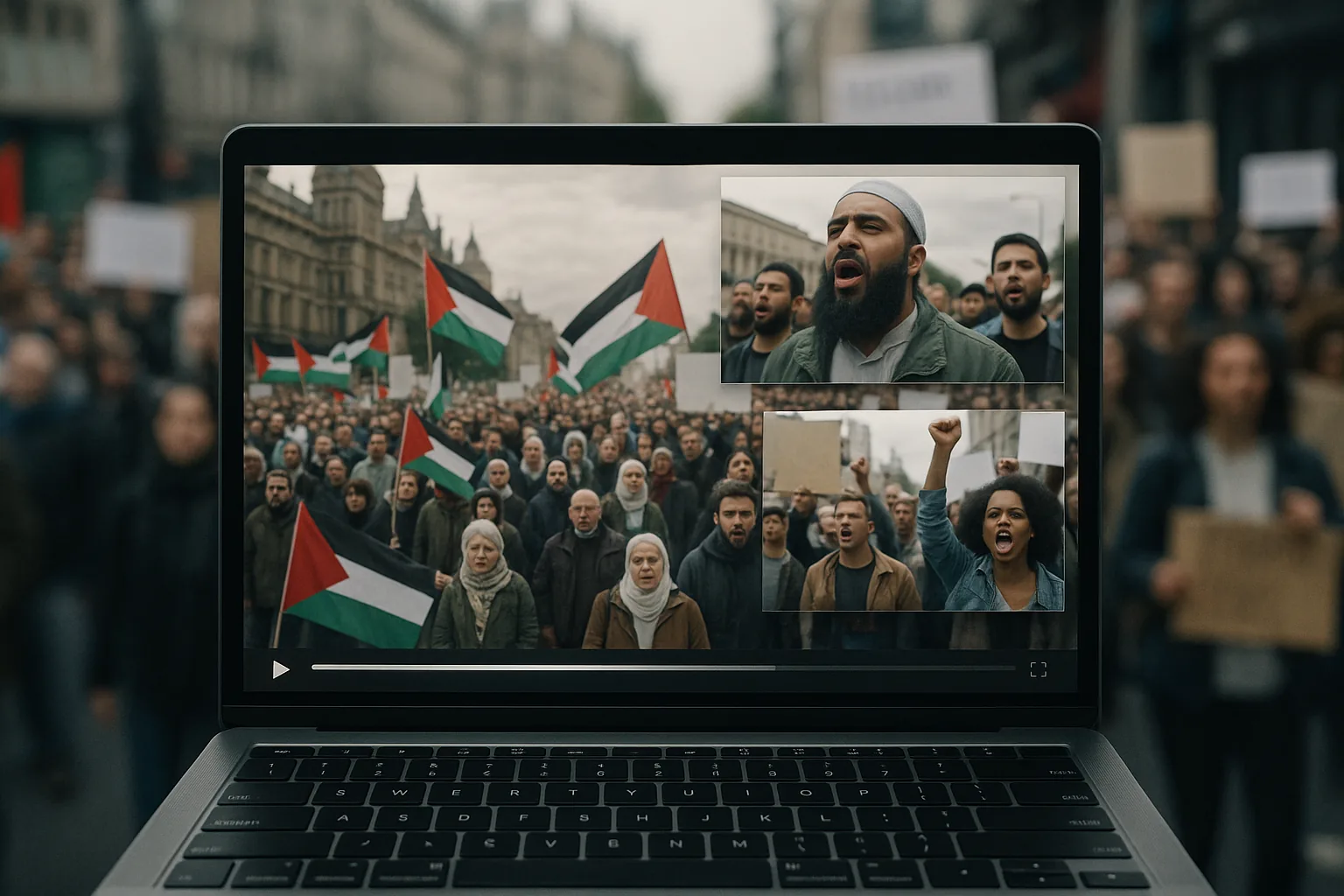
A wave of AI-generated fake videos depicting protests, public rallies, and social gatherings that never occurred has been circulating across Facebook, Threads, and TikTok throughout September and October 2026, targeting audiences in the United Kingdom, Ireland, and beyond. The videos are sophisticated enough to draw thousands of reactions and hundreds of reshares before fact-checkers can intervene, and they consistently exploit politically charged topics — immigration, the conflict in Gaza, the cost of living — to provoke strong emotional responses. What makes this moment distinct is not merely the volume of fabricated content, but the growing body of forensic evidence that allows researchers to trace exactly how these videos were made and what tools were used to make them.
A False Palestine March Bearing Google’s Own Watermark
One of the clearest documented cases in this wave involves a Facebook video captioned ‘UK peoples Stand with Palestine 🇵🇸 free Palestine free Gaza’, which shows a large crowd marching through British streets carrying Union Jack and Palestinian flags. The imagery is emotionally resonant and superficially plausible — genuine pro-Palestine demonstrations have taken place in the UK throughout 2025 and 2026 — but the video is entirely fabricated. Full Fact, the UK-based independent fact-checking organisation, confirmed that the footage is AI-generated.
The forensic evidence in this case is unusually direct. The video contains both audio and visual Google SynthID watermarks — a signal embedded by Google’s AI systems to indicate that content was generated or substantially edited using their tools. SynthID is designed to survive common post-processing steps such as compression and format conversion, making it a robust marker even when a video has been re-uploaded multiple times. Beyond the watermark, Full Fact’s analysts noted visible glitches in the footage: unnatural crowd movement and flag anomalies that are characteristic of current generative video models struggling to render complex, physics-bound objects like fabric in wind.
A related video on Threads, posted by the account ‘torontopost11’ on 21 May 2026 with the caption ‘London UK Rises for Palestine — Massive Rally Fills the Streets’, accumulated over 20,000 views and more than 390 reshares before it was flagged. Thai PBS Verify analysed this footage using Hive Moderation, an AI-content detection tool, which returned a 99.9 percent probability of AI generation. The two videos are not confirmed to share a common creator, but they demonstrate how similar fabricated narratives can spread independently across different platforms, each reinforcing the impression that a large-scale UK solidarity movement exists at a scale or in a form that may not reflect reality.
Cost-of-Living Protests That Never Happened
The Palestine-related videos are not isolated. A separate piece of AI-generated content, dated 3 June 2026, depicts an aerial shot of UK streets filled with protesters, intercut with an interview of a man speaking about the cost of living, immigration, and NHS waiting lists. The video gathered over 3,000 reactions and hundreds of shares on Facebook before fact-checkers intervened. Full Fact’s investigation found that this video, too, carries SynthID watermarks in both its audio and video tracks.
Additionally, the aerial street scenes do not correspond to any identifiable London geography — a detail that would be difficult for most viewers to verify independently but which becomes apparent when the footage is compared against satellite imagery and known street layouts. The visual glitches present in this video follow a pattern consistent with AI generation: figures at the edges of the crowd dissolve or repeat, and the lighting on the interview subject does not match the ambient conditions of the street behind him. These are not subtle artefacts; they become visible on close inspection, but casual viewers scrolling through a social media feed are unlikely to pause and scrutinise individual frames.
👉 Read also: AI-Generated and Manipulated Videos Spread False Claims About UK Protests, Asylum Policy, and Disasters
The choice of subject matter is deliberate in its political valence. Cost-of-living pressures, immigration policy, and NHS capacity are among the most contested domestic issues in British public debate. Fabricated footage of mass protests on these topics can serve to amplify the perceived intensity of public anger, potentially influencing how real people assess the political climate and how they believe their fellow citizens feel. Experts interviewed in a Euronews report published on 24 September 2026 stated that AI-generated protest videos of this kind are being used to ‘amplify societal polarisation’ — a capability that is particularly concerning given the realistic visual quality now achievable with consumer-accessible generative tools.
A Broader European Pattern on TikTok
The UK-focused videos exist within a wider European context. As of late September 2026, a mass of AI-generated videos of protests across Europe had emerged on TikTok, with content claiming that citizens in various countries had gathered to protest against immigration. The Euronews coverage confirmed this pattern, describing a sustained wave of fabricated content that had been building over approximately four months. The videos vary in production quality and in the specific claims they make, but they share a common structural feature: they depict large, emotionally charged public gatherings that cannot be verified through any contemporaneous reporting, eyewitness accounts, or official records.
This pattern matters because it suggests a coordinated or at least convergent strategy of using generative AI to manufacture the appearance of grassroots public sentiment. When a viewer sees what appears to be a crowd of thousands marching through a European capital, the natural inference is that a significant portion of the population feels strongly enough about an issue to take to the streets. Fabricated protest footage exploits this inference, creating a false impression of social consensus or mass mobilisation that can then be cited in online arguments, shared as evidence of public mood, or used to justify extreme positions.
Ireland has not been immune. AI images and false claims spread during Ireland’s fuel protests, shaping how those events were perceived online — a pattern documented by Virgin Media News. The Irish case illustrates how AI-generated content does not always replace real events but can distort the representation of genuine ones, making actual protests appear larger, more violent, or differently motivated than they were.
Anti-Muslim Narratives and the Oversight Board’s Intervention
A recurring theme in this wave of fabricated content is its targeting of Muslim communities and the use of AI-generated material to spread anti-Muslim narratives and far-right conspiracy theories in Britain. This has been documented by TRT World, which reported on the broader pattern of AI-generated content being weaponised to portray Muslim communities in the UK as threatening or culturally incompatible with British society.
The Meta Oversight Board addressed a concrete case on 17 September 2026, finding that a deepfake video of a UK local politician that fabricated the politician’s views on immigration should be removed from Facebook. The Board determined that the video contained hate speech against refugees. This ruling is significant for several reasons. First, it confirms that AI-generated fake videos are now reaching the level of specificity required to impersonate named, real individuals in ways that generate actionable platform-level consequences. Second, it establishes a precedent — at least within Meta’s own governance framework — that deepfake content fabricating political speech on immigration can meet the threshold for removal under hate speech policies, not merely under misinformation policies.
The distinction matters practically. Misinformation labels and reduced distribution are softer interventions than outright removal. By routing the deepfake politician video through hate speech policy rather than simply labelling it false, the Oversight Board applied a more decisive remedy — one that may inform how platforms handle similar content going forward.
👉 Read also: AI-Generated Videos Spread False Claims About UK Protests, Immigration, and Asylum
How Detection Works: SynthID, Hive Moderation, and Visual Forensics
The cases documented here illustrate three distinct but complementary approaches to detecting AI-generated video content. The first is watermark detection. Google’s SynthID system embeds imperceptible signals into content generated by its AI tools, and these signals can be read by authorised detection systems. The presence of SynthID watermarks in both the Palestine march video and the cost-of-living protest video provides direct, tool-specific evidence of AI generation. Watermarking is not foolproof — content generated by tools that do not embed watermarks will not carry them — but when a watermark is present, it constitutes strong forensic evidence.
The second approach is probabilistic AI-content detection, as used by Thai PBS Verify with the Hive Moderation tool. These systems analyse visual and audio features statistically, comparing them against patterns associated with AI-generated content. A 99.9 percent confidence score does not mean absolute certainty, but it represents a threshold that, combined with other evidence, supports a confident verdict. Probabilistic tools are useful precisely because they do not depend on a specific watermark being present — they can flag content from a wide range of generative systems.
The third approach is manual visual forensics: examining footage frame by frame for the characteristic artefacts of current generative video models. These include unnatural motion in complex objects such as flags, hair, and water; inconsistent lighting between foreground subjects and backgrounds; figures at crowd edges that dissolve or duplicate; and geographic or architectural details that do not correspond to real locations. These glitches are not always obvious at normal playback speed, but they become apparent under scrutiny — which is why trained fact-checkers are able to identify them even when automated tools are not immediately available.
The Full Fact investigation into the UK Palestine march video demonstrates how these methods work in combination: the SynthID watermark provided the initial forensic anchor, and visual analysis of the glitches provided corroborating evidence that the footage was not simply edited real video but was generated from scratch.
The Global Reach of Fabricated Protest Footage
The phenomenon is not confined to Europe. Multiple AI-generated videos, deepfakes, and fabricated narratives circulated during protests by Delhi’s Cockroach Janata Party at Jantar Mantar, with fake audio, misleading captions, and altered visuals spreading across Indian social media platforms. This was documented by CyberPeace, which tracked the specific techniques used: audio deepfakes spliced over genuine footage, AI-generated crowd scenes presented as documentation of real events, and captions that misidentified the location, date, or subject of the protests.
The Delhi case reinforces a pattern visible across all the documented incidents: AI-generated fake videos are most effective — and most commonly deployed — when they attach themselves to real, ongoing controversies. Genuine protests about Gaza, genuine public anxiety about the cost of living, genuine debates about immigration in Ireland and the UK — all of these provide a plausible context into which fabricated footage can be inserted. Viewers who already know that real demonstrations are happening are primed to accept that a particular video might be genuine evidence of one. The fabrication exploits prior belief, not ignorance.
Understanding this dynamic is essential for anyone trying to assess video content encountered on social media. The question is not only whether a protest or gathering could have happened, but whether this specific footage can be verified through independent reporting, geographic matching, or forensic analysis. The tools available to fact-checkers — watermark detection, probabilistic AI classifiers, and frame-by-frame visual scrutiny — are increasingly accessible to informed members of the public as well, and developing familiarity with what AI-generated video artefacts look like remains one of the most practical defences against a form of misinformation that is only going to become more technically sophisticated as generative models continue to improve.
This article was produced with AI assistance and reviewed editorially.

Political Ads in 2026 Midterms Contain False or Misleading Claims About Opponents

Trump Administration ‘Super Intelligence’ Accord Misspells ‘United States’ as ‘Unites States’

Trump Administration ‘Super Intelligence’ Accord Misspells ‘United States’ as ‘Unites States’

No Going Back PAC Ad Makes Misleading Claim About Roy Cooper and Rape Kits
