
Current Affairs
AI-Generated Deepfakes and Synthetic Media Drive Growing Share of Fact-Checking Workload
The volume of fabricated media flowing through social platforms has reached a point where AI deepfakes detection is no longer a niche technical concern — i

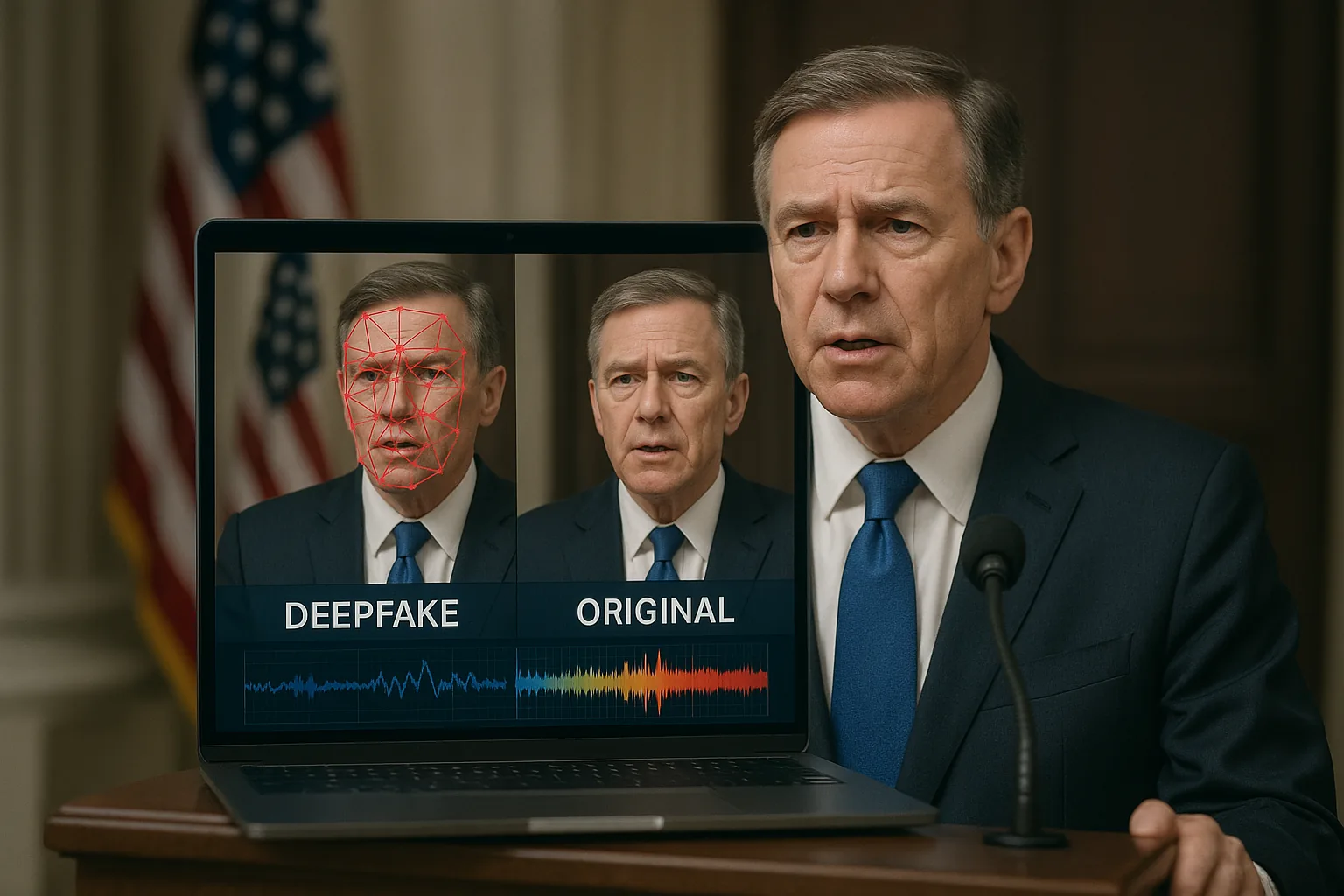
The volume of fabricated media flowing through social platforms has reached a point where AI deepfakes detection is no longer a niche technical concern — it is a daily operational necessity for newsrooms, fact-checking organisations, and ordinary people trying to understand what is real. Synthetic video, AI-generated audio, and algorithmically produced images now form a substantial and growing portion of the misinformation that researchers and journalists are called upon to investigate, representing what many in the field describe as a structural shift in how false narratives are built and distributed. Understanding how this shift happened, what it looks like in practice, and what tools and habits can help audiences navigate it has become one of the more urgent media-literacy challenges of the current decade.
How Synthetic Media Became a Dominant Misinformation Format
For most of the internet’s history, the primary vehicle for misinformation was text — a misleading headline, a fabricated quote presented in a screenshot, a manipulated statistic buried inside an otherwise credible-looking article. Images entered the picture as editing software became widely available, but creating a convincing fake video or a realistic synthetic voice remained technically demanding enough to limit who could do it. That barrier has collapsed. Generative AI tools capable of producing photorealistic video, cloning voices from a few seconds of audio, and animating still photographs are now accessible to anyone with a consumer device and an internet connection.
The consequence is visible in fact-checking workloads globally. Researchers and journalists at organisations tracking misinformation have noted that AI has become the bedrock of much of the misinformation being debunked today, spanning AI-generated images, deepfake audio, and synthetic video. This is not a marginal category sitting alongside more traditional forms of false content — it is increasingly central to the work. At the same time, NewsGuard’s AI tracking centre monitors more than 3,749 AI content farm sites and counting, websites that exist primarily to produce and distribute algorithmically generated content at scale, with little or no human editorial oversight and no meaningful commitment to accuracy.
What makes this shift particularly consequential is the combination of production volume and perceptual plausibility. A poorly written fabricated article often contains tells — awkward phrasing, implausible sourcing, internal contradictions. A well-produced deepfake video can be far more convincing on first viewing, because human cognition is wired to treat moving images and familiar voices as strong evidence. Research into how audiences respond to synthetic media has consistently shown that people’s ability to detect deepfake videos varies considerably, with many viewers unable to identify manipulated content without specific training or detection assistance.
What Deepfake Misinformation Actually Looks Like
The category of AI-generated misinformation is broad, and it helps to understand the specific forms it takes in circulation. Fact-checkers encounter several recurring types, each with its own logic and intended effect.
Fabricated Video of Public Figures
The most politically sensitive form involves deepfake video — footage in which a real person’s face and voice are synthesised to show them saying or doing something they never did. Political leaders, heads of state, and prominent business figures are frequent targets, partly because their faces and voices are extensively documented in public archives, providing the training data that generative models require. The potential consequences are serious: deepfake videos can be used to influence elections by discrediting political opponents, a concern that election-security researchers and democratic institutions have raised repeatedly as generative tools have improved. A fabricated clip showing a candidate making a damaging admission, or appearing to collapse publicly, can circulate across social platforms and accumulate millions of views before any correction reaches a comparable audience.
👉 Read also: AI-Generated and Manipulated Videos Spread False Claims About Political Events and Figures
AI-Generated Images Presented as Photographs
Synthetic still images present a related but distinct challenge. Unlike video, they require no motion coherence and can be generated in seconds, making them even easier to produce at scale. They circulate widely when they appear to document a newsworthy moment — a dramatic weather event, a crowd scene, an artefact or historical object. The challenge for audiences is that modern image-generation models produce output that closely mimics photographic texture and lighting, and casual inspection rarely reveals the fabrication. Reverse image search can help in some cases, but AI-generated images have no original source to trace back to, which limits that approach.
Synthetic Audio and Fabricated Quotes
Voice cloning has matured to the point where a convincing synthetic recording of a real person can be produced from a brief audio sample. This makes it possible to fabricate statements attributed to celebrities, scientists, or historical figures — presenting them as audio evidence of something never said. Text-based fabricated quotes, formatted to resemble screenshots of posts or news articles, have a longer history, but the addition of synthetic voice narration adds a layer of apparent authenticity that makes correction more difficult.
Why AI Deepfakes Detection Is Technically Difficult
Detection of synthetic media is an active area of technical research, and the difficulty is genuine. The fundamental problem is that detection tools and generation tools are locked in an iterative competition: as detectors improve, generation models are updated — sometimes explicitly trained to evade detection — and the cycle continues. This dynamic means that no single detection method offers permanent or universal reliability.
Current technical approaches to AI deepfakes detection fall into several broad categories. Forensic analysis looks for artefacts introduced by the generation process — inconsistencies in lighting direction, unnatural blinking patterns, subtle distortions around hairlines and teeth, or compression signatures that differ from authentic camera footage. Provenance-based approaches attempt to verify the origin of a piece of media by checking whether it carries authenticated metadata from a trusted recording device, using standards such as the Coalition for Content Provenance and Authenticity (C2PA) framework, which embeds cryptographic attestation into media files at the point of capture. Behavioural analysis examines whether facial movements, speech rhythms, and micro-expressions are consistent with natural human performance.
Each approach has limitations. Forensic artefacts become harder to detect as models improve. Provenance metadata is only useful when the recording device supports it, and most existing video on the internet was captured before such standards existed. Behavioural analysis requires high-quality source footage and can be fooled by models trained on large datasets of natural human movement. In practice, professional fact-checkers typically combine multiple methods and treat no single signal as definitive.
The Human Detection Problem
Technical tools matter, but the majority of people who encounter synthetic media are not running forensic software — they are scrolling a social feed on a phone. Research into human perception of deepfakes consistently finds that detection accuracy is highly variable across individuals and contexts. Factors that appear to influence performance include prior familiarity with the subject of the video, the viewing conditions (screen size, playback quality, time spent watching), and whether the viewer has received any prior training in identifying synthetic media.
👉 Read also: Viral AI-Generated and Manipulated Videos Spread False Claims About Recent Events
Crucially, confidence and accuracy do not reliably correlate. Some studies have found that people who are most certain they can identify a deepfake are not necessarily better at doing so. This matters because overconfidence can lead individuals to dismiss legitimate media as fake — a phenomenon sometimes called the liar’s dividend, where the mere existence of deepfake technology allows bad actors to cast doubt on authentic footage by simply claiming it was generated. The problem of AI deepfakes detection is therefore not only about identifying what is false but also about preserving trust in what is genuine.
Structural Responses: What Organisations and Platforms Are Doing
Responses to the synthetic media challenge are emerging at multiple levels, though none has yet proved sufficient on its own. Platform-level interventions have included labelling requirements for AI-generated content, automated detection pipelines that flag suspected synthetic media before it reaches wide distribution, and policies requiring political advertisers to disclose AI-generated elements in campaign material. The effectiveness of labelling depends heavily on whether users notice and interpret the labels correctly, and research on this question has produced mixed findings.
Newsroom and fact-checking organisations have invested in specialist training for journalists in synthetic media verification, covering both technical tools and analytical frameworks. Collaborative networks allow findings to be shared across organisations, reducing duplicated effort when the same fabrication circulates in multiple countries or languages. Some organisations have developed public-facing guides to help audiences apply basic verification steps themselves — checking whether a video can be found on the original broadcaster’s website, using reverse image search, looking for metadata inconsistencies, and consulting dedicated AI deepfakes detection resources.
At the standards level, the C2PA framework represents an attempt to build content authenticity into the capture and distribution pipeline itself, so that a photograph or video can carry a verifiable record of where and when it was created. Adoption is growing among camera manufacturers and major platforms, but widespread implementation will take time, and the framework does not address the vast existing archive of unattested media.
Building Practical Verification Habits
For individuals, the most reliable defence against synthetic media is not a single tool but a set of habits applied consistently. Slowing down before sharing is foundational — synthetic media tends to exploit the emotional urgency that drives rapid sharing, and pausing to ask basic questions disrupts that mechanism. Key questions include: Does this appear on any verified news source? Is the claimed event corroborated by other footage from different angles? Does the movement of the subject’s face look natural throughout, including at the edges of the frame? Is the audio perfectly synchronised with lip movement, or is there a subtle lag?
Reverse image and video search tools can identify whether footage has appeared elsewhere under a different description, which is often a strong indicator of manipulation. Dedicated AI deepfakes detection platforms — several of which are available to the public — can provide a probabilistic assessment of whether an image or short video clip shows signs of synthetic generation, though their outputs should be treated as one input among several rather than a definitive verdict. No automated tool is infallible, and the field is moving quickly enough that a tool calibrated to detect today’s generation models may lag behind tomorrow’s.
The broader challenge is cultural as much as technical. A media environment in which AI-generated content farm sites number in the thousands and synthetic video of public figures can be produced in minutes requires audiences to maintain a degree of scepticism that runs against the intuitive trust humans extend to audiovisual evidence. Building that scepticism without collapsing into a generalised distrust of all media — including authentic, important documentation — is the delicate balance that media literacy efforts are working to strike. The tools for detection will continue to improve, and so will the tools for generation; what endures as a defence is the habit of verification itself, applied carefully and consistently before any piece of synthetic-seeming content is accepted or passed on.
This article was produced with AI assistance and reviewed editorially.

Political Ads in 2026 Midterms Contain False or Misleading Claims About Opponents

Trump Administration ‘Super Intelligence’ Accord Misspells ‘United States’ as ‘Unites States’

Trump Administration ‘Super Intelligence’ Accord Misspells ‘United States’ as ‘Unites States’

No Going Back PAC Ad Makes Misleading Claim About Roy Cooper and Rape Kits
