
Current Affairs
Democratic and Republican Campaign Ads Make False or Misleading Claims in 2026 Senate Race
Democratic and Republican campaign ads in the 2026 Senate races contain false or misleading claims. Fact-checkers flag distorted records and fabricated connections affect

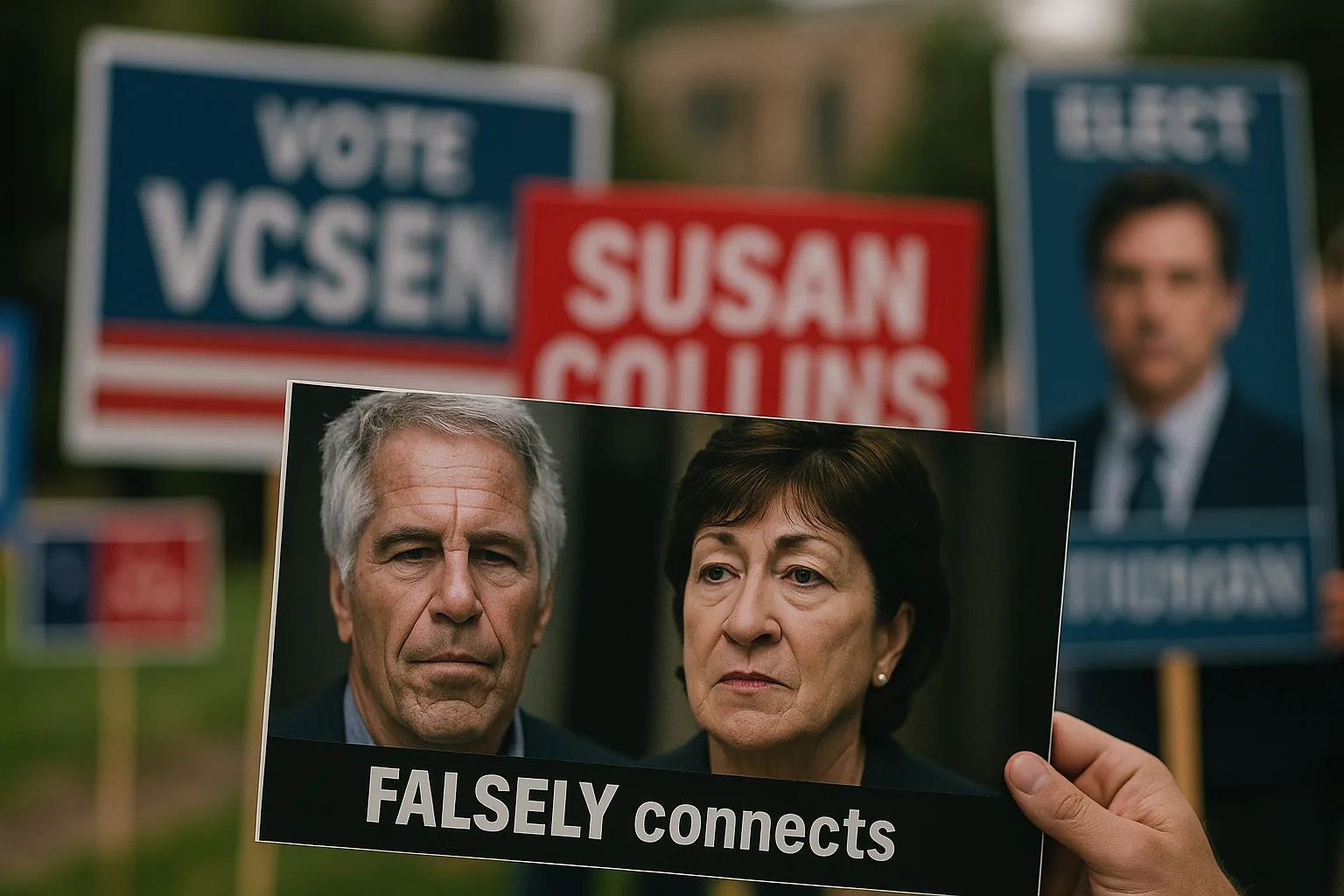
As the 2026 midterm election cycle reaches its peak intensity, a troubling and well-documented pattern has emerged across U.S. Senate races from coast to coast: false campaign ads in 2026 are appearing in significant volume from both major parties, distorting candidates’ records, misrepresenting votes, and in some cases making connections that independent fact-checkers have found to be misleading or outright false. With ad spending in Senate races approaching $500 million between early and late September 2026 alone, according to data from the Wesleyan Media Project, the sheer scale of political advertising means that even a modest percentage of misleading content reaches millions of voters at a critical moment in the democratic process.
The Scale of the Problem in This Election Cycle
The 2026 Senate landscape is fiercely competitive, and that competition has translated directly into an advertising arms race. The Wesleyan Media Project, which tracks political advertising data across broadcast and cable television, reported that spending in U.S. Senate races exceeded $112 million in a single three-week window — from September 8 through September 27, 2026. That figure represents only a fraction of the total cycle spending, which approached the half-billion-dollar threshold during that same compressed period.
When that much money floods the airwaves in a short time, the pressure on campaigns and outside groups to produce attention-grabbing content is immense. Fact-checkers at organizations including FactCheck.org, PolitiFact, and NewsGuard have been working overtime to keep pace, flagging advertisements that stretch, distort, or fabricate the records of candidates on both sides of the aisle. The Wesleyan data also found that cost of living and taxes were the top issue mentions in congressional spots during this cycle — a finding that helps explain why so many ads, regardless of party, gravitate toward economic claims that are particularly susceptible to selective framing and misleading statistics.
What makes this cycle notable is not simply the presence of misleading advertising — that is a perennial feature of American political campaigns — but rather the systematic and bipartisan nature of the distortions being documented. Independent fact-checkers have flagged significant examples from Democratic-aligned groups and Republican-aligned super PACs in roughly equal measure, undermining any narrative that one party holds a monopoly on misleading political messaging.
Democratic Ads and the Collins-Epstein Connection
One of the most striking examples of misleading advertising documented so far in this cycle involves Senator Susan Collins of Maine. According to a fact-check published by FactCheck.org, Democratic campaign advertisements have misleadingly connected Collins to Jeffrey Epstein — the financier who died in federal custody in 2019 while awaiting trial on federal sex trafficking charges.
The nature of such an ad — drawing a link between a sitting U.S. senator and one of the most notorious figures in recent American criminal history — represents an especially aggressive form of political messaging. FactCheck.org’s assessment characterizes the connection as misleading, a verdict that sits between outright fabrication and a fully accurate claim. Misleading content, by the standards used by major fact-checking organizations, typically involves true elements assembled in a way that leads viewers to a false conclusion — a technique that is arguably more insidious than an outright lie because it is harder to rebut cleanly.
The Collins-Epstein ad illustrates a broader tactic that has become more common as campaigns seek to disqualify opponents through association rather than policy contrast. When a claim is technically grounded in something real but stripped of context that would change its meaning, voters who see only the ad and not the fact-check are left with an impression that the evidence does not support. This is particularly consequential in a Senate race where name recognition and reputation are central to a candidate’s viability.
👉 Read also: Political Ads Mislead on Senate Candidates: Collins-Epstein, Cooper Rape Kits Claims Fact-Checked
Republican Ads and the Pattern of Misrepresentation
The Republican side of the ledger contains its own well-documented examples of false campaign ads in 2026, with the Senate Leadership Fund — a major Republican super PAC — featuring prominently in fact-checkers’ findings.
In the Iowa U.S. Senate race, the Senate Leadership Fund aired an advertisement claiming that Democratic candidate Josh Turek “supports amnesty for illegals.” PolitiFact, which reviewed the ad and its underlying evidence, rated the claim Half-True. That rating reflects a situation where the ad captures something real about Turek’s policy positions — he has expressed support for certain immigration reform measures — but frames those positions in a way that overstates their scope and uses charged language that does not accurately describe what the candidate has actually advocated. The “amnesty” label carries specific policy meaning that PolitiFact found the evidence did not fully support.
A separate Senate Leadership Fund advertisement targeted Sherrod Brown, the Democratic senator from Ohio, claiming that he supports “sex change surgery for minors.” Fact-checkers at Cleveland.com reviewed the ad and found that it was based on comments Brown made in 2023 about a proposed federal ban on gender-affirming care for transgender youth. The ad’s characterization of those comments — reducing a position on a proposed federal legislative ban to an endorsement of a specific medical procedure — was found to be a significant distortion of what Brown actually said and the context in which he said it.
Both of these Republican examples share a structural similarity with the Democratic Collins-Epstein ad: they begin with something real — an actual vote, an actual statement, an actual policy position — and then reframe it in language designed to provoke a reaction that the underlying facts do not warrant. This is the definition of misleading rather than false in the strict sense, but the practical effect on voters who do not have access to the original context can be the same.
Why Misleading Framing Is Often More Effective Than Outright Falsehood
Understanding why campaigns and outside groups gravitate toward misleading framing rather than outright fabrication requires a brief look at the incentive structures of political advertising. A claim that is entirely invented can be definitively rebutted with primary sources — a voting record, a transcript, a document. A claim that is misleading is far harder to counter efficiently in a thirty-second response ad, because the rebuttal requires explaining context, which is inherently more complex than the original accusation.
This dynamic is well understood by political media consultants and has been a feature of campaign advertising for decades. What has changed in 2026 is the speed and reach of digital distribution, which means a misleading ad can accumulate millions of views on social media before a fact-check is published, let alone before a rebuttal ad airs. NewsGuard’s 2026 elections misinformation tracker has been monitoring this phenomenon across the current cycle, documenting how false and misleading content spreads through social platforms in ways that traditional broadcast advertising never could.
The Wesleyan Media Project data adds important quantitative texture to this picture. When cost of living and taxes dominate issue mentions in congressional advertising, it signals that campaigns are fighting on terrain where statistics are easily cherry-picked, time periods can be selectively chosen, and causation can be falsely implied from correlation. Economic claims are particularly fertile ground for misleading framing because the underlying data is genuinely complex and voters rarely have the background to evaluate competing interpretations on the spot.
👉 Read also: Republican Campaign Ads in 2026 Senate Races: Three Fact-Checks of Misleading Claims
The Fact-Checking Ecosystem and Its Limitations
The organizations doing the most systematic work to document false campaign ads in 2026 — FactCheck.org, PolitiFact, the Wesleyan Media Project, NewsGuard, and local news outlets — perform an essential public service. Their verdicts are methodologically rigorous, their sourcing is transparent, and their willingness to apply the same standards regardless of party affiliation gives their findings credibility across the political spectrum.
But the fact-checking ecosystem operates under real constraints. The volume of advertising in a cycle approaching $500 million in Senate races alone means that a significant proportion of ads will never be reviewed. Fact-checkers must triage, prioritizing the most widely aired and most consequential claims. Ads that run in smaller markets, or that circulate primarily through digital micro-targeting, may escape scrutiny entirely.
There is also the well-documented problem of asymmetric reach: a misleading ad seen by millions of voters in a competitive state will generate a fact-check read by a far smaller audience, typically one that is already more politically engaged and more likely to seek out corrective information. The voters most likely to be influenced by a misleading ad — those with lower political knowledge and higher reliance on television advertising for political information — are statistically less likely to encounter the fact-check that corrects it.
What Voters Can Do Between Now and Election Day
For voters navigating this environment, a few practical habits significantly reduce the risk of being misled by political advertising in the final weeks of the 2026 cycle.
- Check the claim, not just the ad. When an ad makes a specific factual assertion — a vote, a statement, a statistic — search for the primary source before accepting the framing. Congressional voting records are publicly available, and candidate statements are often on the record in full.
- Note what the ad does not say. Misleading ads frequently omit the context that would change the meaning of a true fact. Ask what the full picture looks like before drawing a conclusion.
- Consult multiple fact-checkers. FactCheck.org and PolitiFact apply different methodologies and sometimes reach different nuanced conclusions. Reading both on the same claim gives a fuller picture.
- Be especially cautious with economic claims. Given that cost of living and taxes dominate this cycle’s advertising, and given how easily statistics in these areas can be selectively presented, economic claims in ads deserve particular scrutiny.
- Consider the source of the ad. Super PACs and outside groups operate under different legal constraints than candidate committees and are not required to have the candidate appear in the ad. The disclaimer at the end of an ad identifies who paid for it.
A Bipartisan Problem Without a Simple Solution
The evidence gathered by fact-checkers across this cycle makes one thing clear: false campaign ads in 2026 are not the exclusive property of either party. Democratic groups have produced content that misleads voters about Senator Collins. The Senate Leadership Fund has produced content that mischaracterizes Josh Turek’s immigration positions and distorts Sherrod Brown’s record on healthcare. The pattern is bipartisan, and the techniques — selective framing, misleading association, stripping context — are shared across the aisle.
This does not mean all misleading ads are equivalent in their severity or their reach, and fact-checkers are careful to rate individual claims on their specific merits rather than applying a blanket equivalence. But it does mean that voters who assume their preferred party is immune to this behavior are operating on an assumption the evidence does not support. The most reliable protection against being misled is the same regardless of which party’s ad is on the screen: verify before you conclude, and treat any political advertisement as a starting point for inquiry rather than a final answer.
As Election Day approaches and the volume of political advertising continues to climb, the documented examples from Iowa, Ohio, Maine, and beyond serve as a useful reminder that the gap between what an ad claims and what the evidence shows can be significant — and that closing that gap, one claim at a time, remains the essential work of an informed electorate.
This article was produced with AI assistance and reviewed editorially.

Political Ads in 2026 Midterms Contain False or Misleading Claims About Opponents

Trump Administration ‘Super Intelligence’ Accord Misspells ‘United States’ as ‘Unites States’

Trump Administration ‘Super Intelligence’ Accord Misspells ‘United States’ as ‘Unites States’

No Going Back PAC Ad Makes Misleading Claim About Roy Cooper and Rape Kits
