
Current Affairs
Houston Imam’s Request for Muslim Business Owners to Remove Haram Products Mischaracterized as Coercive Order
A Houston imam’s voluntary request to Muslim business owners to remove haram products was falsely reframed as a coercive 30-day ultimatum. Learn what actually happened.

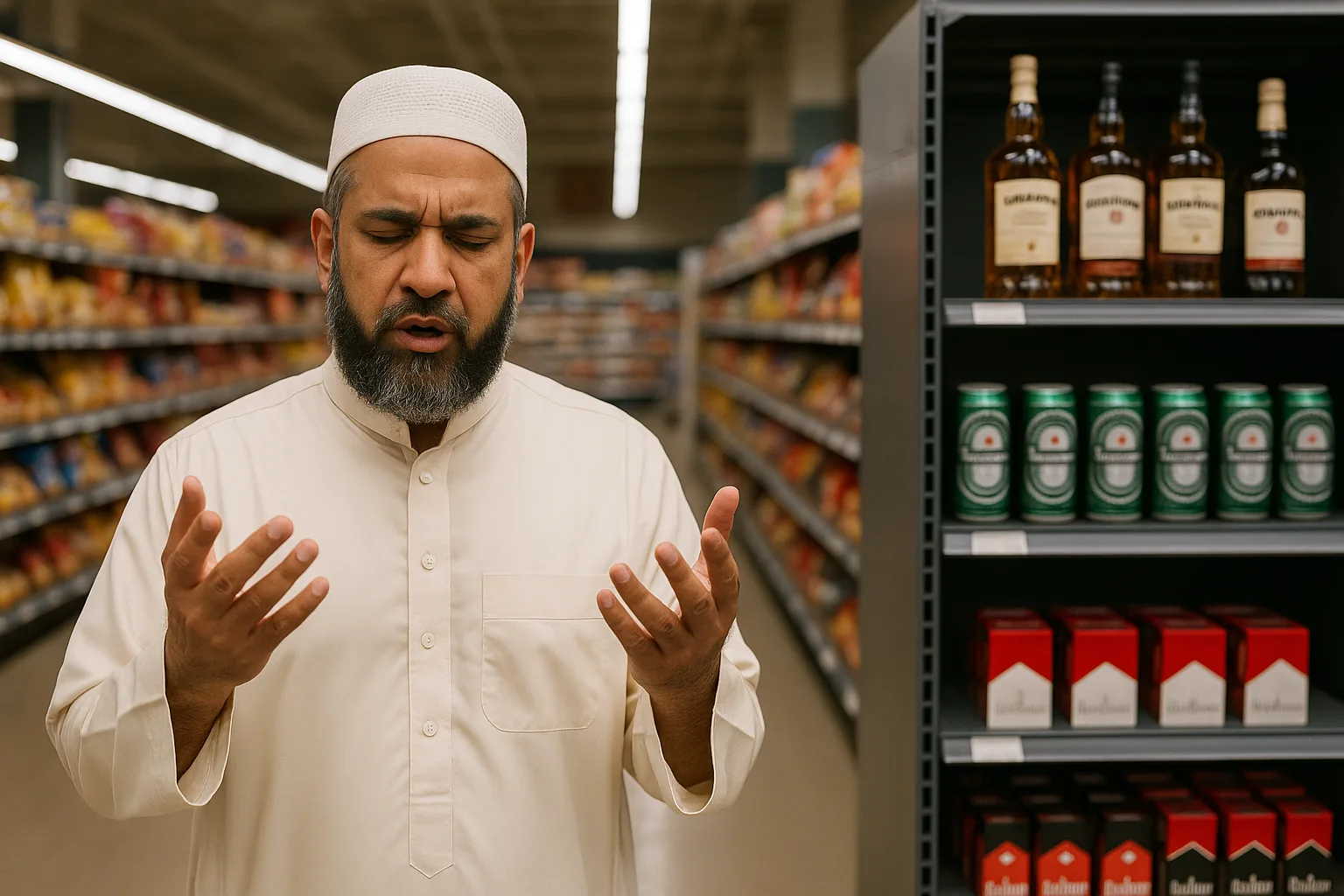
A viral social media episode that unfolded in September 2025 illustrates how quickly a religious leader’s appeal to his own community can be stripped of context and repackaged as something far more alarming. At the center of the story is F. Qasim ibn Ali Khan, a Houston imam whose request to Muslim business owners — asking them to voluntarily stop selling products forbidden under Islamic law — was transformed, in the retelling, into a coercive 30-day ultimatum directed at all Houston businesses. Understanding what actually happened, and what did not, requires separating the imam’s words from the characterizations layered on top of them. The episode involving houston imam haram products quickly became a flashpoint for political commentary, media misreporting, and broader debates about religious expression in public life in the United States.
What F. Qasim ibn Ali Khan Actually Said
In September 2025, F. Qasim ibn Ali Khan circulated videos online in which he addressed Muslim business owners in the Houston area. His request was specific in its target audience and specific in its content: he asked fellow Muslims who owned and operated businesses to consider voluntarily removing haram — that is, Islamically forbidden — products from their shelves. The products he identified included pork, alcohol, and lottery tickets, all of which fall under prohibitions recognized across major schools of Islamic jurisprudence.
The appeal was directed at co-religionists. Khan was not addressing non-Muslim business owners, not addressing the city of Houston as a whole, and not invoking any legal mechanism. He was making a moral and religious case to members of his own faith community who happened to be in commerce. This is a form of religious persuasion that has deep roots across many traditions: religious leaders routinely encourage their congregants to bring their professional and commercial lives into alignment with their faith. A Catholic priest urging parishioners not to work on Sundays, or a rabbi encouraging Jewish shop owners to close for Shabbat, would occupy the same category of speech.
Fact-checkers who reviewed the videos and surrounding context confirmed that the imam’s request was a free-speech appeal to co-religionists, not a mandate. There was no enforcement mechanism attached to his words. There was no body empowered to act on his request. There was no legal instrument, no threat of penalty, and no organizational structure described that could compel any business owner to do anything. The request was, in the most precise sense of the term, advisory.
How the Mischaracterization of Houston Imam Haram Products Spread
What circulated widely on social media bore little resemblance to what Khan had actually said. Social media posts falsely claimed he had issued a binding 30-day ultimatum to all Houston businesses, demanding they remove haram products or face unspecified consequences. The framing transformed a voluntary religious appeal into something that sounded like an extrajudicial decree — a religious leader claiming authority over commercial activity across an entire American city.
This kind of mischaracterization follows a recognizable pattern in the contemporary information environment. A piece of content — in this case, videos of a religious leader speaking to his community — is extracted from its context. Key qualifiers are dropped. The audience is expanded beyond what was specified. A voluntary ask becomes a demand. An appeal becomes an ultimatum. A timeframe that may not have appeared in the original content at all is introduced, lending a sense of urgency and menace to the retelling. The result is a version of events that is emotionally and politically potent, even if it is factually inaccurate.
The specific claim of a 30-day ultimatum is particularly telling. Snopes, which published a fact-check on the matter, found that social media posts presented this timeframe as though it were part of Khan’s original message. Whether Khan himself specified any such deadline in his original videos is not established by the verified record. What is established is that the framing of a binding, time-limited ultimatum directed at all Houston businesses was false. The houston imam haram products story, as it traveled across platforms, had been substantially altered from its origins.
The mechanics of this kind of distortion are worth examining in detail, because they are not accidental. When a claim includes a specific number — thirty days — it acquires a concreteness that makes it feel more credible, even when that number is fabricated or unverifiable. Readers encountering “a Houston imam asked Muslim business owners to consider their product choices” are likely to process that differently than readers encountering “a Houston imam issued a 30-day ultimatum to all businesses.” The second version activates alarm; the first invites reflection. Viral misinformation tends to favor the version that activates alarm.
The Political Response and Its Relationship to the Mischaracterization
The mischaracterized version of events drew sharp responses from prominent Texas political figures. Texas Governor Greg Abbott issued a statement that included the lines: “Texas law and Texas courts govern those businesses and those neighborhoods” and “No ranting imam can change that.” Senator Ted Cruz also issued a rebuke. Both responses were reported by outlets including the Texas Scorecard and picked up widely.
The political responses are themselves worth examining carefully. Governor Abbott’s statement addressed the question of legal authority — correctly noting that Texas law governs businesses in Texas, not religious proclamations. That is an accurate statement of how American law works. But the framing of his response presupposed that Khan had in fact claimed or sought legal authority over Houston businesses, which the verified record does not support. Khan made a religious appeal to fellow Muslims. He did not claim legal authority. He did not invoke sharia as a replacement for Texas law. He did not threaten non-Muslim businesses or claim jurisdiction over them.
Abbott’s response, and Cruz’s rebuke, made more sense as answers to the mischaracterized version of events — the 30-day ultimatum to all businesses — than to what Khan had actually said. This is one of the downstream consequences of viral mischaracterization: it shapes the political responses that follow, which in turn lend further credibility to the false version, because prominent figures appear to be responding to a real threat. The cycle reinforces itself. Readers who encounter Abbott’s statement about “no ranting imam” changing Texas law may reasonably infer that the imam had indeed attempted to change Texas law, when the evidence does not support that inference.
The Council on American-Islamic Relations Texas chapter (CAIR Texas) addressed the political response in its own coverage, noting that Abbott had called out the Houston imam as part of what it characterized as a broader GOP focus on targeting sharia law. The political dimension of the episode extended well beyond the original videos.
Free Speech, Religious Community, and the Limits of a Religious Leader’s Authority
One of the clearest ways to assess what Khan did is to place it within the framework of First Amendment-protected speech. Religious leaders in the United States have broad latitude to make moral and religious appeals to their communities. They can encourage, exhort, advise, and even pressure members of their congregations to live according to religious principles. What they cannot do — and what Khan did not do — is issue legally binding orders, enforce compliance, or claim governmental authority.
The distinction between a religious appeal and a coercive order is not merely technical. It is foundational to how religious freedom and civil law coexist in the United States. A pastor telling his congregation that Christians should not patronize businesses that sell certain products is exercising free speech. An imam telling Muslim business owners that their faith calls them to remove certain products from their shelves is exercising free speech. Neither is issuing a law. Neither is exercising authority over non-members of their faith community. Neither is subject to government intervention simply because the content of the speech is religious.
The houston imam haram products episode is, in this sense, a test case for how clearly the public and media can distinguish between religious speech and coercive authority. When that distinction collapses — when a voluntary religious appeal is described as a binding ultimatum — the result is not only inaccurate reporting but a potential chilling effect on the religious expression of minority communities. If the standard applied to Khan’s appeal were applied consistently, many forms of religious exhortation common across American faith communities would be subject to the same alarm.
Why Accuracy in Reporting This Story Matters
The stakes of getting this story right extend beyond one imam and one set of videos. Mischaracterizations of Muslim religious leaders’ statements as threats to American law have a documented history of generating harassment, threats, and broader anti-Muslim sentiment. When a voluntary religious appeal is described as a coercive order, the community associated with that leader faces consequences that bear no relationship to what actually occurred.
Accurate reporting on the houston imam haram products story requires holding two things simultaneously: first, that F. Qasim ibn Ali Khan made a real request, directed at Muslim business owners, to voluntarily remove pork, alcohol, and lottery tickets from their inventory; and second, that the claim he issued a binding 30-day ultimatum to all Houston businesses is false. Both facts matter. The first establishes that something actually happened and that it is legitimate to discuss and even disagree with. The second establishes that the most alarming version of the story, the version that drove political responses from the governor and a US senator, was not accurate.
Snopes’ fact-check of the episode provides a useful reference point for anyone seeking to trace the claim back to its origins. Snopes’ fact-check on the Houston imam’s haram products request documents the gap between what Khan said and what social media posts claimed he said, and it is the kind of primary verification that should anchor any serious reporting on the episode.
The broader lesson is one that applies to dozens of similar episodes: the speed at which content travels online consistently outpaces the verification of that content. By the time a fact-check establishes what actually happened, the mischaracterized version has already reached audiences many times larger than those who will encounter the correction. Political figures have already responded. Narratives have already hardened. The work of accurate reporting is therefore not only about correcting the record after the fact but about building habits of verification before amplifying claims — especially claims that describe members of religious minority communities as threats to civil order. In this case, the verified record is clear: what Khan did was ask. What he was accused of doing was something categorically different, and that difference is not a minor detail.
This article was produced with AI assistance and reviewed editorially.

Political Ads in 2026 Midterms Contain False or Misleading Claims About Opponents

Trump Administration ‘Super Intelligence’ Accord Misspells ‘United States’ as ‘Unites States’

Trump Administration ‘Super Intelligence’ Accord Misspells ‘United States’ as ‘Unites States’

No Going Back PAC Ad Makes Misleading Claim About Roy Cooper and Rape Kits
