
Information
Old Sheffield Street Video Reshared as Recent Event
A Sheffield street video from August 2024 resurfaced in September 2026 with false captions claiming it shows a recent event. Fact-checkers confirm the temporal manipulati

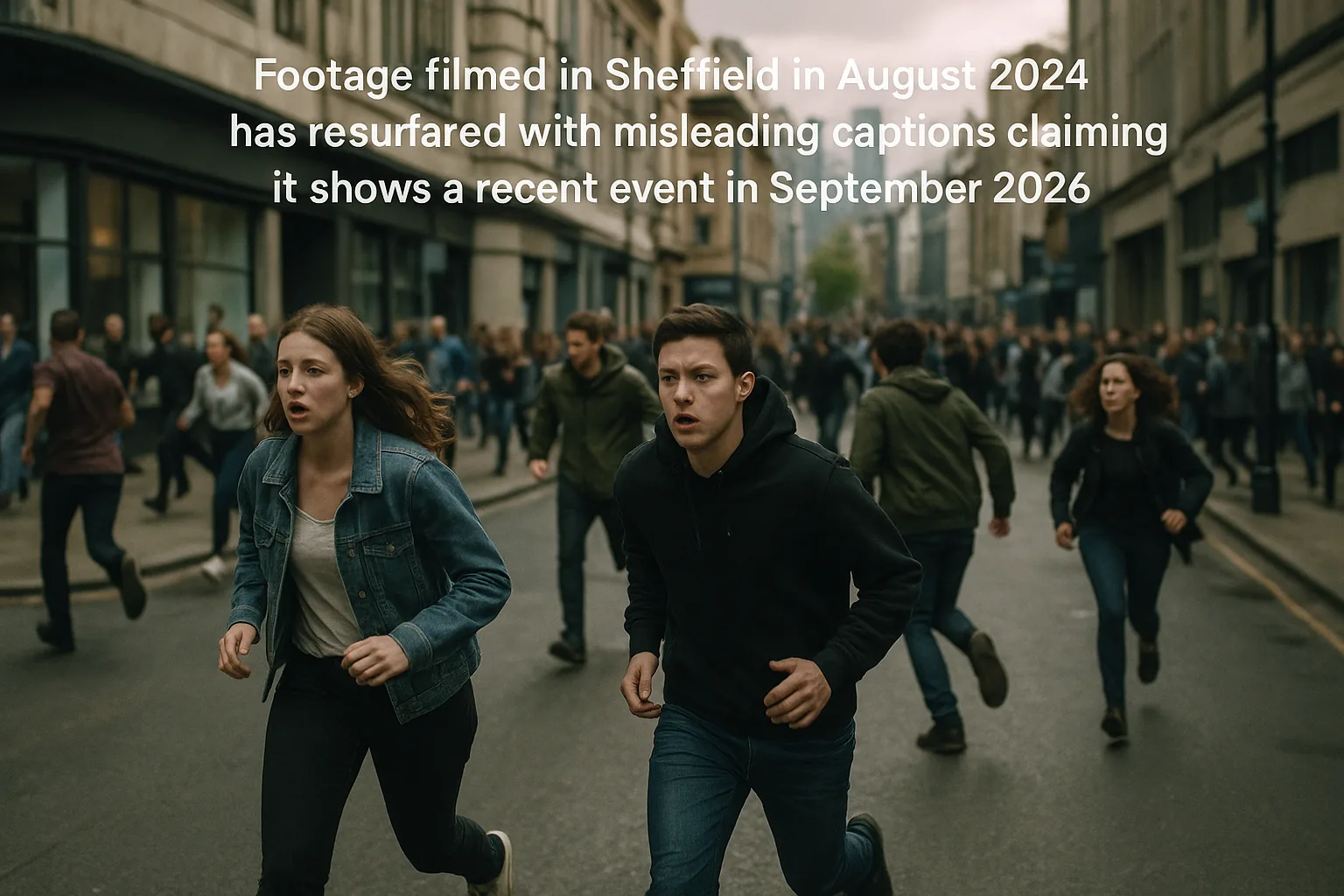
A video showing a crowd running through the streets of Sheffield, England, has resurfaced across social media platforms in September 2026, accompanied by captions claiming the footage documents a dramatic event that occurred on September 13, 2026. The problem is straightforward and verifiable: the clip is more than two years old. This is a textbook case of old video reshared with misleading captions, a pattern that fact-checkers encounter with increasing regularity and one that carries real consequences for public understanding of current events. Both Full Fact and Reuters have independently confirmed that the footage originates from August 4, 2024, not from any event in September 2026.
What the Video Actually Shows
The footage depicts a crowd of people moving rapidly through streets in Sheffield, a city in South Yorkshire, England. The scene is visually striking — hooded figures, movement, urban surroundings — and carries the kind of immediacy that makes it easy to believe it is capturing something happening right now. That visual urgency is precisely what makes it effective as a piece of misleading content.
According to Full Fact, the video was filmed on August 4, 2024, and shows a protest at Barker’s Pool, a well-known public square in Sheffield city centre. South Yorkshire Police confirmed the clip’s origin, placing it firmly at that location on that date. The Reuters fact-check, published on September 23, 2026, reached the same conclusion independently: the footage shows events in Sheffield on August 4, 2024, and has no connection to September 13, 2026 or any event on that date.
The Full Fact article, published on September 29, 2026, further underlines that the footage is more than two years old relative to the point at which it was being reshared. That time gap is not incidental — it is the entire mechanism of the deception. The video has not been altered in its content; what has been altered is the frame around it, specifically the captions and context supplied by those who reshared it.
How Old Video Reshared With Misleading Captions Spreads So Effectively
Understanding why an old video reshared with misleading captions can circulate so successfully requires looking at how people encounter and process video content online. When a short clip appears in a social media feed, the surrounding text — the caption, the account name, any hashtags — functions as the primary interpretive frame. Most viewers do not independently research the provenance of a video before forming an opinion about what it shows. They rely on the framing provided by whoever posted it.
In this case, the framing claimed the footage showed something that happened on September 13, 2026. For anyone who saw the post without prior knowledge of the original August 2024 event, there was no immediate visual cue to contradict that claim. Sheffield’s streets look like Sheffield’s streets. A crowd running through an urban environment does not carry a timestamp on its face. The deception works because it exploits the gap between what a viewer can see and what a viewer can verify.
This mechanism is not unique to this clip. Fact-checkers at organisations including Full Fact and Reuters document dozens of similar cases each year, in which genuine footage — real events, real people, real places — is stripped of its original context and repackaged with false dating or false location claims. The footage itself is not fabricated; the manipulation is entirely contextual. That distinction matters because it means the video passes a basic visual authenticity test. It looks real because it is real. Only the surrounding narrative is false.
👉 Read also: Mislabeled and Recycled Videos Spread Online as Recent Events in September 2026
The temporal dimension adds a particular layer of difficulty. When a video is mislabelled with a false location, a viewer familiar with the actual location may recognise the error immediately. But when a video is mislabelled with a false date, the only reliable way to catch the error is to find the original upload or a contemporaneous report — and that requires active investigation rather than passive viewing. Most people scrolling through a feed are not conducting active investigations.
The Role of Official Confirmation in Fact-Checking
One of the strongest elements of this fact-check is the involvement of South Yorkshire Police in confirming the footage’s origin. Official confirmation from a law enforcement agency is a primary source in the strictest sense: it is an institution with direct knowledge of events in its jurisdiction, speaking on the record. When South Yorkshire Police confirmed that the clip dates from August 4, 2024, that statement closed the most important evidentiary question — when was this filmed?
Full Fact’s methodology in cases like this typically involves tracing the video back to its earliest verifiable appearance online, cross-referencing with local news reports from the time, and seeking official comment where possible. The combination of archival tracing and official confirmation is the standard by which a temporal claim about footage can be resolved with confidence. In this instance, both elements were available, which is why the verdict is unambiguous.
Reuters conducted its own independent fact-check, published six days before the Full Fact piece, and arrived at the same conclusion through its own verification process. The convergence of two independent fact-checking organisations on the same finding, supported by police confirmation, leaves no reasonable basis for doubt about the footage’s origin. The video shows Sheffield on August 4, 2024. It does not show Sheffield on September 13, 2026.
Why the Specific Date Claim Matters
The misleading captions did not merely claim the footage was “recent” in a vague sense. They claimed a specific date: September 13, 2026. That specificity is worth examining because it performs a particular rhetorical function. A precise date makes a claim feel authoritative and eyewitness-like. It suggests the person posting the video was there, or at minimum had reliable information about when the event occurred. It discourages the casual viewer from questioning the framing, because who would invent a specific date unless they actually knew it?
This is a well-documented feature of misinformation: specificity confers false credibility. A claim that says “this happened last Tuesday in Sheffield” is more persuasive than “this happened somewhere recently,” even though neither claim has been verified by the viewer. The more concrete the false claim, the more cognitive effort it takes to dislodge it once it has been accepted.
In practice, this means that corrections — even accurate, well-sourced corrections from credible organisations — face an uphill battle. The original claim travels fast because it is simple, concrete, and visually supported. The correction requires the reader to accept that something they believed was true is not, and to update their mental model accordingly. Research on misinformation correction consistently finds that this updating process is incomplete: people who have been exposed to a false claim and then corrected often retain some residual belief in the original claim. This is sometimes called the continued influence effect, and it is one reason why preventing the initial spread of misleading content matters more than any subsequent correction.
👉 Read also: Viral Videos Misidentify Unrelated Footage as Recent Events
Temporal Manipulation as a Distinct Category of Misleading Content
It is worth situating this case within the broader taxonomy of misleading media. Fact-checkers typically distinguish between several types of problematic content: fabricated media (content that did not happen and was created from scratch or altered), out-of-context media (real content from a real event, but misrepresented as showing something else), and temporally manipulated media (real content from a real event, but presented as occurring at a different time). This Sheffield video falls into the third category.
Temporally manipulated content is particularly common during periods of heightened public attention to a particular location or type of event. When there is broad awareness that something significant is happening in a city or country, older footage from that place becomes newly useful to those who want to make claims about current conditions. The footage does not need to be fabricated; it simply needs to be old enough that most current viewers will not recognise it, and recent enough that its visual details — clothing, vehicles, signage — do not immediately signal a different era.
Sheffield, as a large English city with a documented history of public gatherings and protests, has generated a substantial archive of footage over the years. Any clip from that archive, stripped of its original metadata and recaptioned, becomes a potential vehicle for false claims about current events. The August 2024 Barker’s Pool footage is one example, but the underlying dynamic — old video reshared with misleading captions to suggest a current event — is a recurring phenomenon that fact-checkers across multiple countries document regularly.
What Viewers Can Do to Identify Misleading Footage
There are practical steps that any viewer can take to reduce the risk of being misled by old video reshared with misleading captions. None of them require specialist tools or training, though some require more effort than others.
- Reverse image search the video thumbnail. Most major search engines allow users to search by image. Uploading a screenshot from the video can surface earlier appearances of the same footage, often with the original date and context attached.
- Check the posting account’s history. Accounts that routinely share inflammatory or unverified content about public disorder are more likely to be sources of misleading material. A brief look at an account’s prior posts can provide useful context about its reliability.
- Look for corroborating local news coverage. If something significant happened in Sheffield on September 13, 2026, local outlets such as the Sheffield Star or regional broadcasters would have covered it. The absence of any such coverage is itself informative.
- Check established fact-checking organisations. Full Fact, Reuters Fact Check, and similar organisations publish their findings publicly and their archives are searchable. If a video is circulating widely, there is a reasonable chance it has already been examined.
- Note the specificity of the claim. As discussed above, a very precise date or location claim in a caption is not evidence of reliability — it can be a marker of a sophisticated false framing. Treat specificity as a prompt to verify, not as a substitute for verification.
The Verdict and Its Implications
The verdict on this specific piece of content is clear. The video shows a protest at Barker’s Pool in Sheffield on August 4, 2024. South Yorkshire Police confirmed this. Full Fact confirmed this on September 29, 2026. Reuters confirmed this on September 23, 2026. The captions claiming the footage shows an event from September 13, 2026 are false. The footage is more than two years old relative to the date of resharing, and nothing in the video itself supports the September 2026 dating.
The case is misleading rather than fabricated: the underlying footage is genuine, and the events it records did occur. What is false is the temporal framing applied by those who reshared it. That distinction does not reduce the harm — a viewer who believes they are watching a September 2026 event in Sheffield will form incorrect beliefs about current conditions in the city — but it does shape how the correction should be communicated. The footage is real; the caption is not.
Cases like this one illustrate why media literacy cannot be reduced to asking whether a video “looks real.” In an era where the most effective misleading content is often entirely genuine footage repackaged with false context, the critical question is not what the video shows but when and where it was actually filmed. Answering that question reliably requires the kind of primary-source verification that organisations like Full Fact and Reuters provide — and it requires audiences willing to pause before sharing, long enough to ask whether the framing they have been given is the framing the footage deserves.
This article was produced with AI assistance and reviewed editorially.

Political Ads in 2026 Midterms Contain False or Misleading Claims About Opponents

Trump Administration ‘Super Intelligence’ Accord Misspells ‘United States’ as ‘Unites States’

Trump Administration ‘Super Intelligence’ Accord Misspells ‘United States’ as ‘Unites States’

No Going Back PAC Ad Makes Misleading Claim About Roy Cooper and Rape Kits
