
Current Affairs
Texas Transgender Flyers Attributed to Nonexistent Student Union
False attribution flyers in Texas falsely claimed to come from a nonexistent ‘Texas Transgender Student Union,’ mimicking real nonprofit branding in a $4 million mailer c

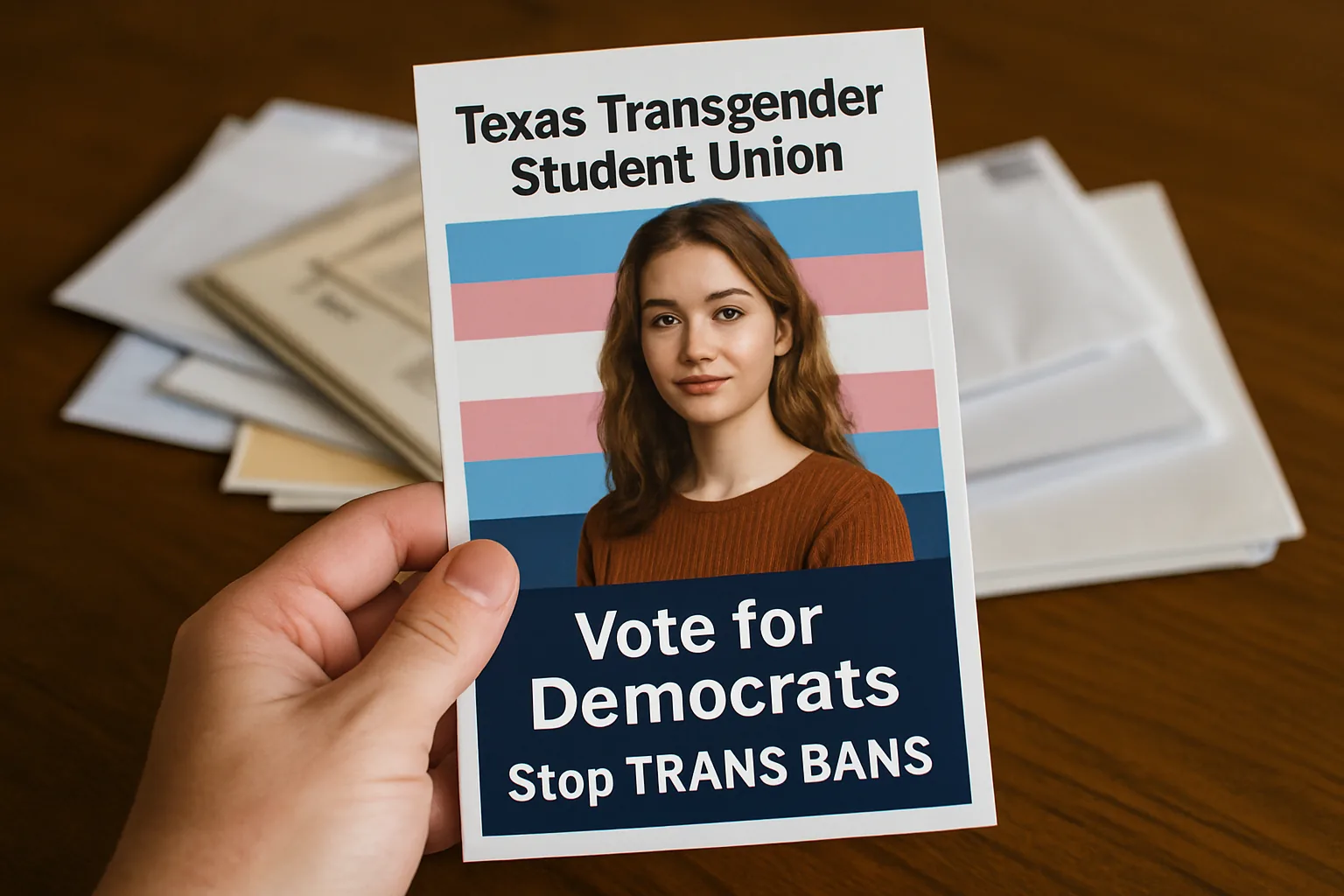
A political mailer campaign that landed in Texas voters’ mailboxes in October 2026, just ahead of early voting in the midterm elections, has drawn scrutiny after investigators and advocacy groups established that the flyers bore the name of an organization that does not exist — while closely mimicking the visual identity of a real Texas nonprofit. The episode illustrates how false attribution flyers in Texas can blur the line between legitimate advocacy and coordinated deception, raising urgent questions about accountability in election-season political messaging.
A Name That Belongs to No One
The flyers identified their sender as the “Texas Transgender Student Union” — a name that, according to reporting by The New Republic, corresponds to no registered or operating organization. No such group appears in Texas nonprofit filings, no website operates under that name, and no advocacy community recognizes it as a functioning entity. The attribution was, in plain terms, invented.
What made the campaign more than a simple case of anonymous political mail was the deliberate visual mimicry involved. The branding on the mailers closely replicated the look of the Transgender Education Network of Texas, known as TENT — a real, established organization that advocates for transgender Texans. The similarity was close enough that recipients could reasonably have assumed TENT was responsible for the content.
TENT moved quickly to distance itself from the materials. The organization publicly disavowed the mailings, making clear it had no role in producing or distributing them. That disavowal is significant: it confirms that the branding was used without authorization, and that the real organization whose identity was borrowed had no knowledge of or involvement in the campaign.
What the Flyers Actually Said
The content of the pamphlets was substantive and specific, not merely symbolic. According to verified reporting, the mailers advised recipients on how to emancipate from their parents and on how to access out-of-state medical care. Both topics carry direct legal and political weight in Texas, where state law has significantly restricted gender-affirming care for minors and where the legal relationship between minors and their parents in medical contexts has been the subject of ongoing legislative activity.
The practical guidance embedded in the flyers — covering legal emancipation pathways and out-of-state care options — meant that recipients were not just receiving a political message but were being directed toward specific courses of action. Whether that information was accurate, misleading, or legally sound is a separate question; what is established is that the materials were framed as coming from an authoritative student-led organization that does not, in fact, exist.
The combination of fabricated attribution, mimicked branding, and action-oriented content distinguishes this campaign from ordinary anonymous political mail. False attribution flyers in Texas are not unheard of in election cycles, but the scale and specificity of this effort set it apart from typical unsigned campaign literature.
The Scale of the Operation
One of the most striking verified details of this story is the financial footprint of the campaign. Reporting by the Concho Observer established that approximately $4 million was spent to send the transgender mailers ahead of early voting. That figure places this effort well outside the range of a low-budget fringe operation. Producing, printing, and mailing political literature at a volume sufficient to justify a $4 million expenditure requires infrastructure, planning, and funding sources that imply an organized and well-resourced actor — though the identity of that actor has not been established by any verified source.
It is important to be precise here: no verified reporting has identified who sent the mailers or which individual, group, or political entity funded the campaign. The $4 million figure speaks to the scale of the operation; it does not, on its own, identify the operator. Attributing the campaign to any specific party, political movement, or ideological faction would go beyond what the evidence currently supports.
→ Read also: False mental health facility claim about Texas Democrat James Talarico
What the spending figure does establish is that this was not a spontaneous or low-effort effort. A $4 million mailer campaign requires vendor contracts, mailing list acquisition, print runs, and postage logistics. Someone — or some organization — committed substantial resources to ensure these flyers reached Texas voters’ mailboxes in October 2026.
Timing and the Midterm Election Context
The timing of the mailers is a documented fact, not an inference. Residents received the flyers in mid-October 2026, a period that coincides directly with the run-up to early voting in the Texas midterm elections. Political mailers are a routine feature of election season, but the proximity of this campaign to early voting windows means that recipients were encountering the materials at a moment of heightened political decision-making.
Texas has been a focal point for legislative battles over transgender rights, parental rights in medical contexts, and related issues across multiple recent legislative sessions. That backdrop gives the content of these flyers — covering emancipation and out-of-state medical access — a specific resonance in the state’s political environment in October 2026. The mailers arrived at a moment when these topics were already prominent in public debate.
The use of false attribution flyers in Texas during an active election cycle compounds the concern. When voters receive materials that purport to come from a named organization — especially one whose branding resembles a known advocacy group — they may reasonably treat the content as more credible or authoritative than anonymous literature. The fabricated “Texas Transgender Student Union” label served, at minimum, to lend a veneer of organizational legitimacy to materials whose actual origin remains unknown.
TENT’s Position and the Impersonation Question
The Transgender Education Network of Texas occupies an uncomfortable position in this story: it is the real organization whose visual identity was apparently co-opted without its consent. TENT’s public disavowal of the mailers is the clearest on-record statement from any established entity directly connected to the campaign’s branding.
The Advocate reported on the impersonation angle, framing the episode as one in which TENT’s identity was used in a way the organization neither authorized nor endorsed. The mimicry of TENT’s branding — rather than, say, creating an entirely original visual identity — suggests that whoever produced the flyers wanted recipients to associate the materials with an existing, recognizable presence in Texas transgender advocacy.
Whether TENT has taken any additional steps in response to the impersonation — such as legal action or changes to its public-facing materials — has not been established by verified sources, and this article does not speculate on those possibilities. What is confirmed is the organization’s explicit rejection of any connection to the mailers and its public statement that the attribution was false.
What Remains Unknown
Responsible reporting on this campaign requires being explicit about the boundaries of current knowledge. The identity of the sender has not been established by any verified source. The specific geographic distribution of the mailers across Texas — which counties, cities, or districts received them — has not been confirmed in verified reporting. Whether the campaign was coordinated with any political candidate, party committee, or independent expenditure group is not established.
These are not minor gaps. In a story involving a $4 million political operation, the question of who is responsible is the central unanswered question. Readers and voters in Texas deserve that answer, and the fact that it remains open as of the time of this writing reflects the opacity that often surrounds large-scale anonymous political mail operations. For further context on disclosure requirements for political mailers, the Federal Election Commission’s guidance on political committee basics provides a useful reference point for understanding what federal law does and does not require.
The mailer campaign targeting Texas voters in October 2026 presents a documented case of fabricated organizational identity deployed at significant financial scale, during an active election period, on one of the most contested policy topics in state politics. The false attribution flyers Texas residents received bore a name that does not exist, mimicked the branding of an organization that explicitly rejected them, and contained specific guidance on legal and medical matters — all without any verified accountability for who produced or funded them. Until the sender is identified, the full significance of the campaign cannot be assessed, but the established facts alone warrant serious attention from voters, journalists, and election integrity advocates alike.
This article was produced with AI assistance and reviewed editorially.

Political Ads in 2026 Midterms Contain False or Misleading Claims About Opponents

Trump Administration ‘Super Intelligence’ Accord Misspells ‘United States’ as ‘Unites States’

Trump Administration ‘Super Intelligence’ Accord Misspells ‘United States’ as ‘Unites States’

No Going Back PAC Ad Makes Misleading Claim About Roy Cooper and Rape Kits
