
Current Affairs
Viral Video Misidentifies FC Schalke 04 Supporters as Muslim Protesters in Dublin
A viral video from October 2025 showing FC Schalke 04 hooligans in Dublin was falsely recirculated in 2026 as Muslims chanting, demonstrating how viral video misidentific

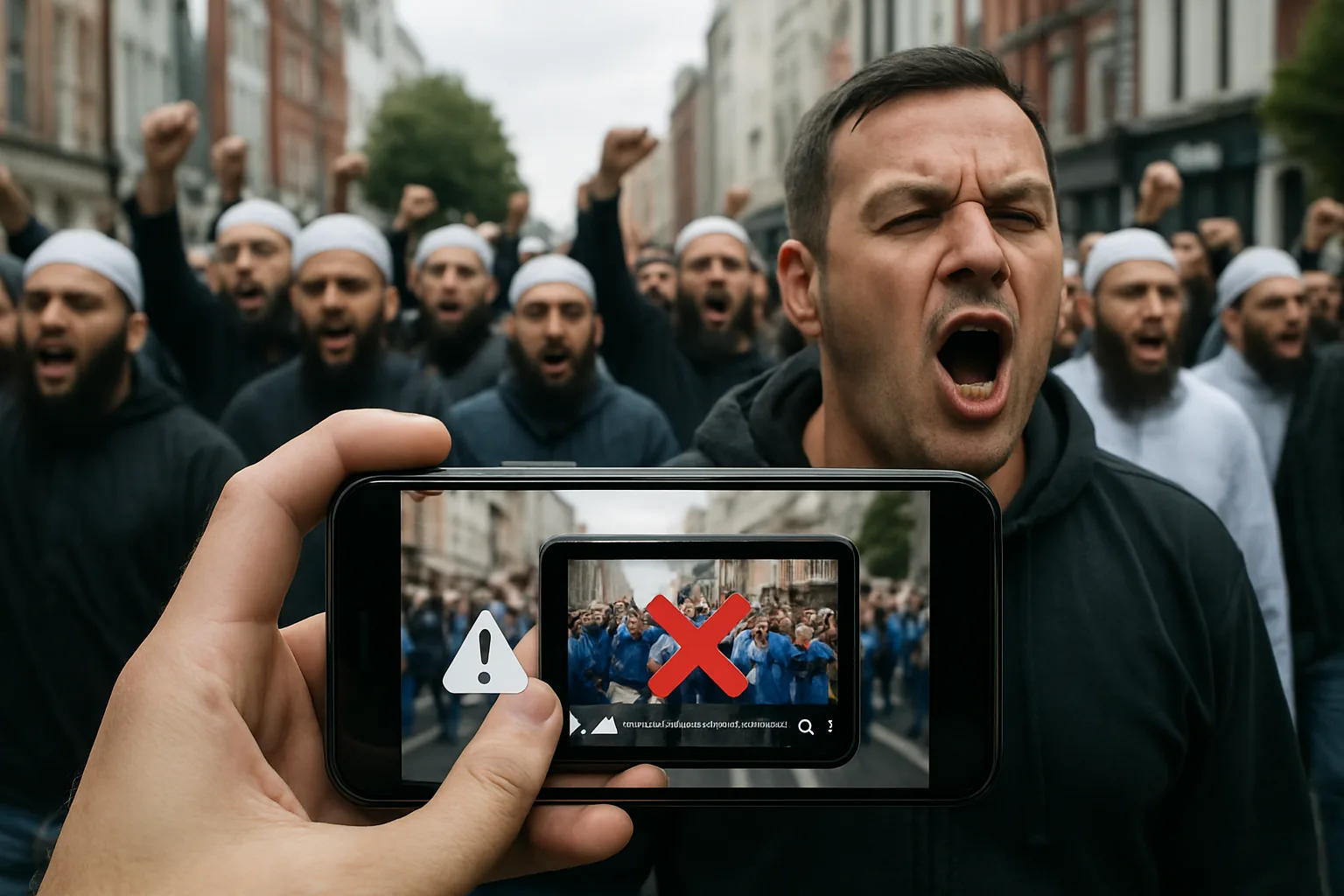
A video that spread widely across social media platforms in the weeks leading up to October 2026 carried a false and inflammatory claim: that it showed a large group of Muslims chanting on the streets of Dublin. In reality, the footage was an authentic clip from October 11, 2025, showing FC Schalke 04 football supporters — including ultras and hooligans — marching through Dublin ahead of a match. The episode is a textbook case of viral video misidentification, one that amplified religious and ethnic prejudice by stripping genuine footage of its actual context and reattaching it to a completely fabricated narrative.
What the Video Actually Shows
The footage at the center of this episode is not fabricated, staged, or AI-generated. It is a real recording of real events. On October 11, 2025, groups of FC Schalke 04 ultras were filmed marching through Dublin’s streets, chanting and, according to verified reporting, acting violently in the lead-up to a football fixture. The scenes were dramatic enough on their own terms: a large contingent of supporters moving through an urban environment in an aggressive and coordinated manner, the kind of behavior that draws attention and concern from bystanders and authorities alike.
FC Schalke 04 itself responded to the incident. The club condemned the actions of the hooligans, making clear that the behavior on display did not represent the club’s values. That condemnation was significant: it confirmed both the identity of those involved and the club’s acknowledgment that what occurred in Dublin was serious enough to warrant an official response.
None of that context accompanied the video when it resurfaced in circulation during 2026. Instead, the footage was stripped of every identifying detail — the Schalke supporter colors, the football context, the European travel dimension — and relabeled as something it was not.
How Viral Video Misidentification Fueled a False Narrative
The false claim attached to the video was specific and inflammatory: that the people shown were Muslims chanting in Dublin. According to AFP Fact Check, the footage was misrepresented not only as a religious demonstration but also, in some versions of the claim, as an anti-immigrant protest. These two framings are distinct but both false, and both were capable of provoking strong reactions from audiences who had no independent way of verifying what they were watching.
→ Read also: Viral Videos Misidentify Crowds and Events Through Mislabeling and Old Footage
This kind of viral video misidentification follows a well-documented pattern. An authentic video — one that carries the visual credibility of real events — is detached from its original context. A new caption or narrative is applied. The video then travels across platforms carried by the emotional weight of the false claim rather than any factual grounding. Audiences who encounter it mid-chain, far from the original source, have no visible signal that anything has been altered. The footage looks real because it is real. Only the label is false.
What makes this particular instance especially consequential is the nature of the false label applied. Misidentifying a group of European football hooligans as Muslims chanting in an Irish capital city is not a neutral error. It feeds into existing anxieties about immigration, religious identity, and public order in ways that can have measurable effects on public discourse and, potentially, on the safety of real communities.
John Cleese and the Role of High-Profile Amplification
The video’s reach was significantly extended by the involvement of John Cleese, the British comedian and actor, who posted the footage on social media. Cleese’s account carries a large following, and his sharing of the misidentified clip brought it to an audience far wider than it might otherwise have reached through anonymous or low-profile accounts alone.
The role of high-profile individuals in amplifying misidentified or mislabeled content is a recurring feature of modern misinformation episodes. A verified or widely followed account lends implicit credibility to whatever it shares. Followers are more likely to accept the framing offered by someone they recognize and trust, and less likely to interrogate the underlying claim. When that content also carries the visual authenticity of real footage, the combination can be particularly difficult for audiences to question.
It is worth being precise about what is established here: Cleese posted the video. What his intentions were in doing so, and whether he was aware that the identification was false, are matters that the verified record does not speak to directly. Epistemic discipline requires that the act be reported and the assessment of intent be left to the reader.
→ Read also: Viral Videos Misidentify Unrelated Footage as Recent Events
Why Dublin, and Why This Footage
Dublin has been a recurring location in misinformation narratives related to immigration and identity, particularly in the period following civil unrest in the city in late 2023. That background makes it a plausible-sounding setting for claims about public demonstrations by minority or immigrant communities, which may partly explain why the false framing attached to this footage found traction.
The Schalke 04 footage, for its part, had genuine visual drama. Groups of ultras marching through city streets, chanting in unison, are visually striking in ways that make footage of such scenes feel significant and shareable. When that footage is relabeled to suggest a religious or political demonstration rather than a football-related incident, it does not require much additional fabrication. The emotional charge is already present in the images. The false caption simply redirects it.
This is a key mechanism of viral video misidentification: the footage does not need to be manufactured. It only needs to be recontextualized. The labor required to deceive is minimal compared to the scale of the potential impact.
Identifying and Countering the Misidentification
The misidentification was identified and reported by multiple fact-checking outlets. Verified reporting confirmed that the video dated to October 11, 2025, and showed FC Schalke 04 supporters in Dublin — not a religious gathering of any kind. The club’s own condemnation of the hooligans’ behavior provided an additional layer of confirmation, anchoring the footage firmly in a football context that had been publicly documented at the time of the original incident.
Reverse image and video search tools are among the most effective instruments for countering this type of misidentification. When applied to the circulating footage, they can surface the original context — in this case, coverage of Schalke supporters’ behavior in Dublin from October 2025 — and establish a clear timeline that contradicts the false framing. The gap between the original event (October 2025) and the resurgence of the misidentified clip (the period leading into October 2026) is itself a telling detail: content that resurfaces after a significant delay has often been deliberately repackaged for a new audience or a new political moment.
What the FC Schalke 04 Dublin episode demonstrates, with unusual clarity, is that the authenticity of footage is not a guarantee of the accuracy of the claim attached to it. Real video can carry false information. The credibility that comes from watching genuine events unfold on screen can be — and routinely is — exploited to make false narratives feel true. Recognizing that dynamic, and applying basic verification before sharing, remains the most reliable defense available to anyone who encounters striking footage online. The label on a video is not the video.
This article was produced with AI assistance and reviewed editorially.

Political Ads in 2026 Midterms Contain False or Misleading Claims About Opponents

Trump Administration ‘Super Intelligence’ Accord Misspells ‘United States’ as ‘Unites States’

Trump Administration ‘Super Intelligence’ Accord Misspells ‘United States’ as ‘Unites States’

No Going Back PAC Ad Makes Misleading Claim About Roy Cooper and Rape Kits
