
Information
Viral Videos Misidentify Crowds and Events Through Mislabeling and Old Footage
Every week, millions of people share videos online without questioning whether the footage actually shows what the caption claims. This is the engine behin

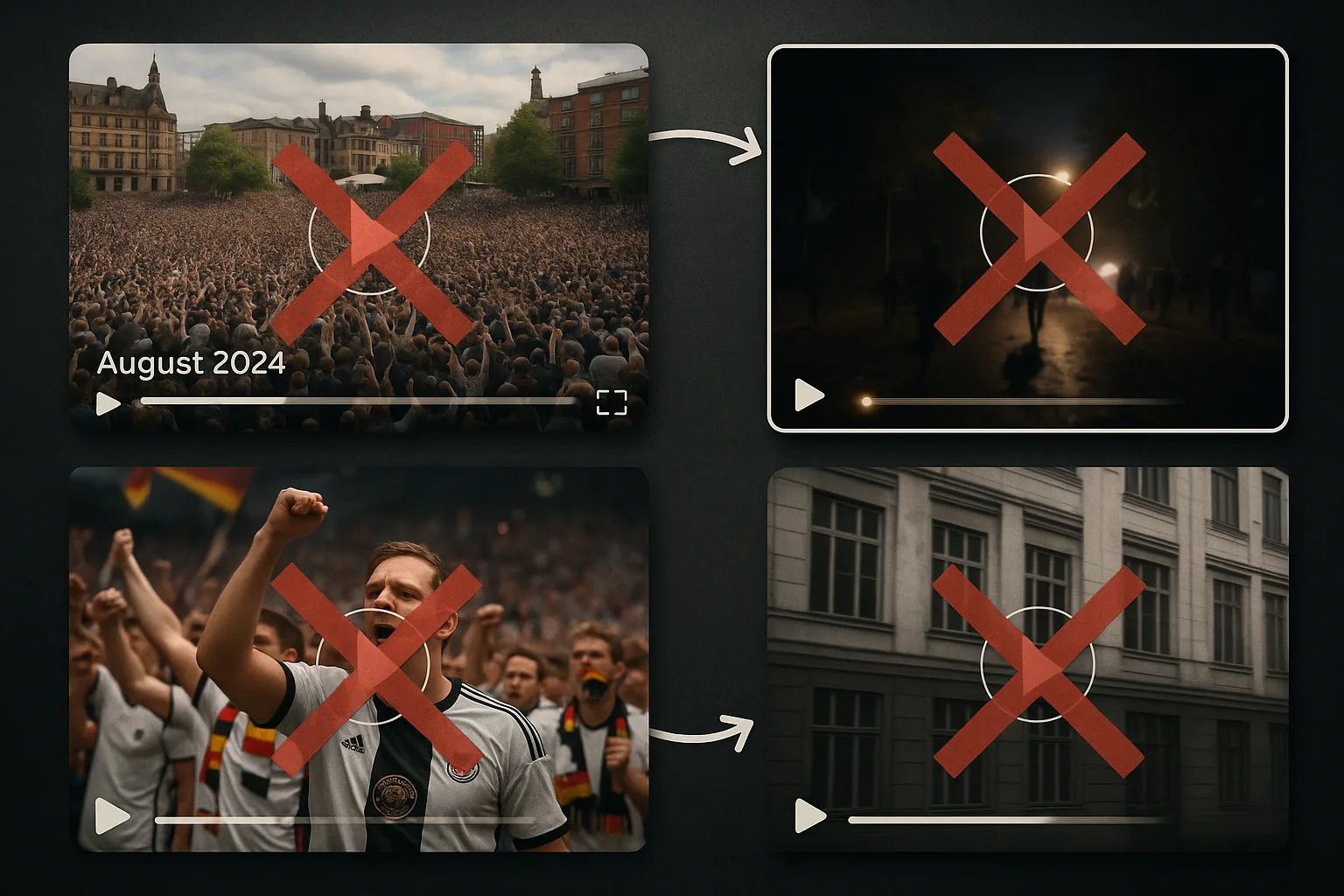
Every week, millions of people share videos online without questioning whether the footage actually shows what the caption claims. This is the engine behind viral video misinformation: content that may be entirely real in a technical sense — unaltered, unmanipulated — yet spread under a completely false label, in a different country, or from a different year than the one advertised. The gap between what a video depicts and what people believe it depicts has become one of the most consequential information problems of the present moment, and understanding how it works is the first step toward limiting its damage.
Why Mislabeled Videos Travel Faster Than Corrections
The mechanics of how a false video claim spreads are not mysterious. A clip surfaces, usually on a platform that rewards engagement over accuracy, and within hours it has been screenshot, reposted, and quoted by accounts with no knowledge of its origin. The emotional resonance of the image does most of the work: a large crowd, a dramatic queue, a mass gathering — these visuals trigger instinctive reactions that override the skeptical pause a reader might apply to a written claim.
Corrections, by contrast, move slowly. They require explanation, sourcing, and a degree of prior trust in the outlet doing the correcting. By the time a fact-check reaches a significant audience, the original false claim has already shaped the mental model of many who will never see the follow-up. Researchers who study information ecosystems sometimes call this the first-mover advantage of misinformation: the false version arrives first, and cognitive science suggests that initial impressions are disproportionately sticky.
This dynamic is not new, but the scale has changed dramatically. Smartphones mean that footage of any crowd, queue, or public gathering can be captured and uploaded globally within minutes. The same clip can be repurposed with a new caption months or years after the original event, exploiting the fact that most viewers have no way of knowing when or where something was filmed simply by watching it.
The Anatomy of Viral Video Misinformation: Four Common Patterns
While specific incidents circulating in recent months require individual verification before their details can be stated as established fact, the types of mislabeling that recur are well-documented. Fact-checking organizations have identified several consistent patterns that account for the majority of misleading video content online.
Old Footage Presented as Current
Perhaps the most common form of viral video misinformation involves footage that is entirely authentic but presented as if it were filmed recently. A crowd gathered for a summer festival in one year gets reshared during a politically charged moment two years later with a caption implying it is happening right now. The video is real; the temporal context is false. Because most social media platforms strip or obscure upload metadata, ordinary viewers have almost no way to detect the deception without actively searching for the original source.
This category is particularly effective because anyone who investigates and confirms “yes, that crowd was real” may mistakenly conclude the caption is also accurate. The manipulation is entirely in the framing, not in the footage itself.
👉 Read also: Mislabeled and Recycled Videos Spread Online as Recent Events in September 2026
Geographic Mislabeling
A second pattern involves footage filmed in one location being attributed to another. A demonstration in one country gets labeled as occurring in a different city or nation, usually to support a narrative about that second location. Footage may be real but mislabelled to make a political point, as Full Fact’s guide to misleading videos explicitly notes. This kind of mislabeling is especially effective when the locations share visual similarities — urban streets, public squares, transit hubs — that make geographic identification difficult for unfamiliar viewers.
In some documented cases, groups of people have been falsely identified by nationality, religion, or political affiliation simply because the caption asserted it. A crowd of sports supporters, for instance, might be relabeled as a religious or political gathering if the visual cues are ambiguous enough to sustain the false claim for a news cycle or two.
Contextual Misrepresentation of Queues and Gatherings
Queues are a particularly versatile raw material for misinformation. A long line of people waiting outside a building is visually striking and emotionally legible — it implies demand, urgency, or scarcity. But a queue outside a retail sale, a concert venue, or a government office looks much the same regardless of its actual purpose. Captions asserting that people are queuing for emergency food aid, free government services, or some politically charged program can attach to almost any crowd footage and be difficult to refute at a glance.
The same principle applies to institutional videos. A promotional or commemorative clip produced by an organization for one specific occasion — an anniversary, a summit, a campaign launch — can be recirculated later with a caption implying it is new, current, or represents a fresh policy position. Video manipulation includes missing context: an unaltered video presented without or with misstated context, a category that fact-checkers now treat as seriously as digital forgery.
Identity Mislabeling of Groups
Some of the most socially damaging instances of viral video misinformation involve the false identification of groups of people by religion, ethnicity, nationality, or political affiliation. A gathering of fans, workers, or ordinary members of the public gets relabeled as a threatening or alien “other,” and the video circulates as supposed evidence of a social trend or demographic shift. Because the footage is genuine and the people in it are real, the claim feels grounded in observable reality even when it is entirely fabricated at the level of description.
This pattern tends to spike during periods of social tension, when audiences are primed to believe that groups they distrust are growing in number or influence. The false label exploits existing anxiety rather than creating it from scratch.
How Professional Fact-Checkers Trace the Origin of Viral Clips
The verification of viral video content has become a specialized discipline, and the methodology is more systematic than many people realize. Fact-checkers verify viral videos by tracing early uploads, checking accounts and metadata, and using visual analysis and open-source tools, according to documented practice in the field. Each of these steps addresses a different layer of the potential deception.
Tracing early uploads means searching for the oldest available version of a clip across multiple platforms. Tools designed for reverse video search allow investigators to find where footage first appeared, often revealing that a “breaking” clip was actually uploaded months or years earlier. The account that first posted it, its follower count at the time, and any captions attached to the original upload can all provide crucial context.
👉 Read also: Viral Videos Misidentify Unrelated Footage as Recent Events
Metadata analysis — when metadata has not been stripped by the platform — can reveal the device used to film the footage, the date and time of recording, and sometimes the GPS coordinates of the camera. Even when this data is unavailable, visual analysis can be decisive: street signs, vehicle license plates, architectural styles, vegetation, clothing brands, and even the angle of sunlight can all help pinpoint when and where footage was captured.
Open-source tools like satellite imagery allow investigators to match a filmed location to a specific address. If a caption claims footage was shot in Dublin but the satellite view of the street in the video matches a location in another city, the geographic mislabeling is exposed. Snopes fact-checked at least 20 viral videos in 2024 addressing content that was digitally manipulated or misrepresented, illustrating the volume of work this kind of verification now requires.
The Specific Challenge of Institutional and Archival Footage
A growing subcategory of viral video misinformation involves footage produced by governments, international organizations, or major institutions for one specific purpose — a milestone anniversary, a policy launch, a diplomatic event — that is later recirculated as if it represents a current development. This is particularly insidious because the footage is often high-quality, professionally produced, and associated with credible-sounding organizations. Its polish lends it an air of authority that amateur footage lacks.
When a commemorative video from a major international body, produced for a specific anniversary year, resurfaces two years later with captions implying it represents a new initiative, readers have little reason to question it. The organization is real, the footage is real, and the production values suggest legitimacy. Only the temporal framing is false — but that false framing can significantly distort public understanding of what an institution is currently doing or prioritizing.
What Ordinary Viewers Can Do Before Sharing
The gap between professional fact-checkers and ordinary social media users is real, but it is not unbridgeable. Several habits, practiced consistently, substantially reduce the likelihood of amplifying mislabeled content.
- Pause before sharing any video that provokes a strong emotional reaction. Anger, outrage, and alarm are precisely the emotions that viral video misinformation is most effective at triggering, and they are also the emotions most likely to short-circuit critical evaluation.
- Check the caption against the visual evidence. Does the footage actually show what the caption claims? Are there visible signs — street signs, flags, uniforms, text on buildings — that confirm or contradict the stated location?
- Search for the earliest version of the clip. Even a basic reverse image or video search can reveal whether footage described as “today” was actually uploaded months or years ago.
- Look for corroborating coverage. If something significant is genuinely happening, multiple independent outlets will be reporting it. A dramatic event that exists only as a single viral clip, with no news coverage, is a strong signal that the framing is false.
- Treat high production quality as a neutral signal, not a mark of credibility. Institutional footage can be repurposed just as easily as amateur footage; polish does not equal accuracy.
Platform Responsibility and Structural Pressures
Individual vigilance matters, but the structural conditions that allow viral video misinformation to thrive are largely outside any individual viewer’s control. Platforms that reward engagement — measured in shares, reactions, and watch time — create an environment in which emotionally charged, context-free content outperforms careful, nuanced reporting. A mislabeled crowd video generates more immediate engagement than a 600-word fact-check explaining why the caption is false.
Some platforms have introduced friction mechanisms — interstitial warnings, reduced algorithmic amplification for flagged content, or labels attached to posts that have been reviewed — but the effectiveness of these interventions varies considerably, and their application is uneven across languages, regions, and political contexts. The challenge is not purely technical: it involves decisions about what counts as misinformation, who gets to make that determination, and how quickly the process operates relative to the speed of viral spread.
The pattern of mislabeled and recycled footage is not a new problem, and it will not be solved by any single intervention. What has changed is the sophistication of the verification tools available to those willing to use them, and the growing public awareness that a video’s emotional impact is not evidence of its accuracy. Every viewer who pauses, searches, and checks before amplifying a dramatic clip is, in a small but meaningful way, slowing the machinery that makes this kind of misinformation so effective.
This article was produced with AI assistance and reviewed editorially.

Political Ads in 2026 Midterms Contain False or Misleading Claims About Opponents

Trump Administration ‘Super Intelligence’ Accord Misspells ‘United States’ as ‘Unites States’

Trump Administration ‘Super Intelligence’ Accord Misspells ‘United States’ as ‘Unites States’

No Going Back PAC Ad Makes Misleading Claim About Roy Cooper and Rape Kits
