
Current Affairs
Trump administration declines OSCE election observers for midterms
The Trump administration did not invite OSCE election observers to the 2026 midterm elections, ending a 24-year tradition of international monitoring that began in 2002.

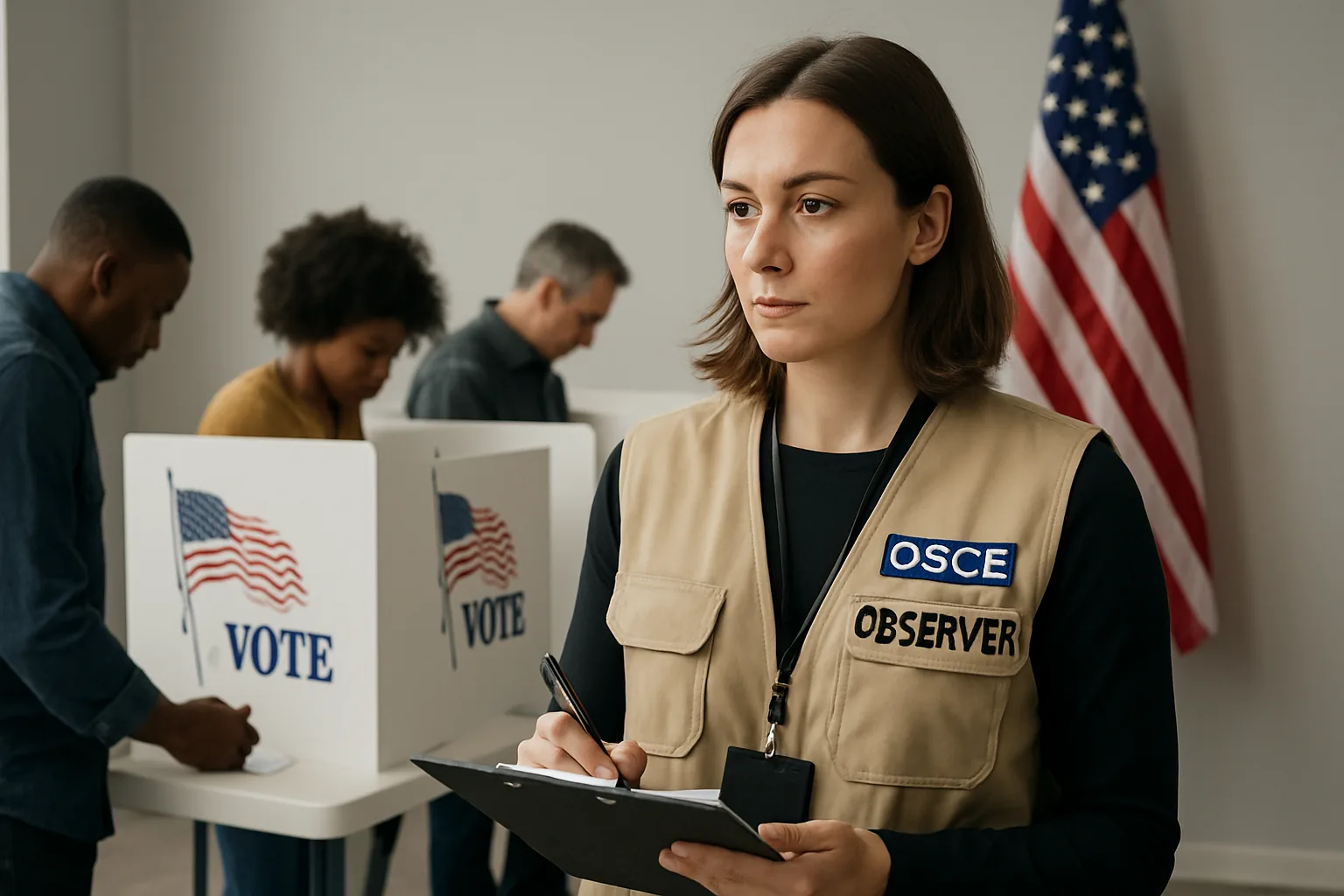

With the November 3, 2026 midterm elections now less than two weeks away, the United States is heading toward one of its most closely watched congressional votes in years — but without the international monitoring presence that has accompanied every federal election since the early years of the post-9/11 era. The Trump administration did not invite OSCE election observers to the midterms, ending a practice that had been unbroken for nearly a quarter century and drawing immediate criticism from lawmakers and international institutions alike.
A 24-Year Tradition Comes to an Abrupt End
Since 2002, the United States has extended a standing invitation to the Organization for Security and Co-operation in Europe to send observers to federal elections. That invitation covered presidential contests, midterm cycles, and off-year federal votes alike, making the United States one of the more consistent participants in the OSCE’s election-monitoring framework among its 57 member states. The arrangement was not legally mandated — it was a voluntary diplomatic gesture, rooted in the principle that open democratic processes benefit from external scrutiny.
The practical work of those observations fell to the OSCE’s Office for Democratic Institutions and Human Rights, known by its acronym ODIHR. ODIHR missions typically deploy a combination of long-term and short-term observers who assess voter registration procedures, campaign environments, media access, polling-day conduct, and the integrity of the count. Their reports, published after each election, have historically offered both commendations and pointed criticisms of U.S. electoral administration — including observations about decentralized voting systems, voter identification requirements, and the role of money in campaigns.
The decision announced in October 2026 breaks that sequence entirely. For the first time since the practice began, no ODIHR mission will be present for a federal U.S. election. Whether the administration intends this as a one-time departure or a permanent policy shift has not been confirmed from a verified source, but the immediate consequence is unambiguous: the November 3 midterms will proceed without the monitoring infrastructure that American diplomats have for decades cited as a mark of democratic openness.
How OSCE Election Observers Actually Work in the Midterms Context
Understanding what is being removed requires understanding what ODIHR observer missions actually do — and do not do. ODIHR teams do not administer elections, certify results, or intervene in any operational capacity. They observe, document, and report. In a country as large and administratively complex as the United States, where election rules vary significantly by state and even by county, the logistical challenge of comprehensive observation is considerable. ODIHR missions in the U.S. have historically focused on a sample of jurisdictions rather than attempting nationwide coverage.
→ Read also: US Vote Against UN Women's Equality Resolution: Fact-Check After Trump Withdrew from UN Women
Their presence carries symbolic weight that exceeds their operational footprint. When the United States hosts OSCE election observers for midterms or presidential races, it signals to other OSCE member states — including those with far more fragile democratic institutions — that scrutiny is a feature rather than a threat. The U.S. has, in parallel, used ODIHR reports on elections in countries like Belarus, Russia, and Hungary as diplomatic leverage, citing the organization’s findings to press for reform. Critics of the current decision argue that leverage is now significantly weakened.
ODIHR’s methodology is also notable for its consistency. Because the same institutional framework applies to elections from Warsaw to Washington, the resulting reports are broadly comparable across contexts — a feature that gives them credibility in international forums even when their findings are disputed by the governments being observed.
Senator Shaheen and Congressional Reaction
U.S. Senator Jeanne Shaheen, Democrat of New Hampshire and Ranking Member of the Senate Foreign Relations Committee, was among the first prominent voices to publicly condemn the administration’s move. Shaheen characterized the exclusion of international observers as an unprecedented step, framing it as inconsistent with the United States’ stated commitments to democratic norms both at home and abroad.
Her criticism landed in a politically charged environment. With control of the House and Senate both competitive in the November cycle, the administration’s decision is being interpreted through multiple lenses simultaneously — as a question of international obligations, as a domestic political signal, and as a test of how far the executive branch is willing to depart from post-Cold War diplomatic conventions. The Senate Foreign Relations Committee, on which Shaheen serves in a leadership capacity, has historically played a role in U.S. engagement with multilateral institutions including the OSCE.
No verified rationale from the Trump administration for the exclusion decision has been confirmed by the sources underlying this article. The absence of an official, on-record explanation makes it difficult to assess whether the decision reflects a substantive policy objection to international election monitoring, a broader skepticism toward multilateral institutions, or some other consideration entirely. Attributing a specific motive without that verified basis would go beyond what the available evidence supports.
→ Read also: U.S. Votes Against U.N. Women's Equality Resolution: Was America Alone?
The OSCE’s Response and What It Signals
The OSCE described the decision as ‘regrettable’ — a term that, in the measured language of international institutions, carries significant weight. The organization has not, based on verified sources, issued a more detailed public statement beyond that characterization. The word nonetheless places the United States in a category of OSCE member states that have declined or obstructed observation missions — a category that has historically included governments the U.S. itself has criticized for democratic backsliding.
The OSCE framework operates on the principle that member states have committed to welcoming election observation as part of their obligations under the OSCE’s human dimension commitments. Those commitments are political rather than legally binding in the strict sense, but their force derives precisely from consistent voluntary compliance. A decision by one of the organization’s most prominent members to forgo an invitation — particularly one that breaks a 24-year chain — has implications for how other member states may calculate their own compliance going forward.
It is worth noting that the OSCE’s 57-member composition includes states with very different democratic track records. The organization’s election observation function has always depended on a degree of reciprocity: states that invite observers gain standing to cite ODIHR findings when pushing back on elections elsewhere. That reciprocal dynamic is now, at minimum, complicated for U.S. diplomats operating in OSCE forums.
Precedent, Context, and What Comes Next
The 2002 baseline matters for context. The United States began inviting OSCE observers in the aftermath of the 2000 presidential election, a contest whose disputed resolution exposed significant vulnerabilities in American electoral administration. The invitation was, in part, a response to international criticism and a demonstration that the U.S. was willing to subject its processes to the same scrutiny it applied to others. That origin story gives the current reversal an added layer of significance: the practice was adopted precisely as a confidence-building measure, and its removal raises questions about what confidence is now being built or eroded.
The midterms on November 3, 2026 will determine the composition of the entire House of Representatives and a portion of the Senate. They arrive at a moment of heightened domestic and international attention to the health of American democratic institutions. The elections themselves will proceed under the administration of state and local officials, as they always have — ODIHR’s absence does not alter the legal or administrative framework governing the vote. What it alters is the external accountability layer that has, for more than two decades, provided an internationally recognized reference point for assessing that vote’s conduct.
Whether the administration revisits this decision for future election cycles, and whether Congress moves to formalize the invitation process in statute rather than leaving it to executive discretion, are questions that will almost certainly be debated in the weeks and months following November 3. For now, the United States heads into its first unobserved federal election in 24 years — a fact that carries weight regardless of how the ballots ultimately fall.
This article was produced with AI assistance and reviewed editorially.

Political Ads in 2026 Midterms Contain False or Misleading Claims About Opponents

Trump Administration ‘Super Intelligence’ Accord Misspells ‘United States’ as ‘Unites States’

Trump Administration ‘Super Intelligence’ Accord Misspells ‘United States’ as ‘Unites States’

No Going Back PAC Ad Makes Misleading Claim About Roy Cooper and Rape Kits
