
Current Affairs
Flydubai Flight FZ1073 Incident Spawns Multiple False Conspiracy Videos
When Flydubai Flight FZ1073 was dramatically diverted to Saudi Arabia on September 30, 2026 , the world had barely processed the news before a parallel inf

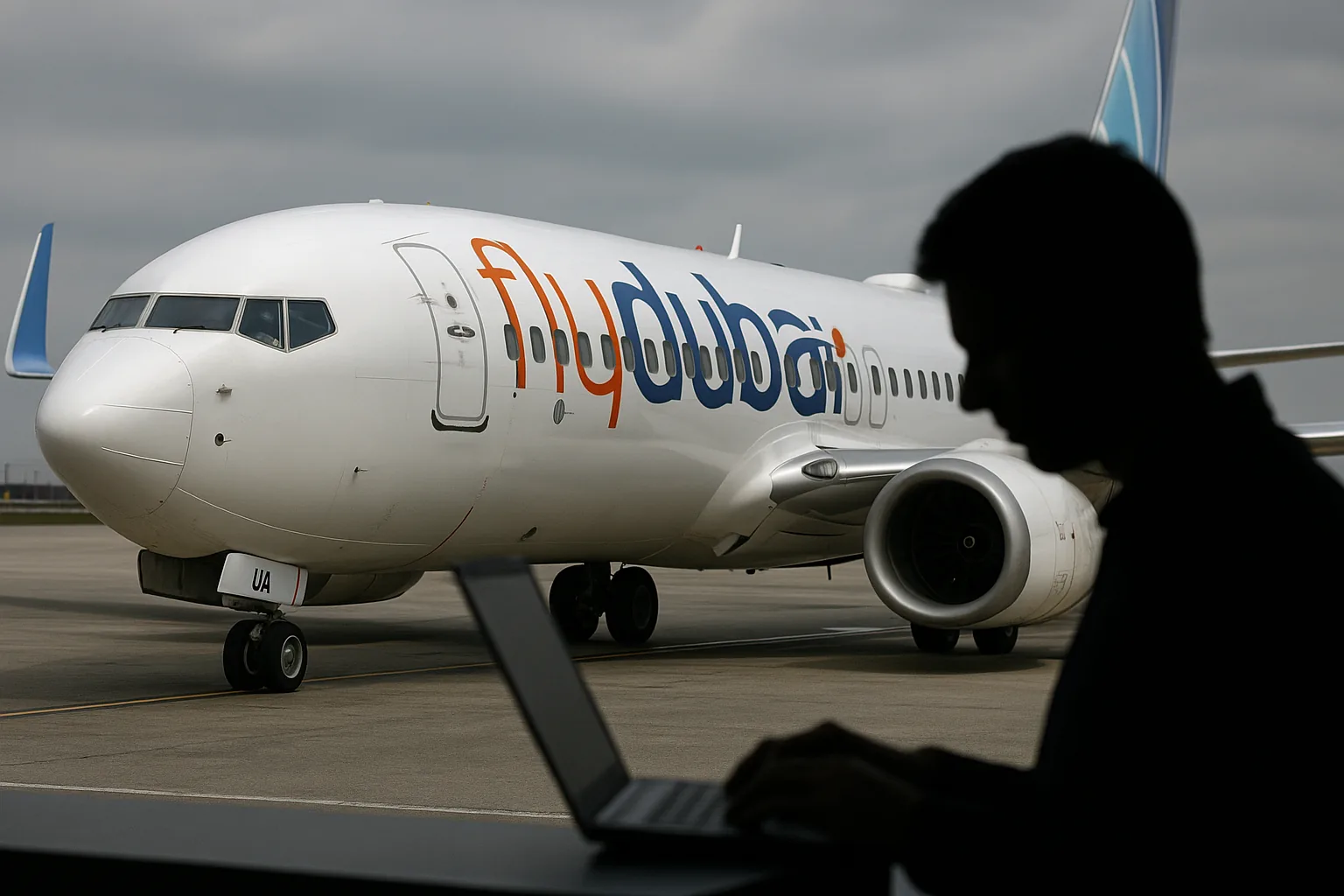
When Flydubai Flight FZ1073 was dramatically diverted to Saudi Arabia on September 30, 2026, the world had barely processed the news before a parallel information crisis erupted online. Within sixty minutes of the attempted hijacking becoming public, conspiracy theories were already circulating across social media platforms — a speed of fabrication that illustrates just how sophisticated and pre-positioned the modern misinformation ecosystem has become. The flydubai flight conspiracy narrative that followed the real incident offers a precise, documented case study in how bad actors exploit genuine emergencies to manufacture alternative realities, and why verifying even apparently compelling video evidence matters more than ever.
What Actually Happened Aboard FZ1073
The verified facts of the incident are striking enough without embellishment. Flight FZ1073, operated by the Dubai-based low-cost carrier Flydubai, was travelling from Dubai to Tel Aviv on September 30, 2026, carrying approximately 174 passengers aboard a Boeing 737 MAX 8. Partway through the flight, the co-pilot allegedly attacked the captain — a shocking breach of cockpit security that triggered an emergency response. The aircraft was diverted to Tabuk, in Saudi Arabia, where it landed safely.
Among the passengers, four Israeli travellers were subsequently recognised for their actions during the crisis. They received heroism awards for helping to subdue the co-pilot, preventing the situation from escalating further. The captain at the controls was identified as Smit Machchhar, a detail that would later be weaponised in fabricated media designed to mislead audiences about the nature of the event.
In the immediate aftermath, the operational consequences were significant. Flydubai halted its Israel flights entirely, and Emirates suspended its Flydubai codeshare operations to and from Tel Aviv. These were concrete, real-world responses to a genuine security incident — yet within the same news cycle, a parallel universe of invented explanations was already being assembled and distributed online.
The Scale and Speed of the Flydubai Flight Conspiracy Campaign
The speed with which disinformation attached itself to the FZ1073 incident was not accidental. According to data published by the Anti-Defamation League (ADL), at least 25,000 posts on X pushed conspiracy theories within just 48 hours of the incident becoming public. That volume — roughly one post every six seconds across two days — reflects coordinated amplification rather than organic, spontaneous public scepticism.
The Jerusalem Post reported that conspiracy theories began circulating within an hour of the attempted hijacking. That timeline is critical: it means fabricated narratives were being seeded before any authoritative account of events had been established, let alone verified. Audiences encountering the story for the first time were, in many cases, encountering the conspiracy version first. This is a well-documented feature of modern information warfare — the first-mover advantage of disinformation, which forces fact-checkers and legitimate journalists into a reactive posture.
Among the most widely shared false claims were allegations that Israeli Prime Minister Benjamin Netanyahu and Mossad, Israel’s intelligence agency, had staged the entire incident. The Jerusalem Post documented these claims, which framed the hijacking attempt as a false flag operation — a fabricated event designed to serve Israeli political or military interests. No evidence was presented by those making these claims, and none has since emerged from any credible source. The allegations drew on pre-existing antisemitic tropes and were amplified by accounts with established histories of sharing anti-Israel content.
The flydubai flight conspiracy content spread across multiple platforms simultaneously, making platform-level containment difficult. X (formerly Twitter) bore the brunt of the documented volume, but the ADL noted that content migrated across Telegram channels, YouTube comment threads, and alternative social media spaces within the same 48-hour window.
👉 Read also: Flydubai September 2026 Incident Spawns Wave of Fabricated Videos and Deepfakes
Fabricated Video Evidence: The Edited Screams and the Dubai Footage
Two specific categories of manipulated video became central to the misinformation campaign, and both have been documented by independent fact-checkers with reference to verifiable technical and contextual evidence.
The first involved a video of the interior of a passenger aircraft in which screams had been edited into the audio track. Reuters fact-checkers, publishing on October 2, 2026, confirmed that the screams heard in the widely shared clip were not original to the footage — they had been added in post-production to create the impression of a terrifying mid-air struggle. The underlying video was real footage of a plane interior, but the audio manipulation transformed it into apparent evidence of the hijacking in progress. This technique — grafting emotionally compelling audio onto neutral footage — is a low-cost, high-impact method of fabrication that requires no sophisticated technology. A basic video editing application is sufficient.
The second fabricated video was geographically misrepresented. France 24 investigators found that a video being circulated as footage from the FZ1073 incident had actually been filmed in Dubai, not aboard the diverted aircraft or at Tabuk airport. The video was real in the sense that it had not been digitally generated, but its framing as evidence of the hijacking was entirely false. Context stripping — taking genuine footage and relabelling it to fit a different narrative — is among the most common and effective forms of video misinformation because the footage itself survives basic authenticity checks. Viewers who verify that a video has not been deepfaked may incorrectly conclude that its claimed context is also accurate.
Together, these two videos illustrate the range of technical sophistication deployed in a single misinformation campaign. The edited-screams video required active manipulation; the Dubai footage required only deliberate mislabelling. Both were effective at deceiving audiences, and both circulated widely before corrections reached comparable audiences.
The AI-Generated Deepfake Targeting Pilot Smit Machchhar
The most technically sophisticated element of the flydubai flight conspiracy campaign was the creation and distribution of a fake BBC report. France 24 confirmed that this report was an AI-generated deepfake — fabricated media designed to impersonate the visual and editorial style of a credible, globally recognised news organisation.
The fake BBC report falsely implicated an Indian passenger in the incident. It also drew on the real identity of captain Smit Machchhar, whose name had entered public circulation through legitimate news coverage of the event. By anchoring the fabrication to a real name and a real incident, the creators of the deepfake gave their content a veneer of plausibility that purely invented stories lack. Audiences encountering the fake report who then searched for Machchhar’s name would find real references — which could inadvertently seem to corroborate the fabricated account.
The BBC branding is significant. Impersonating a broadcaster with the BBC’s global reputation for editorial standards is a deliberate strategy: the credibility of the institution is borrowed to lend authority to content the institution never produced. This pattern — brand hijacking via deepfake — has been documented in numerous previous campaigns targeting major news organisations, but the FZ1073 deepfake represents one of the fastest deployments of this technique following a breaking news event. France 24 noted that the fake report was circulating within the same compressed timeframe as the other misinformation, meaning it was produced and distributed within hours of the actual incident.
The targeting of an Indian passenger and an Indian-named pilot also served a specific amplification purpose. By introducing an Indian national as a suspect, the fabricators tapped into a separate, pre-existing set of community tensions and grievances that could drive organic sharing within Indian diaspora networks and South Asian social media communities — audiences that might not otherwise have been engaged with a story about a Dubai-Tel Aviv flight. This kind of audience segmentation in misinformation design — tailoring false claims to resonate with specific communities — significantly extends the reach of a campaign beyond its original target audience.
👉 Read also: AI-Generated and Manipulated Videos Spread Misinformation About September 2026 Events
Antisemitic Framing and the Political Architecture of the False Claims
The conspiracy theories surrounding FZ1073 did not emerge in a vacuum. The ADL’s analysis and the Jerusalem Post’s reporting both situated the campaign within a broader pattern of antisemitic content that accelerated following the October 7, 2023 Hamas attacks on Israel and has remained elevated ever since. The allegation that Netanyahu and Mossad staged the hijacking attempt drew directly on the false flag trope — the claim that a government or intelligence service manufactures a violent incident to justify political or military action.
This framing has a long history in antisemitic conspiracy theory, and its application to FZ1073 was rapid and formulaic. The fact that the flight was travelling to Tel Aviv, and that Israeli passengers were among those who helped subdue the alleged attacker, provided raw material that bad actors shaped into a narrative of Israeli orchestration. The heroism awards given to the four Israeli passengers — a verifiable, documented fact — were reframed in conspiracy content as evidence of pre-planning rather than genuine bravery.
This inversion of documented facts is a characteristic feature of sophisticated conspiracy content: real events are not denied outright but are reinterpreted to fit the predetermined narrative. The awards become proof of staging; the diversion to Saudi Arabia becomes evidence of a scripted route; the co-pilot’s alleged attack becomes a performance. Each real element is repurposed, making the overall conspiracy resistant to simple factual correction because it appears to engage with reality rather than ignore it.
The ADL’s documentation of 25,000 posts within 48 hours provides a quantitative measure of the campaign’s reach, but the qualitative character of the content — its rootedness in antisemitic tropes, its exploitation of a genuine security incident, its rapid technical sophistication — points to an environment in which the infrastructure for this kind of campaign is mature and readily deployable. Fact-checkers at Reuters, France 24, and ABC News all published corrections within 48 hours, but the verified corrections faced the same structural disadvantage that corrections always face: the original false content had a head start measured in hours and a distribution network measured in tens of thousands of posts.
Why Verification Methodology Matters in Breaking-News Crises
The FZ1073 misinformation campaign offers several specific lessons for anyone consuming news during a breaking crisis. The edited-screams video demonstrates that authentic-looking footage is not the same as authentic footage — audio manipulation can transform neutral imagery into apparent evidence of events that never occurred. The Dubai footage demonstrates that even genuinely unmanipulated video can be weaponised through context stripping. And the fake BBC deepfake demonstrates that institutional branding can be replicated with sufficient fidelity to deceive audiences who do not apply source-verification habits.
The practical implication is that the verification questions a reader must ask have multiplied. It is no longer sufficient to ask whether a video has been digitally manipulated; one must also ask whether its audio is original, whether its claimed location matches its actual location, and whether the outlet purportedly publishing it actually produced it. Each of these questions requires a different verification technique, and none of them is answered by simply watching the video carefully.
The flydubai flight conspiracy campaign is also a reminder that speed is itself a weapon in the misinformation arsenal. The 25,000 posts documented by the ADL were not the product of slow, deliberate persuasion — they were a flood designed to saturate the information environment before verified accounts could establish themselves. For audiences, the appropriate response to that speed is not matching speed with rapid sharing but the opposite: deliberate slowness, source-checking, and a default scepticism toward dramatic content that arrives without institutional verification, particularly in the first hours after a breaking news event.
Flight FZ1073 was a real incident with real consequences — a genuine security breach, a real diversion, real passengers who acted with documented courage, and real operational decisions by airlines that followed. The misinformation campaign that ran alongside it was designed to obscure all of that, substituting invented narratives for documented facts. The record left by fact-checkers at multiple independent organisations makes clear which version of events is supported by evidence, and which is not.
This article was produced with AI assistance and reviewed editorially.

Political Ads in 2026 Midterms Contain False or Misleading Claims About Opponents

Trump Administration ‘Super Intelligence’ Accord Misspells ‘United States’ as ‘Unites States’

Trump Administration ‘Super Intelligence’ Accord Misspells ‘United States’ as ‘Unites States’

No Going Back PAC Ad Makes Misleading Claim About Roy Cooper and Rape Kits
