
Current Affairs
Political Ads Misrepresent Candidates’ Tax and Social Security Positions
Republican campaign ads misrepresent Democratic candidates’ positions on taxes affecting tips, overtime, and Social Security. Fact-checkers document misleading claims str

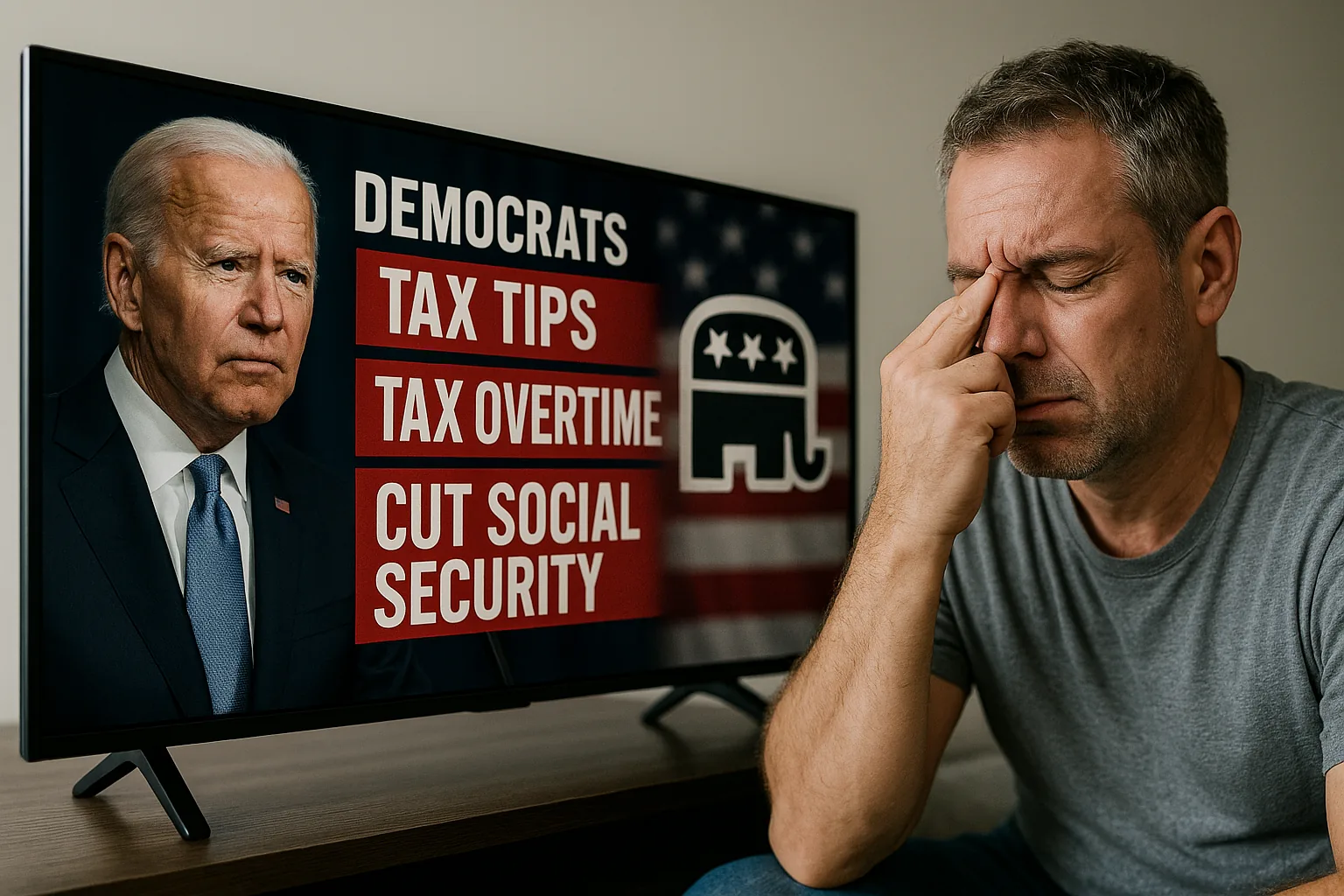
As early voting proceeds across congressional districts this October, a troubling pattern has emerged in political advertising: Republican-aligned campaign groups and PACs are running ads that misrepresent Democratic candidates’ positions on taxes affecting tips, overtime pay, and Social Security benefits. The phenomenon is not limited to a single race or a single claim. Instead, it reflects a broader strategy of stripping legislative votes and public statements of context in ways that lead viewers to false conclusions — a textbook example of how political ads misrepresent tax and Social Security positions to shape voter perception in the final weeks before Election Day. Understanding exactly what these ads say, what the underlying legislation actually does, and what the targeted candidates have actually stated on the record is essential to cutting through the noise.
The Legislative Backdrop: The One Big Beautiful Bill Act
Most of the misleading advertising in this cycle traces back to a single piece of legislation: the One Big Beautiful Bill Act, signed into law by President Donald Trump on July 4, 2025. The law included several tax provisions that proved broadly popular with working Americans, among them cuts affecting tips, overtime pay, and certain benefits for older Americans. Because these provisions polled well across party lines, they became immediate fodder for political messaging — particularly attack advertising aimed at Democratic incumbents and challengers in competitive congressional races.
The central fact that anchors any honest assessment of the ads is straightforward: not a single Democrat in either the House or the Senate voted in favor of the One Big Beautiful Bill Act. That is a documented, verifiable fact. Republican campaign operatives have used that unified Democratic opposition to argue, in ad after ad, that Democratic candidates therefore oppose the specific tax cuts for tipped workers, overtime earners, and seniors that the bill contained. The logical leap embedded in that argument is where the misleading framing begins.
Voting against a bill is not the same as opposing every provision within it. Omnibus legislation routinely bundles popular measures with deeply contested ones, and members of Congress frequently vote against a bill as a whole while publicly supporting individual elements it contains. Treating a party-line vote against a large, multi-subject piece of legislation as evidence that a candidate opposes a specific popular tax provision inside it is a form of misrepresentation — one that fact-checkers have documented repeatedly in this cycle.
What the Attack Ads Actually Claim
The ads running in congressional races around the country follow a recognizable template. A narrator states — or the on-screen text asserts — that the Democratic candidate “voted against” or “opposes” tax cuts on tips, overtime, or Social Security benefits. In some versions, the framing is even more direct: that the candidate wants to raise taxes on tipped workers or wants seniors to pay more. These are claims that go well beyond what a no vote on the OBBBA can actually establish.
What makes the pattern particularly significant is that many of the Democratic candidates being targeted have explicitly and publicly stated that they support the specific tax-cut provisions in question. Some have co-sponsored standalone legislation addressing tip income. Others have issued formal policy statements endorsing relief for overtime workers. When a candidate’s stated position directly contradicts what an attack ad claims that candidate believes, the ad is not simply presenting an unflattering interpretation — it is presenting a claim that the candidate’s own record refutes.
The mechanism of misrepresentation here is what researchers who study political communication sometimes call context stripping: taking a true fact (the candidate voted against the OBBBA) and presenting it without the context that would allow a viewer to evaluate its meaning (the OBBBA was a sweeping piece of legislation opposed for many reasons, and the candidate has separately expressed support for the specific provisions at issue). The result is a statement that is technically grounded in a real event but leads to a conclusion that the evidence does not support — a pattern that places these ads squarely in the misleading category rather than the outright false one.
👉 Read also: Republican Campaign Ads in 2026 Senate Races: Three Fact-Checks of Misleading Claims
The Rob Wittman Ad: A Case Study in Attack Advertising
While much of the documented misleading advertising has flowed from Republican groups toward Democratic candidates, the phenomenon is not entirely one-directional. A separate ad in the Virginia congressional race illustrates how attack advertising can misrepresent candidates on both sides of the aisle.
Your Community PAC ran an advertisement claiming that Republican Representative Rob Wittman voted to give himself a personal tax break of $60,000. The figure itself comes from an estimate produced by the Institute on Taxation and Economic Policy, a think tank that models the distributional effects of tax legislation. Using an outside organization’s estimate of how a law might benefit a particular individual is a legitimate journalistic and advocacy practice — but presenting it as a straightforward, established fact in a political ad, without acknowledging that it is a modeled estimate rather than a documented payment, compresses important nuance.
The ad’s framing implies that Wittman personally engineered or uniquely benefited from a provision designed for his own gain, when the reality is more complex: the OBBBA’s tax changes affected many Americans in the same income bracket, and any benefit to Wittman would reflect the law’s broad application rather than targeted self-dealing. That distinction matters for voters trying to evaluate their representative’s conduct. The claim is not fabricated — the estimate exists and the vote is real — but the framing leads viewers toward a conclusion that the underlying evidence does not fully support.
This case is useful precisely because it demonstrates that the problem of misleading political advertising is not the exclusive property of one party or ideological direction. The same analytical standards apply regardless of which side is running the ad.
Social Security Claims and the Broader Pattern
Among the most politically sensitive claims in this cycle involve Social Security. Ads targeting Democratic candidates in competitive races have suggested that those candidates are indifferent to — or even supportive of — cuts to Social Security benefits. These claims are particularly potent because Social Security is a program that a large share of the electorate either currently relies on or expects to rely on, making any suggestion that a candidate would undermine it deeply alarming to voters.
The documented pattern of how political ads misrepresent tax and Social Security positions in this cycle follows the same structural logic as the tips and overtime claims: a vote against the OBBBA, or a vote against a procedural measure, is presented as evidence of hostility to Social Security protections that the candidate has separately and explicitly endorsed. The selective presentation of a single legislative action, divorced from the candidate’s broader record and stated positions, is the engine driving these mischaracterizations.
It is worth noting that Social Security’s financing and benefit structure involve genuinely complex policy tradeoffs, and there are real, substantive disagreements between the parties about how to address the program’s long-term solvency. Voters are entitled to accurate information about those disagreements. When advertising substitutes manufactured controversy for real policy debate, it does not just mislead individual voters — it degrades the quality of democratic deliberation at exactly the moment it matters most.
👉 Read also: Republican Campaign Ads Contain Misleading Claims on Rape Kits and Rural Hospitals in 2026 Election
Why TV Stations Air These Ads Unchanged
A question that frequently arises when misleading political ads circulate is why television stations do not simply refuse to broadcast them. The answer lies in federal law. Federal law requires TV stations to air candidate-purchased political advertisements without censoring or changing their content. This is a long-standing legal obligation rooted in the principle that the government should not be in the business of deciding which political speech is acceptable for broadcast.
The practical consequence is that a candidate who purchases airtime can say things in an ad that a station’s own news department would fact-check and correct — and the station has no legal recourse to alter or refuse the spot. Third-party PAC ads occupy a somewhat different legal space, but the practical result is similar: the volume and velocity of political advertising in the final weeks of a campaign cycle far outpaces any real-time fact-checking capacity.
This legal framework places a significant burden on voters, journalists, and independent fact-checkers to do the work that the broadcast system cannot. It also underscores why media literacy — the ability to evaluate the source, framing, and evidentiary basis of a political claim — is an increasingly important civic skill. An ad that appears authoritative, with official-sounding narration and footage of a candidate, carries the visual grammar of credibility even when its claims do not survive scrutiny.
How Voters Can Evaluate Political Ad Claims
Given the volume of misleading advertising in the current cycle, a few practical approaches can help voters assess what they are seeing and hearing.
- Trace the vote to the bill, not just the provision. When an ad says a candidate voted against a specific tax cut, find out what bill that vote concerned. Large omnibus bills contain many provisions, and opposition to the whole does not equal opposition to every part.
- Check the candidate’s own stated record. Official campaign websites, press releases, and floor statements are primary sources. If a candidate has explicitly endorsed a policy in their own words, that is directly relevant to evaluating an ad’s claim that they oppose it.
- Identify the source of any figures cited. Numbers like the $60,000 tax break estimate in the Wittman ad come from specific methodological choices made by specific organizations. Knowing whether a figure is a documented payment, a modeled estimate, or a projection changes how much weight it should carry.
- Consult independent fact-checkers. Organizations that apply consistent, transparent standards across both parties — checking the claim, not the claimant — provide a useful corrective to the partisan framing inherent in attack advertising. FactCheck.org is one such resource that has documented the current cycle’s misleading ad patterns in detail.
- Be alert to context stripping. The most common form of misleading political advertising does not involve outright fabrication. It involves presenting a true fact — a vote, a statement, a figure — without the surrounding context that would allow a viewer to interpret it accurately. Asking “what else do I need to know to evaluate this claim?” is a useful habit.
The Stakes of Misleading Advertising in a Competitive Cycle
The October 2026 election cycle is unfolding in a highly competitive environment, with control of congressional chambers potentially at stake in a significant number of races. In that context, the strategic logic of misleading advertising is easy to understand: ads that link an opponent to unpopular positions — even through misrepresentation — can shift voter perceptions in races decided by narrow margins. Early voting was already underway as of late September 2026, meaning that some voters were making decisions while the most intensive wave of advertising was still building.
The documented pattern of misleading claims about tips, overtime, and Social Security in this cycle is not evidence that political advertising as a whole is uniquely dishonest in 2026. Misleading political ads have been a feature of American campaigns for generations. What changes from cycle to cycle is the specific legislative hook, the particular provisions being weaponized, and the candidates being targeted. What remains constant is the underlying mechanism: selecting and presenting information in ways designed to produce a false impression without making a claim that is straightforwardly and demonstrably untrue.
Voters who understand that mechanism — who know to ask what bill a vote concerned, whose estimate a figure reflects, and what a candidate has actually said in their own words — are far better equipped to evaluate the advertising environment they are navigating. The fact that political ads misrepresent tax and Social Security positions is, at this point, a predictable feature of competitive elections. The response to that predictability is not cynicism but the disciplined habit of verification: following the claim back to its source before allowing it to shape a judgment.
This article was produced with AI assistance and reviewed editorially.

Political Ads in 2026 Midterms Contain False or Misleading Claims About Opponents

Trump Administration ‘Super Intelligence’ Accord Misspells ‘United States’ as ‘Unites States’

Trump Administration ‘Super Intelligence’ Accord Misspells ‘United States’ as ‘Unites States’

No Going Back PAC Ad Makes Misleading Claim About Roy Cooper and Rape Kits
