
Current Affairs
Edited and Mislabeled Videos Misrepresent Real Events and People
Real video footage is being edited, mislabeled, and stripped of context to spread misinformation. Learn how these manipulation techniques work and why authentic imagery m

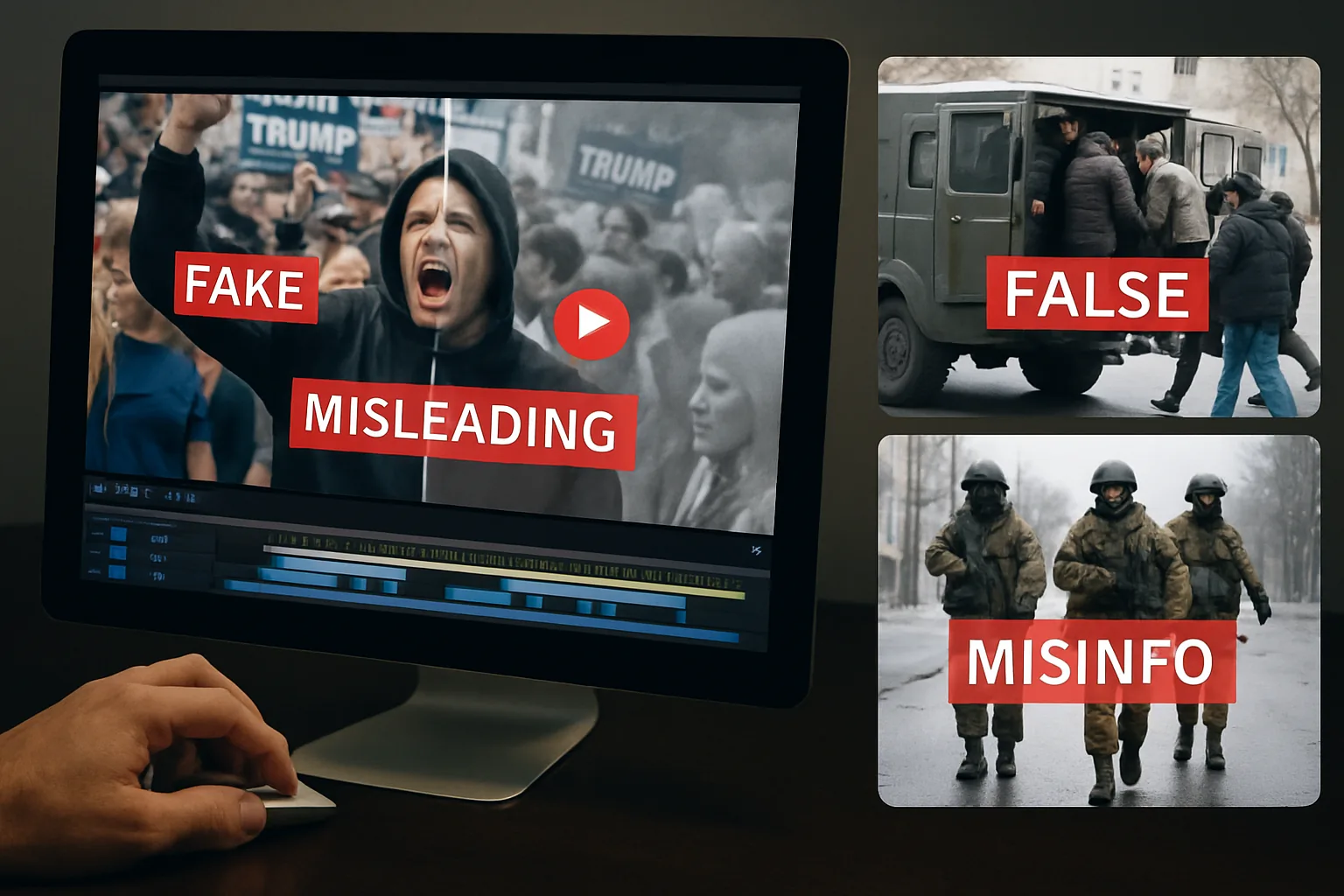
The spread of manipulated videos misinformation has become one of the defining challenges of the current information environment. Real footage — drawn from protests, political rallies, conflict zones, and public events — is routinely clipped, re-labeled, stripped of context, or paired with fabricated audio to make it appear to show something entirely different from what actually occurred. The result is a form of deception that is particularly difficult to counter, because the underlying imagery is genuine: viewers see real people, real places, and real movement, and reasonably trust what their eyes tell them.
Why Real Footage Makes the Most Convincing Lies
There is a long tradition of outright fabrication in propaganda — invented stories, staged photographs, actors playing roles. But the more durable and harder-to-debunk category of false content today relies not on invention but on misrepresentation. Authentic video carries an implicit authority. When a viewer recognises a real location, a recognisable public figure, or a crowd that looks genuinely distressed, their critical instincts are less likely to engage than they would be with an obviously artificial image.
This is precisely why edited and mislabeled video has become the preferred vehicle for spreading false narratives. The manipulation often involves only a small intervention: a caption placed over real footage, an audio track swapped out, a clip extracted from a longer sequence and posted without the surrounding context that would make its true meaning clear. Each of these techniques exploits the viewer’s trust in visual evidence while requiring relatively little technical skill.
According to research compiled by media literacy educators, video manipulation falls into several broad categories: missing context, deceptive edits, omission of key information, and outright misrepresentation of who is involved and what is happening. Understanding these categories is the first step toward recognising them in the wild.
The Main Techniques Used to Distort Video
Missing Context and Mislabeling
Perhaps the most common technique requires no editing at all. A video filmed at one event, in one country, on one date is simply posted with a caption claiming it shows something else entirely. Footage of a protest in one city becomes “evidence” of unrest in another. A crowd filmed years ago is presented as a reaction to a recent news event. The video itself is untouched; only the frame around it has been falsified.
This approach is particularly common in coverage of conflicts and political crises, where audiences are hungry for visual evidence and may not have the local knowledge to recognise that the street signs, uniforms, or architecture in the footage do not match the claimed location. Reverse image and reverse video searches — running a frame through a search engine to find earlier instances of the same footage — are among the most effective tools for catching this kind of mislabeling.
👉 Read also: Deepfake and Out-of-Context Video Compilations Spread False Narratives About Ukraine, Trump, and School Violence
Deceptive Edits and Selective Clipping
A second technique involves cutting a longer video to remove the context that would change its meaning. A speaker’s words, clipped mid-sentence, can be made to assert the opposite of what they actually said. A confrontation that began with one party’s aggression looks entirely different when only the response is shown. A peaceful demonstration can be made to appear violent if only the moment of scuffle is extracted and the hours of calm footage surrounding it are discarded.
This kind of selective editing is especially damaging when it involves public figures, because it can circulate widely before the full original footage is found and the correction made. By the time a clarification reaches most viewers, the clipped version has already shaped their understanding of the event.
Audio Manipulation and Addition
A third and increasingly common technique involves altering or replacing the audio track of a video. Audio of people screaming, gunfire, or crowd panic has been added to unrelated footage to create the impression of violence or chaos where none existed. Conversely, a speaker’s voice can be altered in pitch or timing to change the emotional register of what they appear to be saying, making a calm statement sound agitated or a firm denial sound uncertain.
Detecting this kind of manipulation requires careful listening. Fact-checkers and media literacy guides point to several red flags: audio that seems to come from a different acoustic environment than the visuals suggest, crowd noise that does not match the size or density of the crowd on screen, and speech that has an unnatural cadence — pauses in the wrong places, syllables that seem slightly out of sync with lip movements.
How Artificial Intelligence Has Raised the Stakes
For most of the history of video manipulation, the techniques described above required either journalistic negligence on the part of those who spread the content, or a deliberate willingness to deceive. The underlying footage, however, remained real. That constraint is now eroding. Advances in artificial intelligence and editing software have made it significantly harder to distinguish manipulated from authentic video, and have lowered the technical barrier to creating convincing false content from scratch.
Synthetic media — sometimes called deepfakes — can place a real person’s face and voice into footage they were never part of. The results are not always perfect, and trained eyes can often spot telltale signs: unnatural blinking patterns, slight mismatches between the subject’s face and the surrounding background, or lip movements that do not quite align with the audio. But as the technology improves with each passing month, these artifacts become less reliable as detection signals.
👉 Read also: AI-Generated and Mislabeled Videos Spread False Claims About Protests, Arrests, and Public Events
The practical consequence is that the burden on viewers has increased substantially. Where once it was sufficient to ask “is this footage real?”, the question now must be “is this footage real, unedited, correctly attributed, and presented with its full context?” Each of those conditions can be violated independently, and each violation produces a different kind of false impression.
Recognising Manipulated Videos Misinformation in Practice
Media literacy researchers and fact-checking organisations have developed a set of practical habits that can help ordinary viewers evaluate video content before sharing it. These are not technical skills requiring specialist software — most can be applied with nothing more than a careful eye and a few minutes of additional research.
- Check the source. Who originally posted the video, and when? A clip that has been recirculating for months or years but is being presented as current-day footage is a strong indicator of mislabeling.
- Run a reverse video search. Extracting a frame and running it through a search engine can reveal earlier instances of the same footage, often with accurate captions attached.
- Listen critically to the audio. Does the sound environment match the visual environment? Does background noise seem consistent with what is shown on screen?
- Look for contextual detail. Street signs, vehicle license plates, uniforms, architectural styles, and seasonal vegetation can all help establish where and when footage was actually filmed.
- Seek the original, longer version. If a clip appears to begin or end abruptly, look for the full recording. What happens immediately before and after the extracted segment often changes its meaning entirely.
- Consult established fact-checking resources. Organisations such as AFP Fact Check maintain searchable databases of previously debunked videos and images.
Why Corrections Rarely Catch Up
One of the most frustrating features of manipulated video misinformation is the asymmetry between its spread and its correction. A false clip, particularly one that provokes strong emotion — outrage, fear, moral indignation — tends to travel faster and further than the factual correction that follows it. This is not a new observation, but it has taken on greater urgency as social media platforms have become the primary news environment for large portions of the population.
The emotional charge of manipulated video is not incidental to its effectiveness: it is often the mechanism. Footage that appears to show an injustice, an attack, or a scandal activates the impulse to share before the impulse to verify. The speed of sharing and the emotional intensity of the content are themselves signals worth pausing on — not because strong emotions indicate falsehood, but because they are reliably exploited by those who produce false content.
Platform labeling systems, which attach warnings to content that has been flagged as potentially manipulated, have had mixed results. Labels can reduce sharing rates for some users, but they also risk creating a false sense of security: content that has not yet been labeled may be assumed to be verified, when in fact the review process simply has not caught up with the volume of material being posted.
The Responsibility of Readers and Sharers
Institutional responses — platform policies, regulatory frameworks, automated detection tools — matter, but they cannot substitute for individual habits of verification. The production of manipulated video content is cheap and fast; the verification of it is slower and requires deliberate effort. Every person who pauses before sharing, searches for the original source, or checks a claim against an independent fact-checker is performing a small but meaningful act of resistance against the spread of false content.
That resistance does not require certainty. It is entirely appropriate to share content with explicit acknowledgment of uncertainty — “this is circulating and I cannot verify it” — rather than presenting unverified footage as established fact. Stated uncertainty, far from being a weakness, is one of the markers of genuine credibility in an information environment where false confidence is in abundant supply. The discipline of separating what can be verified from what cannot is not a specialist skill; it is a habit anyone can develop, and one that the current media landscape makes increasingly necessary.
This article was produced with AI assistance and reviewed editorially.

Political Ads in 2026 Midterms Contain False or Misleading Claims About Opponents

Trump Administration ‘Super Intelligence’ Accord Misspells ‘United States’ as ‘Unites States’

Trump Administration ‘Super Intelligence’ Accord Misspells ‘United States’ as ‘Unites States’

No Going Back PAC Ad Makes Misleading Claim About Roy Cooper and Rape Kits
