
Current Affairs
GOP Ads Misrepresent Taxes on Tips, Overtime, and Social Security Benefits
GOP campaign ads falsely claim Democratic candidates oppose tax relief on tips, overtime, and Social Security. Fact-checkers find the claims mislead voters by conflating

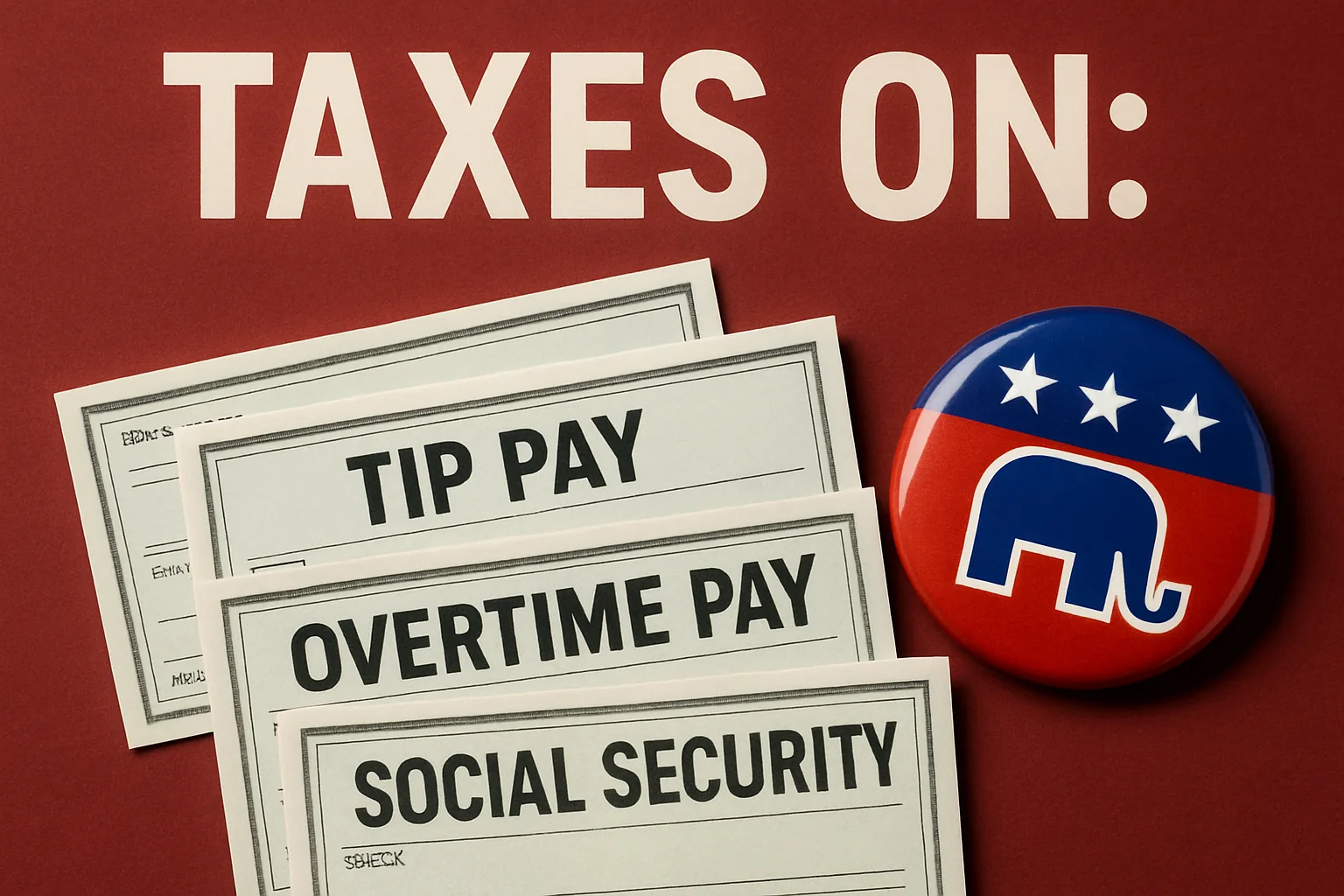
As congressional midterm campaigns intensify in October 2026, a wave of Republican political advertisements has targeted Democratic candidates over their alleged positions on taxes — specifically on tips, overtime pay, and Social Security benefits. A close examination of these ads, including analysis published by FactCheck.org on October 8, 2026, finds that the claims frequently misrepresent where Democratic candidates actually stand. Understanding the full picture requires tracing how the debate over democratic taxes, tips, overtime, and Social Security became a flashpoint in this election cycle — and where the evidence diverges from the advertising.
The Legislative Context: The “One Big Beautiful Bill Act”
The tax provisions at the center of this controversy did not emerge from nowhere. They are rooted in Republicans’ One Big Beautiful Bill Act, a sweeping legislative package that included, among many other items, provisions related to eliminating or reducing federal taxes on tipped income, overtime wages, and Social Security benefits received by older Americans. Republicans positioned these provisions as major wins for working-class and middle-class Americans — and then made Democratic opposition to the broader bill the centerpiece of a campaign attack strategy.
The framing of the attacks follows a familiar pattern in campaign advertising: take a complex legislative vote or position, strip it of context, and present the result as a simple, damaging fact. In this case, Democratic candidates who did not support the One Big Beautiful Bill Act — for any number of reasons, including concerns about other provisions in the legislation — were characterized in ads as opposing tax relief for tipped workers, overtime earners, and retirees. According to FactCheck.org’s reporting, that characterization is misleading.
What Democratic Candidates Have Actually Said
One of the most significant findings documented by FactCheck.org is that many Democratic candidates in these congressional races have explicitly stated they support the tax cut provisions for tips, overtime, and Social Security — even as they opposed the broader legislative package that contained them. This distinction is crucial, and it is precisely the distinction that the Republican ads erase.
Opposing a bill that bundles dozens of policy measures together is not the same as opposing any individual provision within it. A candidate can support tax-free tips and still vote against a bill that includes unrelated spending cuts, debt ceiling changes, or other provisions they find objectionable. Campaign advertising that collapses this distinction — presenting a “no” vote on a package as a “no” vote on popular tax relief — is not an accurate representation of a candidate’s position. FactCheck.org’s analysis characterizes exactly this kind of framing as misleading.
👉 Read also: Republican Campaign Ads Contain Misleading Claims on Rape Kits and Rural Hospitals in 2026 Election
This matters especially in races where voters are genuinely trying to understand candidates’ tax positions. When ads about democratic taxes, tips, overtime, and Social Security conflate a procedural or package-level vote with a substantive policy stance, they deprive voters of accurate information at a moment when that information is most consequential.
Senator Booker’s Counterargument: What the Bill Actually Contains
Adding a further layer of complexity to the debate, Senator Cory Booker has publicly stated that taxes on tips, taxes on overtime, and taxes on Social Security benefits remain in the Republicans’ own Big Beautiful Bill — directly contradicting the premise that the legislation fully delivers on its advertised promises to workers and retirees. Booker’s statement, made in remarks published on his Senate office’s website, challenges the foundational claim underlying the GOP ad campaign: that the bill unambiguously eliminates these taxes and that Democrats who opposed it were blocking relief.
If Booker’s characterization of the bill’s contents is accurate, then the attack ads face a double problem. First, they misrepresent Democratic candidates’ own stated positions on tax relief for tips, overtime, and Social Security. Second, they may overstate what the Republican legislation actually delivers on those fronts. The result is a political messaging environment in which voters are receiving inaccurate information from multiple directions simultaneously.
It is worth noting that Booker’s statement represents an attributed assessment — a claim made by a political figure with a clear stake in the debate. Readers and voters should weigh it alongside the primary legislative text and independent analysis. What it does establish, however, is that the factual picture is considerably more contested than the ads suggest.
Why This Pattern of Advertising Is Misleading
Political advertising has always involved simplification, but there is a meaningful difference between simplification and misrepresentation. The ads examined by FactCheck.org cross that line in at least two identifiable ways.
First, they attribute positions to candidates that those candidates have not held. When a Democratic candidate has publicly stated support for eliminating taxes on tips and overtime — and the ad claims the opposite — the ad is making a factually false claim about that candidate’s record, not merely offering a contestable interpretation of it.
👉 Read also: Republican Campaign Ads Make Misleading Claims About Cooper's Rape Kit Record and Ossoff's Tax Vote
Second, they use legislative votes as proxies for policy positions without disclosing the complexity of those votes. A vote against a large, multi-provision bill is not a vote against every provision in that bill. Presenting it as such is a form of misleading framing that FactCheck.org’s analysis specifically flags as problematic in the context of these congressional races.
This is not a novel tactic in American political advertising. The pattern of taking a complex vote and reducing it to a single, damaging soundbite has appeared in campaigns across both parties and across many election cycles. What makes the current wave of ads notable, according to FactCheck.org, is how directly it mischaracterizes positions that the targeted candidates have explicitly and publicly contradicted. When a candidate goes on record supporting a provision and an ad says they oppose it, the ad is not offering a different interpretation — it is stating something demonstrably at odds with the evidence.
The Broader Stakes for Voters and Democratic Accountability
The debate over democratic taxes, tips, overtime, and Social Security is not merely a campaign-season abstraction. These are issues with real consequences for millions of Americans. Tipped workers — in restaurants, hotels, transportation, and other service industries — represent a substantial portion of the workforce, and the question of whether their gratuity income should be subject to federal income tax has genuine policy implications. The same is true for overtime pay, which affects hourly workers across a wide range of industries, and for Social Security benefits, which are the primary or sole source of retirement income for a large share of older Americans.
When campaign advertising distorts candidates’ positions on these issues, it does more than create an unfair advantage for one side. It undermines the ability of voters to make informed decisions on questions that directly affect their financial lives. A voter who believes a candidate opposes tax relief on their tips or Social Security check — when that candidate has actually stated support for such relief — is being denied accurate information at the moment they need it most.
FactCheck.org’s role in documenting these misleading claims is part of a broader ecosystem of accountability journalism that attempts to slow the spread of inaccurate political messaging. But fact-checking organizations operate with limited reach compared to the advertising budgets of well-funded political groups. The ads in question are running in competitive congressional districts where they can reach large audiences repeatedly, while corrections and fact-checks reach a smaller and often already-skeptical readership.
That asymmetry is itself a structural feature of modern political communication — one that makes it all the more important for voters to seek out primary sources, candidate statements, and independent analysis before drawing conclusions from paid advertising. The claims being made about democratic taxes, tips, overtime, and Social Security in this election cycle are a reminder that the most politically potent messages are not always the most accurate ones, and that the gap between what an ad says and what the evidence shows can be wide enough to matter in a close race. Voters in competitive districts deserve better than advertising that misrepresents the positions of the candidates they are being asked to evaluate.
This article was produced with AI assistance and reviewed editorially.

Political Ads in 2026 Midterms Contain False or Misleading Claims About Opponents

Trump Administration ‘Super Intelligence’ Accord Misspells ‘United States’ as ‘Unites States’

Trump Administration ‘Super Intelligence’ Accord Misspells ‘United States’ as ‘Unites States’

No Going Back PAC Ad Makes Misleading Claim About Roy Cooper and Rape Kits
