
Current Affairs
Democratic Ads Link Senator Collins to Epstein Without Evidence
Democratic ads link Senator Susan Collins to Jeffrey Epstein without evidence. Fact-checkers rate the allegations false and misleading.

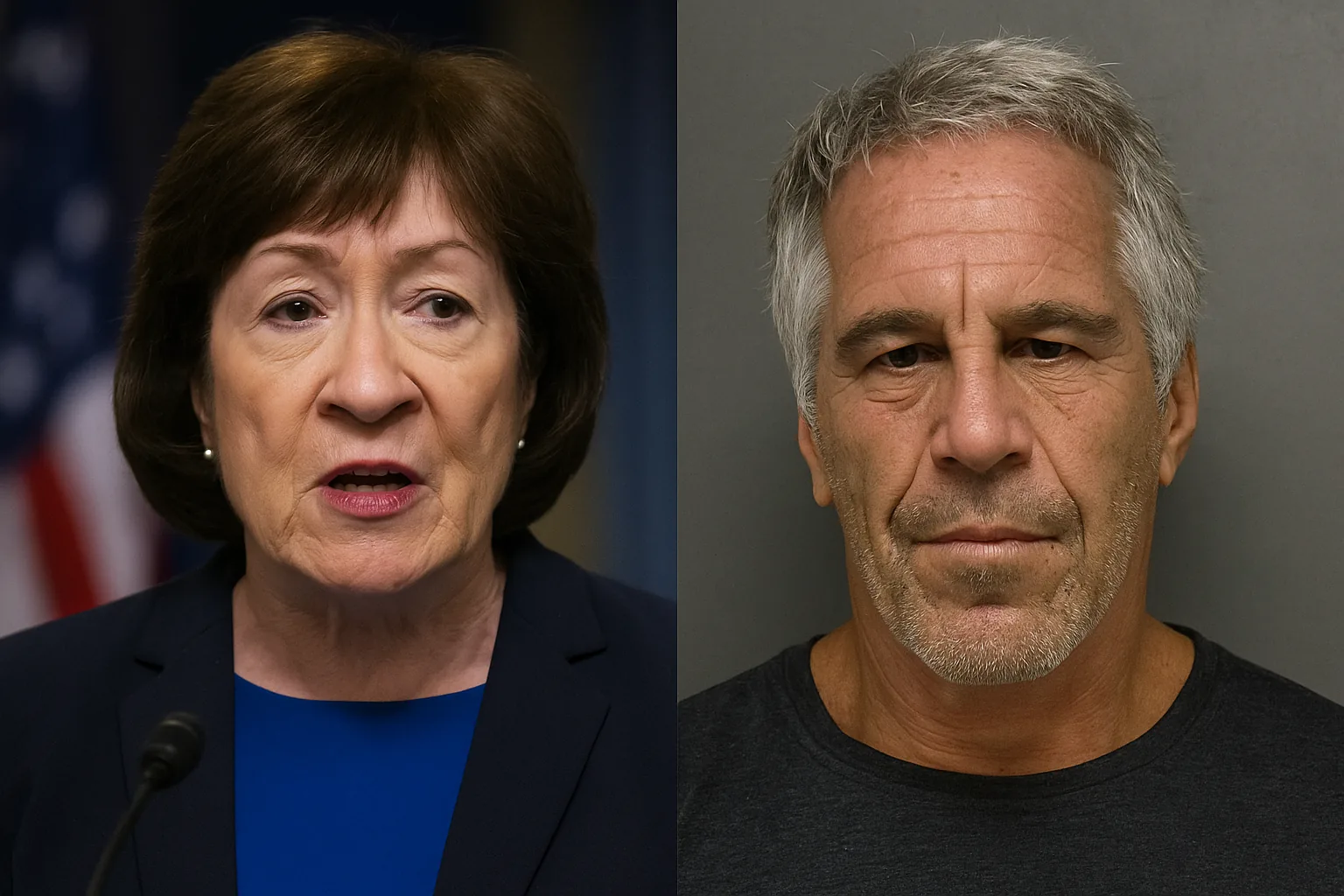
With less than thirteen months until Election Day 2026, the Maine Senate race has become one of the most closely watched contests in the country, and the advertising wars surrounding it have grown correspondingly fierce. A cluster of Democratic campaign advertisements — sponsored by a group identified in fact-checking records as WinSenate — have attempted to draw a direct line between Senator Susan Collins and the late convicted sex offender Jeffrey Epstein. Multiple independent fact-checkers, examining the specific claims made in those ads, have found the central allegations to be false or misleadingly framed. Understanding exactly what the ads say, what the evidence actually shows, and why the distinction matters is essential for Maine voters and for anyone tracking the broader use of the Epstein narrative as a political weapon in the current election cycle. The fact-checking record on the susan collins epstein ads is unusually clear and consistent across several outlets.
What the Ads Actually Claim
The advertisements at the center of this controversy make two distinct, load-bearing allegations. The first is that Senator Collins voted to “cover up the Epstein files.” The second is that Jeffrey Epstein’s “business partner funneled $3 million” to a Collins super PAC. Both claims were aired in late September 2026 and quickly drew scrutiny from fact-checkers at FactCheck.org, PolitiFact, the Maine Monitor, the Bangor Daily News, and local television station WMTW.
One of the ads features a woman identified on screen as “Debbie,” described as a retired junior high teacher, who delivers the allegations directly to the camera in a testimonial format. The use of an ordinary citizen rather than a narrator or political spokesperson is a common technique in political advertising designed to lend the claims the credibility of lived experience. But the credibility of the messenger does not bear on the accuracy of the underlying claims — and it is those claims that fact-checkers examined in detail.
It is worth being precise about what the ads do and do not say, because precision matters here. The verified record — drawn from PolitiFact, FactCheck.org, and the Bangor Daily News — confirms the two specific allegations described above. The brief does not establish additional specific claims beyond those two, and responsible reporting requires staying within what the evidence actually documents.
The “Cover-Up” Vote: What PolitiFact Found
The allegation that Collins “voted to cover up the Epstein files” was rated False by PolitiFact, which published its fact-check on September 28, 2026. PolitiFact’s analysis found that the ad cherry-picks Collins’s voting record in a way that distorts the actual context of the vote in question. The outlet concluded that the framing of a single procedural or legislative vote as a deliberate act of concealment — specifically concealment of Epstein-related materials — was not supported by the evidence.
This kind of cherry-picking is one of the most common and consequential forms of political misinformation. A senator may cast hundreds of votes in a given congressional session. Selecting one vote, stripping it of its procedural context, and repackaging it as evidence of a sinister motive is a technique that can technically point to a real event — an actual vote — while producing a conclusion that the underlying facts do not support. PolitiFact’s characterization of the ad as cherry-picking Collins’s vote is significant precisely because it identifies the mechanism by which a false impression is constructed from a partially true foundation.
The Maine Monitor and the Bangor Daily News, both of which published their own examinations of the ads in late September 2026, similarly concluded that the advertisements oversell their biggest claims. The word “oversell” is important: it acknowledges that there may be some underlying factual material being referenced, while making clear that the conclusions drawn from that material go far beyond what the evidence can support. That is a meaningful distinction from an outright fabrication, and it reflects the nuanced reality of how political misinformation often works in practice — not as pure invention, but as aggressive overstatement.
👉 Read also: Political Ads Mislead on Senate Candidates: Collins-Epstein, Cooper Rape Kits Claims Fact-Checked
The “$3 Million from Epstein’s Business Partner” Claim
The second major allegation — that Epstein’s “business partner” funneled $3 million to a Collins super PAC — is the more structurally complex of the two claims, and in some respects the more revealing about how the ads were constructed.
PolitiFact’s investigation found no evidence that Stephen Schwarzman was Jeffrey Epstein’s business partner. The ad, as fact-checkers reconstructed it, appears to work by identifying a donor to a Collins-aligned super PAC, connecting that donor to Epstein through some asserted relationship, and then presenting the chain as evidence of a financial link between Collins and Epstein himself. The problem, as PolitiFact documented, is that the foundational link in that chain — the characterization of Stephen Schwarzman as Epstein’s business partner — is not supported by evidence.
This matters enormously. The $3 million figure may well reflect an actual donation to a super PAC. But the characterization of the donor as Epstein’s “business partner” is the element that transforms a political contribution into a sinister association — and it is precisely that characterization that fact-checkers found to be without evidentiary foundation. Removing it, the remaining claim is simply that a wealthy donor gave money to a super PAC supporting a Republican senator, which is neither illegal nor unusual in contemporary American campaign finance.
The structure of this claim is worth examining carefully because it illustrates a broader pattern in political advertising: taking a verifiable fact (a donation), attaching an unverified or false characterization to the donor (Epstein’s “business partner”), and presenting the combination as damning evidence of something it does not actually demonstrate. FactCheck.org, in its October 2026 analysis, concluded that the ads as a whole lack substantive evidence for the connection they attempt to draw between Collins and Epstein.
Why the Epstein Connection Is Politically Potent — and Why That Makes Scrutiny More Important
Jeffrey Epstein’s name carries extraordinary political and emotional weight in 2026. His death in federal custody in August 2019, the subsequent release of court documents naming associates and alleged victims, and the ongoing public demand for full disclosure of records connected to his network have kept the Epstein story alive as a political flashpoint for years. In early 2025, the release of what became known as the “Epstein files” — a tranche of documents and records related to his network — generated intense media coverage and public attention, and politicians across the spectrum found themselves under pressure to take clear positions on disclosure.
That context is precisely what makes the susan collins epstein ads politically potent as a campaign tool, and precisely what makes rigorous fact-checking of those ads so important. When a topic generates strong public emotion, the risk that voters will accept a misleading framing without interrogating its evidentiary basis is significantly elevated. Voters who are rightly angry about Epstein’s crimes and rightly concerned about accountability for his associates are a natural audience for ads that claim a sitting senator helped shield those records — whether or not that claim is accurate.
This is not a new dynamic in American politics. Connecting an opponent to a figure of widespread public revulsion — through whatever chain of association can be constructed — is a tactic with a long history. What is relatively new is the speed and reach with which such ads can circulate, and the degree to which the emotional resonance of a name like Epstein can cause viewers to accept an association before they have had the opportunity to examine its factual basis. The ads in question aired in late September 2026, and fact-checks began appearing within days — but the timeline of ad exposure versus fact-check reach is rarely equal.
👉 Read also: Democratic and Republican Campaign Ads Make False or Misleading Claims in 2026 Senate Race
How Multiple Fact-Checkers Reached the Same Conclusion
One of the notable features of the fact-checking record on the susan collins epstein ads is the consistency of the findings across independent outlets. PolitiFact, FactCheck.org, WMTW, the Maine Monitor, and the Bangor Daily News all examined the ads and reached materially similar conclusions: the central claims are either false or significantly overstated.
That convergence is meaningful. In an environment where accusations of partisan bias in fact-checking are common, the alignment of a national outlet (FactCheck.org), a state-focused investigative publication (the Maine Monitor), a regional daily newspaper (the Bangor Daily News), and a local television station (WMTW) on the same verdict strengthens confidence that the conclusion reflects the actual evidentiary record rather than any single outlet’s editorial perspective.
PolitiFact’s formal rating of False for the two central claims — the cover-up vote allegation and the Epstein business partner allegation — carries particular weight because PolitiFact’s methodology requires documented sourcing for each element of its rating. A False rating does not mean the underlying topic is irrelevant or that Collins’s full voting record on disclosure-related matters is beyond scrutiny. It means that the specific claims as stated in the ads are not supported by the available evidence.
What the Ads Reveal About the 2026 Maine Senate Race
The emergence of these advertisements reflects the intensity of the competition for Collins’s Senate seat in 2026. Maine has become a genuinely contested state at the federal level, and a Democratic effort to unseat a long-serving Republican incumbent naturally involves aggressive advertising. The decision by WinSenate to run ads centered on an Epstein connection suggests a strategic calculation that the association, even if not fully supported by evidence, could be electorally effective.
That calculation, and the fact-checking response it has generated, raises questions that go beyond any single race. When campaign ads make claims that multiple independent fact-checkers rate as false, what accountability mechanisms exist? The Federal Election Commission regulates campaign finance but does not adjudicate the truth or falsity of political advertising content. Broadcast stations have limited authority to refuse legally sponsored political ads. The primary check on misleading political advertising, in practice, is the work of journalists and fact-checkers — and the willingness of voters to seek out and weigh that work before forming their judgments.
The susan collins epstein ads are a case study in a form of political communication that is increasingly common: ads that use a name or topic of genuine public concern as a vehicle for claims that do not withstand factual scrutiny. The fact-checking record here is unusually robust, with multiple outlets arriving at the same conclusion within days of the ads’ initial airing. What that record shows, plainly, is that the two central allegations — the cover-up vote and the Epstein business partner donation — are not supported by the evidence, and that voters in Maine and observers elsewhere are entitled to know that before drawing their own conclusions about what the ads mean for the race.
In an election environment where every Senate seat carries national significance, the accuracy of the claims made in campaign advertising is not a minor procedural concern. It is a direct question about whether voters are being given the information they need to make informed choices — and in this case, the answer from the fact-checking record is clear: the ads go well beyond what the evidence supports.
This article was produced with AI assistance and reviewed editorially.

Political Ads in 2026 Midterms Contain False or Misleading Claims About Opponents

Trump Administration ‘Super Intelligence’ Accord Misspells ‘United States’ as ‘Unites States’

Trump Administration ‘Super Intelligence’ Accord Misspells ‘United States’ as ‘Unites States’

No Going Back PAC Ad Makes Misleading Claim About Roy Cooper and Rape Kits
