
Current Affairs
Staged Funeral Procession Video From March 2020 Wrongly Linked to Gaza
A staged funeral video from March 2020 in Jordan has been falsely linked to Gaza conflict events. Learn how this COVID-19 curfew prank became viral disinformation.

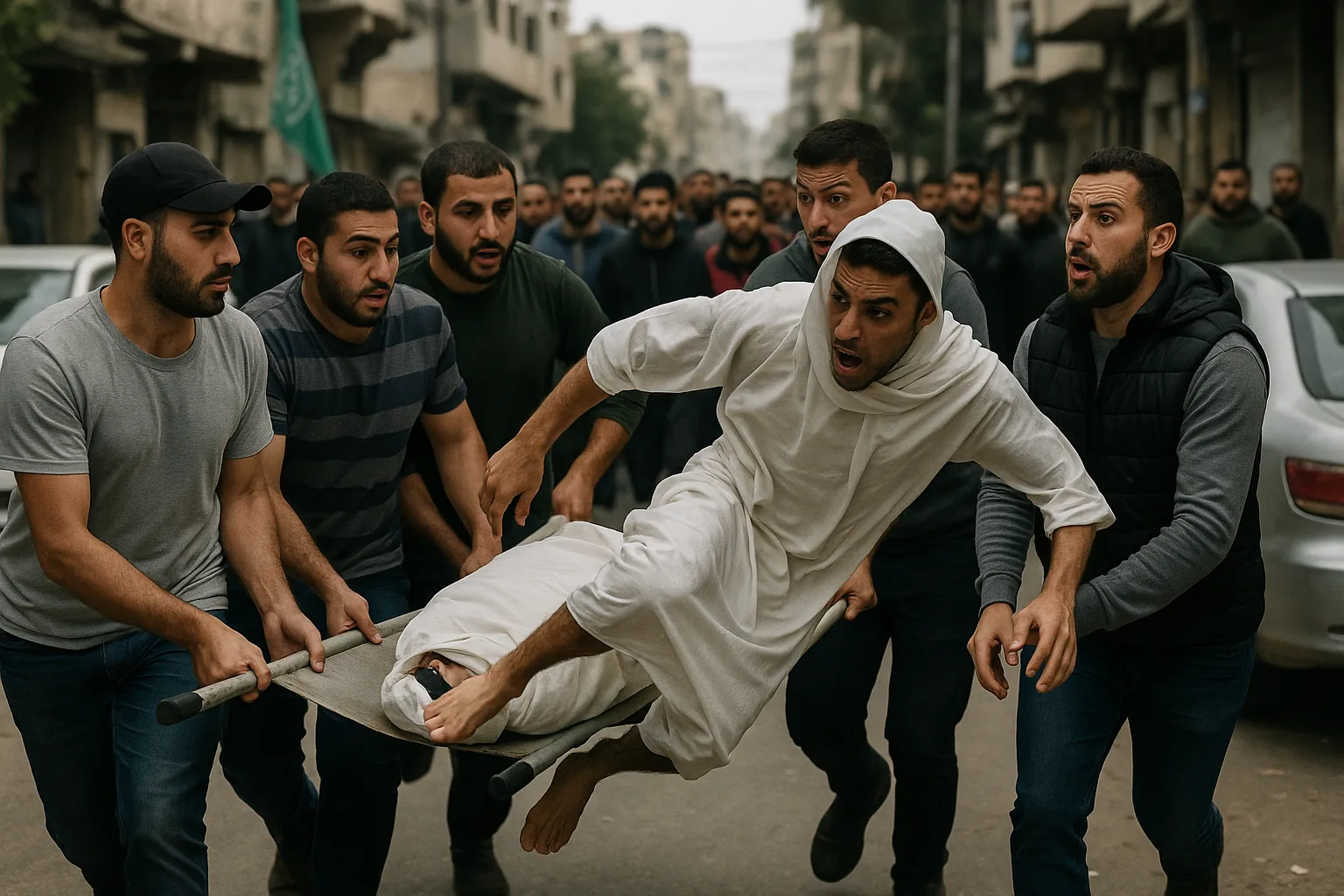
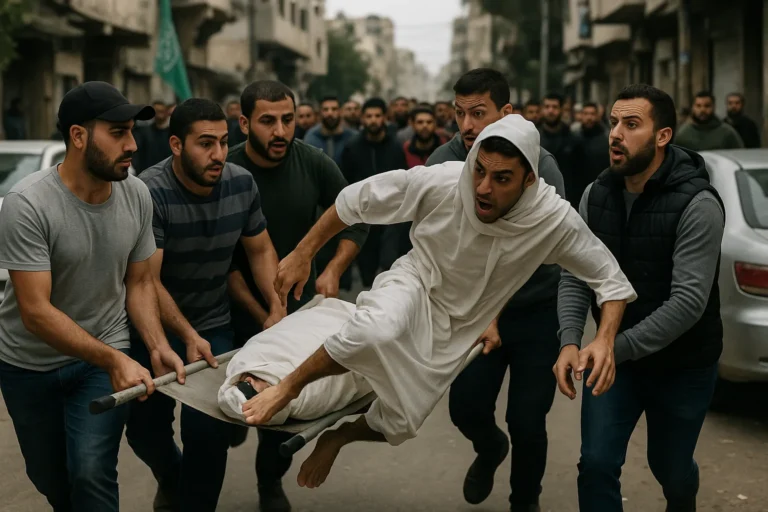
A video clip that has circulated online for more than six years continues to mislead audiences around the world, most recently by being falsely connected to the ongoing conflict in Gaza. The footage, originally filmed in March 2020 in Jordan during the early weeks of the COVID-19 pandemic, shows what appears to be a funeral procession — until a siren sounds, the pallbearers drop the stretcher and scatter, and the person wrapped in a burial shroud leaps up and sprints away. That prank, staged by young men attempting to circumvent a pandemic curfew, has since become one of the most persistently misattributed pieces of video content linked to the Gaza conflict, resurfacing with fresh false claims as recently as October 2026. Understanding why this particular staged funeral video keeps being weaponized against Gaza — and why audiences keep believing it — requires tracing its full history and examining the mechanics of viral misattribution.
What the Video Actually Shows: A COVID-19 Curfew Prank from Jordan
The footage at the centre of this fact-check is unmistakable once you know what you are looking at. A group of individuals carries a stretcher bearing a body wrapped in a white burial shroud, moving through what appears to be a street or outdoor area. The procession has the visual hallmarks of a traditional funeral — solemnity, a covered body, a gathered group. Then, abruptly, the sound of a siren interrupts the scene. The pallbearers drop the stretcher and flee in multiple directions. The figure on the stretcher, far from being dead, stands up and runs away just as quickly.
According to Full Fact, the video was filmed in March 2020 and was reportedly shot in Jordan. AP News confirmed that the video circulated widely on social media accounts from Jordan in March 2020, and that media outlets reporting on it at the time explained the context clearly: the teens had staged a mock funeral as a tactic to get out of the house during COVID-19 lockdowns. The siren in the footage, which triggers the group’s flight, was apparently interpreted by the participants as a sign of approaching authorities enforcing the curfew.
According to PesaCheck, the video depicts individuals attempting to break the COVID-19 lockdown curfew — a detail that gives the footage its internal logic. Staging a funeral was, in the early pandemic period, one of the few reasons authorities in many countries permitted people to gather or move through the streets. The prank was therefore not merely a joke but a calculated, if ultimately unsuccessful, attempt to exploit an exception to lockdown rules. When the siren sounded, the ruse collapsed, and the participants scattered — all of it captured on video and shared widely, almost certainly by someone in the group itself.
The clip gained significant traction across social media platforms in Jordan and the broader Arab-speaking world in March 2020. It was reported on by multiple news outlets at the time as a curiosity — an example of the lengths to which people were going to circumvent pandemic restrictions. At that point, the video’s origin and meaning were not in serious dispute. The problems began later, when the clip was stripped of its context and redeployed to serve an entirely different narrative.
How a Staged Funeral Video Became a Gaza Disinformation Tool
The misattribution of this staged funeral video to Gaza did not happen in isolation. It followed a pattern that researchers and fact-checkers have documented repeatedly across multiple conflicts: old footage, stripped of its original context, is reshared with new captions that connect it to a current, emotionally charged event. The technique exploits the speed of social media sharing, the emotional weight of the subject matter, and the assumption that viral content must be current.
👉 Read also: Viral Videos Misidentified With False Context or Recycled Archival Footage
According to AP News, social media users shared the video — described as a “year-old satirical video from Jordan” — with false claims stating that it shows Palestinians staging a funeral during the Israel-Hamas conflict. According to Misbar, the false claim circulated on social media in October 2023 amid escalating violence between Israel and Hamas. The timing was not coincidental: October 2023 marked a dramatic intensification of the conflict, generating enormous global media attention and an accompanying surge in the spread of unverified content across social platforms.
The specific false narrative attached to the video in its Gaza-linked incarnation is a serious one. The claim that Palestinians stage funerals — that the dead are not really dead, that grief is performed rather than felt — is a form of dehumanisation with a long history in conflict propaganda. By presenting the Jordanian COVID prank as evidence of Palestinian deception, those who reshared the footage with false captions were not merely making a factual error. They were inserting a piece of manipulated context into a deeply contested information environment at a moment of maximum sensitivity.
This is why multiple independent fact-checking organisations moved quickly to address the misattribution. Full Fact, AP News, Reuters, PolitiFact, Misbar, and PesaCheck all published debunks identifying the video’s true origin. Reuters specifically noted, in a fact-check published on October 13, 2023, that the old video showing a staged funeral was unrelated to the 2023 Hamas-Israel war. The convergence of six independent organisations on the same conclusion, each tracing the footage back to its March 2020 Jordanian origin, constitutes a robust evidentiary base for the verdict: the claim linking this video to Gaza is false.
The Pattern of Repeated Resurfacing
What makes this particular piece of footage especially significant is not just that it was misattributed once, but that it has been repeatedly misattributed across multiple cycles of conflict-related disinformation. The same footage has resurfaced during later conflicts with misleading claims that it shows Palestinians staging deaths or funerals. This is a documented pattern, not a one-time occurrence.
The mechanics of this kind of repeat misattribution are worth examining in detail. A video with strong visual impact — and a person leaping up from a funeral stretcher is genuinely startling — tends to be saved and stored by users who encounter it. When a new conflict or controversy arises that the footage can be made to seem relevant to, those stored copies are retrieved and reshared with new captions. The original debunks, published in 2020 and again in 2021 and 2023, do not automatically attach themselves to the video as it travels across platforms. A user encountering the clip for the first time in 2026 may have no awareness of its prior circulation or the fact-checks that addressed it.
This dynamic — sometimes called the zombie content problem — is one of the central challenges facing digital media literacy efforts. Content that has been definitively debunked does not disappear; it re-emerges whenever conditions make it seem newly relevant. The staged funeral video from Jordan is a textbook example of this phenomenon. Its visual clarity and emotional punch make it highly shareable; its apparent relevance to ongoing debates about the authenticity of suffering in conflict zones makes it attractive to those seeking to advance particular narratives; and its lack of visible date or location stamps makes it easy to present as current.
It is worth noting that the video’s original context — a group of young people trying to sneak out during a pandemic lockdown — is actually a story about a relatively harmless act of youthful rule-breaking. The participants were not attempting to deceive anyone about death or grief in any serious sense; they were trying to fool a curfew checkpoint. The transformation of that prank into supposed evidence of systematic Palestinian deception is itself a significant act of misrepresentation, layering a false political meaning onto footage that had an entirely different, and far more mundane, original purpose.
👉 Read also: Mislabeled and Recycled Videos Spread Online as Recent Events in September 2026
Why Fact-Checkers Keep Returning to This Clip
The fact that six separate, independent fact-checking organisations have each published debunks of this video — at different points in time, responding to different waves of circulation — tells us something important about the scale and persistence of the misattribution problem. Full Fact is a UK-based independent fact-checking charity. AP News operates one of the world’s largest newsgathering operations. Reuters is a global news agency with its own dedicated fact-checking unit. PolitiFact is a Pulitzer Prize-winning US fact-checking outlet. Misbar is an Arabic-language fact-checking platform focused on the Middle East and North Africa region. PesaCheck is an African fact-checking initiative. The geographic and institutional diversity of this group is significant: the misattribution of this video has reached audiences across multiple continents and language communities, prompting responses from fact-checkers with very different primary audiences.
Each of these organisations conducted its own independent verification, tracing the video back to its March 2020 origin in Jordan through reverse image searches, social media archive searches, and contemporaneous news reporting. The consistency of their findings — same date, same location, same context — is itself a form of evidence. When six independent investigations, using different methodologies and drawing on different source networks, arrive at the same conclusion, that conclusion is on very solid ground.
The process of debunking a video like this typically begins with a reverse video search or a keyframe image search, which allows fact-checkers to find earlier instances of the footage online. In this case, those searches consistently returned results from March 2020, predating any connection to the Gaza conflict by more than three years. Contemporaneous news reporting from Jordan and the wider Arab media confirmed the curfew-breaking context. The internal evidence of the video itself — the white burial shroud consistent with Islamic funeral practice, the street setting, the siren — does not contradict a Jordanian origin, and nothing in the footage places it in Gaza.
What Audiences Can Do When Encountering Similar Content
The staged funeral video from Jordan offers a useful case study for anyone trying to navigate the information environment around conflict. Several features of the footage should prompt caution before sharing. The clip has no visible date or location information embedded in the frame. It shows a dramatic, emotionally resonant event — exactly the kind of content that spreads fastest on social media. It arrived, in its Gaza-linked incarnation, during a period of intense media attention to the conflict, when audiences were hungry for information and verification standards were under pressure.
Reverse image and video search tools — available through major search engines — allow anyone to check whether footage has appeared online before, and in what context. Searching for the earliest instance of a video is often the most reliable way to establish its true origin. In this case, that search leads directly to March 2020 and to Jordanian social media, not to Gaza.
It is also worth paying attention to the source of a claim, not just its content. The false Gaza-linked versions of this video were spread by social media accounts making assertions without providing verifiable evidence of when or where the footage was recorded. By contrast, the debunks published by Full Fact, AP News, Reuters, PolitiFact, Misbar, and PesaCheck each cite specific evidence and trace their reasoning transparently. That difference in evidentiary standard is itself a meaningful signal.
The staged funeral video from Jordan will almost certainly resurface again. It has done so repeatedly since 2020, and the conditions that make it attractive for misuse — its visual drama, its apparent relevance to debates about conflict and authenticity, its lack of embedded metadata — have not changed. What has changed is the breadth of the documented record debunking it. That record now spans more than six years, six independent fact-checking organisations, and multiple waves of false circulation. Anyone encountering the footage linked to Gaza, or to any other conflict, can be confident that the claim is false: the video shows a COVID-19 lockdown prank staged by young men in Jordan in March 2020, and it has no connection to events in Gaza whatsoever.
This article was produced with AI assistance and reviewed editorially.

Political Ads in 2026 Midterms Contain False or Misleading Claims About Opponents

Trump Administration ‘Super Intelligence’ Accord Misspells ‘United States’ as ‘Unites States’

Trump Administration ‘Super Intelligence’ Accord Misspells ‘United States’ as ‘Unites States’

No Going Back PAC Ad Makes Misleading Claim About Roy Cooper and Rape Kits
