
Current Affairs
AI-Generated Videos Falsely Attributed to Bill Gates, Elon Musk, and Public Figures
The spread of deepfake videos falsely attributing dangerous or embarrassing statements to well-known public figures has become one of the most persistent a

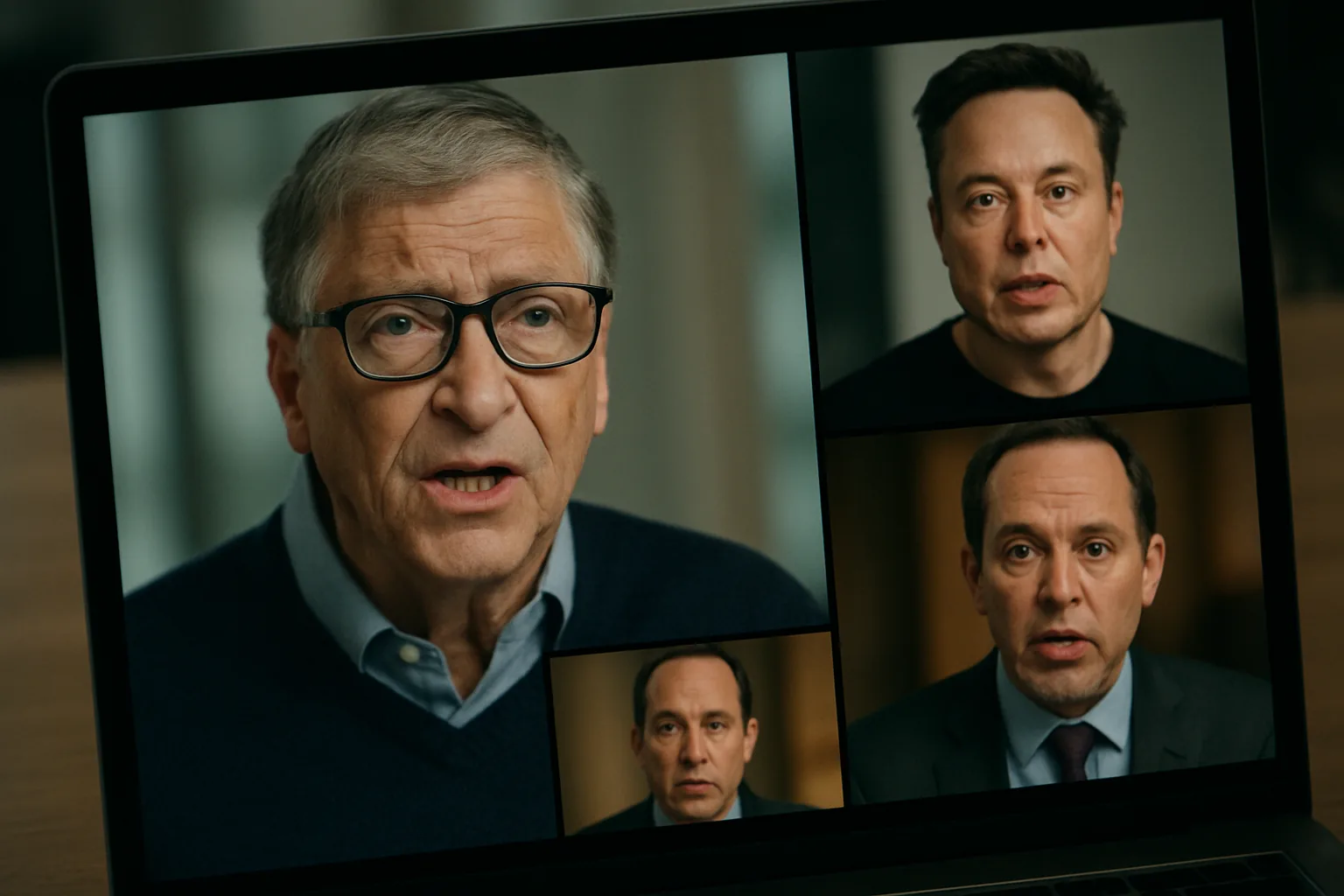
The spread of deepfake videos falsely attributing dangerous or embarrassing statements to well-known public figures has become one of the most persistent and damaging forms of digital misinformation circulating today. From fabricated interviews with technology billionaires to manipulated footage of political leaders, AI-generated media is increasingly difficult to distinguish from authentic recordings — and the consequences for individuals, institutions, and public trust are real and growing.
What Deepfake Videos Actually Are
The term deepfake refers to images or videos that have been altered — or created entirely from scratch — to make people appear to say and do things they never actually said or did. The technology draws on machine-learning techniques, particularly a class of algorithms that can map one person’s facial features and voice patterns onto another person’s body, or generate entirely synthetic footage of a real individual. The results can be strikingly convincing, especially when viewed quickly on a social media feed without critical scrutiny.
According to PolitiFact’s guide on detecting deepfake videos, the core defining characteristic is manipulation or fabrication: the subject of the video did not perform the actions shown, did not speak the words attributed to them, and was not present in the context the video implies. That definition covers a wide spectrum, from subtle lip-sync alterations to fully synthetic avatars modelled on real people’s likenesses.
Snopes, one of the longest-running fact-checking organisations, uses a “Fake” rating specifically for visual or audio media that has been manipulated or created from scratch via CGI software, AI tools, or other digital editing programs. That rating exists as a distinct category precisely because fabricated media requires a different kind of verification than a false written claim — it demands technical as well as contextual analysis.
Public Figures as Preferred Targets
Certain categories of public figure attract a disproportionate share of deepfake activity. Technology entrepreneurs with high public profiles, political leaders, and members of royal families all appear repeatedly in fabricated videos, for reasons that are not difficult to understand. Their faces and voices are extensively documented in publicly available footage, which provides the raw material AI systems need to generate convincing imitations. Their names carry authority, which makes fabricated statements from them more likely to be believed and shared.
👉 Read also: AI-Generated Deepfakes and Synthetic Media Drive Growing Share of Fact-Checking Workload
A viral video purporting to show Bill Gates making alarming statements in an interview setting was identified as fake and created using deepfake technology, according to a verified fact-check by Factly. The specific claims attributed to Gates in that video — which circulated widely before being debunked — were entirely fabricated. Gates made no such statements. The video was manufactured to exploit his credibility on public health topics, a recurring pattern in deepfake targeting of figures associated with science and medicine.
Elon Musk has become arguably the most frequently impersonated figure in AI-generated fraud. CBS News Texas reported that deepfakes of Musk have contributed to billions of dollars in fraud losses in the United States alone, as scammers use his fabricated likeness to promote investment schemes, cryptocurrency frauds, and other deceptive financial products. The scale of harm here is not hypothetical — it is financial and measurable, affecting ordinary people who trusted what appeared to be an endorsement from a recognisable name.
The phenomenon extends well beyond the technology sector. A growing number of celebrities — including Tom Hanks and broadcaster Gayle King — have publicly stated that scammers are using AI deepfakes of their likenesses to promote dubious products on social media platforms, according to reporting confirmed by multiple sources. These individuals have had to issue explicit public denials of endorsements they never gave, a burden that falls entirely on the person being impersonated rather than on the platforms distributing the fabricated content.
How Fabricated Media Spreads and Why It Works
Understanding why deepfake videos succeed in deceiving audiences requires looking at the mechanics of social media distribution. Most platforms are optimised for engagement rather than accuracy: content that provokes a strong emotional reaction — fear, outrage, excitement — travels faster and further than content that is calm or nuanced. A video purporting to show a famous figure predicting catastrophic events, or behaving in a shocking or inappropriate way, satisfies precisely the kind of emotional trigger that drives rapid sharing.
By the time a fact-check is published and distributed, the original fabricated video may have been viewed millions of times. Corrections rarely achieve the same reach as the original false content. This asymmetry is structural, not accidental, and it means that the burden of proof effectively operates in reverse: fabricated media spreads freely, while verified rebuttals must work against the current.
The problem is compounded by the improving quality of AI generation tools. Early deepfakes were identifiable by characteristic artifacts — unnatural blinking patterns, blurred edges around the hairline, inconsistent lighting on the face relative to the background. More recent generations of the technology have eliminated many of these tells, making visual inspection alone an unreliable detection method. Verification now requires a combination of technical analysis, contextual research, and source-tracing that most ordinary viewers are neither equipped nor expected to perform.
👉 Read also: AI-Generated and Manipulated Videos Spread False Claims About Political Events and Figures
Legal and Platform Responses to the Deepfake Problem
Regulatory frameworks are beginning to catch up with the technology, though the pace is uneven across jurisdictions. One significant area of legislative action concerns non-consensual intimate imagery — deepfake content of a sexual nature created without the subject’s knowledge or consent. In several jurisdictions, creating such content using artificial intelligence is being made a criminal offence, a development confirmed by reporting from Sky News in early 2026. The legislation recognises that the harm caused by fabricated intimate imagery is equivalent in many respects to the harm caused by distributing real non-consensual material.
Broader deepfake regulation — covering political misinformation, financial fraud, and reputational damage — remains a patchwork. Some jurisdictions require disclosure labels on AI-generated content used in political advertising. Others have pursued platform liability frameworks that place obligations on social media companies to detect and remove verified deepfakes. None of these approaches has yet produced a comprehensive solution, in part because the technology evolves faster than legislative processes can respond.
Platform-level responses have included the deployment of AI detection tools, watermarking systems for AI-generated content, and partnerships with third-party fact-checkers. The effectiveness of these measures varies considerably. Detection tools operate probabilistically rather than with certainty, and watermarking can be removed or circumvented. Fact-checking partnerships help identify and label false content after it has spread, but do not prevent initial distribution.
Recognising Fabricated Media: Practical Guidance
While no single method reliably identifies every deepfake, a combination of approaches significantly improves detection accuracy. Fact-checkers and media literacy educators generally recommend the following practices when encountering a video that makes surprising or alarming claims from a public figure:
- Check the original source. Does the video come from a verified account belonging to the person shown? Has the organisation they supposedly represent confirmed the statement?
- Search for corroborating coverage. If a prominent figure made a significant public statement, credible news organisations would report it. The absence of any such coverage is a strong indicator that the statement was fabricated.
- Examine the video technically. Look for inconsistencies in lip movement relative to speech, unnatural eye movement, irregular blinking, or lighting that does not match the claimed setting. These artifacts are less reliable indicators than they once were, but remain worth checking.
- Reverse-search the footage. Tools that allow frame-by-frame reverse image searching can sometimes identify the original source footage from which a deepfake was constructed, revealing the manipulation.
- Consult established fact-checkers. Organisations that specialise in verifying media — including Factly, PolitiFact, and Snopes — publish findings on widely circulating fabricated videos and can be searched before sharing content.
The Broader Stakes for Public Trust
The cumulative effect of deepfake proliferation extends beyond any individual incident of fraud or reputational harm. When fabricated videos of public figures circulate widely enough, they contribute to a generalised erosion of confidence in video evidence itself. This dynamic — sometimes described as the liar’s dividend — means that authentic footage can be dismissed as fake, and real statements can be denied with the claim that they were AI-generated. The technology does not merely create false content; it undermines the epistemic value of genuine content.
This is why the work of identifying and clearly labelling fabricated media matters beyond the individual cases involved. Each verified debunking reinforces the principle that evidence can be examined, that claims can be tested, and that the origin of media can be traced. The alternative — a media environment in which fabrication is so pervasive that audiences simply stop trusting any video — would represent a serious degradation of the shared informational basis on which democratic societies depend. The tools and practices of rigorous verification are not merely useful; in the current environment, they are increasingly essential.
This article was produced with AI assistance and reviewed editorially.

Political Ads in 2026 Midterms Contain False or Misleading Claims About Opponents

Trump Administration ‘Super Intelligence’ Accord Misspells ‘United States’ as ‘Unites States’

Trump Administration ‘Super Intelligence’ Accord Misspells ‘United States’ as ‘Unites States’

No Going Back PAC Ad Makes Misleading Claim About Roy Cooper and Rape Kits
