
Current Affairs
Republican Campaign Ads: Three Fact-Checked Claims About Cooper, Rural Hospitals, and Public Option
As the 2026 midterm cycle reaches peak intensity, political advertising has flooded television, radio, and digital platforms with claims that range from th

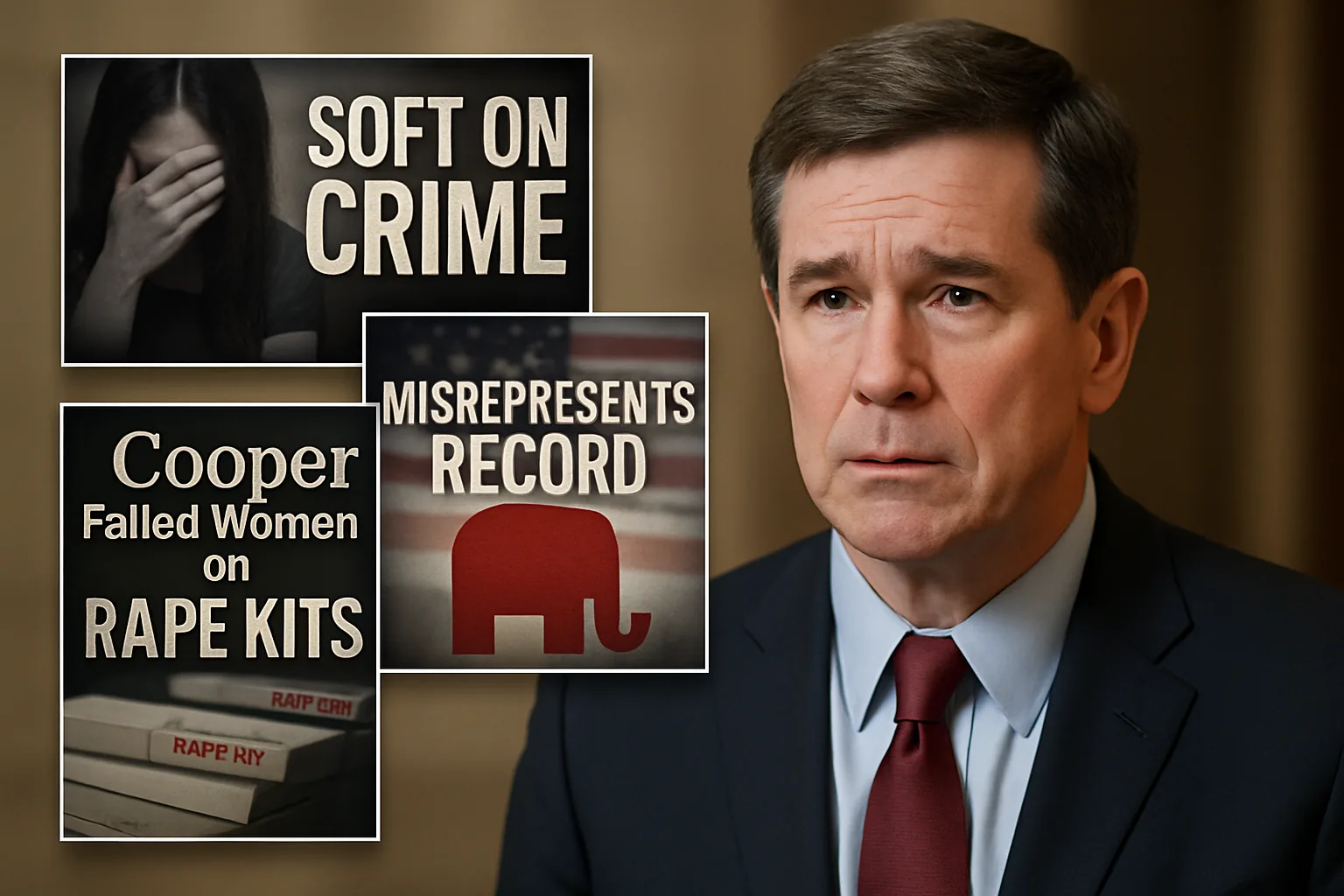
As the 2026 midterm cycle reaches peak intensity, political advertising has flooded television, radio, and digital platforms with claims that range from the tendentious to the outright false. Voters trying to fact check campaign ads in 2026 face an unusually dense information environment, where Republican-funded groups and Democratic campaigns alike are making sharp, often misleading assertions about healthcare, crime, and policy records. Three clusters of Republican advertising stand out for the scrutiny they have attracted: ads targeting Roy Cooper of North Carolina with a rape kit narrative, ads warning that public option proposals will shutter rural hospitals in Texas and Pennsylvania, and the broader GOP messaging strategy on healthcare — a strategy that sits in notable tension with the party’s own recent legislative record.
The Cooper Rape Kit Attack: What the Ads Claim and What Is Verified
Republican-aligned groups running ads in North Carolina have sought to define Roy Cooper through a soft-on-crime frame, with at least one advertisement invoking rape kit backlogs as evidence of a weak public-safety record. The underlying political logic is straightforward: Cooper, a Democrat with an extensive record in state government, is a high-profile target, and crime-related attacks have historically polled well in competitive Southern states.
What is verified is that Republican advertisements have appeared countering a soft-on-crime narrative around Cooper. What is not fully established in the available documentation is the precise factual claim the ads make about rape kit processing, the timeframe they reference, or whether the figures they cite are drawn from Cooper’s tenure specifically or from a broader period of state governance. That distinction matters enormously in any honest evaluation. Attributing a systemic backlog to a single officeholder requires establishing both that the backlog existed during his direct authority and that his decisions contributed to it — neither of which can be confirmed or denied from the sourcing currently available.
The responsible conclusion at this stage is that the rape kit claim warrants scrutiny but cannot yet be assigned a clean verdict. Voters encountering these ads should ask which agency held responsibility, over which years, and whether comparable backlogs existed in states under different leadership. Those are the questions that separate a fair accountability argument from a misleading political attack.
Rural Hospitals and the Public Option: Unpacking the GOP Ad Claims
The more thoroughly documented cluster of misleading advertising concerns public health insurance option proposals in Texas and Pennsylvania. Republican-funded ads circulating in both states claim that Democratic candidates’ support for a public option would put dozens of rural hospitals out of business. The ads present this as a near-certain consequence — a direct, causal chain from policy adoption to facility closure.
👉 Read also: Republican Campaign Ads in 2026 Senate Races: Three Fact-Checks of Misleading Claims
According to FactCheck.org’s September 2026 analysis, the GOP ads rely on an industry-backed study whose assumptions do not apply uniformly to all public option proposals. This is a critical methodological problem. Public option designs vary considerably: some proposals tie reimbursement rates to Medicare schedules, others set rates through state negotiation, and still others include explicit rural hospital protections or supplemental payments. A study modeled on one set of assumptions — particularly one commissioned by hospital industry groups with a financial interest in the outcome — cannot reliably predict the impact of a differently structured proposal.
The ads do not make these distinctions. They present a worst-case scenario derived from a specific modeling exercise as though it were a universal, settled finding. That is a textbook example of a misleading claim: the underlying study may exist and may contain real data, but stripping it of its methodological context and applying its conclusions to proposals it was not designed to evaluate leads viewers to a false impression of certainty.
Rural hospital financial fragility is a genuine policy concern, and that reality gives the ads their surface plausibility. Hospitals in low-density areas operate on thin margins, depend heavily on government payers, and have faced sustained closure pressure for years. Invoking that genuine vulnerability to argue against a policy whose actual impact on those hospitals is contested — and potentially positive under some designs — is precisely the kind of selective framing that makes political advertising so difficult to evaluate without independent analysis.
The GOP Healthcare Messaging Paradox
Perhaps the most striking feature of the 2026 Republican advertising landscape on healthcare is its internal contradiction. Republican candidates who voted to cut federal funding under the One Big Beautiful Bill Act are now running ads positioning themselves as defenders of healthcare access, according to reporting from NPR published in July 2026. The same cycle in which Medicaid funding reductions passed with Republican support is the cycle in which Republican ad makers are casting Democrats as the threat to community health infrastructure.
This is not merely a messaging irony. It represents a factual tension that voters deserve to have surfaced. If a candidate voted for legislation that independent analysts and Democratic campaign ads both characterize as reducing Medicaid funding, and that same candidate then runs advertising warning that a Democratic opponent’s healthcare proposal will harm vulnerable communities, the two positions require reconciliation. Voters cannot evaluate either claim in isolation.
👉 Read also: Republican Campaign Ads Contain Misleading Claims on Rape Kits and Rural Hospitals in 2026 Election
Democrats have not been passive in this environment. Midterm advertising from Democratic campaigns has portrayed GOP-backed Medicaid cuts as a direct threat to rural healthcare — a claim that has its own evidentiary requirements and its own potential for selective framing. The point is not that one party is honest and the other is not; it is that both sides are making healthcare claims that require independent verification before they should be accepted at face value.
How to Actually Fact Check Campaign Ads in 2026
The three ad clusters examined here illustrate a set of recurring techniques that appear across the 2026 cycle and that voters can learn to identify. Understanding these patterns is the most durable tool available for anyone trying to fact check campaign ads in 2026 without relying entirely on third parties.
- Source laundering: Ads cite a real study or report but omit that the source was commissioned by an interested party, or that its methodology does not apply to the scenario being discussed. The rural hospital ads exemplify this.
- Responsibility conflation: Ads attribute systemic outcomes to a single officeholder without establishing the causal chain. The Cooper crime-record framing follows this pattern.
- Selective timeframes: Ads choose the period of measurement that produces the most damaging comparison, without disclosing that other timeframes would show different results.
- Worst-case universalization: Ads take a modeled worst-case scenario and present it as the expected or inevitable outcome, erasing the range of possibilities.
- Omission of legislative record: Ads attack opponents on issues where the attacking party’s own recent votes cut against the implied position.
None of these techniques are new to 2026, but the volume and targeting precision of digital advertising mean they reach audiences with less friction than broadcast ads once did. A claim that would have required a thirty-second spot and a media buy can now be delivered as a short video to a narrowly defined demographic, with no requirement for the kind of disclosure that broadcast standards once imposed.
Why the Industry Study Problem Matters Beyond This Cycle
The reliance on industry-backed research as the evidentiary backbone of political advertising deserves particular attention, because it is a pattern likely to persist. When a trade association or industry group funds a study, that does not automatically invalidate the findings — but it does create a structural incentive to design the study in ways that support the funder’s preferred conclusion. Peer-reviewed research, government actuarial analyses, and studies from institutions without a financial stake in the outcome provide a more reliable basis for policy claims.
When an ad says a policy “will” produce a specific outcome — rather than “could” or “may, under certain assumptions” — and the underlying source is a model built on contested assumptions funded by an interested party, the word “will” is doing enormous and unjustified work. That single word transforms an uncertain projection into a stated fact, and it is precisely the kind of linguistic precision that separates honest political communication from misleading advertising.
The 2026 advertising cycle is not unique in containing misleading claims — every cycle does. What makes this moment worth careful attention is the convergence of high spending, sophisticated targeting, and genuinely consequential policy debates about healthcare access, rural infrastructure, and public safety. The claims in these ads are not trivial: they concern hospitals that serve communities with few alternatives, and candidates whose records on those issues will shape legislation for years. Getting the facts right matters, and the first step is recognizing when an ad is asking you to accept a contested projection as though it were settled truth.
This article was produced with AI assistance and reviewed editorially.

Political Ads in 2026 Midterms Contain False or Misleading Claims About Opponents

Trump Administration ‘Super Intelligence’ Accord Misspells ‘United States’ as ‘Unites States’

Trump Administration ‘Super Intelligence’ Accord Misspells ‘United States’ as ‘Unites States’

No Going Back PAC Ad Makes Misleading Claim About Roy Cooper and Rape Kits
