
Information
Deepfake Videos of Bill Gates, Elon Musk, and Anthony Albanese Spread False Claims About Mass Mortality
AI-generated deepfake videos falsely depicting Bill Gates, Elon Musk, and Anthony Albanese have circulated widely, making false claims about mass mortality and promoting

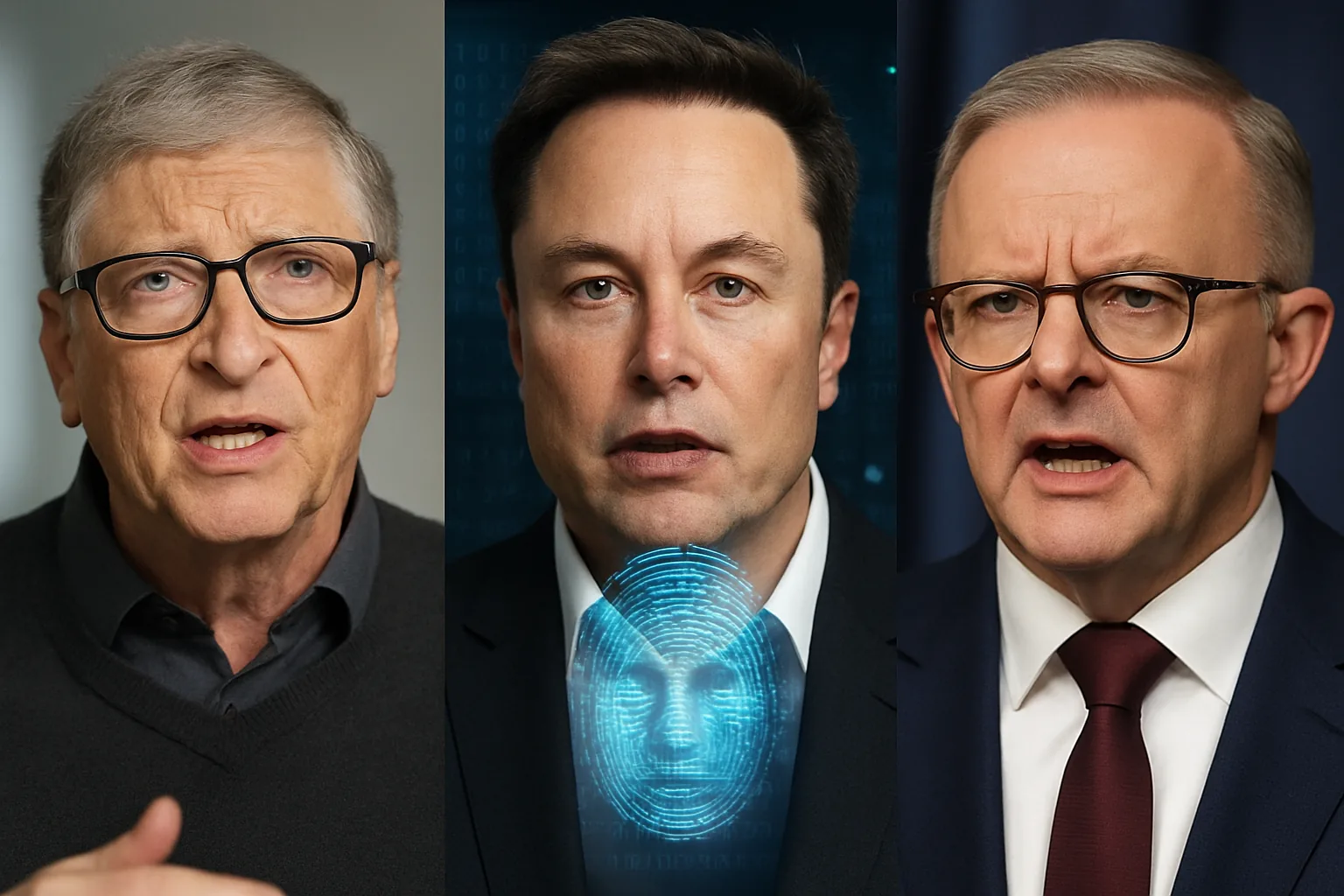
Artificial intelligence has made it easier than ever to put words into the mouths of the world’s most recognisable figures, and a wave of deepfake videos targeting Bill Gates, Elon Musk, and Australian Prime Minister Anthony Albanese illustrates just how far that capability has advanced — and how damaging the consequences can be for public understanding of real-world issues like water security and financial safety.
What These Deepfake Videos Actually Show
The videos at the centre of this disinformation wave are not crude edits or simple voice-overs. They use AI-powered voice cloning and lip-syncing tools to produce footage that, to the untrained eye, appears entirely authentic. In one documented case, a video falsely depicting Bill Gates discussing water shortages and mass mortality was constructed by taking real footage — specifically, material sourced from a CNBC interview recorded in October 2025 — and overlaying a fabricated audio track that makes Gates appear to endorse alarming claims he never made. That video was subsequently shared thousands of times on Facebook, reaching audiences who had no reason to question its authenticity.
The technique itself is worth understanding in detail. Voice cloning works by training an AI model on a sample of a person’s genuine speech, allowing the system to generate new sentences in that person’s voice with striking accuracy. Lip-syncing tools then manipulate the video frames so that the subject’s mouth movements match the fabricated audio. When applied to high-quality source footage of a well-known figure — someone viewers already associate with credibility on a given topic — the result can be persuasive enough to circulate widely before fact-checkers or platform moderators intervene.
Different Targets, Overlapping Tactics
While the Gates video focused on provoking concern about environmental catastrophe, deepfake videos of Elon Musk have followed a different but equally damaging path. Documented cases show Musk’s likeness being used to promote fraudulent cryptocurrency investment schemes, with fabricated footage presenting him as endorsing platforms or opportunities that do not exist or are outright scams. The MIT AI Risk Repository has recorded incidents in which deepfake Musk videos contributed to financial harm for viewers who trusted what they believed to be a genuine endorsement.
In Australia, Prime Minister Anthony Albanese has been subjected to a similar pattern. AI-generated deepfakes of Albanese have been used in fake investment schemes, according to reporting by The Briefing podcast. The use of a sitting head of government lends these videos a particular authority — viewers may reason that a national leader would only endorse a financial product after rigorous scrutiny, making the deception especially effective.
👉 Read also: AI-Generated Deepfakes and Synthetic Media Drive Growing Share of Fact-Checking Workload
What connects all three cases is the deliberate selection of figures whose names carry weight in specific domains. Gates is globally associated with public health and environmental philanthropy. Musk is synonymous with technology and financial speculation. Albanese, as a national leader, carries the implicit endorsement of a democratic institution. Creators of these deepfakes are, in effect, borrowing reputational capital that took decades to build and deploying it in seconds.
How Deepfake Videos Spread So Effectively
Understanding why these videos travel so far requires looking at the platforms on which they circulate. Facebook, TikTok, and YouTube have all been identified as distribution channels for celebrity deepfake content. Each platform’s recommendation algorithm tends to surface content that generates strong engagement — and videos appearing to show famous people making shocking or counterintuitive statements generate exactly that kind of response: shares, comments, and emotional reactions that feed the algorithm and extend reach.
The social architecture of sharing also plays a role. When a user encounters a video that appears to show a trusted figure — whether a tech billionaire or a prime minister — saying something alarming, the instinct is often to share it as a warning. That act of sharing, even when motivated by concern rather than credulity, amplifies the video’s reach. By the time a correction or fact-check appears, the original content has often already reached its intended audience many times over.
There is also a timing dynamic at work. The Gates deepfake drew on footage from October 2025, but the video’s wider circulation and detection came in October 2026 — a gap of roughly a year. This suggests that some deepfake content is either produced with a delayed release strategy in mind, or that it circulates quietly for extended periods before triggering enough concern to attract scrutiny. Either way, the lag between creation and detection creates a window during which false claims can embed themselves in public consciousness.
Detection, Verification, and the Limits of Current Tools
Fact-checkers and researchers have developed a range of methods for identifying AI-generated video. These include analysing inconsistencies in facial movement, checking for unnatural blinking patterns, examining audio waveforms for signs of synthesis, and using dedicated deepfake detection software. Full Fact’s investigation into the Bill Gates video applied several of these approaches and concluded the footage was AI-generated, citing specific technical markers consistent with voice cloning and lip-sync manipulation.
However, detection is not a solved problem. AI generation tools are improving at a pace that consistently outstrips detection capabilities. A model trained to identify the artefacts produced by today’s deepfake tools may be obsolete within months as those tools are updated. This arms-race dynamic means that no single detection method can be considered definitive, and that human editorial judgement — cross-referencing claims against known statements, checking original source footage, and consulting primary records — remains an essential part of the verification process.
👉 Read also: AI-Generated and Manipulated Videos Spread False Claims About Political Events and Figures
For ordinary viewers, a practical first step is to ask a simple question: where did this person actually say this? Genuine statements by public figures of the prominence of Gates, Musk, or Albanese are covered by mainstream media. If a striking claim attributed to one of them cannot be found in any credible news outlet, that absence is itself significant evidence.
Why This Matters Beyond the Individual Videos
The harm caused by these specific videos extends beyond the individuals depicted. When false claims about water shortages and mass mortality circulate under the apparent authority of a globally recognised philanthropist, they can distort public understanding of genuine environmental risks. Audiences may become either falsely alarmed about non-existent crises or, if they later discover the video was fake, more sceptical of legitimate warnings about real resource challenges. Both outcomes serve to undermine informed public debate.
The financial deepfakes targeting Musk and Albanese carry a more direct harm: people who act on fraudulent investment advice can lose real money. The use of a head of government’s image to promote scam schemes also carries a corrosive secondary effect on institutional trust. If a sitting prime minister’s face and voice can be convincingly fabricated to endorse a fraud, the implicit question raised in viewers’ minds is: can I trust any video of any public figure? That generalised scepticism, sometimes called the liar’s dividend, may ultimately be as damaging as the specific false claims themselves — because it creates an environment in which even authentic footage can be dismissed as potentially fabricated.
What Platforms, Regulators, and the Public Can Do
Platform responsibility is increasingly central to discussions about deepfake proliferation. Facebook, TikTok, and YouTube each have policies against manipulated media designed to deceive, but enforcement is inconsistent and reactive rather than preventive. Videos are typically removed after they have already spread, not before. Stronger pre-publication screening — particularly for content depicting named public figures making claims in their voice — would require significant investment in both technology and human moderation.
Regulatory frameworks are developing in several jurisdictions. Legislation requiring provenance labelling of AI-generated content — so that viewers can see, embedded in the metadata, that a video was produced or significantly altered by AI — represents one promising approach. The practical challenge is that such labels can be stripped from a video file before it is re-shared, and that most viewers do not inspect metadata before forming an opinion about what they have watched.
For individual users, the most durable protection remains a habit of verification: pausing before sharing, checking whether a claim appears in credible reporting, and treating any video of a public figure making an extraordinary statement as something that warrants a second look. The existence of sophisticated deepfake videos does not mean that all video is untrustworthy — but it does mean that trust should be earned through corroboration, not assumed on the basis of a convincing appearance alone. The cases of Gates, Musk, and Albanese are a clear demonstration that the technology to fabricate that appearance is now widely accessible, and that the people most likely to be targeted are precisely those whose names carry the most persuasive weight.
This article was produced with AI assistance and reviewed editorially.

Political Ads in 2026 Midterms Contain False or Misleading Claims About Opponents

Trump Administration ‘Super Intelligence’ Accord Misspells ‘United States’ as ‘Unites States’

Trump Administration ‘Super Intelligence’ Accord Misspells ‘United States’ as ‘Unites States’

No Going Back PAC Ad Makes Misleading Claim About Roy Cooper and Rape Kits
