
Current Affairs
Old and Fabricated Videos Misattributed to Recent Riyadh Airport Attacks
Fact-checkers confirmed that videos circulating after the October 2026 Riyadh airport attacks were AI-generated or unrelated older footage, not evidence of the actual str

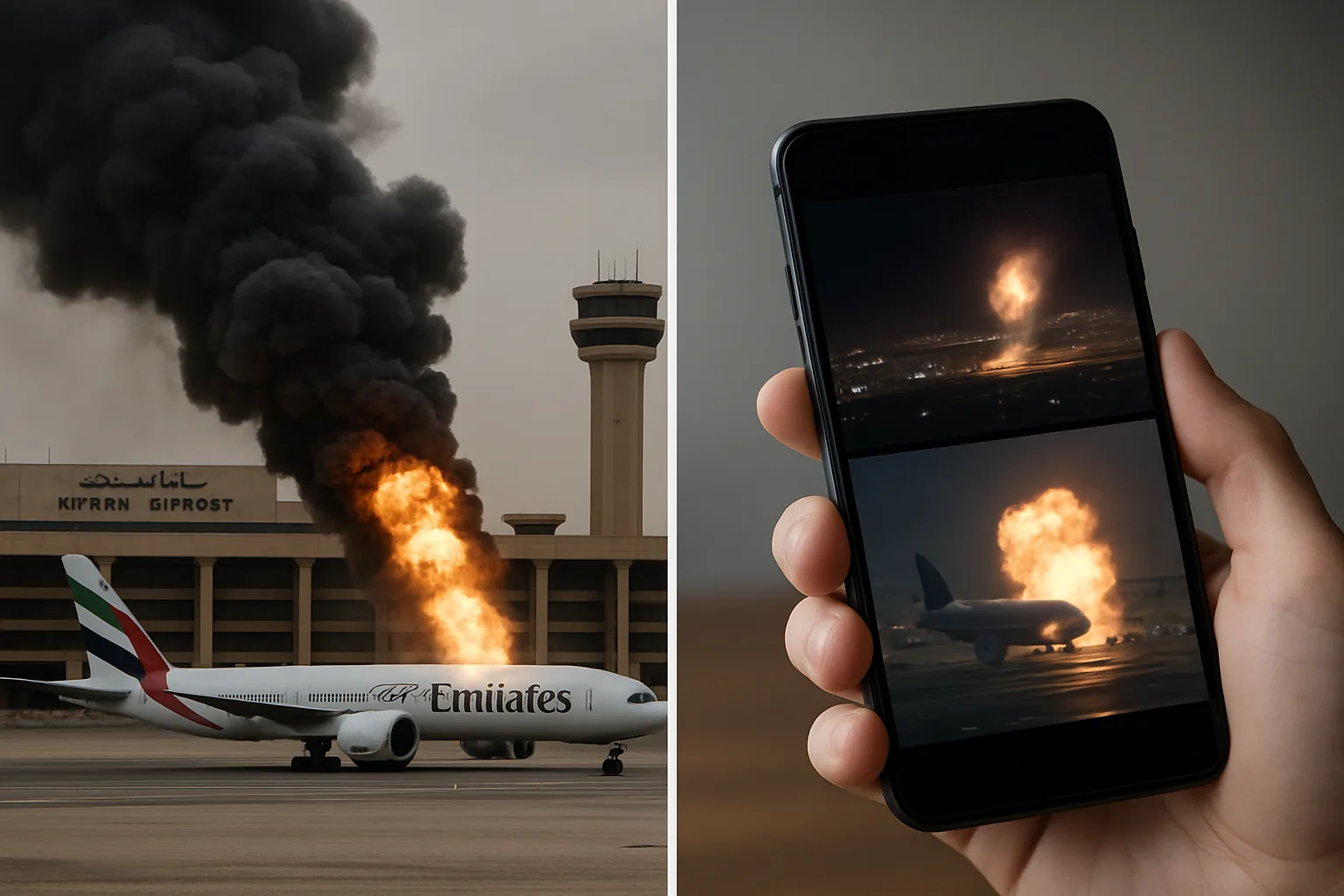
When real violence strikes a high-profile target, fabricated footage almost always follows within hours. The attacks on Riyadh’s King Khalid International Airport on 10 and 11 October 2026 were no exception. As verified reports confirmed that the strikes — claimed by the Houthis, an Iran-backed rebel group based in Yemen — had killed at least 14 people and injured hundreds more, a separate wave of false visual content began circulating online. Videos presented as evidence of the carnage turned out to be either AI-generated fabrications or unrelated older footage from a different country entirely. Multiple independent fact-checking organisations, including Full Fact, DW, AFP, France 24, and CyberPeace, documented the same pattern between 12 and 14 October 2026, making this one of the more thoroughly cross-verified misinformation episodes of the year.
What Actually Happened at King Khalid International Airport
The attacks took place across two consecutive days, 10 and 11 October 2026, targeting King Khalid International Airport in Riyadh, Saudi Arabia. The Houthis publicly claimed responsibility for both strikes. According to verified reporting published by Full Fact on 14 October 2026, the attacks resulted in at least 14 deaths and left hundreds of people injured — a significant and well-documented casualty toll that gave the story immediate global newsworthiness.
The Houthis have conducted long-range drone and missile attacks against Saudi targets throughout the ongoing Yemen conflict, and their claim of responsibility for the Riyadh airport strikes was consistent with that established pattern. The gravity of the event — a major international airport in the Saudi capital struck on two successive days — created exactly the kind of information vacuum that fabricated content is designed to fill. When verified footage is scarce and public demand for visual evidence is high, false videos find an unusually receptive audience.
Riyadh Airport Attack Videos Fake: The AI-Generated Footage
One of the most widely shared videos purporting to show the strikes was AI-generated. DW‘s fact-check team, publishing on 12 October 2026, confirmed that at least one viral video falsely presented as footage of a missile strike at the airport had been fabricated using artificial intelligence tools. Crucially, this was not a video produced in response to the October attacks. AFP‘s fact-checkers established that the AI-generated video had already been circulating since March 2026 — roughly seven months before the actual strikes occurred.
The timeline matters enormously. A video created and distributed in March 2026 cannot, by definition, be documentary evidence of events that took place in October. Yet when the real attacks happened, the pre-existing fabrication was reshared across social media with new captions attributing it to the October 2026 strikes. This recycling of previously debunked or contextually misused content is a well-documented feature of online misinformation: a piece of false content may circulate quietly for months, then surge again whenever a related real-world event provides a new hook.
👉 Read also: Fabricated Missile and Attack Videos
The CyberPeace organisation also independently documented the AI-generated video’s false attribution to the Houthi attack on Riyadh airport, adding a further layer of cross-verification to what DW and AFP had already established. The convergence of findings from organisations working independently of one another strengthens the confidence with which the fabricated nature of this content can be stated.
Old Dubai Airport Footage Mislabelled as Riyadh
Alongside the AI-generated material, a second category of false content also spread: genuine video footage that was real, but filmed at the wrong place and at an unspecified earlier time. Full Fact‘s investigation, published on 14 October 2026, identified one prominent viral video as showing Dubai airport, not Riyadh’s King Khalid International Airport. The footage was old and had no connection to the October 2026 attacks.
This type of misinformation — sometimes called decontextualised media — is in some respects more insidious than outright fabrication, because the footage itself is authentic. Viewers who might be alert to the visual imperfections of AI-generated content have no visual cue to trigger scepticism. The video shows a real airport, real people, real infrastructure. Only by tracing the footage back to its original source and verifying the location — comparing architectural details, signage, runway configurations, or other identifiable features — can fact-checkers establish that what is being shown is Dubai, not Riyadh.
France 24 also documented this pattern of decontextualised videos circulating on social media, in a video report published on 12 October 2026. The simultaneous emergence of both AI-generated fabrications and mislabelled real footage is characteristic of high-attention breaking news events, where speed of sharing consistently outpaces verification.
How the Misinformation Spread and Why It Matters
The documented misinformation campaign unfolded rapidly. Attacks occurred on 10 and 11 October; false videos were already being flagged and fact-checked by 12 October, with further documentation continuing through 14 October 2026. That two-to-four day window between the real events and the publication of fact-checks reflects how quickly fabricated content can achieve wide distribution before corrections catch up.
👉 Read also: AI-Generated and Manipulated Videos Spread Misinformation About September 2026 Events
The research brief underlying this article notes that the specific platforms on which the videos spread most widely have not been detailed in the available verified source material, so no platform-specific claims are made here. What the verified record does establish is that the content reached a wide enough audience to prompt independent responses from at least five separate fact-checking organisations across different countries and languages — Full Fact (UK), DW (Germany), AFP (France/international), France 24 (France/international), and CyberPeace — all converging on the same core findings within a 72-hour period.
The significance of the false content goes beyond the immediate news cycle. When fabricated or misattributed videos circulate alongside real reporting on a violent event, they can distort public understanding of the scale, nature, and visual character of what actually happened. In conflict contexts specifically, false footage can also be used to support particular narratives about who is responsible, what was targeted, and what the consequences were — even when, as in this case, responsibility for the underlying attack was already publicly claimed.
Distinguishing Real Reporting from Fabricated Evidence
The episode illustrates several principles that apply broadly to breaking-news misinformation. First, AI-generated videos can predate the events they are later attributed to — the March 2026 fabrication being a clear example. Verifying when a piece of content first appeared online is therefore as important as verifying where it was filmed. Second, genuine footage from unrelated events can be just as misleading as outright fabrications when stripped of its original context and relabelled. Third, the speed of social media sharing means that false content can achieve significant reach before any fact-check is published.
Readers encountering dramatic video footage during breaking news events can apply a few basic verification steps: searching for the earliest known instance of the video using reverse image or video search tools; checking whether established news organisations with journalists on the ground have published or authenticated the footage; and looking for identifying details — landmarks, signage, weather, infrastructure — that can confirm or contradict the claimed location. When those steps are not possible, treating unverified visual content as unverified is the appropriate response.
For this specific episode, the verified record is clear. The attacks on King Khalid International Airport on 10 and 11 October 2026 were real, deadly, and claimed by the Houthis. The videos circulating as evidence of those attacks included at least one AI-generated fabrication that had existed since March 2026 and at least one piece of genuine footage from Dubai airport that had nothing to do with Riyadh. Organisations seeking to understand what actually happened at the airport should rely on reporting from verified journalists and official statements — not on viral videos whose origins, as documented here, do not withstand scrutiny. The full verification record is available through Full Fact’s published fact-check on the Riyadh airport attack videos, which remains the most comprehensive single-source account of the false content identified to date.
This article was produced with AI assistance and reviewed editorially.

Political Ads in 2026 Midterms Contain False or Misleading Claims About Opponents

Trump Administration ‘Super Intelligence’ Accord Misspells ‘United States’ as ‘Unites States’

Trump Administration ‘Super Intelligence’ Accord Misspells ‘United States’ as ‘Unites States’

No Going Back PAC Ad Makes Misleading Claim About Roy Cooper and Rape Kits
