
Current Affairs
False Celebrity Endorsement Claims About Trump
Fabricated quotes falsely attributed to Denzel Washington, Matthew McConaughey, and Mick Jagger praising Trump circulate online. Learn how these fake celebrity endorsemen

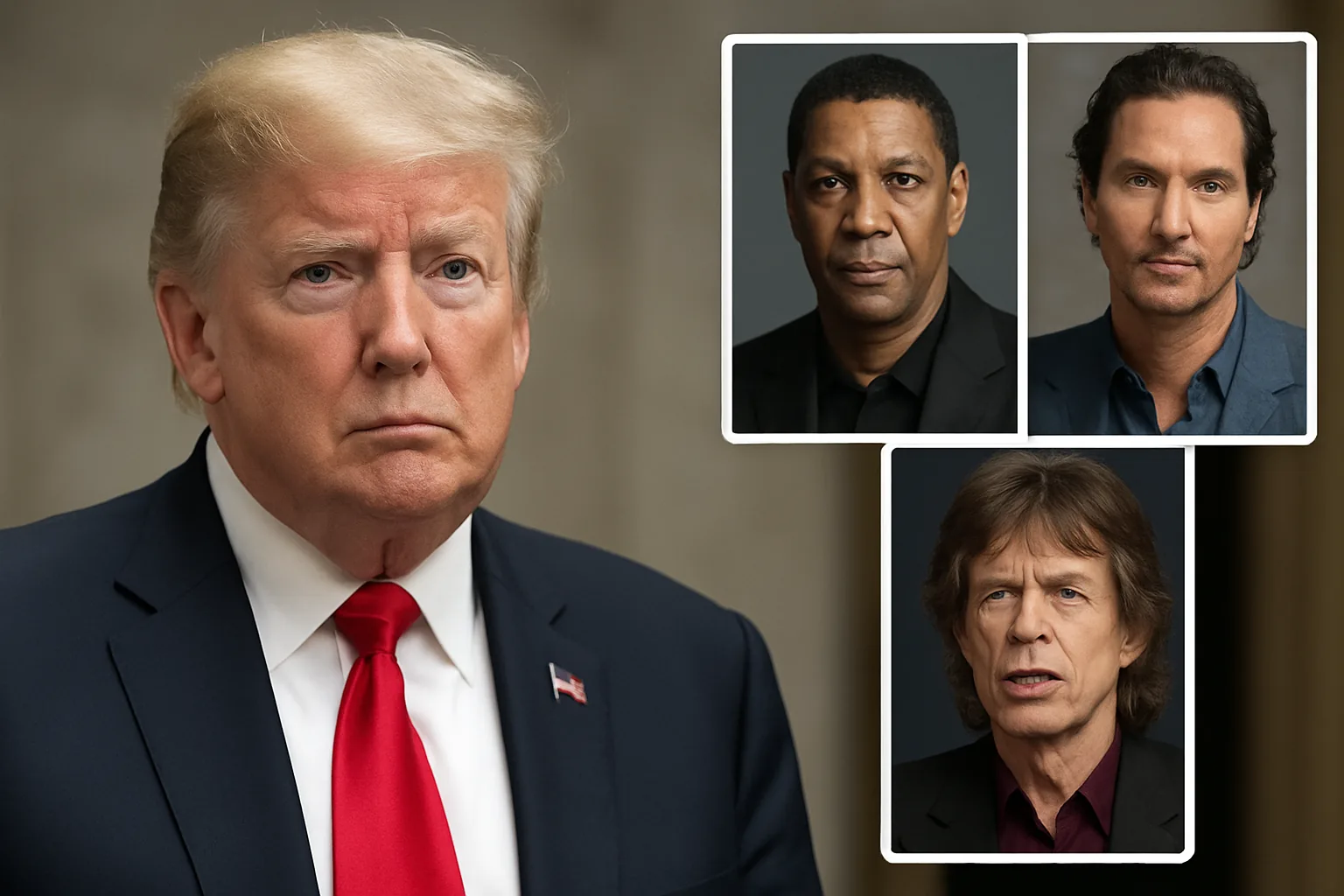
A recurring wave of fabricated celebrity endorsements has been circulating across social media platforms, with multiple high-profile actors, musicians, and athletes falsely quoted as praising Donald Trump in glowing terms. The problem of fake celebrity endorsement claims is not new, but the current political cycle has pushed it to a new level of visibility — particularly after President Donald Trump himself amplified one such fabricated quote on his Truth Social platform, attributing effusive praise to Oscar-winning actor Denzel Washington. Washington’s representative confirmed the endorsement was entirely fabricated, making this a textbook case of how political misinformation travels from anonymous origin to presidential amplification in a matter of hours.
What Was Falsely Attributed to Denzel Washington
The fabricated quote attributed to Denzel Washington portrayed the actor as an enthusiastic Trump supporter, crediting him with words he never said. A representative for Washington stated clearly and on the record that the endorsement shared by the president on Truth Social was fabricated — meaning the actor did not make those statements in any verified context: not in an interview, a social media post, a public appearance, or any other documented format.
What makes this particular case notable is the chain of amplification. The false quote did not simply circulate among anonymous accounts or fringe corners of the internet. It reached the president’s own verified Truth Social account, where it was shared as though it were genuine. That act of amplification dramatically extended the quote’s reach, lending it an air of credibility it had not earned. Once a claim is shared by a high-profile account — especially one carrying institutional authority — the corrective information faces a significantly steeper climb to reach the same audience.
Washington is one of the most respected figures in American cinema, and his perceived endorsement of any political figure would carry real cultural weight. That is precisely why his name is attractive to those constructing fake celebrity endorsement claims: the more credible and admired the source, the more persuasive the fabrication appears to casual readers who do not stop to verify.
A Broader Pattern Across Political Figures and Celebrities
The Washington case is far from isolated. Reporting confirms that dozens of bogus testimonies attributed to American actors, singers, and athletes have proliferated during the current political cycle, targeting both Republican and Democratic figures. The fabrications are not partisan in their mechanics — they exploit the reputational weight of any celebrity whose name might move opinion — but they have been particularly visible in content supportive of Trump.
→ Read also: Denzel Washington quote praising Trump as 'brave' and 'smart' is fabricated
Taylor Swift is among the celebrities whose name has been attached to false political endorsements, according to reporting from CNN. The phenomenon of attaching Swift’s name to political content reflects a broader strategy: identify a celebrity with a large, engaged fanbase and a perceived political valence, then manufacture a quote that either confirms or contradicts that perception, depending on the intended audience.
The brief mentions that similar fabricated quotes have been attributed to other well-known public figures in connection with Trump endorsements, though the specific quotes and their exact wording have not been independently verified through primary sources available at the time of writing. What is verified is the pattern itself: multiple celebrities across entertainment and music have had words placed in their mouths that they never spoke, and those fabrications have been circulated as genuine endorsements during a politically charged period.
Why Fake Celebrity Endorsement Claims Spread So Effectively
Understanding why these fabrications gain traction requires looking at how people process political information online. Most users encounter a quote in a shared post, often without clicking through to any source. The quote appears alongside a recognizable name and sometimes a photograph, and the combination is enough to create a sense of authenticity. Cognitive shortcuts — the mental heuristics people use when processing large volumes of information quickly — make celebrity endorsements feel credible when they align with what a reader already believes or wants to believe.
There is also a structural problem with social media platforms. Sharing is frictionless; verification is not. A fabricated quote can be shared thousands of times in the hours before any fact-check reaches a significant audience, and by then the false version has already shaped the impressions of many readers who will never see the correction. This is sometimes described as the asymmetry of misinformation: falsehoods travel fast and light, while corrections carry the weight of nuance and sourcing.
The political context intensifies this dynamic. During election cycles and periods of high political tension, audiences are actively seeking signals about who prominent cultural figures support. A celebrity endorsement — real or fabricated — functions as a social proof mechanism, suggesting that a candidate is broadly admired beyond traditional political circles. Fake celebrity endorsement claims exploit this appetite directly, manufacturing the social proof that genuine endorsements would otherwise need to be earned.
→ Read also: Viral Quotes Attributed to Trump, Denzel Washington, and Buzz Aldrin Are Unverified or Fabricated
How to Identify and Verify Celebrity Endorsement Claims
When a quote attributed to a celebrity appears in your feed, several straightforward steps can help establish whether it is genuine before you share it.
- Search for the quote in the celebrity’s own words. Genuine endorsements from public figures almost always originate in a verifiable context: a press release, an interview with a named publication, a post on the celebrity’s own verified social media account, or a public appearance with video or audio record. If none of these exist, treat the quote with significant skepticism.
- Check whether the celebrity’s representative has commented. In the Washington case, a representative issued a clear denial. Publicists and management teams routinely respond to false attributions, and a search for the celebrity’s name alongside the word “representative” or “spokesperson” will often surface those denials quickly.
- Look for the original source of the image or post. Many fabricated endorsements use real photographs of celebrities alongside invented text. Reverse image search tools can help establish where a photograph originally appeared and whether the accompanying quote was part of that original context.
- Consult established fact-checking organizations. Organizations that specialize in political misinformation routinely track and document fabricated endorsements. The USA Today fact-check desk has documented fabricated claims in the current political cycle, and similar resources exist across multiple outlets.
- Apply extra scrutiny to content that confirms your existing beliefs. Fabricated endorsements are most persuasive when they tell us what we already want to hear. Recognizing that bias is the first step toward resisting it.
The Responsibility of Amplification
The Washington case raises a question that goes beyond the mechanics of fact-checking: what responsibility do those who amplify fabricated content bear, regardless of whether they originated it? When President Trump shared the false Denzel Washington endorsement on Truth Social, the reach of that post almost certainly exceeded the reach of the original fabrication by orders of magnitude. The president’s account carries an audience that most anonymous originators of misinformation could never access.
This is not a problem unique to any single political figure or platform. High-follower accounts across the political spectrum have shared fabricated quotes, sometimes inadvertently and sometimes without performing basic verification. The effect is the same regardless of intent: the false claim reaches more people, and the corrective information reaches fewer. Amplification without verification is itself a form of participation in the spread of misinformation, even when the person sharing the content did not create it.
Platforms have responded with varying degrees of effectiveness. Labels, reduced algorithmic distribution, and community-sourced context notes have all been deployed as tools, but none has fully resolved the asymmetry between the speed of false content and the slower pace of accurate correction. The burden, for now, falls significantly on individual users and on the journalists and fact-checkers who document these patterns in real time.
The fabrication attributed to Denzel Washington — denied by his representative and documented as false — is a reminder that fake celebrity endorsement claims are not harmless noise. They distort the public record of who supports whom, they exploit the reputations of people who have not consented to be used as political props, and they erode the baseline of shared factual reality that democratic deliberation depends on. Verifying before sharing remains the simplest and most effective individual response to a problem that shows no sign of diminishing as political seasons continue to intensify.
This article was produced with AI assistance and reviewed editorially.

Political Ads in 2026 Midterms Contain False or Misleading Claims About Opponents

Trump Administration ‘Super Intelligence’ Accord Misspells ‘United States’ as ‘Unites States’

Trump Administration ‘Super Intelligence’ Accord Misspells ‘United States’ as ‘Unites States’

No Going Back PAC Ad Makes Misleading Claim About Roy Cooper and Rape Kits
