
Current Affairs
Republican and Democratic Campaign Ads Make False or Misleading Claims in 2026 Election Cycle
Political ads in the 2026 election cycle contain systematic distortions. GOP misrepresents Democratic tax positions on tips and overtime, while Democratic ads strip conte

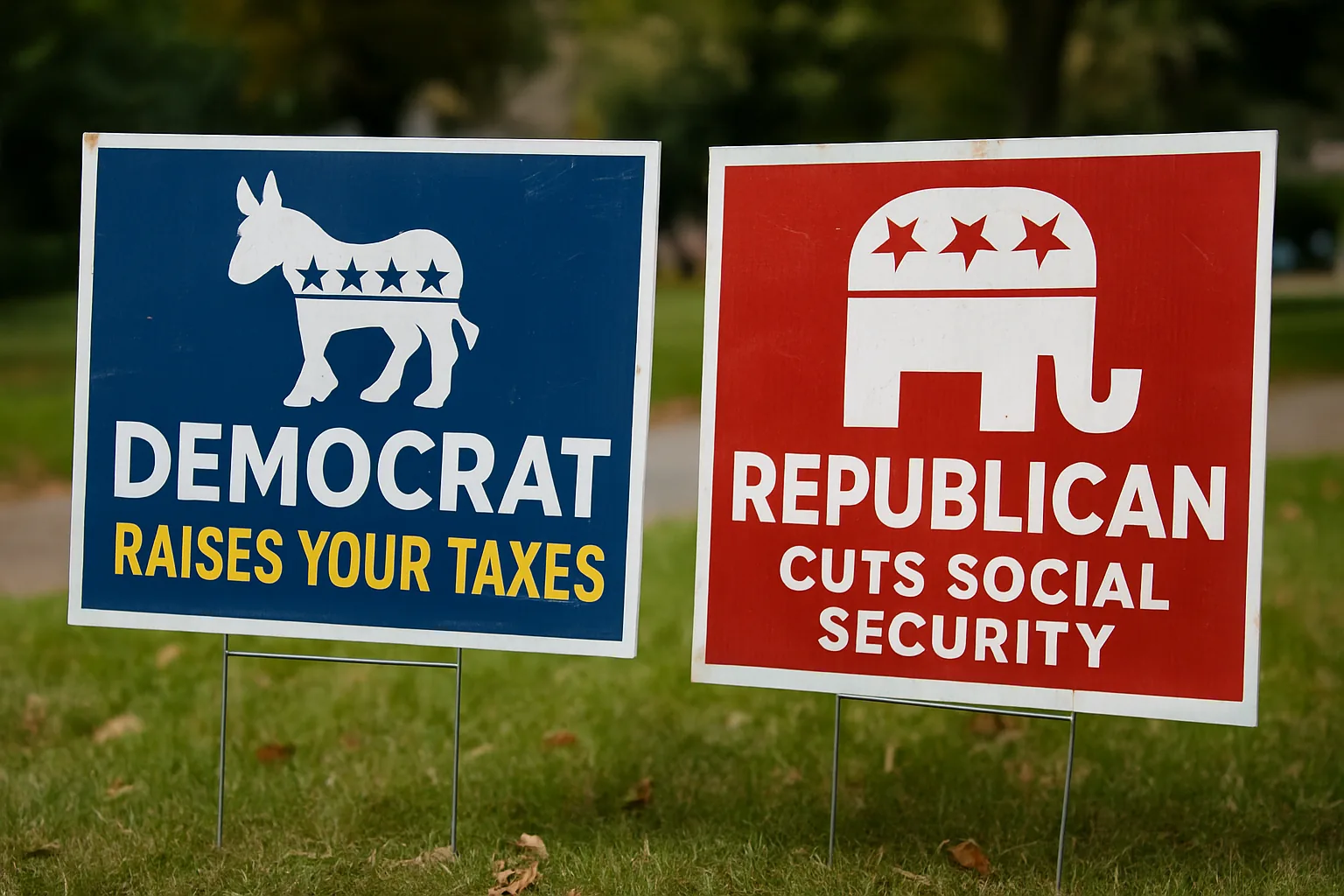
As the 2026 election cycle reaches its final stretch, voters across the country are being bombarded with political advertising that increasingly blurs the line between sharp rhetoric and outright falsehood. The volume and velocity of misleading campaign ads in 2026 have drawn renewed scrutiny from fact-checkers, media watchdogs, and election law scholars — and the pattern cuts across party lines. Ads from both Republican and Democratic candidates and their supporting organizations have been flagged for containing claims that are false, stripped of essential context, or framed in ways that lead viewers to conclusions the underlying evidence does not support.
Why Political Ads Remain a Fact-Checker’s Busiest Beat
Campaign advertising has always been a fertile ground for distortion, but several structural factors make the 2026 cycle particularly challenging for voters trying to separate fact from spin. Federal law requires television stations to air candidate-purchased political advertisements even when those ads contain misleading or inaccurate claims — a legal reality that removes one of the most obvious gatekeeping mechanisms that applies to ordinary commercial advertising. A car manufacturer cannot legally make a provably false claim about fuel economy; a Senate candidate faces no equivalent constraint.
This regulatory gap means the burden of correction falls almost entirely on independent fact-checkers, journalists, and, ultimately, voters themselves. Organizations such as FactCheck.org have been tracking the 2026 advertising landscape systematically, cataloguing claims from both parties and rating them against primary source evidence. What their work reveals is not a problem confined to one side of the aisle. The modus operandi — taking a grain of truth and stretching it past the point of accuracy — is bipartisan.
GOP Tax Attacks: Misleading Claims About Tips, Overtime, and Social Security
One of the most prominent categories of misleading campaign ads in 2026 involves Republican attacks on Democratic candidates over tax policy, specifically targeting positions on tips, overtime pay, and Social Security benefits. According to analysis published by FactCheck.org, these GOP ads misrepresent the actual policy records and stated positions of Democratic candidates in ways that are materially inaccurate.
The specific mechanics of the distortion follow a recognizable template. An ad will cite a real vote, a real legislative record, or a real policy proposal — but strip away the context that would allow a viewer to assess what that vote or proposal actually meant. A Democrat who voted against a particular amendment to a tax bill might be characterized in an ad as having voted to “raise taxes on tips” or “cut Social Security,” when the actual legislative history shows the vote was about something else entirely, or when the candidate has an explicit public record supporting the protection of those benefits.
This kind of decontextualization is technically distinct from outright fabrication, but its effect on voters can be equally distorting. When a claim is built from real components — a real vote, a real bill number, a real dollar figure — it carries a surface plausibility that a straightforwardly invented claim does not. Fact-checkers describe this as one of the hardest categories of misinformation to counter, precisely because debunking it requires walking an audience through legislative procedure and context that can feel dry or complex compared to the punchy thirty-second claim being challenged.
👉 Read also: Political Ads Misrepresent Candidates' Tax and Social Security Positions
The Social Security angle is particularly sensitive in 2026, given ongoing congressional debate about the program’s long-term funding. Ads that characterize a Democratic candidate as a threat to Social Security benefits — without accurately representing their actual stated position — exploit genuine voter anxiety about the program’s future while adding nothing accurate to the public debate.
Democratic Attack Ads and the Problem of Guilt by Association
The misleading campaign ads in 2026 are not a Republican-only phenomenon. Democratic advertising has drawn its own share of fact-checker criticism, with analysts noting a pattern of connecting Republican candidates to figures, events, or positions with which those candidates have no verified meaningful relationship.
Guilt-by-association framing is a longstanding feature of attack advertising, but it becomes factually problematic when the association itself is either invented or so attenuated as to be meaningless. An ad that places a candidate’s image alongside that of a controversial figure — without establishing any genuine policy, financial, or personal connection — is not making a factual argument. It is manufacturing an emotional impression. When that impression concerns something as serious as criminal conduct or extremist association, the reputational harm to the targeted candidate can be severe and difficult to correct.
The broader concern raised by fact-checkers is that this approach treats voters as targets for emotional manipulation rather than as citizens capable of evaluating evidence. A campaign that genuinely believes its opponent holds dangerous or disqualifying positions should be able to make that case with accurate evidence. When the evidence is not there, the temptation to manufacture an impression through visual association or decontextualized quotation is apparently difficult to resist — on either side.
The Stripped-Quote Problem: How Context Becomes a Casualty
Another recurring technique in 2026 campaign advertising involves the use of real quotations from real public figures — but edited or presented in ways that fundamentally alter their meaning. A statement made in one context, about one subject, gets repurposed in an ad to suggest the speaker meant something quite different.
This technique is particularly insidious because it is superficially verifiable. A viewer who looks up the quote will find that the words were genuinely spoken. What the ad conceals is the surrounding sentence, the question that prompted the remark, or the broader argument of which it was a part. Stripped of that context, a statement in favor of immigration reform can be made to sound like an endorsement of lawlessness; a statement about criminal justice policy can be made to sound like opposition to public safety.
👉 Read also: GOP Ads Misrepresent Taxes on Tips, Overtime, and Social Security Benefits
Fact-checkers rate stripped-quote ads as misleading rather than outright false, which is an important distinction. The claim is not fabricated from nothing, but the impression it creates in a viewer who has no access to the original context is functionally false. This distinction matters for how platforms, broadcasters, and regulators think about accountability — but from the voter’s perspective, the practical effect is the same: they are being led to a conclusion the evidence does not support.
Why the Pattern Persists — and What Voters Can Do
Understanding why misleading campaign ads in 2026 continue to proliferate requires looking at the incentive structure of modern political advertising. Attack ads that generate strong emotional responses — anger, fear, disgust — are demonstrably effective at motivating base turnout and suppressing enthusiasm among persuadable voters. Campaigns invest in these ads because they work, at least in the short term. The reputational cost of being fact-checked is, in most races, lower than the electoral benefit of landing an effective attack.
The legal framework reinforces this dynamic. Because broadcasters are required to air candidate ads and cannot apply the same standards they would apply to commercial advertising, there is no market mechanism that penalizes inaccuracy at the point of broadcast. Digital platforms have introduced some content moderation policies around political advertising, but enforcement is inconsistent and the rules vary significantly by platform.
For individual voters, the most practical defense is a habit of source-tracing: when an ad makes a specific factual claim — about a vote, a quote, a policy position, a statistic — treat that claim as a hypothesis rather than a fact, and look for the primary source. What did the candidate actually vote for? What is the full text of the quote? What does the policy proposal actually say? These questions are not always easy to answer quickly, but the tools to answer them — legislative records, official transcripts, nonpartisan fact-checking organizations — are more accessible than they have ever been.
Nonpartisan organizations that track political advertising systematically provide a particularly valuable resource. Their methodology — citing primary sources, distinguishing between false and misleading claims, applying the same standards to all parties — offers a model of epistemic discipline that voters can apply to their own media consumption. The goal is not to emerge from every political ad with a verdict of “true” or “false,” but to develop the habit of asking what the evidence actually shows before accepting any claim as settled.
The 2026 election cycle will not be the last one in which campaign ads distort, mislead, and occasionally fabricate. But the accumulating record of fact-checked claims — from both parties, across multiple races — makes it harder for campaigns to operate in an environment of complete informational impunity. Every corrected claim is a small recalibration of the informational landscape, and over time, that record matters. Voters who engage with it are better equipped not just for this election, but for every one that follows.
This article was produced with AI assistance and reviewed editorially.

Political Ads in 2026 Midterms Contain False or Misleading Claims About Opponents

Trump Administration ‘Super Intelligence’ Accord Misspells ‘United States’ as ‘Unites States’

Trump Administration ‘Super Intelligence’ Accord Misspells ‘United States’ as ‘Unites States’

No Going Back PAC Ad Makes Misleading Claim About Roy Cooper and Rape Kits
