
Current Affairs
Unverified Claims About Trump Administration Actions Circulate on Social Media
Fact-checkers document false claims about Trump administration actions spreading online, including fabricated Truth Social posts and unverified meeting claims.

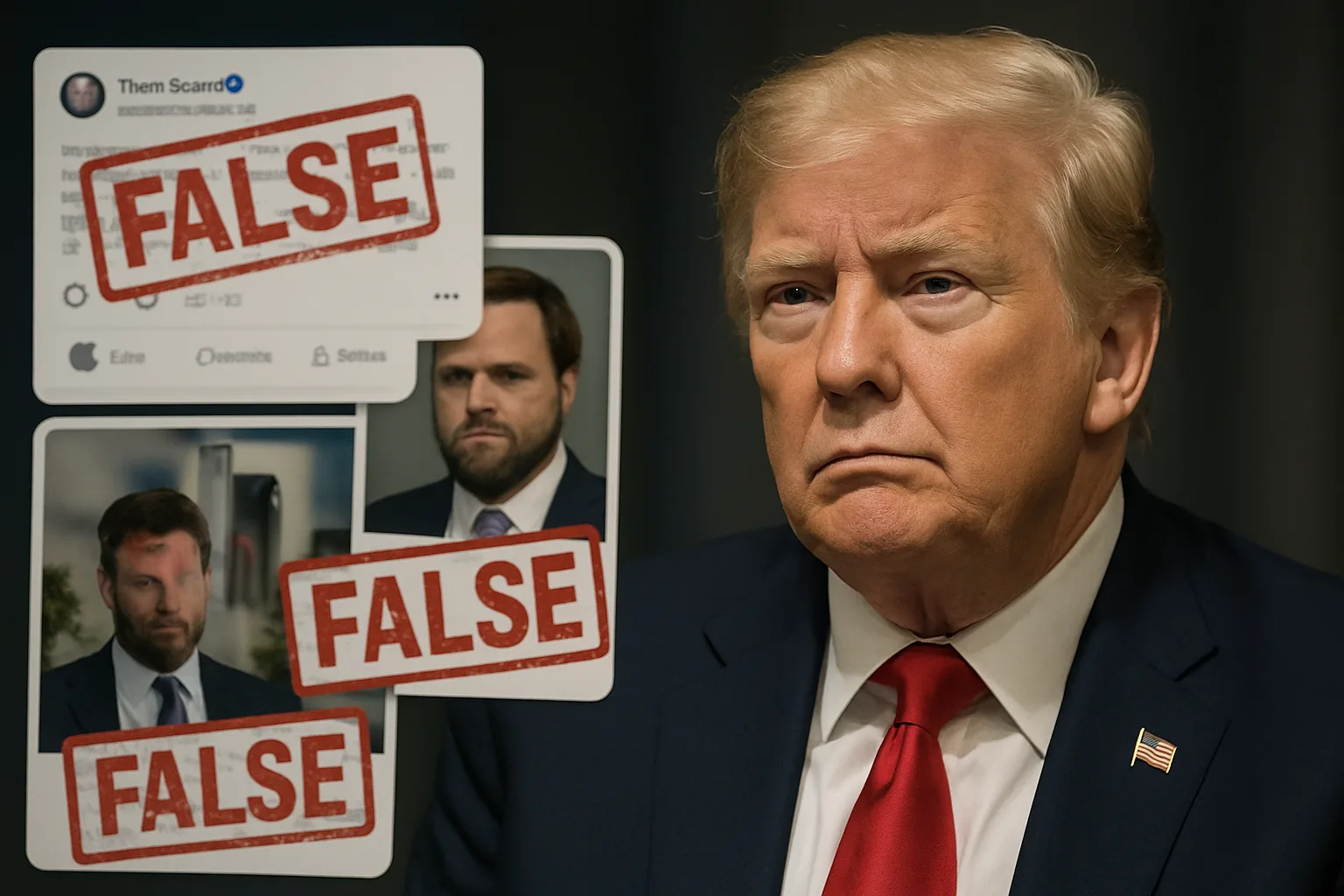
The digital information environment surrounding the Trump administration has become a persistent battleground for fabricated content, selectively edited statements, and claims stripped of their original context. As fact-checkers continue to track the volume and variety of false claims about Trump administration actions circulating on social media and messaging platforms, a clear pattern has emerged: audiences are regularly encountering content that misrepresents official statements, invents posts that never existed, and attributes meetings or decisions to public figures that cannot be verified against any official record. Understanding how these specific categories of misinformation work — and why they spread — is essential for anyone trying to make sense of the current political information landscape.
Why Fabricated Social Media Posts Are So Effective
Among the most straightforward forms of political misinformation is the fabricated social media post — a screenshot, often convincingly formatted, that attributes a statement to a public figure who never made it. These images circulate rapidly because they appear to offer direct, unmediated access to a politician’s thoughts. A reader sees what looks like a genuine post from an official account and, without pausing to verify it, accepts the statement as authentic.
One category of claims currently circulating involves posts purportedly from President Donald Trump’s Truth Social account. The brief mentions a fabricated post carrying the phrase “LEAVE THE REFINERIES ALONE” as an example of this type of content. While the specific post has not been confirmed in verified primary sources, the broader category of fabricated Truth Social screenshots is well-documented by fact-checkers. The platform’s all-caps formatting and distinctive visual style make it relatively easy to mimic, and the emotional register of the supposed content — short, declarative, confrontational — matches the stylistic expectations audiences have of the account, which lowers their critical guard.
The practical advice for readers encountering any such screenshot is straightforward: go directly to the official account and search for the post using the exact phrase shown. If it does not appear there, treat the screenshot as unverified. Archived posts from official government and political accounts are also frequently preserved by independent archiving services, which provide a secondary check. The absence of a post from both the live account and any archived record is strong evidence that it was never published.
Claims Involving Public Figures and Unverified Meetings
A second major category of misinformation involves false claims about meetings, conversations, or relationships between political figures and other prominent individuals. The brief flags a circulating claim that Vice President JD Vance met with Pope Leo XIV — a claim that, based on available verified sources, cannot be confirmed. This type of fabrication is particularly potent because it blends plausible circumstances (senior US officials do meet with religious leaders) with specific details that are difficult for the average reader to immediately disprove.
→ Read also: Fake Screenshots and Misattributed Quotes Circulate as Trump Truth Social Posts
When evaluating claims about high-profile diplomatic or personal meetings involving government officials, several verification steps are standard practice. Official White House readouts and State Department travel records are published regularly and serve as primary sources. The Vatican’s press office issues its own records of papal audiences. When a claimed meeting appears in none of these official channels, the claim’s credibility drops sharply. The fact that a meeting could have occurred — that it is logistically possible and politically plausible — is not evidence that it did.
These meeting-based fabrications also tend to carry an implicit political message. By associating a political figure with a religious institution or foreign leader, they attempt to shape perceptions of that figure’s values, alliances, or priorities. Readers should be alert to the fact that the purpose of such a claim — whatever it may be — does not establish its truth. A story can be politically convenient and factually false at the same time.
Context and the “Take Out” Remarks About Los Angeles and San Diego
Not all misinformation involves outright fabrication. Some of the most consequential false claims about Trump administration statements involve real remarks that are stripped of their surrounding context, allowing audiences to draw conclusions the original statement does not support. A well-documented recent example involves remarks made by President Trump in which he referenced Iran potentially being able to “take out” Los Angeles and San Diego.
According to FactCheck.org’s analysis of these remarks, the statements sparked significant criticism and wide online discussion, but required careful contextual reading to understand what was actually being claimed. When short clips or partial transcripts of politically charged statements circulate without the surrounding exchange, listeners may reasonably — but incorrectly — infer a meaning the speaker did not intend. This does not mean the original remarks were uncontroversial; it means that the specific claim being shared online about what Trump said may itself be inaccurate or misleading.
This is a critical distinction. Misleading framing of a real statement is still misinformation, even though the underlying words were genuinely spoken. Fact-checkers categorize such content separately from outright fabrications precisely because the appropriate correction is different: rather than establishing that something never happened, the task is to restore the context that changes the statement’s meaning. Readers who encounter clipped video or partial quotes should always seek out the full transcript or recording before drawing conclusions about what a public figure meant.
How False Claims About Policy and Infrastructure Spread
A third recurring pattern in the current wave of false claims about Trump administration actions involves assertions about specific policy areas — energy, infrastructure, national security — where the technical complexity of the subject matter makes it harder for non-specialist readers to evaluate competing claims. The brief references circulating claims about Trump officials making misleading statements regarding electrical grid reliability, though the specific details of those claims have not been confirmed in verified primary sources.
→ Read also: False Celebrity Endorsement Claims About Trump
What is well-established, however, is that energy and infrastructure policy has been a consistent subject of contested claims throughout Trump’s second term. Statements about grid capacity, energy independence, and the reliability of power systems involve technical metrics — reserve margins, generation capacity, transmission bottlenecks — that are rarely explained in political communications. This creates an opening for both overstatement and understatement, and for claims that are technically true in a narrow sense but misleading in their overall implication.
Fact-checkers tracking false claims about Trump administration policy in this space typically rely on data from independent regulatory bodies and industry organizations, comparing official statements against publicly available grid performance data. When a government official’s claim diverges significantly from those independent records, the discrepancy is verifiable. Readers without access to technical expertise can still apply a basic heuristic: if a policy claim is specific and quantitative, look for the independent data source that would confirm or contradict it. Vague or unsourced statistics in political statements are a reliable warning sign.
The Broader Pattern: Why These Claims Cluster Around This Administration
It would be a mistake to treat the current volume of false claims about Trump administration actions as a phenomenon unique to this particular political moment. Fact-checkers have documented misleading content surrounding every recent US administration. What does appear to be distinctive about the current period is the sheer velocity of claim generation and the diversity of formats — fabricated screenshots, clipped video, invented meeting reports, and contested policy statistics — all circulating simultaneously.
FactCheck.org and other established fact-checking organizations have maintained ongoing tracking of false or misleading statements connected to Trump’s second term, noting that the volume of claims requiring evaluation remains high. CNN’s fact-checking coverage similarly documented a significant number of false or misleading claims during Trump’s first hundred days back in office in 2025, establishing a baseline that has continued into the current period.
The appropriate response to this environment is not cynicism — the assumption that nothing can be known — but rather a disciplined approach to verification. Primary sources exist for almost every category of claim discussed here: official social media archives, White House readouts, Vatican press records, regulatory filings, and transcript databases. The distance between a viral claim and its verifiable truth is almost always shorter than it appears, provided readers are willing to travel it.
Navigating a landscape saturated with false claims about Trump administration actions requires the same habits regardless of a reader’s political sympathies: identify the original source, check official records, seek independent corroboration, and treat emotional urgency in a headline as a reason to slow down rather than share. Misinformation does not respect partisan lines, and the credibility of public discourse depends on the same verification standards being applied consistently — to every claim, about every figure, from every direction.
This article was produced with AI assistance and reviewed editorially.

Political Ads in 2026 Midterms Contain False or Misleading Claims About Opponents

Trump Administration ‘Super Intelligence’ Accord Misspells ‘United States’ as ‘Unites States’

Trump Administration ‘Super Intelligence’ Accord Misspells ‘United States’ as ‘Unites States’

No Going Back PAC Ad Makes Misleading Claim About Roy Cooper and Rape Kits
