
Information
Viral Videos Misidentified as Recent Events: Sheffield Crowd, Iran Protests, NATO Campaign
Old videos from 2024 reshared with false 2026 dates create misinformation. Sheffield crowd, Iran protests, and NATO footage circulated with incorrect timestamps.

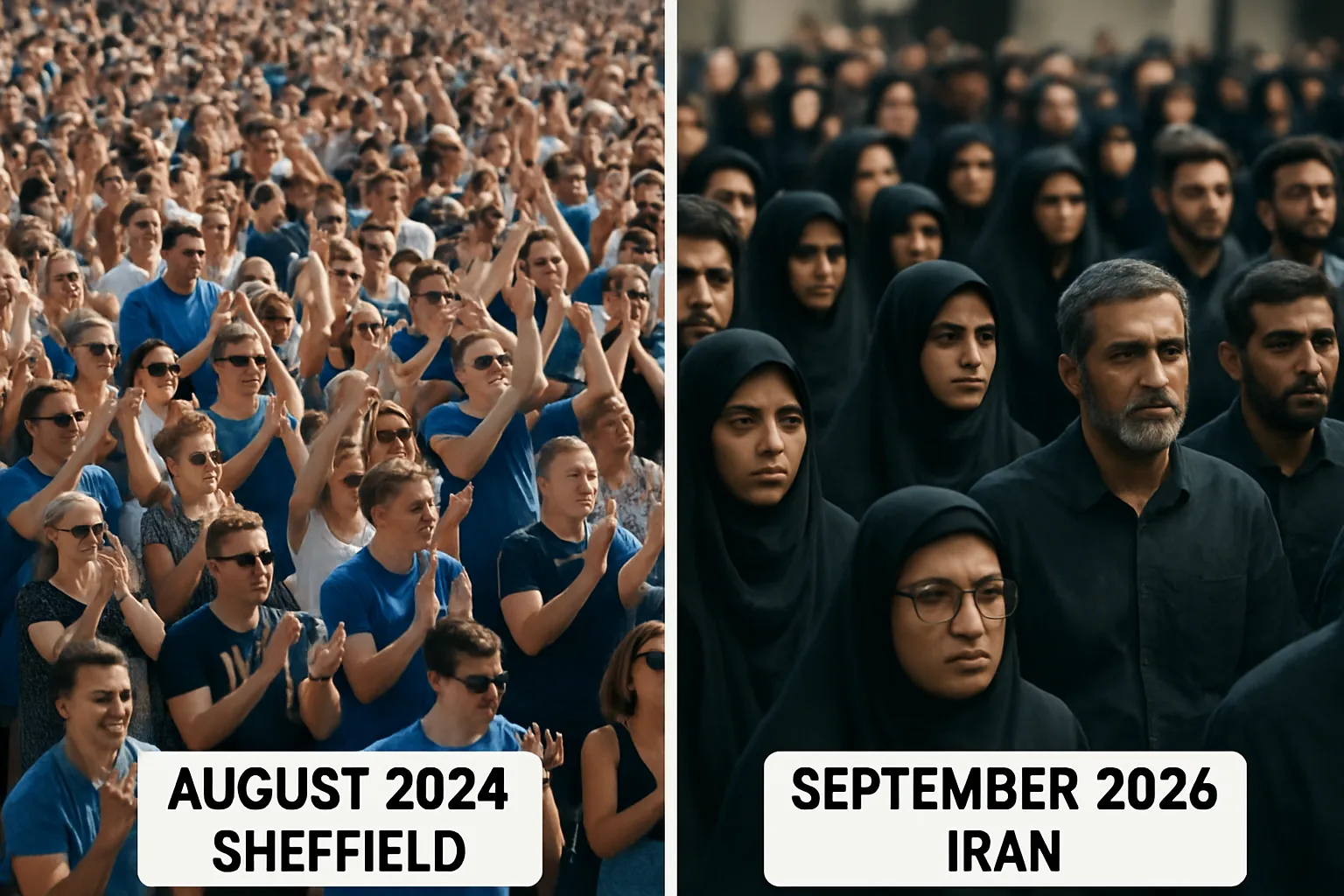
Social media platforms continue to amplify a well-documented but persistently effective form of misinformation: old videos reshared with false date labels, making them appear to document breaking news. In September 2026, fact-checkers identified at least three distinct cases of viral videos false dates attached to footage that originated in 2024 or earlier — a Sheffield crowd scene, Iranian protest footage, and a NATO anniversary video — each circulating with captions that tied them to current events they had nothing to do with.
How Old Footage Gets Recycled as Breaking News
The mechanics of this problem are straightforward. A video is filmed during a genuine event, uploaded to social media, and then — days, months, or even years later — downloaded and re-uploaded with a new caption that places it in a different time or location. The original metadata is stripped or ignored. Viewers encountering the clip through a share or a recommendation algorithm have no immediate way to know when it was actually recorded.
What makes this category of misinformation particularly resilient is that the footage itself is real. There is no altered media, no deepfake, no digitally composited scene. The manipulation is entirely contextual: a true caption becomes a false one. This distinction matters because many people have learned to look for visual artifacts or signs of AI generation, but they are far less likely to question whether a video is simply old. The authenticity of the imagery is used as cover for the inauthenticity of the claim.
Recirculation tends to spike when a related news story breaks. If tensions rise in a particular country, or a city makes headlines, old footage from that location becomes newly attractive to share. The emotional urgency of a current event lowers the threshold for critical scrutiny, and a clip that might otherwise seem unremarkable suddenly feels like evidence of something important.
The Sheffield Crowd Video: August 2024 Footage Labeled September 2026
One of the clearest examples documented in September 2026 involved a video showing a crowd of hooded figures running through a street in an English city. The clip circulated on social media with captions asserting it showed events that had taken place on September 13, 2026. According to a Reuters fact-check published on September 23, 2026, the footage actually originated on August 4, 2024 — more than two years before the date claimed in the caption.
The gap between the real date and the claimed date is significant. August 2024 was a period of notable civil unrest in parts of England, meaning the original footage was genuine documentation of a real event. By relabeling it as September 2026 footage, those resharing it attempted to connect it to whatever was generating headlines at that moment. The video’s dramatic visual quality — crowds moving rapidly through an urban space — made it easy to strip of context and reattach to a new narrative.
→ Read also: Viral Videos Misidentify Crowds and Events Through Mislabeling and Old Footage
Verification in cases like this typically relies on reverse image search, geolocation of visible landmarks, and cross-referencing with contemporaneous news reports. Fact-checkers can often identify the original upload date, the original caption, and the platform where the clip first appeared. In the Sheffield case, the discrepancy between the claimed date and the verified origin date was unambiguous.
Iran Protest Footage: Geography and Timeline Both Wrong
A second case involved video purportedly showing recent anti-government protests in Iran, shared in the context of heightened tensions following Israeli-Iranian airstrikes. The footage was presented as evidence of current unrest inside the country. Full Fact’s investigation found that the video was not recent and did not show what its captions claimed.
The broader information environment around Iran at this time was already severely compromised. Iran had experienced anti-regime demonstrations across several cities and towns over a period of more than two weeks, and verifying protest-related content had become increasingly difficult, as documented by Deutsche Welle’s fact-checking team. An internet blackout and restrictions on journalists made it harder to confirm or refute footage emerging from inside the country — a condition that bad-faith actors can exploit precisely because the uncertainty is genuine.
The problem extended beyond old footage being misdated. AFP Fact Check documented cases in which videos filmed in France and Canada were misrepresented as showing protesters in Iran. This adds a second layer of falsification: not only were the dates wrong, but the locations were wrong too. A crowd scene from a Western European city, filmed in an entirely different context, was repackaged as evidence of Iranian street protests. For viewers with no familiarity with the specific geography shown, there was little visual basis for skepticism.
Together, these cases illustrate how a single news event — genuine protests in Iran — can generate an entire ecosystem of misidentified and mislabeled footage, some of it old, some of it from entirely different countries, all of it circulating as though it were current and local.
NATO’s 75th Anniversary Video Mislabeled as a New 2026 Campaign
The third case is instructive because it involves an institution rather than a conflict zone, and because the original video was itself a piece of official communication. A NATO video that the alliance had originally posted in summer 2024 to mark its 75th anniversary began circulating in 2026 with claims that it represented a new advertising or recruitment campaign. NATO had accompanied the video with a caption referencing the alliance’s role in “protecting our freedom, democracy and our way of life for over 75 years” — language that clearly tied it to the anniversary milestone.
→ Read also: Viral Videos Misidentify Unrelated Footage as Recent Events
Full Fact’s review confirmed that the video was not new and was not a 2026 campaign. The missing context was the date of original publication. Someone encountering the video without knowing when NATO had posted it could reasonably assume it was current, particularly if the caption attached to the reshared version made no mention of the anniversary framing.
This case differs from the Sheffield and Iran examples in one important respect: the video’s content was not dramatic or alarming. It was institutional messaging. The motivation for mislabeling it was likely not to incite panic but to shape perceptions of NATO’s current posture — implying, perhaps, that the alliance was ramping up public communications at a moment of geopolitical tension. Whether that inference was drawn deliberately or arose from careless resharing, the effect was the same: audiences received a false impression of what NATO was doing and when.
Why Viral Videos with False Dates Keep Working
All three cases share a structural feature: they exploit the gap between what a video shows and what a viewer is told about it. Closing that gap requires effort — reverse searches, geolocation, cross-referencing — that most people do not perform before sharing. The viral mechanics of social media reward speed and emotional resonance, not verification.
Several practices can reduce individual vulnerability to this form of misinformation. Before sharing a video that purports to show a recent event, it is worth asking whether the clip has been verified by a named outlet. Reverse video search tools — available through major search engines — can surface earlier instances of the same footage. Checking whether the landmarks, signage, license plates, or seasonal cues in the video match the claimed location and time of year takes only a few minutes and can reveal obvious inconsistencies.
Fact-checking organizations play a central role in this ecosystem, but they operate under a structural disadvantage: a false video can reach millions of people in hours, while a thorough verification takes time. The Reuters, Full Fact, AFP, and DW investigations cited here were published days after the videos had already circulated widely. That lag is not a failure of the fact-checkers; it reflects the asymmetry between producing misinformation and correcting it.
Platform-level interventions — labels on reshared content, friction added to sharing very old videos as though they were new, algorithmic demotion of content flagged by fact-checkers — can narrow that gap, but none of them eliminate it. The most durable protection remains a habit of skepticism applied before, not after, a share. When a video arrives carrying strong emotional weight and a specific recent date, those are precisely the conditions under which pausing to verify matters most. The three cases documented here are not outliers; they are examples of a recurring pattern that shows no sign of slowing, and understanding how it works is the first step toward not being caught by it.
This article was produced with AI assistance and reviewed editorially.

Political Ads in 2026 Midterms Contain False or Misleading Claims About Opponents

Trump Administration ‘Super Intelligence’ Accord Misspells ‘United States’ as ‘Unites States’

Trump Administration ‘Super Intelligence’ Accord Misspells ‘United States’ as ‘Unites States’

No Going Back PAC Ad Makes Misleading Claim About Roy Cooper and Rape Kits
