
Current Affairs
Hegseth Announces Project Meridian with Musk, Gingrich, and Luckey as Co-Leaders
Secretary of Defense Pete Hegseth unveiled Project Meridian defense, a Pentagon study on future warfare led by Elon Musk, Palmer Luckey, and Newt Gingrich, raising confli


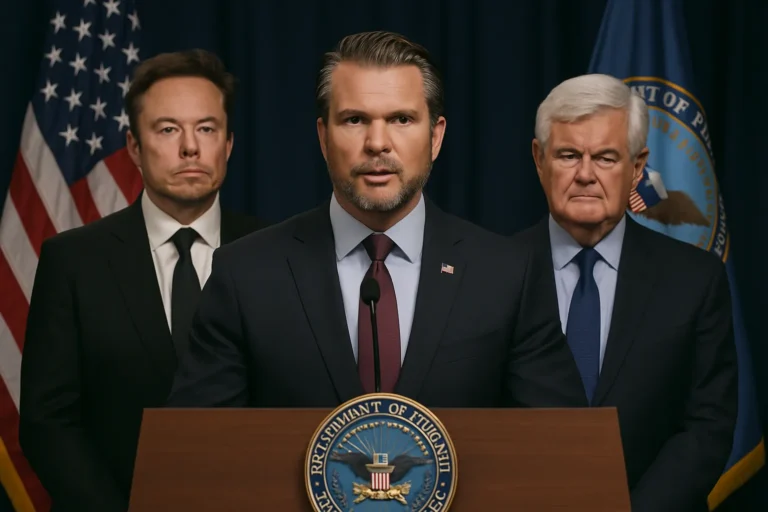
On September 30, 2026, Secretary of Defense Pete Hegseth stepped before cameras to unveil one of the more unusual Pentagon initiatives in recent memory — a study group he described as bringing together “America’s best minds” to examine the future of warfare. The announcement of the Project Meridian defense initiative immediately drew attention not only for its ambitious framing but for the high-profile, and in some cases commercially entangled, figures Hegseth placed at its helm.
What Project Meridian Actually Is
According to the Pentagon’s own characterization, Project Meridian is described as “an effort led by America’s best minds to study the future of warfare.” That framing is deliberately broad. Crucially, the initiative is not meant to develop new strategies or policies — a distinction that matters when assessing the scope of authority its leaders will wield. It is, at its core, a study and analysis function, sitting somewhere between a think tank convening and a formal advisory body.
Overall leadership of the project sits with Emil Michael, the undersecretary of Defense for research and engineering. Michael’s position places Project Meridian within the research and technology arm of the Pentagon rather than in operational or policy channels, which is consistent with the initiative’s stated analytical rather than directive purpose. The co-leadership structure beneath Michael is where the announcement generated the most public interest.
The Co-Leaders: Musk, Luckey, and Gingrich
Three figures have been named as co-leaders of the project meridian defense effort: Elon Musk, Palmer Luckey, and Newt Gingrich. The combination is striking in its range — a tech billionaire who runs a rocket company, a defense-technology entrepreneur, and a former Speaker of the House and longtime national security commentator.
Elon Musk is the founder and chief executive of SpaceX, whose Falcon and Starship launch vehicles have become central to both commercial and government space operations. SpaceX has received billions of dollars in Pentagon contracts, making Musk’s role in a Defense Department study group an immediate focal point for questions about the separation between commercial interests and government advisory functions.
→ Read also: Secretary Hegseth Creates Pentagon Office of Religious Affairs; Names Musk, Gingrich to 'Project Meridian'
Palmer Luckey is the founder of Anduril Industries, a defense technology company that has itself received billions of dollars in Pentagon contracts. Anduril specializes in autonomous systems, surveillance towers, and AI-driven defense platforms — precisely the categories of technology that a study on the future of warfare would be expected to evaluate. Luckey’s inclusion was noted in most reporting on the announcement, though he was absent from some early headline summaries of the initiative.
Newt Gingrich, the former Speaker of the House and a figure who has engaged with defense and technology policy for decades, rounds out the trio. Gingrich brings a different profile than his co-leaders — his background is political and strategic rather than entrepreneurial — and his involvement lends the project a more traditional Washington advisory character alongside its tech-industry orientation.
The Conflict-of-Interest Dimension
The most persistent line of scrutiny surrounding the project meridian defense initiative concerns the financial relationships between its co-leaders and the department that appointed them. Both Musk’s SpaceX and Luckey’s Anduril have received billions of dollars in Pentagon contracts, according to reporting by The Hill. Placing the heads of two major defense contractors in a role that involves studying the future of warfare — even in an analytical capacity — raises legitimate structural questions.
It is worth being precise about what is and is not established here. The verified fact is that both companies hold substantial Pentagon contracts. What remains an assessment, rather than an established fact, is whether those financial relationships will influence the findings or recommendations that emerge from Project Meridian, or whether they were a factor in the appointment decisions. Those questions have been raised by observers and commentators, but the causal links involve intent and outcome that cannot yet be documented.
The Pentagon’s clarification that the project is not designed to produce new strategies or policies is relevant context. If the initiative’s output is analytical rather than directive, the pathways through which commercial interests could translate into policy outcomes are less direct than they would be in a formal acquisition or strategy-setting body. That said, the distinction between studying warfare’s future and shaping how the Defense Department thinks about it is not always a clean one in practice.
→ Read also: Pentagon Execution Livestream Claim and Military Justice Procedures Require Legal Clarification
Why This Appointment Model Is Unusual
The Defense Department has a long history of convening outside advisory panels — the Defense Science Board being the most established example — and those bodies regularly include executives from defense contractors. What distinguishes Project Meridian is the seniority and public profile of its named co-leaders, the direct announcement by the Secretary of Defense himself, and the explicit branding of the effort as a study of warfare’s future rather than a narrower technical or acquisition review.
Hegseth’s personal announcement of the initiative on September 30, 2026 gave it a visibility and political weight that routine advisory appointments rarely receive. Naming Musk — one of the most recognizable figures in global technology and a figure with significant political associations — as a co-leader ensured that the initiative would be read through multiple lenses simultaneously: as a defense modernization effort, as a continuation of Musk’s broader engagement with federal institutions, and as a potential conflict-of-interest question.
Gingrich’s inclusion adds yet another interpretive frame. His presence signals that the project is meant to engage with the political and doctrinal dimensions of future warfare, not just its technological ones. Whether that combination of tech founders and political strategists produces coherent analytical output is a question that will be answered only as the initiative’s work becomes visible.
What Comes Next for Project Meridian
The initiative is in its early stages. As of the announcement date, the primary public documentation consists of Hegseth’s statement and subsequent reporting by outlets including The Hill and Snopes. The specific scope of the group’s work — what questions it will address, how it will operate, and how its findings will be transmitted to Pentagon leadership — had not been fully detailed in verified public sources at the time of reporting.
Emil Michael’s role as the senior Pentagon official providing overall leadership suggests that the project will operate within established departmental structures rather than as a fully independent body. That institutional anchoring may provide some procedural guardrails around how the co-leaders’ contributions are solicited and used. It also means that Michael, as a confirmed government official, carries the formal accountability that advisory co-leaders from the private sector do not.
The project meridian defense initiative arrives at a moment when the Pentagon is actively grappling with the integration of autonomous systems, artificial intelligence, and commercial space capabilities into military doctrine — precisely the areas in which Musk and Luckey have built their companies. Whether that alignment is seen as an asset or a liability will depend substantially on how transparently the project operates and what it ultimately produces. For now, the announcement has done what it was perhaps designed to do: signal that the Defense Department under Hegseth intends to look beyond conventional Washington advisory circles when asking fundamental questions about how America will fight in the decades ahead.
This article was produced with AI assistance and reviewed editorially.

Political Ads in 2026 Midterms Contain False or Misleading Claims About Opponents

Trump Administration ‘Super Intelligence’ Accord Misspells ‘United States’ as ‘Unites States’

Trump Administration ‘Super Intelligence’ Accord Misspells ‘United States’ as ‘Unites States’

No Going Back PAC Ad Makes Misleading Claim About Roy Cooper and Rape Kits
