
Current Affairs
False Claims About Migration, Vaccines, and AI-Generated Content Circulating in September 2026
Examining false claims circulating in autumn 2026 about vaccines, migration, and AI-generated images. Full Fact and fact-checkers debunk misinformation on Channel crossin

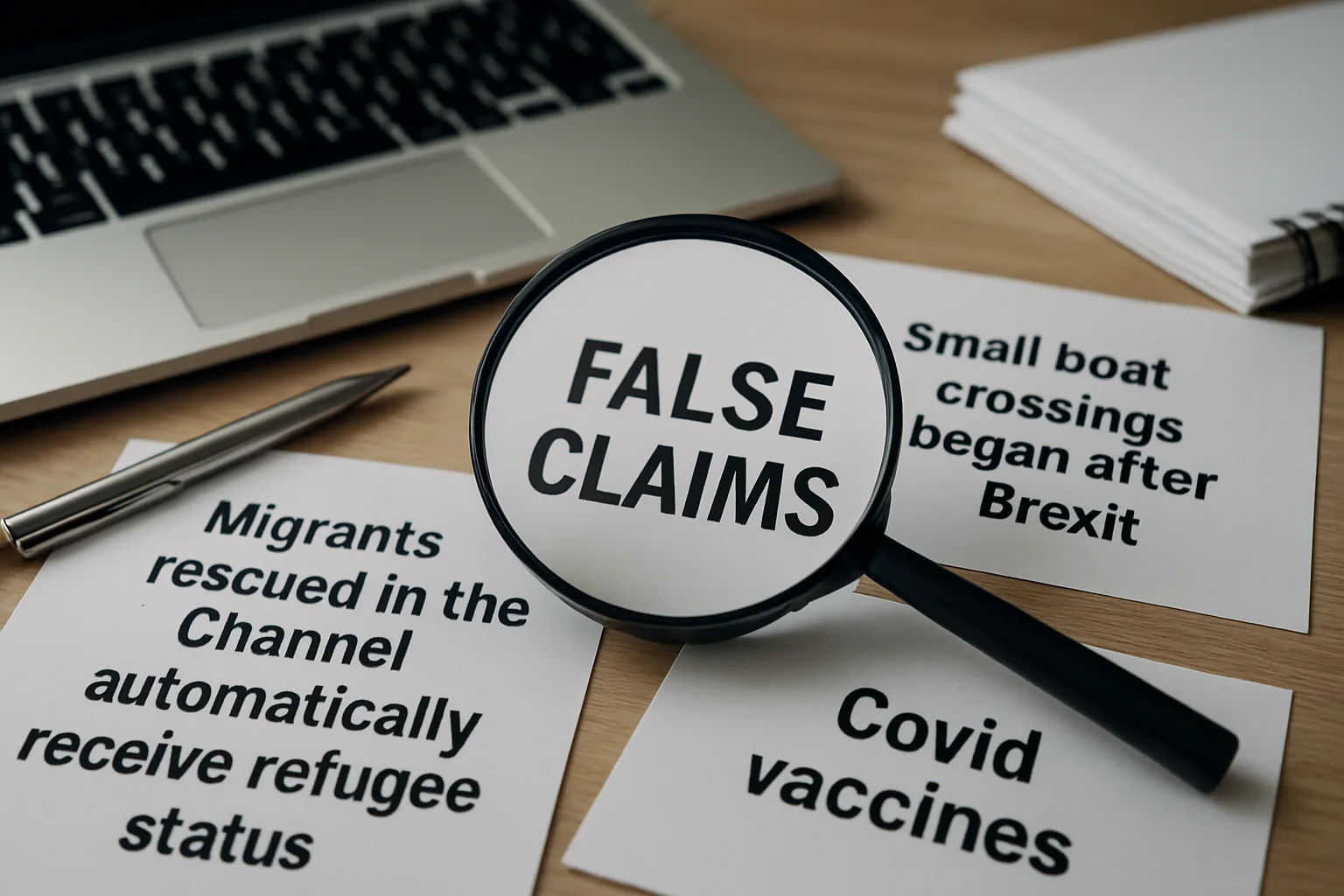
Misinformation rarely arrives in isolation. In the autumn of 2026, a cluster of false claims has been circulating across UK social media, covering topics as varied as Channel crossings, Covid-19 vaccines, and the authenticity of protest photographs. Conducting a thorough false claims fact check across all of them reveals a consistent pattern: emotionally charged assertions, stripped of context, spread faster than the corrections that follow them. What the verified evidence actually shows is worth examining carefully, claim by claim.
How Vaccine Misinformation Keeps Reinventing Itself
One of the most persistent false claims to resurface this autumn concerns Covid-19 vaccines and their alleged effects on health outcomes. The claim, which has recirculated widely on social media platforms, asserts that Covid-19 vaccines caused a tripling of miscarriage and cancer rates, along with a tenfold rise in neurological conditions. Full Fact’s vaccine fact-checking coverage has tracked this claim and found it to be false.
This is not a new assertion. Variants of it have appeared repeatedly since mass vaccination programmes began, and each iteration tends to borrow authority from the previous one — citing the earlier social media post as though it were a primary source. The specific figures cited — tripling, tenfold — are not drawn from any published peer-reviewed study, national health registry, or regulatory safety database. They appear to originate within the misinformation ecosystem itself, repeated until they acquire the texture of established fact.
What makes this particular iteration notable is its timing. By autumn 2026, the acute phase of the Covid-19 pandemic is several years in the past, and public attention to vaccine safety has shifted. Claims that would have faced immediate, high-profile rebuttal in 2021 or 2022 now circulate in a lower-scrutiny environment. Vaccine safety monitoring systems in the UK — which collect and publish adverse event data on an ongoing basis — have not reported the dramatic spikes in cancer, miscarriage, or neurological events that the claim describes. The absence of such findings in continuous, large-scale surveillance data is itself significant evidence against the claim.
The epistemic structure of this type of claim deserves attention. It presents precise-sounding numbers — not “some increase” but a specific multiple — without identifying a data source, a time period, a comparison baseline, or a definition of the condition being measured. Precision without sourcing is a common feature of health misinformation, because it mimics the form of scientific reporting without its substance.
AI-Generated Images and the Anatomy of Visual Misinformation
A separate but equally significant strand of misinformation involves fabricated visual content. Verified fact-checking work has identified multiple AI-generated images circulating as authentic photographs of real events — specifically, images purporting to depict scenes from protests in Tirana, Albania.
→ Read also: False Claims About Migrants, Refugees, and UK Border Policy Fact-Checked
Several distinct fabrications have been identified and documented. One AI-generated image was used to falsely claim that Kosovo Serbs were travelling to Albania to escalate ongoing protests. Another showed a banner with an inscription claiming that protesters in Tirana were confronting Serbian police — an image that was also generated with AI tools rather than captured at any real event. A third set of AI-generated images depicted protest scenes in Tirana more broadly, presented as photographic evidence of what was happening on the ground.
These are not cases of photographs being taken out of context or mislabelled — a form of manipulation that has existed as long as photography itself. These are images that were created, not captured. The scenes they depict did not occur in the form shown. The individuals, banners, and confrontations visible in the images are synthetic constructs.
What makes AI-generated imagery particularly challenging for audiences is the rapid improvement in image quality. Earlier AI-generated photographs often contained telltale artefacts — distorted hands, inconsistent lighting, text that dissolved into illegibility on close inspection. Current generation tools produce images that require deliberate, trained scrutiny to identify as fabricated. Fact-checkers examining these Tirana-related images used a combination of reverse image search, metadata analysis, and AI-detection tools to establish their fabricated nature.
The geopolitical context matters here. The images were designed to be plausible within a real and ongoing situation — protests in Albania involving genuine political tensions. Fabricated content is most effective when it is grafted onto real events, because the audience’s existing knowledge of the genuine situation makes the false details harder to isolate and question. This is a recurring feature of altered media in conflict-adjacent or politically charged contexts.
Why False Claims About Migration Are Especially Hard to Correct
The verified research brief for this article flags several migration-related claims that have circulated in the UK — including assertions about the automatic granting of refugee status to people rescued in the Channel, and claims about when small boat crossings began — but the available primary sources do not provide sufficient verified detail to state specific findings as established fact. This matters, and it is worth explaining why.
A responsible false claims fact check requires more than the identification of a claim as implausible or politically motivated. It requires traceable primary evidence: official statistics, legal texts, government records, or similarly authoritative sources that directly address the specific assertion. Where that chain of evidence is incomplete, the honest position is to say so plainly rather than fill the gap with inference.
→ Read also: AI-Generated Videos Spread False Claims About UK Protests, Immigration, and Asylum
What can be said in general terms, based on widely established public knowledge of UK immigration law, is that the process of claiming asylum in the United Kingdom involves a formal application, an interview, a casework assessment, and a decision — none of which are automatic or instantaneous. Rescue at sea establishes neither refugee status nor the right to remain; it establishes only that a person has been brought to safety. The legal determination of refugee status is a separate administrative and legal process governed by domestic and international law.
Claims that compress this complex process into a single automatic outcome — “rescued means granted status” — misrepresent how the system works. But the specific claim as it has circulated, and the precise form of its inaccuracy, requires verified sourcing before it can be formally adjudicated. Readers encountering migration-related claims on social media should apply the same standard: ask what primary source the claim draws on, and whether that source actually says what the claim asserts.
Recognising the Patterns That Connect Disparate False Claims
Across vaccine misinformation, AI-generated imagery, and migration claims, several structural features recur. Understanding them is more useful than cataloguing individual falsehoods, because the same patterns generate new false claims continuously.
- False precision: Specific numbers — a tripling, a tenfold rise — lend false authority to claims that have no underlying data. Real statistics come with definitions, methodologies, and sources.
- Plausible context: The most effective misinformation attaches itself to real events or genuine concerns. The Tirana protest images worked because Tirana protests were real. Vaccine safety concerns are legitimate; the fabricated statistics exploit that legitimacy.
- Platform velocity: False claims spread faster than corrections because they are simpler, more emotionally engaging, and algorithmically rewarded by engagement metrics. A correction requires more cognitive effort than the original claim.
- Iterative recycling: Claims that have been debunked reappear in slightly modified forms, often months or years later, when the original debunking has faded from memory. The Covid vaccine claim is a clear example of this cycle.
- Visual authority: Images carry an implicit claim to documentary truth that text does not. AI-generated images exploit this assumption, presenting fabricated scenes with the visual grammar of photojournalism.
What a Rigorous False Claims Fact Check Actually Requires
The discipline of fact-checking is not simply a matter of labelling claims true or false. It requires identifying the specific assertion, locating the primary sources that bear on it, assessing what those sources actually establish, and being transparent about what they do not establish. A false claims fact check that overstates its own certainty — that presents inferences as findings, or secondary sources as primary ones — undermines the credibility of the entire enterprise.
This is particularly important when fact-checking intersects with politically sensitive topics such as migration, where claims circulate in an environment of genuine policy disagreement. The goal is not to adjudicate the policy debate but to establish what the evidence shows about specific factual assertions. Those are different tasks, and conflating them produces neither good journalism nor good fact-checking.
For audiences navigating the current information environment, the practical implication is straightforward: treat claimed statistics as prompts for a question, not as answers. Ask what the source is, what the comparison baseline is, and whether the definition of the measured phenomenon is consistent. For images, ask whether a reverse image search locates an original, and whether the claimed context matches the image’s actual origin. These habits do not require specialist training. They require only the willingness to pause before sharing — a small friction that the architecture of social media is not designed to encourage, but that remains the most effective individual defence against the spread of false claims.
This article was produced with AI assistance and reviewed editorially.

Political Ads in 2026 Midterms Contain False or Misleading Claims About Opponents

Trump Administration ‘Super Intelligence’ Accord Misspells ‘United States’ as ‘Unites States’

Trump Administration ‘Super Intelligence’ Accord Misspells ‘United States’ as ‘Unites States’

No Going Back PAC Ad Makes Misleading Claim About Roy Cooper and Rape Kits
