
Current Affairs
Fake Epstein Files Email Falsely Attributed to Marco Rubio
A viral claim attributed an Epstein files email to Marco Rubio, but fact-checkers found no evidence. The email’s sender field is redacted.

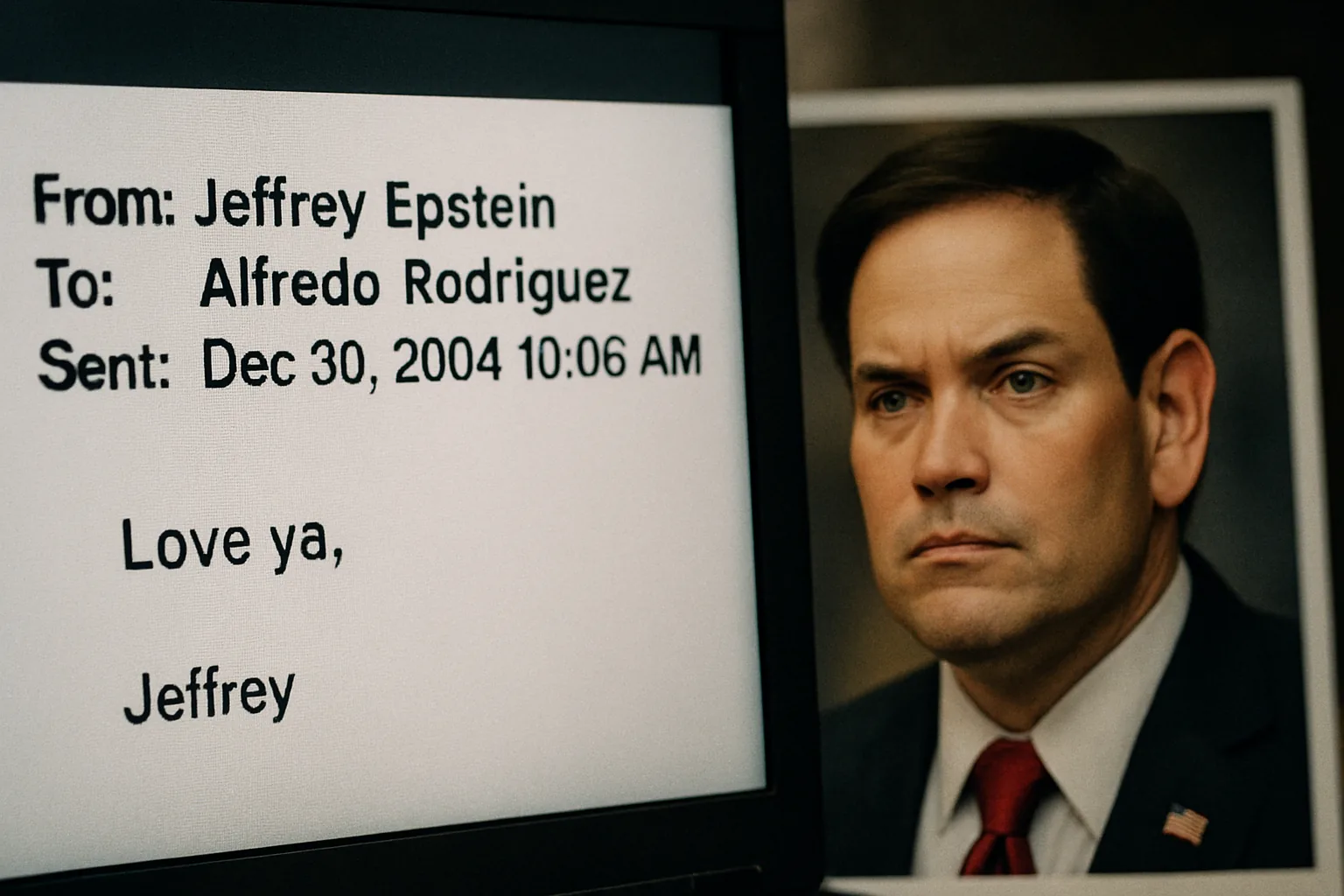
When the Justice Department released more than three million pages of documents related to Jeffrey Epstein, the sheer volume of material created fertile ground for misinformation. Within days, social media was flooded with claims about named individuals — some grounded in the documents, others entirely fabricated. One of the most widely shared false claims involved a specific email from those files, an email ending with the phrase “Love ya,” which was attributed without any supporting evidence to Marco Rubio, the U.S. Secretary of State and former senator. The question of the epstein files fake email marco rubio attribution became a case study in how quickly a redacted document can be weaponized to spread disinformation about a public figure.
The Claim: An Epstein Files Email Attributed to Rubio
On October 9, 2026, an account identified as @jeffreymlevy on X posted a claim asserting that an email found within the released Epstein files — an email that closes with the phrase “Love ya” — was written by Marco Rubio. The post quickly gained traction, spreading across platforms and prompting widespread commentary about Rubio’s alleged connection to Epstein’s network.
The claim was straightforward in its presentation: here is an email from the Epstein files, and Rubio wrote it. That directness made it effective as misinformation. Readers encountering it had no immediate reason to question the attribution, particularly in an environment where the Epstein document release was generating a constant stream of genuine revelations about real individuals. The context of a massive, legitimate document dump made a single false claim harder to isolate and scrutinize.
By October 13, 2026, Lead Stories had published a formal fact-check examining the claim in detail. The fact-check — accompanied by a video — concluded that there is no evidence that Rubio wrote the email in question. The finding was unambiguous: the attribution was false, and the document itself provided no basis for the claim.
What the Actual Document Shows — and Does Not Show
The central problem with the claim is not subtle. According to Lead Stories’ fact-check published October 13, 2026, the email’s “From” field is redacted. So is the signature section of the email. These are the two most basic elements that would establish authorship of any email — the sender’s address and the name the writer used to sign off. Both are absent from the visible document.
→ Read also: Democratic Ads Link Senator Collins to Epstein Without Evidence
This means that anyone looking at the email as released cannot determine who wrote it. The document does not name Rubio. It does not contain his email address, his signature, his title, or any other identifying marker connecting him to the message. The claim that Rubio authored the email is not a misreading of ambiguous evidence — it is an assertion made in the complete absence of evidence from the document itself.
Furthermore, Lead Stories confirmed that no authentic photos or official records link Rubio to the Epstein files or establish any association between him and Epstein. This is a broader finding than just the single email: across the entirety of the released material, there is no verified connection between Rubio and Epstein’s network documented in official records. The false epstein files fake email marco rubio attribution therefore stands unsupported not only by the email’s own content but by the wider body of released documents.
Why Redacted Documents Are Particularly Vulnerable to Misuse
The mechanics of this particular piece of misinformation are worth examining carefully, because they reflect a pattern that has appeared repeatedly since the Epstein files were released. When a document contains redactions — especially redactions of the most identifying information, such as names, addresses, and signatures — it creates a vacuum. That vacuum is easily filled by whoever is presenting the document to an audience.
In this case, the @jeffreymlevy post on X presented the email alongside the claim that Rubio was the author. Readers who did not go back to the original document had no way to know that the “From” field was redacted. The post effectively substituted its own attribution for the missing information, presenting a guess or a fabrication as though it were established fact.
This technique — pairing a genuine document with a false label — is distinct from outright document forgery, but it can be equally misleading. The email itself appears to be real, drawn from the Justice Department’s release of more than three million pages of Epstein-related material. The falsity lies entirely in the attribution. That distinction matters for how readers and platforms respond: the document is not fake, but the claim about who wrote it is.
The epstein files fake email marco rubio case illustrates why the volume of the document release itself creates risk. When three million pages are released simultaneously, no individual journalist, researcher, or member of the public can read and verify all of it in real time. Bad actors can exploit that gap by presenting claims about specific documents before any systematic review has taken place, knowing that the sheer scale of the release makes rapid independent verification difficult.
→ Read also: Political Ads Mislead on Senate Candidates: Collins-Epstein, Cooper Rape Kits Claims Fact-Checked
The Broader Misinformation Landscape Around the Epstein Files
The false Rubio email claim did not emerge in isolation. The release of the Epstein files was accompanied by a significant wave of misinformation, including AI-generated deepfakes, falsely labeled images, and fabricated attributions affecting multiple public figures. Fact-checkers documented cases in which entirely synthetic media — images and audio not derived from any real source — circulated alongside the genuine document release, exploiting public interest in the files to spread false narratives about named individuals.
This context is important for understanding why the @jeffreymlevy post found an audience. Readers primed to expect revelations from the Epstein files were encountering a steady stream of claims, some true and some false, with no reliable way to sort them in real time. A post asserting that a specific email was written by a specific prominent figure fit the pattern of what people expected to find in the documents. The claim was plausible in its form, even though it was unsupported by the underlying document.
It is also worth noting what the verified facts do and do not establish about how the false attribution spread beyond the initial X post. The research confirming this fact-check does not document the specific chain of amplification — which accounts reshared it, which platforms carried it, or what role algorithmic recommendation may have played. What is confirmed is that the claim reached sufficient circulation to prompt a formal fact-check by Lead Stories within four days of the original post.
What Rubio Said — and What Remains Unknown
One significant gap in the available record is Marco Rubio’s own response to the false claim. As of the fact-check published on October 13, 2026, no verified public statement from Rubio addressing the email attribution has been confirmed by the sources available for this article. Whether his office issued a denial, whether he addressed it publicly, or whether the claim was considered too marginal to merit an official response is not established in the verified record.
This absence of a confirmed response should not be read as indifference or implicit acknowledgment. Public figures and their offices make strategic decisions about which false claims to address publicly, and responding to every piece of social media misinformation is neither practical nor always advisable. The absence of a documented statement is simply that — an absence in the record, not evidence of anything beyond it.
What is established is that the false epstein files fake email marco rubio claim has been formally examined and found to lack any evidentiary basis. The email’s authorship cannot be determined from the document as released, and no other verified source connects Rubio to the Epstein files. The claim originated in a single X post on October 9, 2026, and was debunked by Lead Stories four days later. That is the complete verified picture: a false attribution, a redacted document, and a fact-check that found nothing to support the claim. In an information environment flooded with Epstein-related content — genuine, fabricated, and everything in between — the discipline of returning to what the primary source actually shows remains the most reliable check on claims that travel far faster than the documents they purport to describe.
This article was produced with AI assistance and reviewed editorially.

Political Ads in 2026 Midterms Contain False or Misleading Claims About Opponents

Trump Administration ‘Super Intelligence’ Accord Misspells ‘United States’ as ‘Unites States’

Trump Administration ‘Super Intelligence’ Accord Misspells ‘United States’ as ‘Unites States’

No Going Back PAC Ad Makes Misleading Claim About Roy Cooper and Rape Kits
